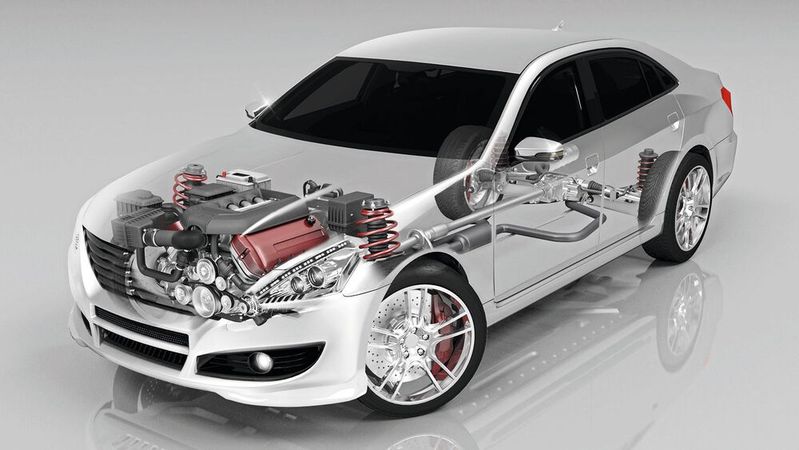
In order for modern vehicles to precisely recognize their surroundings, sensors and cameras play a crucial role. The combination of camera, sensors, and software enhances driving comfort and safety.
Modern Vehicles: They are equipped with cameras and sensors that assist the driver. Software complements the cameras and sensors to analyze, for example, the driver's line of sight.
(Image: Kyocera)
Dr. Matthias Neundorf is the Head of Design Center & BIC at Kyocera Automotive & Industrial Solutions.
Cameras play a central role in modern vehicles. While there are assistance functions like ACC (Adaptive Cruise Control) for which ideally other sensor types such as radar or lidar are used, the use cases for specialized cameras are steadily increasing. They include safety aspects such as detecting pedestrians and cyclists and marking them on the driver's display or head-up display, as well as functions for increased driving comfort. Examples of the latter include rear-view cameras or 360-degree all-around views in parking assistants.
Kyocera offers specialized cameras as well as other semiconductor and electronic components for applications in vehicles. Among the improved hardware features offered is an optimized evaluation cycle in close coordination between Kyocera and the respective OEM. This allows customer feedback to be incorporated from a very early stage of product development, reducing the time from conception to market launch to up to one-third of the previously usual duration.
Specialized camera modules for the automotive industry
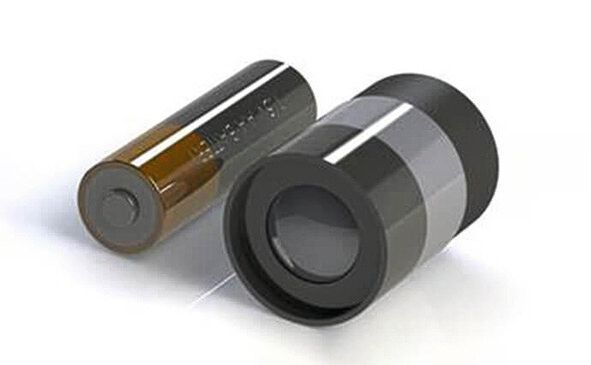
Compact camera modules are the eyes of a modern vehicle. For route monitoring, the cameras can identify pedestrians, cyclists, and other road users and objects.
(Image:Kyocera)
The camera modules developed for use in vehicles meet the requirements of the automotive industry. Additionally, their optics and image sensors offer very high resolutions depending on the area of application. As with any type of camera, the achievable overall quality crucially depends on the interplay of the optical components (lens system), electronics hardware (image sensor), and software (for example, image processing or recognition). To deliver the best possible image quality even in difficult lighting conditions such as backlight or twilight, the camera modules work with a very high dynamic range (HDR). Where motion display plays a role, high refresh rates ensure smooth displays.
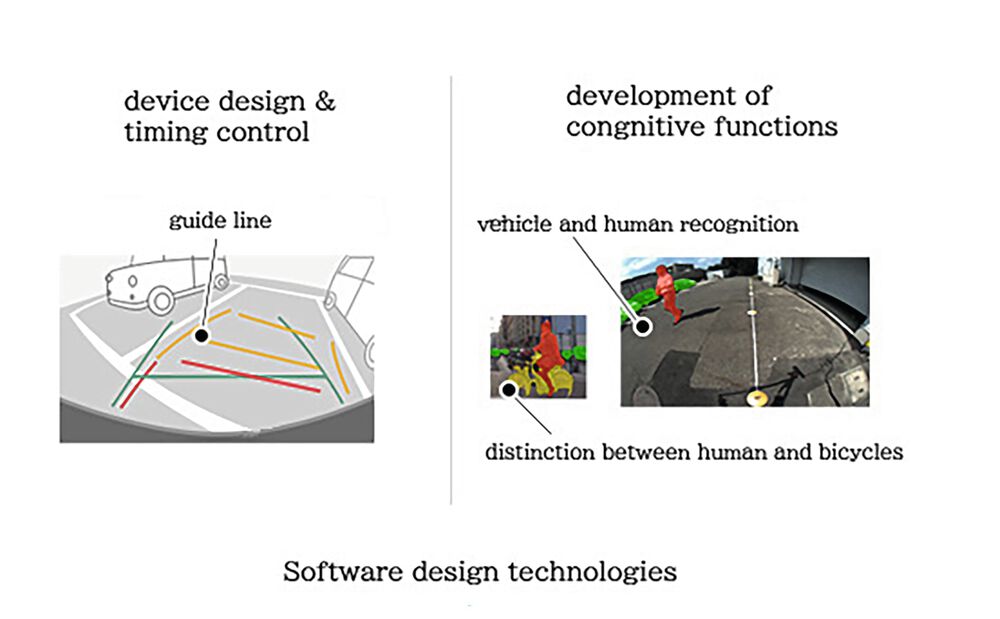
In addition to hardware, cameras rely on software. This includes spatial and temporal processes as well as analysis software.
(Image:Kyocera)
Kyocera develops and manufactures all relevant technologies in-house. This applies to both the control electronics and the mechanical elements such as camera housings and sensor systems, where the company also leverages its expertise in fine ceramics. On this basis, all necessary hardware and software functions can be provided and customized. This starts with exposure control or color matching and extends to application support in the software. Examples include the display of guide lines in parking assistance systems or object recognition in safety systems.
Specialized camera modules depending on the application
Depending on the application, the range offers specially tailored applications: Camera modules used for route monitoring are optimized for overseeing the area in front of the vehicle. They can identify pedestrians, bicycles, and other road users and objects, enabling the vehicle software to display warnings in the driver's or head-up display in hazardous situations. Exposure control and high dynamic range ensure that recognition accuracy and image quality remain high even in backlight, low sun, or other unfavorable lighting conditions.
Cameras optimized for digital video recorder (DVR) functions are used, for example, to record the traffic situation for potential accident analysis (dashcam function) or for general surveillance of the vehicle's surroundings, such as when cars are parked. These functions are typically networked with other sensors, such as collision detection or proximity and vibration sensors in stationary vehicles. It is important to comply with the respective legal requirements in different target markets—this is typically fulfilled by the vehicle software developed by the OEM themselves.
Monitoring the driver is also playing an increasingly important role in modern cars—for instance, if the driver is inattentive or shows clear signs of fatigue, an appropriate warning should be issued. To implement these functions with high recognition accuracy, eye tracking is integrated into the analysis software, which analyzes the driver's direction of gaze. Driver monitoring systems now significantly contribute to avoiding risky traffic situations and, in the worst case, accidents.
Driver comfort and safety through cameras
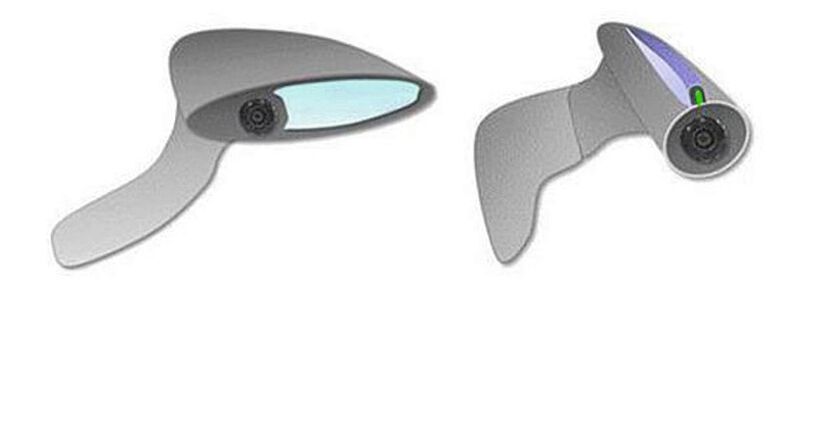
E-Mirror camera modules are designed to replace conventional rear and side mirrors, reducing or completely eliminating blind spots.
(Image:Kyocera)
A 360-degree surround view enables advanced parking assistants to provide a clear representation of the entire vicinity of the vehicle on the driver's or central display. The surround view also covers blind spots, thus aiding in confusing parking situations to prevent rear-end collisions or worse. The image geometry is designed so that the software can compose a coherent and recognizable overall display from the individual images of the cameras, enhancing the driver’s perception and ability to navigate and maneuver safely.
Date: 08.12.2025
Naturally, we always handle your personal data responsibly. Any personal data we receive from you is processed in accordance with applicable data protection legislation. For detailed information please see our privacy policy.
Consent to the use of data for promotional purposes
I hereby consent to Vogel Communications Group GmbH & Co. KG, Max-Planck-Str. 7-9, 97082 Würzburg including any affiliated companies according to §§ 15 et seq. AktG (hereafter: Vogel Communications Group) using my e-mail address to send editorial newsletters. A list of all affiliated companies can be found here
Newsletter content may include all products and services of any companies mentioned above, including for example specialist journals and books, events and fairs as well as event-related products and services, print and digital media offers and services such as additional (editorial) newsletters, raffles, lead campaigns, market research both online and offline, specialist webportals and e-learning offers. In case my personal telephone number has also been collected, it may be used for offers of aforementioned products, for services of the companies mentioned above, and market research purposes.
Additionally, my consent also includes the processing of my email address and telephone number for data matching for marketing purposes with select advertising partners such as LinkedIn, Google, and Meta. For this, Vogel Communications Group may transmit said data in hashed form to the advertising partners who then use said data to determine whether I am also a member of the mentioned advertising partner portals. Vogel Communications Group uses this feature for the purposes of re-targeting (up-selling, cross-selling, and customer loyalty), generating so-called look-alike audiences for acquisition of new customers, and as basis for exclusion for on-going advertising campaigns. Further information can be found in section “data matching for marketing purposes”.
In case I access protected data on Internet portals of Vogel Communications Group including any affiliated companies according to §§ 15 et seq. AktG, I need to provide further data in order to register for the access to such content. In return for this free access to editorial content, my data may be used in accordance with this consent for the purposes stated here. This does not apply to data matching for marketing purposes.
Right of revocation
I understand that I can revoke my consent at will. My revocation does not change the lawfulness of data processing that was conducted based on my consent leading up to my revocation. One option to declare my revocation is to use the contact form found at https://contact.vogel.de. In case I no longer wish to receive certain newsletters, I have subscribed to, I can also click on the unsubscribe link included at the end of a newsletter. Further information regarding my right of revocation and the implementation of it as well as the consequences of my revocation can be found in the data protection declaration, section editorial newsletter.
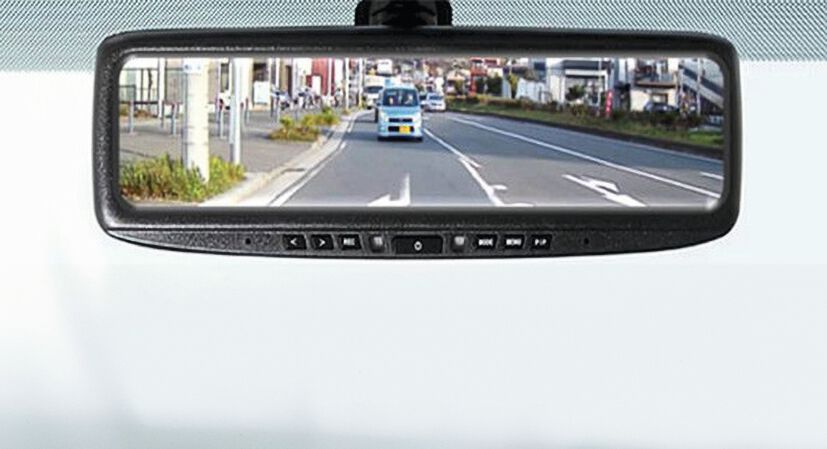
Even the external mirrors can be replaced by cameras.
(Image:Kyocera)
Kyocera's E-Mirror camera modules are optimized to replace conventional rear-view and side mirrors. In modern, aerodynamically optimized car bodies, this can reduce or eliminate blind spots and improve visibility, for example, when rear passengers or luggage obstruct the driver’s field of view. Additionally, the aerodynamically shaped housings of electronic side mirrors significantly reduce air resistance compared to traditional external mirrors. The automatic adjustment of the camera image to current light conditions, such as during tunnel driving, can also enhance the driver's visibility and prevent glare from other road users.
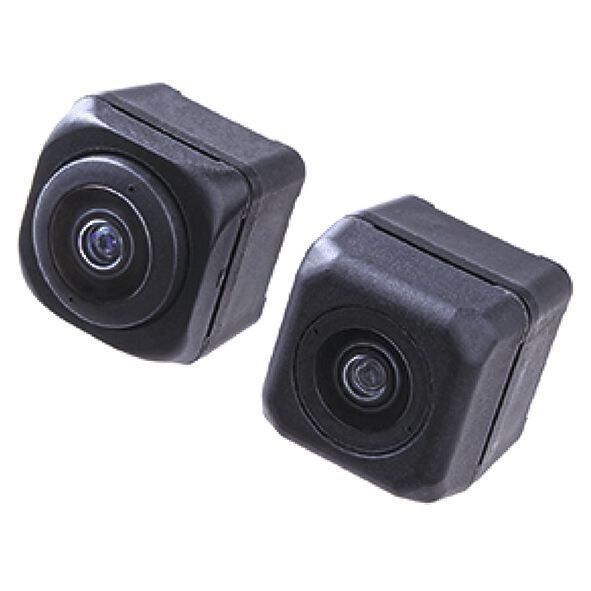
Traditional backup cameras control exposure and image processing and are capable of recognizing surroundings and objects regardless of available light.
(Image:Kyocera)
The classic backup cameras are also optimized. Exposure control and image processing provide high contrast and recognize the surroundings and objects regardless of the available light. Image geometry and field of view are enhanced for integration with software, which displays guiding and boundary lines and other graphical hints in the camera image in parking assistants. The software functions are provided at the OEM's request and can include additional features such as AI-based object detection and classification. In this case, the camera not only identifies vehicles but also people or pets within its field of view, allowing the software to provide clear warnings to the driver accordingly.
Far-infrared sensors and stereo camera in development
Kyocera is also working on future products and technologies, including Far Infrared (FIR) sensors, which are planned to be introduced to the market in 2025. These types of camera sensors use infrared radiation to detect pedestrians, obstacles, or vehicles at a distance—even in darkness or poor weather conditions. The camera is compact and can be flexibly installed in the vehicle. Potential positions include the grille, in a roof module, or at any other suitable location on the body. In this case, the hardware module includes recognition software that ensures reliable detection of vehicles, people, and objects even in darkness or fog.
Kyocera is also developing a high-resolution stereo camera, which is expected to be introduced to the market in 2025. The stereo principle allows for the detection and differentiation of objects at greater distances as well as smaller objects in close proximity. Thus, this camera is not only suitable for use in cars but can also be integrated into more compact mobility devices such as electric scooters or scooters and used in autonomous robotic systems. (heh)
Cameras in the vehicle
Cameras provide high-resolution images with many details, helping to identify objects, traffic signs, or road markings. Compared to a Lidar system, cameras are more cost-effective. However, despite their advantages, cameras have limited effectiveness in poor light and weather conditions. Therefore, modern vehicles often combine different types of sensors including cameras, radar, and Lidar to enhance detection capabilities and provide reliable performance under various environmental conditions.



:quality(80)/p7i.vogel.de/wcms/8e/63/8e631ccb75fda465c197fc52848289fa/0130260202v1.jpeg "According to the Laser-Zentrum Hannover, what is sizzling away underwater marks the first steps towards a way of repairing steel structures more cheaply and without complications using robots, laser 3D printing and AI ... (Image:LZH)")
:quality(80)/p7i.vogel.de/wcms/67/30/6730b015b3dd6f925877edd795eda319/0130247463v1.jpeg "The comparison between the SLA printable plastics Accura Xtreme Grey (above) and the robust newcomer Accura Xtreme Black now used at Speedpart, which represents an inexpensive and deep black alternative to mechanically processed plastic prototypes ... (Image:Speedpart)")
:quality(80)/p7i.vogel.de/wcms/06/9d/069d939b77a4feab0a8d2ece62c28dc1/0129655701v1.jpeg "This turned part is slotted twice. The deburring that would otherwise be necessary is no longer required for high-pressure machining. (Image:Knoll)")
:quality(80)/p7i.vogel.de/wcms/3f/72/3f72e30d61f3522bff192171b60776a4/0130245214v1.jpeg "No idea what else your humanoid robot can do, or where it fails? Then it might be worth taking a look at the Humanoid Capabilities Navigator, which now helps you to find the right robot for a job, or to improve humanoids in a targeted manner ... (Image:Fraunhofer IPA)")
:quality(80)/p7i.vogel.de/wcms/ba/28/ba28ec056a82abd76758c8c87296c0d5/0130213997v1.jpeg "The Nexy automatic material call-off system (AMS) controls the replenishment of non-stocked materials or components. (Image:Steute Technologies GmbH & Co. KG, Löhne)")
:quality(80)/p7i.vogel.de/wcms/21/3b/213b5e5454b0c4344ba0eaa700857607/0129635774v1.jpeg "The QRV flow control valves from Lee are available in sizes from 5.5 to 18 mm and cover a flow rate of 0.2 to 20 l/min. Depending on the version, the pressure range is either between 0.1 and 2.75 bar (1.5 - 40 psi) or between 0.17 and 2 bar (2.5 - 30 psi). (Image:Lee)")
:quality(80)/p7i.vogel.de/wcms/63/e9/63e9db3259a656cca88c5f7158af3fcb/0129385769v1.jpeg "The Agibot A2 at a Fortune China event in December 2025. (Image:Agibot)")
:quality(80)/p7i.vogel.de/wcms/df/a1/dfa1786a3b05f5ff2e51d0f633695c57/0130137877v1.jpeg "Openclaw inspires AI communities. (Image:Openclaw.ai)")
:quality(80)/p7i.vogel.de/wcms/e4/51/e451d52ce0182fb0aaa46a5774f832ef/26-04-pi-fraunhofer-iws-21160-bioslide-pic-01-4128x2321v1v1.jpeg "With the BioSlide research project, the Fraunhofer IWS is investigating how sliding systems can be designed to be more sustainable and energy-efficient. New materials can be tested in a particularly application-oriented manner on this plain bearing test stand. (Image:Fraunhofer IWS)")
![Thanks to advanced 3D printing technology, a more efficient use of resources should contribute to lower-emission aviation—this is the goal of ['skai]-lab. (Image:Oleksandr Pashchenko - stock.adobe.com / AI-generated)](https://cdn1.vogel.de/nghHNSbySccfOjG3n1qCA-FVOjQ=/288x162/smart/filters:format(jpg):quality(80)/p7i.vogel.de/wcms/62/64/626424c97a16e69f871bf216c9629c2a/adobestock-1927043193--c2-a9-20oleksandr-20pashchenko-20-e2-80-93-20stock-adobe-com-ki-generiertv1v1.jpeg "Thanks to advanced 3D printing technology, a more efficient use of resources should contribute to lower-emission aviation—this is the goal of ['skai]-lab. (Image:Oleksandr Pashchenko - stock.adobe.com / AI-generated)")
:quality(80)/p7i.vogel.de/wcms/78/28/7828775af76773458b4d1409ceb1cf0c/368945-20dam-20imagery-digital-transformation-pc-1920x1079v1v1.jpeg "Complex development projects with high regulatory requirements, such as in the aerospace industry, benefit in particular from the Intelligent Product Lifecycle. (Image:PTC)")
:quality(80)/p7i.vogel.de/wcms/e7/82/e7822e208621ba2ae892d609e60481e8/texas-20uni-850x478v1v1.jpeg "Superfoam is a composite that is capable of absorbing 10 times more energy than a conventional foam. (Image:Abbey Toronjo/Texas A&M University Division of Marketing & Communications)")
:quality(80)/p7i.vogel.de/wcms/e6/53/e6539c6b5df2d2af2970ca981131fb42/0130215307v1.jpeg "Volkswagen is in first place in the first two months of 2026—no one has sold as many cars in China as the car manufacturer. (Image:Volkswagen)")
:quality(80)/p7i.vogel.de/wcms/b0/6d/b06d9ad54bfc39053e1db5494df5cb9a/0130237932v1.jpeg "Pleased about their partnership in the field of bidirectional charging: Christian Haferkamp and Aurélie Alemany from enercity as well as Stefan Mecha and Lars Krause, both Volkswagen Commercial Vehicles (from left to right). (Image:PSONNACK)")
:quality(80)/p7i.vogel.de/wcms/2b/0b/2b0b5ff55299be32174cb0ed76718253/0130177406v1.jpeg "Rolls-Royce has received funding of 70 million US dollars from the EU public-private partnership \"Joint Undertakings for Clean Aviation\". (Image:Rolls-Royce)")
:quality(80)/p7i.vogel.de/wcms/95/7e/957ed49b185794b3e76b9e610a8a389f/0130217926v1.jpeg "Bosch wants to offer components for e-vehicles in India together with Tata. (Image:Bosch)")
:quality(80)/p7i.vogel.de/wcms/22/08/22085b4997a696887dd5a712a30b262b/0130211045v1.jpeg "Imec has announced that the world's most advanced high numerical aperture (High NA) EUV lithography system, the ASML EXE:5200, has arrived at its 300mm cleanroom in Leuven. (Image:Imec)")
:quality(80)/p7i.vogel.de/wcms/48/f2/48f250e2385d3f43743dc44133cc4731/0130161592v1.jpeg "The world's first fully functional quantum battery as a proof-of-concept, developed by CSIRO and its cooperation partners, the University of Melbourne and RMIT. (Image:CSIRO and collaborators, The University of Melbourne and RMIT)")
:quality(80)/p7i.vogel.de/wcms/16/9c/169c092e854d8740928a080cead3b88e/0130241261v1.jpeg "NVIDIA's GB300 AI chip with HBM3E and HBM4 from SK Hynix. (Image:SK Hynix)")
:quality(80)/p7i.vogel.de/wcms/3a/50/3a50d3f269f38f14d7a25a93c6f2b2f8/0130147601v1.jpeg "The compact modulator enables fast and energy-efficient data transmission and can be manufactured cost-effectively. (Image:Hugo Larocque, EPFL)")
:fill(fff,0)/images.vogel.de/vogelonline/companyimg/76800/76895/65.jpg "FAULHABER_120mm.jpg ()")
:fill(fff,0)/p7i.vogel.de/companies/67/eb/67eba621ef6ea/logo2.png "logo2 (Wuxi InfiMotion)")
:quality(80)/p7i.vogel.de/wcms/68/e4/68e415db2d000556b2224c9efd1c1c1b/b2024cw00373-retina-2400-1920x1079v1.jpeg "The brands of the Volkswagen Group aim to optimize driver assistance systems with sensor and image data from customer vehicles and real traffic situations. (Image:Volkswagen)")
:quality(80)/p7i.vogel.de/wcms/01/6c/016c68f9d8d817e14fab4a29f1d4c3d4/0128361929v1.jpeg "The Chinese company iMotion wants to reduce the stress of parking. With the help of a highly automated function, vehicles should be able to park themselves in less than 30 seconds. This is where the R-Car-V4H SoC from Renesas comes into play. (Image:iMotiom)")