Krone automates with Kuka in both brownfield and greenfield environments. In Werlte, Lower Saxony, stationary and autonomous mobile robots optimize existing processes.
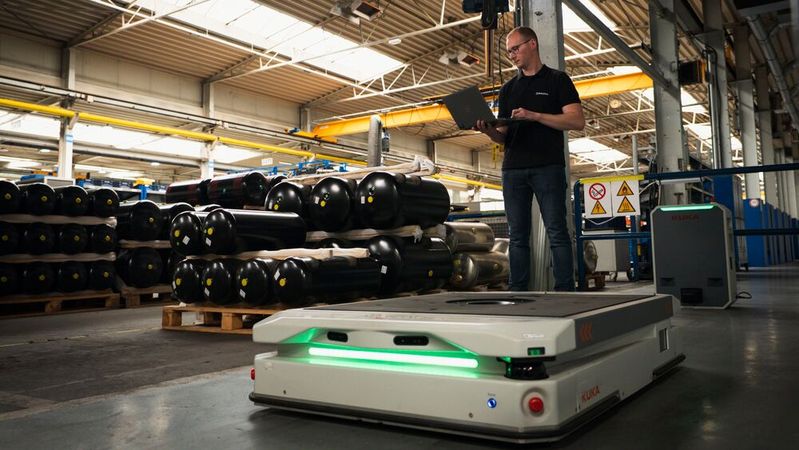
The KMP 1500P is used in the Krone plant in Werlte to minimize forklift traffic.
(Image: Kuka)
It doesn't make much fuss. Almost silently, the autonomously driving platform makes its way through the production hall. With inches precision, it delivers a 26 gallons compressed air tank to a welding station. There, a handling robot from Kuka is already waiting to lift it off the platform and weld it with other components in the processing cell.
What sounds like futuristic assembly for truck components is already everyday reality at the Krone Group, one of the largest manufacturers of agricultural machinery and commercial vehicles: In partnership with Kuka, Krone relies on intelligent automation—both in an existing factory (brownfield) and in a new, smart production facility (greenfield). The result is more efficient processes, higher value creation, relieved employees, and competitive production "made in Germany."
The company relies on Kuka as a technology partner and consistently pursues automation both at an existing plant in Werlte and at the newly built greenfield factory of GTS Green Teuto Systemtechnik GmbH in Ibbenbüren (Germany)—with manufacturing robots working in combination with autonomous transport systems. This is precisely where Krone sees great potential. "The decisive key in the transformation to a smart factory lies in our AMR fleet management," says Nikita Daubert, AMR Business Development Manager for the DACH region at Kuka. "It can be flexibly connected to in-house control systems, such as MES/ERP. This allows us to support customers like Krone with their automation concepts in a needs-driven and future-oriented manner."
Flexibility in the Inventory
In Werlte, Lower Saxony, Krone operates a truck trailer manufacturing facility with established structures. With the support of Silver Robotics, a Krone subsidiary specializing in implementing innovative and customized robotics and mechanical engineering solutions for both Krone and external customers, an automated cell has now been set up. Six-axis Kuka handling and welding robots are digitally networked with autonomous mobile robots such as the KMP 1500P. The compact AMR carries loads of up to 3,300 pounds and moves independently in production using its differential drive technology. Integrated 3D cameras and laser scanners ensure flexibility and safety in a working environment with humans. The inductive charging concept keeps the platform operational around the clock.
"We had previously reviewed all our existing processes and transitioned to new processes and workflows, such as modular construction," explains René Mecklenburg, Managing Director of Silver Robotics GmbH. "And we immediately thought further in the direction of intralogistics and optimized material flow. Because we want to offer our customers our products faster—and with even higher quality at economical, marketable prices."
From the Welding Curtain to the Smart Cell
The supply of welding robots is now autonomous, and forklifts are largely being eliminated from production. Instead, the transport platform independently delivers materials, such as compressed air tanks or door elements, to the cell. There, a handling robot places them into the welding system. The finished assemblies are also automatically transported away from there. "The mobile robots help us connect many processes that are very extensive here. This allowed us to eliminate a lot of conveyor technology while significantly improving efficiency in production and intralogistics processes," says René Mecklenburg. Humans and machines at Krone work hand in hand: "Employees handle the preparation of parts and quality control, while robots take care of the physically demanding welding work. This relieves employees from heavy, monotonous tasks, creates more order, and increases safety," Mecklenburg adds.
This way, we relieve employees of heavy, monotonous tasks, create more order, and increase safety.
René Mecklenburg, Managing Director Silver Robotics
Volker Perk, Production Managing Director of the Krone Commercial Vehicle Group, sees robotics as a key element for securing the location: "We want to continue producing truck trailers like the 'Profi Liner' in Germany in the future. However, we need to automate processes because we simply can no longer find skilled workers for many necessary tasks. Robotics gives us the opportunity to guide our employees toward more efficient or value-added activities."
Date: 08.12.2025
Naturally, we always handle your personal data responsibly. Any personal data we receive from you is processed in accordance with applicable data protection legislation. For detailed information please see our privacy policy.
Consent to the use of data for promotional purposes
I hereby consent to Vogel Communications Group GmbH & Co. KG, Max-Planck-Str. 7-9, 97082 Würzburg including any affiliated companies according to §§ 15 et seq. AktG (hereafter: Vogel Communications Group) using my e-mail address to send editorial newsletters. A list of all affiliated companies can be found here
Newsletter content may include all products and services of any companies mentioned above, including for example specialist journals and books, events and fairs as well as event-related products and services, print and digital media offers and services such as additional (editorial) newsletters, raffles, lead campaigns, market research both online and offline, specialist webportals and e-learning offers. In case my personal telephone number has also been collected, it may be used for offers of aforementioned products, for services of the companies mentioned above, and market research purposes.
Additionally, my consent also includes the processing of my email address and telephone number for data matching for marketing purposes with select advertising partners such as LinkedIn, Google, and Meta. For this, Vogel Communications Group may transmit said data in hashed form to the advertising partners who then use said data to determine whether I am also a member of the mentioned advertising partner portals. Vogel Communications Group uses this feature for the purposes of re-targeting (up-selling, cross-selling, and customer loyalty), generating so-called look-alike audiences for acquisition of new customers, and as basis for exclusion for on-going advertising campaigns. Further information can be found in section “data matching for marketing purposes”.
In case I access protected data on Internet portals of Vogel Communications Group including any affiliated companies according to §§ 15 et seq. AktG, I need to provide further data in order to register for the access to such content. In return for this free access to editorial content, my data may be used in accordance with this consent for the purposes stated here. This does not apply to data matching for marketing purposes.
Right of revocation
I understand that I can revoke my consent at will. My revocation does not change the lawfulness of data processing that was conducted based on my consent leading up to my revocation. One option to declare my revocation is to use the contact form found at https://contact.vogel.de. In case I no longer wish to receive certain newsletters, I have subscribed to, I can also click on the unsubscribe link included at the end of a newsletter. Further information regarding my right of revocation and the implementation of it as well as the consequences of my revocation can be found in the data protection declaration, section editorial newsletter.
New Start With A Plan: The GTS Smart Factory Ibbenbüren
How automation and the smart factory specifically took hold at Krone is described by Jochen Roling, Managing Director at GTS, from his own experience: "In the past, we initially only automated the process behind the welding curtain. At some point, it became clear: to operate the system efficiently and economically, the material flow and operation must also be automated." This is where Kuka's mobile robots came into play.
While Werlte continuously modernizes existing processes "on the fly," a completely new factory for agricultural machinery production was built in just twelve months in Ibbenbüren, Westphalia, with Green Teuto Systemtechnik, GTS, a subsidiary of the Krone Group—a greenfield solution, literally on a "green field." Here, welded assemblies are manufactured automatically, later painted, and then installed in agricultural machinery. "Why a smart factory? Why also a new factory?" asks Jochen Roling, immediately providing the answer: "At Krone, we intend to specialize our plants based on the end product. For us, 'smart' means manufacturing as efficiently and scalably as possible with the help of digitization and automation." The advantage of the greenfield approach was being able to plan without restrictions and without existing structures. "With the support of Kuka, we rely on state-of-the-art, smart, and sustainable manufacturing concepts and processes. That's why we made automated supply and integrated data processing for production and assembly lines a priority right from the start," says Roling. The result: "The entire production architecture of the smart factory was designed from the ground up to be data-driven and scalable—a milestone in Krone's history."
The foundation of the smart factory in Ibbenbüren, Germany is an IT architecture that captures real-time data and processes it on an event-based basis. Every machine, robot, and transport vehicle is digitally networked. "This allows production to immediately respond to tolerance breaches or disruptions. That's why we've long stopped talking about a control circuit and instead refer to a regulatory circuit," says Perk. "The systems are adaptive; they learn and correct themselves independently."
This transformation also affects communication between development and production. "In the past, production adapted to product changes. Today, it's the other way around. All requirements from production are already incorporated into the next development," says Roling.
Three Steps to Full automation
Krone follows a three-step implementation concept on its automation path. The first step involves developing a holistic perspective for process automation. Building on this, solutions for automated material transport via AMR come into focus. Step three is then automated parts handling.
The Ibbenbüren plant was designed by Krone according to this principle. Today, in a single production cell, nine welding and handling robots work synchronously with two machining centers and an automatic measurement cell. This setup has nearly eliminated downtime, as robots and transport platforms continue operating around the clock in sync. Production can be scaled up or down flexibly, ensuring that potential workforce shortages, which are increasingly hard to resolve, no longer become a limiting factor. "This scalability of the production architecture—from small cells to complex interconnected lines—is a core goal of the new smart factory," says Roling. As a test, the first KMP 3000Ps are now being used in Ibbenbüren, Germany. These can move up to three tons within production halls, or double that in tandem, and navigate omnidirectionally with maximum precision even in tight spaces.
"We Make Work more Attractive"
One thing is particularly important to Krone's factory planners: automation does not mean the end of human work but rather its enhancement. "Operating highly automated systems has gained value. Employees see it as a job of the future," says Roling. Mecklenburg adds: "We see colleagues internally actively applying for these positions." Ergonomics also plays a role: "The new workplaces are safer and less physically demanding. This makes them attractive—especially for younger generations," says Perk.
Unattractive in the job market are repetitive, monotonous tasks, handling heavy loads, and the dangers of welding itself: from toxic gases and fumes to the risk of burns and electric shocks. "We simply can no longer find people for these tasks. Robotics helps us keep our locations competitive despite demographic changes," emphasizes Perk. The automotive industry, with its high production volumes, has set the example: "In series production, automation is economically indispensable. Today, this also applies to smaller production volumes, such as those required for the manufacture of individually configured agricultural machinery." On this path, the collaboration with Kuka is considered strategically important at Krone. "Kuka not only provides technology but also brings a systems-thinking approach. We are learning together and continuing to develop together," says Perk.
Looking Ahead: Assembly, Variant Production, And AI
For the future, René Mecklenburg sees further potential in assembly automation: "Especially with products that have numerous variants, we need to automate without losing flexibility." Entirely new possibilities are emerging through the rapid advancements in digitalization and artificial intelligence. "The systems learn to detect errors and optimize themselves," says Volker Perk. "We can build on that." Jochen Roling is reminded of a quote from Dante displayed in the office of owner Bernard Krone: "One waits for the time to change, the other seizes it and acts." There's still much ahead for Krone.
*Jonas Micheler is Content Marketing Manager at Kuka



:quality(80)/p7i.vogel.de/wcms/51/1b/511b420dbcc296aec09e3bffb051b8a8/0133581587v1.jpeg "The cables connect numerous machine components—often in confined spaces. (Image:Helu)")
:quality(80)/p7i.vogel.de/wcms/b5/67/b5676f3bfb36251ed31f9a0cccf650b6/0133167827v1.jpeg "Thanks to JumboFlex Generation 2, employees can effortlessly move wheelchairs weighing as much as 40 kilograms. (Image:Lard)")
:quality(80)/p7i.vogel.de/wcms/5e/c6/5ec615b7a51440f668259f2af9158cb9/0132654694v1.jpeg "Strategic Partnerships in Industry: As buyers and restructuring partners, Chinese investors are increasingly helping to preserve jobs in Germany. (Image: ©Anatolii Rymarchuk - stock.adobe.com)")
:quality(80)/p7i.vogel.de/wcms/eb/2b/eb2bd1b8487afe577b37363cd02f16ff/0113143253v1.jpeg "In our China Market Insider, we regularly provide you with relevant information straight from China. (Image:© Eisenhans - stock.adobe.com)")
:quality(80)/p7i.vogel.de/wcms/aa/3e/aa3e2603a812f8e7d33c00ba8ae28c9f/0133507886v1.jpeg "With the Iggy Rob, igus is bringing a humanoid robot into factories for a price of 47,999 euros ($54,718). (Image: igus)")
:quality(80)/p7i.vogel.de/wcms/92/64/92645c64ffbb6980976d39102388d120/0113143253v1.jpeg "In our China Market Insider, we regularly provide you with relevant information straight from China. (Image:© Eisenhans - stock.adobe.com)")
:quality(80)/p7i.vogel.de/wcms/c7/05/c70542511e0824ee491f7b55e21fa429/0133598424v1.jpeg "In logistics, AI is often implemented only on a case-by-case basis; data is stored in separate systems, and inventory levels, status values, and priorities are not defined consistently. (Image: ©m-project - stock.adobe.com)")
:quality(80)/p7i.vogel.de/wcms/3a/9c/3a9c1fd546e1f041b86bb1d03cf39101/0133610524v1.jpeg "The Mason W-01 combines industrial-grade humanoid hardware, Physical AI-based perception, and autonomous task planning. (Image:Nova X Robotics)")
:quality(80)/p7i.vogel.de/wcms/e7/94/e794290f265afbd0ffc7a06c4fe9d425/adobestock-1887113836--hypnotics-14-stock-adobe-com-ki-generiertv1.jpeg "In both autonomous driving and industrial production, there is growing skepticism as to whether full autonomy is always desirable. (Source: © Hypnotics 14 – stock.adobe.com / AI-generated)")
:quality(80)/p7i.vogel.de/wcms/a8/71/a8712e5c6ef536228444ab5275cedfe2/adobestock-340905887--gorodenkoff-stock-adobe-comv1.jpeg "A new position paper outlines the conditions that the business community, academia, and policymakers must jointly establish in order to ensure the long-term viability of industry in Germany and Europe. (Source: © Gorodenkoff – stock.adobe.com)")
:quality(80)/p7i.vogel.de/wcms/7d/eb/7deb25ca674fa4c781a9d1fab083f7cf/parker-entwicklungszentrum-hresv1.jpeg "The centerpiece of the Parker Center for Drive and Control Technology in Offenbach is the exhibition area. (Source: Parker Hannifin)")
:quality(80)/p7i.vogel.de/wcms/3d/ff/3dff5e51c24b30c8dc37c1d024887157/0133602931v1.jpeg "Just a few years ago, SpaceX specialists were working on the world’s largest rocket—the Starship. Now, Elon Musk’s company has reached a milestone during a test flight: Earth’s orbit! But there was also a downside... (Image: SpaceX)")
:quality(80)/p7i.vogel.de/wcms/78/ab/78abbfbab0565fabb19efe637aea30e8/nio-power-swap-station-4-china-guangzhou-2024-1400x933-jpgv1.webp "Nio and Geely are collaborating on battery replacement for electric cars. (Source: Nio)")
:quality(80)/p7i.vogel.de/wcms/2e/58/2e58c664e733dd182666606f850c5da4/0133400664v1.jpeg "The IM6 is sort of the crossover version of the IM5. (Image:MG Motor)")
:quality(80)/p7i.vogel.de/wcms/40/5f/405f41f4075e8798878011f0932a8195/0133509065v1.jpeg "Caruso has integrated Hyundai into its platform. (Image:Hyundai)")
:quality(80)/p7i.vogel.de/wcms/06/98/06989beb3f95b8fb06d71190c86cffde/tabletv1.jpeg "The cockpit view during a test drive in the simulator. (Source: Uccello et al., IEEE OJITS 2026)")
:quality(80)/p7i.vogel.de/wcms/40/34/4034915f85470ad8264659267e4f02d0/0133655653v1.jpeg "Cariad, Volkswagen's software subsidiary, continues to struggle. Now, another round of layoffs has been announced, which will result in the loss of many jobs ... (Image:Cariad)")
:quality(80)/p7i.vogel.de/wcms/e4/2a/e42af12e2a0816bb3d25fac9932903e9/0133646920v1.jpeg "TSMC's U.S. headquarters in Arizona: According to various media reports, the world's largest contract semiconductor manufacturer may be planning to build up to six additional fabs in the state of Texas. (Image:TSMC)")
:quality(80)/p7i.vogel.de/wcms/de/8c/de8c694e560ce8e8d7d43fa5b91917b3/0133668420v1.jpeg "Open-source AI tools: DeepSeek and Huawei are making programming tools for Ascend processors available, with the aim of simplifying development, chip communication, and AI computations on Huawei's hardware—and thereby intensifying competition with Nvidia. (Image:Dall-E / AI-generated)")
:quality(80)/p7i.vogel.de/wcms/86/25/8625a62499a6e70e629a2ddde2f01dcb/0133671173v1.jpeg "\"OpenAI\" has repeatedly experienced problems in which AI models have accessed the internet without authorization in order to carry out their tasks. The company has now fired three people whom it no longer trusts ... (Image:AI-generated)")
:fill(fff,0)/images.vogel.de/vogelonline/companyimg/76800/76895/65.jpg "FAULHABER_120mm.jpg ()")
:fill(fff,0)/p7i.vogel.de/companies/69/de/69de1b7403b0d/simtos-logo.jpeg "simtos-logo (SIMTOS)")
:quality(80)/p7i.vogel.de/wcms/dd/a1/dda17ea4bc49ac9887d50222a8921564/0128672777v1.jpeg "Two Kuka AMRs meet: In the GTS plant in Ibbenbüren, in addition to the KMP 1500P, the first KMP 3000P units are also being tested.(Image: Kuka)")
:quality(80)/p7i.vogel.de/wcms/a8/4b/a84b7ea726037620cdfffab19d37d257/0128672772v1.jpeg "With centimeter precision, the KMP 1500P delivers 100-liter compressed air tanks to a welding station.(Image: Kuka)")
:quality(80)/p7i.vogel.de/wcms/6f/8d/6f8d50f34068d1330e4ade3632f3e9a1/0128672779v1.jpeg "The fleet manager Kuka AMR Fleet can be flexibly integrated into in-house control systems like at Krone.(Image: Kuka)")
:quality(80)/p7i.vogel.de/wcms/4e/f3/4ef3b6bcd8050a72bfd64d6d32d44f3b/0128672773v1.jpeg "Thanks to its omnidirectional drive, the KMP 3000P navigates confidently even through tight production environments.(Image: Kuka)")
:quality(80)/p7i.vogel.de/wcms/37/8f/378f38b1ee4ff39af46906a5629da178/0127960109v1.jpeg "The solution from Igus improves process stability and workplace ergonomics in everyday manufacturing. (Image:Igus)")
:quality(80)/p7i.vogel.de/wcms/f5/9b/f59b7bb65d53b91bfb0dba9c2cd6a5c9/image1v1.jpeg "The GESSbot from Gessmann, equipped with a BS21 flat belt conveyor from Schnaithmann: This autonomous mobile robot autonomously transports workpiece carriers, small load carriers, or complete assemblies between defined transfer points on a transfer or assembly line. (Image:Schnaithmann)")
:quality(80)/p7i.vogel.de/wcms/20/48/2048d7a876ec38da1df64a5c3c12d1ba/0129069977v1.jpeg "0129069977v1 (Image:AI-generated)")