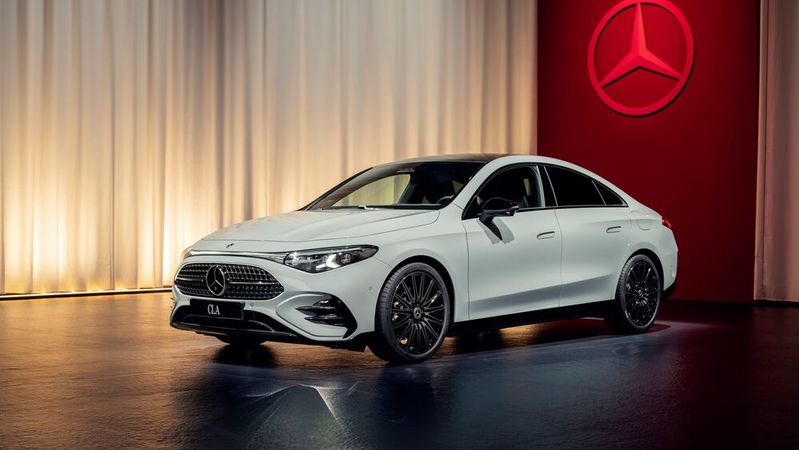
Mercedes' new luxury strategy is taking shape. The CLA will soon mark the entry into the world of Mercedes—initially as a purely electric model. The coupé sedan aims to set standards in efficiency, charging, and digitalization.
Mercedes has unveiled the long-awaited CLA.
(Image: Mercedes-Benz)
Compact models from Mercedes? History. A- and B-Class are heading to the museum. After Mercedes CEO Ola Källenius announced his new luxury strategy a few years ago, things are now taking shape: Anyone who wants to drive a star-branded car in the future must at least get used to a coupé sedan over 4.70 meters long (approx. 15 ft long), called CLA.
The model is the most important new release from Mercedes this year and is considered in the industry both as a beacon of hope and as a test for the company boss. However, by deciding to focus not on volume as in the past, but on higher positioning and thus on better profit margins, the top manager could also be wrong. Furthermore, he is simultaneously playing into the hands of the competition. Both BMW and Audi continue to stick with their compact hatchback models, the 1 Series and the A3.
Entry into the Mercedes brand world will probably be at least 45,000 euros (48.807 USD), initially even higher. Because the CLA will start in the summer initially as an electric model. Here, the 50,000-euro (54.230 USD) mark is likely to be exceeded. The petrol mild hybrid will only come at the end of the year.
Drawn conservatively, announced with fanfare
Considering the importance of the CLA and that the coupé sedan, according to Mercedes, launches the "largest product offensive in the company's history," the design turned out surprisingly restrained, rather drawing on classic Mercedes lines and the proportions of the predecessor. The design courage and progressiveness, as embodied for example by BMW's Neue Klasse sedan, is lacking in the internally called C 174 CLA.
In contrast, it is all the more advanced underneath the surface, especially in the electric version CLA with EQ technology, as it is officially called. For this, the engineers have developed a completely new architecture, the MMA (Mercedes Modular Architecture), based on 800 volts. Many of the innovations could be adopted from the EQXX technology platform, which has already set several long-distance records and covered over 1,200 kilometers (approx. 745,6 miles) on a single battery charge.
The production CLA is also expected to set standards in its segment, particularly in the areas of range, efficiency, and charging speed. Another motto during development was: no compromises in everyday usability compared to conventional drives. As an electric vehicle, the CLA has a trunk size of 400 liters. This is slightly less than before, but an additional 100 liters are provided by the "frunk" under the front hood. The compartment is ideal for storing the charging cable.
In the base version CLA 250+, the sedan has rear-wheel drive. At the rear, there is always a permanently excited synchronous machine (PSM) with 200 kW, combined with a two-speed gearbox. Mercedes calls this newly used and particularly compact drive unit Electric Drive Unit 2.0 (EDU 2.0).
In the all-wheel-drive (CLA 350 4Matic), an additional 80 kW is added at the front axle as a boost function. The system output is specified at 260 kW. Both electric machines are controlled independently. The engineers also opted for a PSM solution at the front, citing better efficiency in operation and higher recuperation performance. To avoid drag losses, the electric motor can be disconnected in a flash via the Disconnect Unit (DCU) when needed. Although the system is technically more complex than with an ASM (asynchronous machine), it positively contributes to the range.
And here, the Swabian automakers aim to set the bar very high. Under WLTP conditions, the over two-ton CLA is expected to achieve up to 790 kilometers (approx. 491 miles) on a single battery charge, although the usable capacity is "only" 85 kWh. However, the good aerodynamics (cW value 0.21), new power electronics including a silicon carbide inverter, and a changed battery chemistry with higher energy density create the necessary conditions here. All this results in a consumption of only 12.2 kWh/100 km (WLTP), a record in its class. For good reason, the Stuttgart developers proudly speak of the "one-liter car of the electric age."
Date: 08.12.2025
Naturally, we always handle your personal data responsibly. Any personal data we receive from you is processed in accordance with applicable data protection legislation. For detailed information please see our privacy policy.
Consent to the use of data for promotional purposes
I hereby consent to Vogel Communications Group GmbH & Co. KG, Max-Planck-Str. 7-9, 97082 Würzburg including any affiliated companies according to §§ 15 et seq. AktG (hereafter: Vogel Communications Group) using my e-mail address to send editorial newsletters. A list of all affiliated companies can be found here
Newsletter content may include all products and services of any companies mentioned above, including for example specialist journals and books, events and fairs as well as event-related products and services, print and digital media offers and services such as additional (editorial) newsletters, raffles, lead campaigns, market research both online and offline, specialist webportals and e-learning offers. In case my personal telephone number has also been collected, it may be used for offers of aforementioned products, for services of the companies mentioned above, and market research purposes.
Additionally, my consent also includes the processing of my email address and telephone number for data matching for marketing purposes with select advertising partners such as LinkedIn, Google, and Meta. For this, Vogel Communications Group may transmit said data in hashed form to the advertising partners who then use said data to determine whether I am also a member of the mentioned advertising partner portals. Vogel Communications Group uses this feature for the purposes of re-targeting (up-selling, cross-selling, and customer loyalty), generating so-called look-alike audiences for acquisition of new customers, and as basis for exclusion for on-going advertising campaigns. Further information can be found in section “data matching for marketing purposes”.
In case I access protected data on Internet portals of Vogel Communications Group including any affiliated companies according to §§ 15 et seq. AktG, I need to provide further data in order to register for the access to such content. In return for this free access to editorial content, my data may be used in accordance with this consent for the purposes stated here. This does not apply to data matching for marketing purposes.
Right of revocation
I understand that I can revoke my consent at will. My revocation does not change the lawfulness of data processing that was conducted based on my consent leading up to my revocation. One option to declare my revocation is to use the contact form found at https://contact.vogel.de. In case I no longer wish to receive certain newsletters, I have subscribed to, I can also click on the unsubscribe link included at the end of a newsletter. Further information regarding my right of revocation and the implementation of it as well as the consequences of my revocation can be found in the data protection declaration, section editorial newsletter.
Charge faster, travel further
Premium travel comfort should also be enabled by short charging times. The CLA can handle over 320 kW at the DC charger. Under optimal conditions, it would be possible to charge the battery from ten to 80 percent in just 22 minutes. Or, more practically expressed: Within ten minutes, a range of 325 kilometers (approx. 201 miles) can be recharged.
A little later in the year, the CLA will also be available with a smaller battery (58 kWh) based on lithium iron phosphate. Alternatively, it will be available as a combustion engine, specifically as a 1.5-liter four-cylinder gasoline hybrid with 48-volt technology. The electric motor has been integrated into the dual-clutch transmission and even allows electric driving up to 100 km/h, "sailing," and recuperation.
Behind the steering wheel, the CLA driver enters a new world of digitalization. The cockpit is dominated by a superscreen. It stretches across the entire width of the dashboard. On the up to three seamlessly integrated screens, real-time graphics can be seen, previously only known from the gaming world. Resolution, display, and computing power are among the best the industry currently has to offer. This is made possible, among other things, by the internally developed operating system MB.OS, essentially the brain of the car. According to Markus Schäfer, Chief Technology Officer, Development & Procurement, this is supposed to make the CLA the "most intelligent vehicle" that Mercedes has ever built.
Autonomous driving—almost there
MB.OS is a so-called chip-to-cloud software operating system that covers infotainment, automated driving, comfort, and charging. Integrated with it is the AI-supported MBUX Virtual Assistant, which allows significantly better and simpler dialogues than before and even understands multiple questions in succession.
That the Stuttgart automaker is among the world's best in the field of autonomous driving is part of the brand's claim with the star. In the CLA, Level 2++ should soon be possible. The combination of radar and camera (expensive lidar sensors are not necessary) will then allow driving even in heavy city traffic without having to keep hands on the steering wheel. However, responsibility remains with the driver, and they must still keep their eyes on the road. Currently, Mercedes is still awaiting approval from Brussels. The system is being tested intensively in China and California and is expected to be introduced by 2026.
The new CLA will be built at the Rastatt plant. However, it will not stop there. The MMA family plans three more models in the coming two years. Still to come this year is a CLA as a Shooting Brake (sports estate) and in 2026 the two SUV derivatives GLA and GLB.
*48.807 USD
Be Informed, Be Inspired
Follow Us on LinkedIn
(Photo:aai)
Looking to stay in the loop with the latest updates and developments on LinkedIn? Join All-About-Industries to receive regular insights that keep you informed about technological advancements and market changes in the industrial sector. Don’t miss out on the knowledge that shapes the industries of tomorrow.



:quality(80)/p7i.vogel.de/wcms/a0/47/a04725ef9bd09fb6c9341a1bea1b5d93/0130443083v1.jpeg "Here, a type of plastic pallet is produced by thermoforming (vacuum forming or deep drawing) at the corresponding division of New England Plastics in the USA. This division, which specializes in so-called liners, is now part of Ringmetall ... (Image:New England Plastics)")
:quality(80)/p7i.vogel.de/wcms/23/99/23992bf2dcdc432c9b7209c34a4a7c48/0129733089v1.jpeg "Stork relies on the modular Neoswiss turning system from Iscar to shorten the set-up times for its sliding headstock lathes and work more productively. (Image:Iscar)")
:quality(80)/p7i.vogel.de/wcms/7d/e2/7de2923434b2f1a78ba5482d8d335269/0113143253v1.jpeg "In our China Market Insider we regularly provide you with relevant information directly from China. (Image:© Eisenhans - stock.adobe.com)")
:quality(80)/p7i.vogel.de/wcms/9d/2b/9d2b802f800e5caf17b2831e74228cd3/screenshot-202026-03-03-20103822-609x343v1v1.png "Visual comparison: on the left, a clean, burr-free cut edge; on the right, typical burr formation with oxidation discoloration. This illustrates how strongly parameter control and gas management influence the quality of the result. (CO₂ laser, oxygen cutting gas, sheet thickness approx. 15 mm). (Image:Picture: Rime)")
:quality(80)/p7i.vogel.de/wcms/b7/36/b736dfebc16c42d6901d0d0e1f390493/3d-druck-20factory-20--20ki-20generiert-1920x1079v1.png "(Source: AI-generated)")
:quality(80)/p7i.vogel.de/wcms/79/b2/79b21aad663f4a7bd4472afc1c1afc62/0130433994v1.jpeg "Mission Joyride: The free-flying robot (shown here in the rendering) will relieve the ISS crew of logistics tasks from 2027 with its two mechanical arms. (Image:Icarus Robotics)")
:quality(80)/p7i.vogel.de/wcms/6b/45/6b4546fa6ebf305c3660326909363f32/0130437089v1.jpeg "Industrial AI in action: Rockwell Automation presents practical solutions for self-controlling production systems at the Hannover Messe. (Image:Rainer Jensen, Deutsche Messe)")
:quality(80)/p7i.vogel.de/wcms/78/e9/78e9188c25a8a94e67c34c9bf8ffe495/visual-agile-20robots-20and-20google-20deepmind-20partner-20to-20bring-20intelligence-20to-20robotics-2500x1406v1v1.jpeg "Together, the partners are developing adaptable, intelligent robots for a wide range of applications (Image:Agile Robots SE)")
:quality(80)/p7i.vogel.de/wcms/59/a2/59a2b11f0aa1b700eff02addd5de8703/adobestock-1788280853--c2-a9-20satria-20-e2-80-93-20stock-adobe-com-5081x2860v1v1.jpeg "Quantum computers require extreme cooling to temperatures close to absolute zero in order to keep qubits stable. (Image:satria - stock.adobe.com)")
:quality(80)/p7i.vogel.de/wcms/49/38/493876a248943456b7e4a6db6edfc454/0130230765v1.jpeg "Safe and reliable in aircraft construction: light-curing adhesive bond combined with universal fastening elements. (Source: Delo)")
:quality(80)/p7i.vogel.de/wcms/b5/c7/b5c749d16c8a2e789c1469c2c8c1c387/0130452780v1.jpeg "Volvo Trucks completes road tests with its new hydrogen-powered trucks. (Image:Volvo Trucks)")
:quality(80)/p7i.vogel.de/wcms/ba/69/ba6975f417a85147084f38dc2cd209e2/0130451386v1.jpeg "Together with Nvidia, Hyundai wants to develop an architecture that will be used for level 4 robotaxis (image) as well as for level 2 customer vehicles. (Image:Hyundai)")
:quality(80)/p7i.vogel.de/wcms/93/4d/934de334b47abaa526c78cba1417d7af/0130343495v1.jpeg "The new SU7 is available in three price categories, \"Standard\", \"Pro\" and \"Max\" (Image:Xiaomi)")
:quality(80)/p7i.vogel.de/wcms/df/a0/dfa048434bb94f1b7d030e346b25b3ae/0130373541v1.jpeg "From August, BMW will be producing the i3 at its main plant in Munich - which the car manufacturer has extensively rebuilt for this purpose. (Image:Rainer Haeckl)")
:quality(80)/p7i.vogel.de/wcms/ee/09/ee09acbd6dc896df25affaa9e871e6e5/0130440053v1.jpeg "IMS chip module for simple system integration into an ion mobility spectrometer. (Image:Fraunhofer IPMS)")
:quality(80)/p7i.vogel.de/wcms/10/6c/106cd22de5f68a0f74639d654827228c/0130345302v1.jpeg "Made in India: According to the India Electronics and Semiconductor Association (IESA), the country should be able to produce between 75 and 80 million chips by the beginning of 2027, once the plants currently under construction become operational. (Image:Pixabay (Montage: Sebastian Gerstl))")
:quality(80)/p7i.vogel.de/wcms/a5/ed/a5ed6fda029d362732a293d6b19d74c4/0130444216v1.jpeg "Thirteen executives from the Chinese chip industry have drawn up a plan to achieve an 80% self-sufficiency rate for semiconductors by 2030. (Image:Maxim_Kazmin - stock.adobe.com)")
:quality(80)/p7i.vogel.de/wcms/31/a6/31a646018b34d8e0a44bfc8bf17837f6/0130361632v1.jpeg "For many companies, PFAS are considered indispensable in electronics production. (Image:freely licensed)")
:fill(fff,0)/images.vogel.de/vogelonline/companyimg/76800/76895/65.jpg "FAULHABER_120mm.jpg ()")
:quality(80)/p7i.vogel.de/wcms/cf/b3/cfb3e0ddb5cfbbedb36672a192961f36/0123623493v1.jpeg "A streamlined body is intended to increase efficiency.(Image: Mercedes-Benz)")
:quality(80)/p7i.vogel.de/wcms/ad/60/ad609f141aaa5b88ff5a81f69598ef04/0123623494v1.jpeg "Under the front hood, there is a frunk.(Image: Mercedes-Benz)")
:quality(80)/p7i.vogel.de/wcms/a1/e9/a1e9e206d5c78902e4fb695a5d9eec3d/0123623489v1.jpeg "The CLA takes another step in digitalization and now gets a screen that spans (almost) the entire cockpit.(Image: Mercedes-Benz)")
:quality(80)/p7i.vogel.de/wcms/17/9b/179b5b2b6de6f79858f5b5f831148358/0123623501v1.jpeg "The sedan is available with both electric and conventional drives.(Image: Mercedes-Benz)")

:quality(80)/p7i.vogel.de/wcms/e5/ee/e5ee073648492750f5074b1be0e98493/0125688721v1.jpeg "Mercedes introduces the CLA as a sleek estate. (Image:Mercedes-Benz)")
:quality(80)/p7i.vogel.de/wcms/cc/4a/cc4a3388efe972f24092ede0722eb316/0125132798v1.jpeg "Still in disguise: The battery-electric driven Mercedes GLC 400 4Matic EQ. (Image:Mercedes-Benz)")