The dependence on the Chinese market is leaving deep marks on Mercedes' balance sheet. As sales stall, the financial figures are hitting rock bottom. The future is full of uncertainties.
At Mercedes, things are not running smoothly at the moment, partly because the premium models are not performing as well in the Chinese automobile market as hoped.
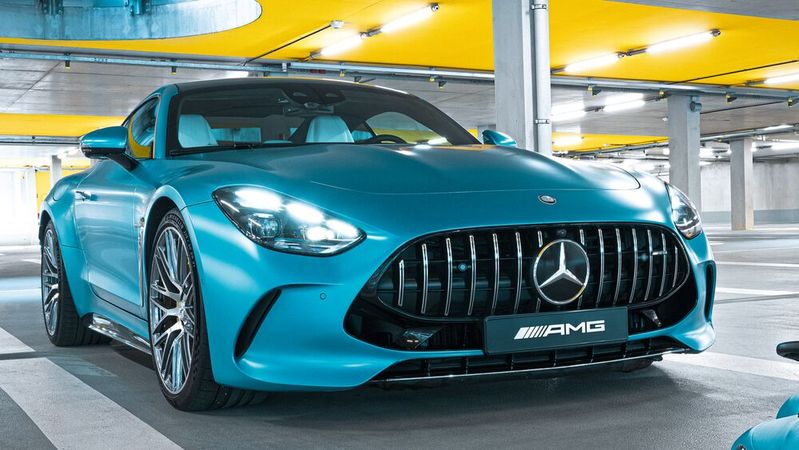
(Image: Mercedes)
Mercedes-Benz experienced a significant drop in profits in the third quarter due to weakness in the crucial Chinese market. The results fell by about half, primarily due to the tough competition in the People's Republic and the generally weak economic situation affecting the passenger car business. "The financial results of the third quarter do not meet the standards we set for ourselves at Mercedes-Benz," said CFO Harald Wilhelm in a statement. He now plans to focus even more on costs and efficiency. The management had already significantly lowered profit expectations for the year in September. The stock declined.
Analysts, following the warnings, had already expected a significantly worse quarter. However, they had not anticipated that Mercedes would achieve only a 4.7 percent operating profit margin before interest, taxes, and special effects in its core passenger car business. A year earlier, it had been 12.4 percent. CEO Ola Källenius had set expectations for the experts at around a 6 percent margin for the second half of the year. Following the disappointment in the third quarter, CFO Wilhelm projected a margin of 6 to 7 percent for the fourth quarter during a conference call with analysts.
Mercedes is facing difficulties primarily in China, as the high-end models with the star emblem are not selling as well as anticipated, and there appears to be no improvement in sight for the current year. These expensive vehicles are a core element of Källenius's strategy and have driven the revenue margins of the Swabian company to record highs in recent years. However, with the economic downturn in the People's Republic, particularly in the real estate market, the affluent Mercedes customers have unexpectedly become more frugal.
Expensive discounts, weak demand
Additionally, competition from domestic automakers is growing in China, a country that has been a guarantor of growth for German manufacturers for many years. In the electric vehicle sector, which is expanding rapidly in China, Mercedes is still waiting for a breakthrough success with its models such as the EQS, the fully electric counterpart to the S-Class. In the third quarter, Mercedes spent a mid-three-figure million euro amount to reduce inventories of electric cars at dealerships through discounts and to support sales in China with subsidies, as Wilhelm stated.
The forecast reduction in September was already the second time this year that management had to temper earnings expectations. Ahead of the weekend, Mercedes accordingly also lowered the revenue expectations for the entire group and the sales expectations for the car division – both are now expected to be slightly below last year's level, instead of at the same level.
Earnings before interest and taxes (EBIT) dropped by almost half to 2.52 billion euros (approx. 2.73 USD) in the last quarter on a year-over-year basis, as reported by the DAX-listed company. Revenue decreased by 6.7 percent to 34.5 billion euros (approx.37.39 USD). The group's net profit fell by more than half to 1.72 billion euros (approx. 1.86 USD).
Declining sales in the third quarter
In the third quarter, Mercedes sold 503,573 passenger cars, which was 1.4 percent less than the previous year. However, the automaker was unable to achieve as high prices and sold a smaller proportion of more expensive cars, causing profits to plummet. Although the decline in van sales was greater, Mercedes was able to contain the drop in the operational results of the vans. The business with financial services and mobility services is also facing problems. Due to the general interest rate trends in the market, the company earned less from financing and leasing.
Mercedes performed better than expected in terms of free cash flow in the industrial business, excluding financial services. This metric is important for investors because, in addition to the regular dividend, Mercedes intends to use the available free funds for share buybacks. These are popular among professional investors because they theoretically increase the earnings per share and thus can support the stock price.
Date: 08.12.2025
Naturally, we always handle your personal data responsibly. Any personal data we receive from you is processed in accordance with applicable data protection legislation. For detailed information please see our privacy policy.
Consent to the use of data for promotional purposes
I hereby consent to Vogel Communications Group GmbH & Co. KG, Max-Planck-Str. 7-9, 97082 Würzburg including any affiliated companies according to §§ 15 et seq. AktG (hereafter: Vogel Communications Group) using my e-mail address to send editorial newsletters. A list of all affiliated companies can be found here
Newsletter content may include all products and services of any companies mentioned above, including for example specialist journals and books, events and fairs as well as event-related products and services, print and digital media offers and services such as additional (editorial) newsletters, raffles, lead campaigns, market research both online and offline, specialist webportals and e-learning offers. In case my personal telephone number has also been collected, it may be used for offers of aforementioned products, for services of the companies mentioned above, and market research purposes.
Additionally, my consent also includes the processing of my email address and telephone number for data matching for marketing purposes with select advertising partners such as LinkedIn, Google, and Meta. For this, Vogel Communications Group may transmit said data in hashed form to the advertising partners who then use said data to determine whether I am also a member of the mentioned advertising partner portals. Vogel Communications Group uses this feature for the purposes of re-targeting (up-selling, cross-selling, and customer loyalty), generating so-called look-alike audiences for acquisition of new customers, and as basis for exclusion for on-going advertising campaigns. Further information can be found in section “data matching for marketing purposes”.
In case I access protected data on Internet portals of Vogel Communications Group including any affiliated companies according to §§ 15 et seq. AktG, I need to provide further data in order to register for the access to such content. In return for this free access to editorial content, my data may be used in accordance with this consent for the purposes stated here. This does not apply to data matching for marketing purposes.
Right of revocation
I understand that I can revoke my consent at will. My revocation does not change the lawfulness of data processing that was conducted based on my consent leading up to my revocation. One option to declare my revocation is to use the contact form found at https://contact.vogel.de. In case I no longer wish to receive certain newsletters, I have subscribed to, I can also click on the unsubscribe link included at the end of a newsletter. Further information regarding my right of revocation and the implementation of it as well as the consequences of my revocation can be found in the data protection declaration, section editorial newsletter.



:quality(80)/p7i.vogel.de/wcms/9e/23/9e23111e49d73012e9e3b7c69428ad5c/0134019347v1.jpeg "The Dominant VA45 high-helix tap from Bass, made of lead-free brass. The long chips, which result from the absence of lead, are clearly visible. (Image:Bass, Inc.)")
:quality(80)/p7i.vogel.de/wcms/1d/09/1d0999956ef87709b72ab1d0402ba207/csf-minis-gruppe-final-01-outputv1.jpeg "Since mid-2026, Harmonic Drive has been offering its CSF Mini gearheads in size 7 as well, in six variants designed for different installation scenarios. (Source: Harmonic Drive)")
:quality(80)/p7i.vogel.de/wcms/ab/08/ab08675922c3a7edea45128248b45b00/0133857009v1.jpeg "In the aerospace industry—one of the most demanding sectors of all—the Shanghai-based company TOPNC has already made a name for itself. (Image:TOPNC)")
:quality(80)/p7i.vogel.de/wcms/ff/48/ff48b1154746e79128935f28bd73ba0e/0113143253v1.jpeg "In our China Market Insider, we regularly provide you with relevant information straight from China. (Image:© Eisenhans - stock.adobe.com)")
:quality(80)/p7i.vogel.de/wcms/6e/bb/6ebb687f573be847aa611b413c6a33b1/0134094461v1.jpeg "From left: Sepp Hochreiter, founder of Nxai and AI researcher, and David Reger, founder and CEO of Neura Robotics, are excited about their collaboration on Physical AI. (Image:Neura)")
:quality(80)/p7i.vogel.de/wcms/89/01/890193a30c52ffd4811d18db82170952/0113143253v1.jpeg "In our China Market Insider, we regularly provide you with relevant information straight from China. (Image:© Eisenhans - stock.adobe.com)")
:quality(80)/p7i.vogel.de/wcms/6b/8a/6b8ac7cd85db2d1d1f6ab30957648711/schaeffler-news-taicanglighthouse6v1.jpeg "At the Lighthouse Factory, robots assemble linear and rotary actuators, among other components. (Source: Schaeffler)")
:quality(80)/p7i.vogel.de/wcms/4f/5a/4f5a2417df55dae5967e90b331e0bbc5/physical-ai-robotics-ariv1.jpeg "With new hardware and software solutions, the productive use of AI in industry is becoming increasingly prominent. (Source: Nvidia)")
:quality(80)/p7i.vogel.de/wcms/c3/68/c368b4f6821557ec497c64bc17fe9f8d/adobestock-2051843806--kaliel-stock-adobe-com-ki-generiertv1.jpeg "To truly harness the full potential of virtual product development, teams and management must radically change their mindset. (Source: © kaliel – stock.adobe.com_AI-generated)")
:quality(80)/p7i.vogel.de/wcms/a3/c1/a3c19e028b66a6fd7c373ab94981631d/paprika-gripperv1.jpeg "For the final, additively manufactured gripper base, SoftGripping chose PA 2200, a material based on polyamide 12 (PA12). It offers balanced mechanical properties and high load-bearing capacity, making it ideal for robust gripper solutions with integrated pneumatics. (Source: SoftGripping GmbH)")
:quality(80)/p7i.vogel.de/wcms/51/b8/51b8e08d2105fdd9952aff385f154192/graphic-2-adma1v1.png "The new surface hardening process enhances the performance of corrosion-resistant alloys by improving their tribological and mechanical surface properties, while preserving the properties of the base material. (Source: Bodycote)")
:quality(80)/p7i.vogel.de/wcms/96/ef/96effc239916cb7e0f396ab75627b8c0/image-space-testingv1.jpeg "Two scientists in front of a vacuum chamber used for testing: As technical instruments for spaceflight become more sensitive, the test facilities are becoming a critical system. (Source: Busch Group)")
:quality(80)/p7i.vogel.de/wcms/4c/61/4c61e3d5582715f2cadafc911480a20a/0132455124v1.jpeg "Mercedes-Benz has announced that it is moving away from its platform-based manufacturing strategy. Management expects a modular design concept to deliver greater benefits... (Image:Mercedes-Benz)")
:quality(80)/p7i.vogel.de/wcms/0d/14/0d14c9be5fc47bc256002ce3df435f21/keb-automation-drive-controller-marinev1.jpeg "Certified for ships, offshore applications, and more: the Combivert F6 Drive Controllers from KEB Automation. (Source: KEB Automation / Miss Irine)")
:quality(80)/p7i.vogel.de/wcms/ba/d3/bad3d62389a59fe3cdbac386a0dce64b/0134098250v1.jpeg "Following initial tests with its robotaxis in Europe, Pony.ai now plans to bring robot trucks to Europe as well. (Image:Pony.ai)")
:quality(80)/p7i.vogel.de/wcms/78/d1/78d124651f6149aa9f33913fc00ef98a/bertrandt-standort-tschechienv1.jpeg "Bertrandt has opened a new facility in the Czech Republic—near Škoda. (Source: Bertrandt)")
:quality(80)/p7i.vogel.de/wcms/27/47/27472d923d2d60f883a5682cb7987558/0134050215v1.jpeg "China's semiconductor industry: At the China International Industry Fair (CIIF) in Shanghai, the chip industry was given its own exhibition area for the first time in 2026. More than 300 companies showcased their technologies and solutions for industrial manufacturing at the “IC Ecosystem Show.” (Image:CIIF)")
:quality(80)/p7i.vogel.de/wcms/bc/20/bc2034a1ba033f00e539d91bcc70e403/bopla-bonext-1-rgbv1.jpeg "A translucent base allows for ambient lighting, either as a design feature or to visually indicate status. (Source: Bopla)")
:quality(80)/p7i.vogel.de/wcms/cd/23/cd239aa506b3ace30e62f44c83fa31ca/0134051508v1.jpeg "Figure 1: Schematic representation of the DAB (Dual Active Bridge) topology. (Image:Texas Instruments)")
:quality(80)/p7i.vogel.de/wcms/8b/35/8b35660420abba32fb891a4c5cc42fbd/0134018092v1.jpeg "Long-range UVC LED with lens and reflector: Close-up of a square LED with a transparent, dome-shaped lens on a dark base plate. The hermetically sealed housing ensures greater reliability and durability under demanding environmental conditions. (Image:FBH_Schurian)")
:fill(fff,0)/p7i.vogel.de/companies/69/de/69de1b7403b0d/simtos-logo.jpeg "simtos-logo (SIMTOS)")
:quality(80)/p7i.vogel.de/wcms/ba/01/ba0186932e02b18ad6e14db198d3f074/0132518745v1.jpeg "Mercedes-Benz records higher profits again in the second quarter of 2026. At the same time, however, revenue is shrinking. The China business and US tariffs are causing concern. Ola Källenius hopes that new models in the second half of the year might turn things around. (Image: Mercedes-Benz)")
:quality(80)/p7i.vogel.de/wcms/c9/01/c90176c00d56449fba73180da5c1a2b1/0132586078v1.jpeg "BMW headquarters in Munich (Image:Blue and White / Rob Oo / CC BY-SA 4.0 / flickr.com)")