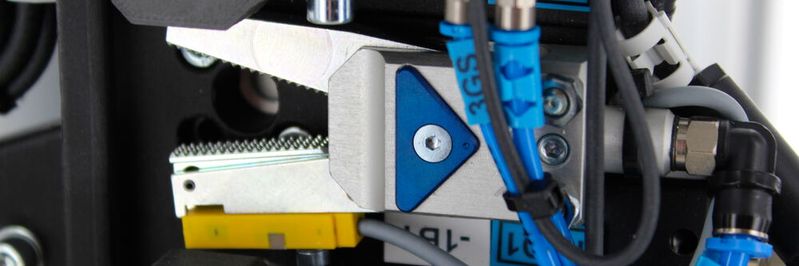
By using 3D printing, ASS Mechanical Engineering can almost completely do without aluminium in custom-made robot grippers. The components reinforced with carbon continuous fibers offer far more benefits for the machine builder and its customers.
Today, almost 100 percent of the individual components for robot grippers at ASS come from the 3D printer.
(Image: Mark 3D)
ASS Maschinenbau has been developing intelligent solutions for automation & robotics for over 40 years. The range extends from gripper parts from the robot hand construction kit to end-of-arm-tooling and complete automation solutions for the automotive and plastics industry. As a company with great manufacturing depth, most components are made directly at ASS Maschinenbau in-house. Typically, the solutions for the customer are in the area of standard parts of the robot construction kit, as these are the easiest and most cost-effective to realize.
However, among ASS's solutions, many gripping solutions have to be developed, designed and manufactured specifically for the customer. This is because different contours are often required to move components from or into an injection molding machine or gripping jaws that perform specific pick-&-place tasks in presses. 90 percent of these customer-specific applications were made from aluminium.
The high variety of variants as well as the complex geometries have long been a challenge in manufacturing. As an alternative, ASS Maschinenbau has previously and for many years used the SLS process in the form of laser-sintered parts. With this process, 3D printed components are also manufactured for final assembly. However, a different solution is required for more mechanically robust components and structures.
Printed components with aluminum strengths
Initially, there were concerns and rumors that 3D-printed parts would not be industrially suitable in terms of strength, quality, cost, reliability, and durability. But today, the individual components, which were previously made of aluminum, come from the industrial 3D printer from Markforged at ASS almost 100 percent of the time.
It was initially doubted, and then put to the test, whether components that exceed the strength of aluminum could be manufactured with the Markforged technology. The project began completely risk-free with individual sample parts from Mark3D that were tested under real conditions. For example, a set of gripper jaws was tested that had to grip a screw. After about 300,000 cycles, no traces could be found on the gripper jaws. Subsequently, additional components were obtained from a 3D print service provider from Mark3D and tested in practice.
After the experts were convinced of the technology internally, the company defined this technology for themselves as the current state of the art and began to equip certain gripping solutions with 3D printed jaws. Gradually, further applications such as mounting brackets or fixtures were added which had previously been mechanically processed.
Fast learning curve in design
Since the powder bed process has been used in the company for decades, the new technology was established very quickly and a good understanding for the additive design was already present. The design freedom is increasingly being exploited and corresponding know-how in the design of components with carbon continuous fibers is being built. Thus, the components are now constructed not only with a focus on manufacturing, but primarily optimized for function.
What stresses is the component subject to and in which direction must the continuous fibers be laid? The optimal orientation of the component in the 3D printer results from these questions. All components are designed with the maximum fiber content in order to achieve the highest possible strength. The innovative technology with its clear advantages is also well received by the customers of ASS. "We were unable to find any comparable 3D printer on the market during our evaluation that was delivered with this level of maturity and the promise of stability. Everything we had hoped for has indeed come true", says Thilo Puchert, Head of Automation, ASS Maschinenbau.
We were unable to find any comparable 3D printer on the market during our evaluation that was delivered with this level of maturity and the promise of stability. Everything we had hoped for has indeed come true.
A product line with 3D printed parts of its own
All gripping solutions where the standard kit cannot be used are now primarily equipped with 3D printed jaws. On average, the printed grippers save about a third of the weight compared to conventionally produced grippers.
The customer receives the parallel jaw gripper PGR combined with 3D printed jaws, which are individually adapted to the customer's component —at a fixed price. The customer just needs to send a CAD file of the component to be gripped. From this, ASS generates the matching gripping jaws.
Date: 08.12.2025
Naturally, we always handle your personal data responsibly. Any personal data we receive from you is processed in accordance with applicable data protection legislation. For detailed information please see our privacy policy.
Consent to the use of data for promotional purposes
I hereby consent to Vogel Communications Group GmbH & Co. KG, Max-Planck-Str. 7-9, 97082 Würzburg including any affiliated companies according to §§ 15 et seq. AktG (hereafter: Vogel Communications Group) using my e-mail address to send editorial newsletters. A list of all affiliated companies can be found here
Newsletter content may include all products and services of any companies mentioned above, including for example specialist journals and books, events and fairs as well as event-related products and services, print and digital media offers and services such as additional (editorial) newsletters, raffles, lead campaigns, market research both online and offline, specialist webportals and e-learning offers. In case my personal telephone number has also been collected, it may be used for offers of aforementioned products, for services of the companies mentioned above, and market research purposes.
Additionally, my consent also includes the processing of my email address and telephone number for data matching for marketing purposes with select advertising partners such as LinkedIn, Google, and Meta. For this, Vogel Communications Group may transmit said data in hashed form to the advertising partners who then use said data to determine whether I am also a member of the mentioned advertising partner portals. Vogel Communications Group uses this feature for the purposes of re-targeting (up-selling, cross-selling, and customer loyalty), generating so-called look-alike audiences for acquisition of new customers, and as basis for exclusion for on-going advertising campaigns. Further information can be found in section “data matching for marketing purposes”.
In case I access protected data on Internet portals of Vogel Communications Group including any affiliated companies according to §§ 15 et seq. AktG, I need to provide further data in order to register for the access to such content. In return for this free access to editorial content, my data may be used in accordance with this consent for the purposes stated here. This does not apply to data matching for marketing purposes.
Right of revocation
I understand that I can revoke my consent at will. My revocation does not change the lawfulness of data processing that was conducted based on my consent leading up to my revocation. One option to declare my revocation is to use the contact form found at https://contact.vogel.de. In case I no longer wish to receive certain newsletters, I have subscribed to, I can also click on the unsubscribe link included at the end of a newsletter. Further information regarding my right of revocation and the implementation of it as well as the consequences of my revocation can be found in the data protection declaration, section editorial newsletter.
This gripper is then delivered to the customer within 3 to 6 days. So far, customers have bought the gripper and then had gripper jaws made themselves in the tool shop. Customers now benefit from the all-inclusive package from ASS.
The printed parts contribute to almost all technical solutions at ASS and are therefore integrated into almost all solutions. So far, almost 1,300 customer-specific applications have been successfully printed, which were previously manufactured mechanically.
Customer projects are being realized due to 3D printing
A decisive project contributed to the acceptance of 3D printing throughout the company. The request of an existing customer was not feasible with the standard solutions due to weight restrictions in the load capacity of the robot, as the gripper including aluminium profiles would have weighed around 6.5 kg.
Finally, the gripper was designed as a compact part, with all functional surfaces individually adjusted to the customer's requirements and then printed. After another iteration loop, the customer received a gripper with a total weight of 2.1 kg (46.3 pounds) compared to the original weight of 6.5 kg (143.3 pounds).
Additional EP coating ensures durability
Many of the components are coated with a highly abrasion-resistant and wear-resistant coating, the so-called EP coating. This can be used universally and is available in two Shore hardnesses and colors: Shore A hardness 90 in the color blue and Shore A hardness 60 in the color black. This coating is applied in-house in a paint-like process when particularly abrasive or sensitive component surfaces need to be handled. For the blue variant, there is a laboratory test certificate for paint compatibility (Labs).
Fiber-reinforced 3D printing
The material behind the high-strength components is Markforged Onyx. It is a polyamide 6 with about 15 percent short carbon fibers.
However, its special advantage lies in the carbon continuous fibers. The grippers and applications at ASS are reinforced with the carbon continuous fiber via a second nozzle in the print head. In this process, the long fiber is inserted into the component and the loads are distributed over the entire area. These strengths go far beyond what is known from the areas of GFK and CFK. Aluminium has been largely replaced as a material.
Growing range—thanks to 3D printing
After having been using the industrial 3D printer intensively for some time now, ASS Maschinenbau wants to use it ever more fully. This will be ensured in the future by the recently developed and new Micro-Light product line—an ultra-light micro gripping system.
The focus in the development of the new, ultra-light gripping system was on ultra-light construction, assembly-friendliness, maximum flexibility and compatibility in terms of connection and application possibilities.
Grippers from this system can be easily connected to all common types of industrially used robots, such as linear systems, articulated arm robots or cobots. The ASS Robot Hand Kit offers cross-system connection options to enable economic and simple integration of the robot hand (EOAT). The 3D-printed components made of high-strength, resistant material reinforced with continuous fibers offer the required stability and lightness. This now also allows the operation of smaller injection molding machines, which was previously not possible.



:quality(80)/p7i.vogel.de/wcms/8e/63/8e631ccb75fda465c197fc52848289fa/0130260202v1.jpeg "According to the Laser-Zentrum Hannover, what is sizzling away underwater marks the first steps towards a way of repairing steel structures more cheaply and without complications using robots, laser 3D printing and AI ... (Image:LZH)")
:quality(80)/p7i.vogel.de/wcms/67/30/6730b015b3dd6f925877edd795eda319/0130247463v1.jpeg "The comparison between the SLA printable plastics Accura Xtreme Grey (above) and the robust newcomer Accura Xtreme Black now used at Speedpart, which represents an inexpensive and deep black alternative to mechanically processed plastic prototypes ... (Image:Speedpart)")
:quality(80)/p7i.vogel.de/wcms/06/9d/069d939b77a4feab0a8d2ece62c28dc1/0129655701v1.jpeg "This turned part is slotted twice. The deburring that would otherwise be necessary is no longer required for high-pressure machining. (Image:Knoll)")
:quality(80)/p7i.vogel.de/wcms/3f/72/3f72e30d61f3522bff192171b60776a4/0130245214v1.jpeg "No idea what else your humanoid robot can do, or where it fails? Then it might be worth taking a look at the Humanoid Capabilities Navigator, which now helps you to find the right robot for a job, or to improve humanoids in a targeted manner ... (Image:Fraunhofer IPA)")
:quality(80)/p7i.vogel.de/wcms/ba/28/ba28ec056a82abd76758c8c87296c0d5/0130213997v1.jpeg "The Nexy automatic material call-off system (AMS) controls the replenishment of non-stocked materials or components. (Image:Steute Technologies GmbH & Co. KG, Löhne)")
:quality(80)/p7i.vogel.de/wcms/21/3b/213b5e5454b0c4344ba0eaa700857607/0129635774v1.jpeg "The QRV flow control valves from Lee are available in sizes from 5.5 to 18 mm and cover a flow rate of 0.2 to 20 l/min. Depending on the version, the pressure range is either between 0.1 and 2.75 bar (1.5 - 40 psi) or between 0.17 and 2 bar (2.5 - 30 psi). (Image:Lee)")
:quality(80)/p7i.vogel.de/wcms/63/e9/63e9db3259a656cca88c5f7158af3fcb/0129385769v1.jpeg "The Agibot A2 at a Fortune China event in December 2025. (Image:Agibot)")
:quality(80)/p7i.vogel.de/wcms/df/a1/dfa1786a3b05f5ff2e51d0f633695c57/0130137877v1.jpeg "Openclaw inspires AI communities. (Image:Openclaw.ai)")
:quality(80)/p7i.vogel.de/wcms/e4/51/e451d52ce0182fb0aaa46a5774f832ef/26-04-pi-fraunhofer-iws-21160-bioslide-pic-01-4128x2321v1v1.jpeg "With the BioSlide research project, the Fraunhofer IWS is investigating how sliding systems can be designed to be more sustainable and energy-efficient. New materials can be tested in a particularly application-oriented manner on this plain bearing test stand. (Image:Fraunhofer IWS)")
![Thanks to advanced 3D printing technology, a more efficient use of resources should contribute to lower-emission aviation—this is the goal of ['skai]-lab. (Image:Oleksandr Pashchenko - stock.adobe.com / AI-generated)](https://cdn1.vogel.de/nghHNSbySccfOjG3n1qCA-FVOjQ=/288x162/smart/filters:format(jpg):quality(80)/p7i.vogel.de/wcms/62/64/626424c97a16e69f871bf216c9629c2a/adobestock-1927043193--c2-a9-20oleksandr-20pashchenko-20-e2-80-93-20stock-adobe-com-ki-generiertv1v1.jpeg "Thanks to advanced 3D printing technology, a more efficient use of resources should contribute to lower-emission aviation—this is the goal of ['skai]-lab. (Image:Oleksandr Pashchenko - stock.adobe.com / AI-generated)")
:quality(80)/p7i.vogel.de/wcms/78/28/7828775af76773458b4d1409ceb1cf0c/368945-20dam-20imagery-digital-transformation-pc-1920x1079v1v1.jpeg "Complex development projects with high regulatory requirements, such as in the aerospace industry, benefit in particular from the Intelligent Product Lifecycle. (Image:PTC)")
:quality(80)/p7i.vogel.de/wcms/e7/82/e7822e208621ba2ae892d609e60481e8/texas-20uni-850x478v1v1.jpeg "Superfoam is a composite that is capable of absorbing 10 times more energy than a conventional foam. (Image:Abbey Toronjo/Texas A&M University Division of Marketing & Communications)")
:quality(80)/p7i.vogel.de/wcms/e6/53/e6539c6b5df2d2af2970ca981131fb42/0130215307v1.jpeg "Volkswagen is in first place in the first two months of 2026—no one has sold as many cars in China as the car manufacturer. (Image:Volkswagen)")
:quality(80)/p7i.vogel.de/wcms/b0/6d/b06d9ad54bfc39053e1db5494df5cb9a/0130237932v1.jpeg "Pleased about their partnership in the field of bidirectional charging: Christian Haferkamp and Aurélie Alemany from enercity as well as Stefan Mecha and Lars Krause, both Volkswagen Commercial Vehicles (from left to right). (Image:PSONNACK)")
:quality(80)/p7i.vogel.de/wcms/2b/0b/2b0b5ff55299be32174cb0ed76718253/0130177406v1.jpeg "Rolls-Royce has received funding of 70 million US dollars from the EU public-private partnership \"Joint Undertakings for Clean Aviation\". (Image:Rolls-Royce)")
:quality(80)/p7i.vogel.de/wcms/95/7e/957ed49b185794b3e76b9e610a8a389f/0130217926v1.jpeg "Bosch wants to offer components for e-vehicles in India together with Tata. (Image:Bosch)")
:quality(80)/p7i.vogel.de/wcms/22/08/22085b4997a696887dd5a712a30b262b/0130211045v1.jpeg "Imec has announced that the world's most advanced high numerical aperture (High NA) EUV lithography system, the ASML EXE:5200, has arrived at its 300mm cleanroom in Leuven. (Image:Imec)")
:quality(80)/p7i.vogel.de/wcms/48/f2/48f250e2385d3f43743dc44133cc4731/0130161592v1.jpeg "The world's first fully functional quantum battery as a proof-of-concept, developed by CSIRO and its cooperation partners, the University of Melbourne and RMIT. (Image:CSIRO and collaborators, The University of Melbourne and RMIT)")
:quality(80)/p7i.vogel.de/wcms/16/9c/169c092e854d8740928a080cead3b88e/0130241261v1.jpeg "NVIDIA's GB300 AI chip with HBM3E and HBM4 from SK Hynix. (Image:SK Hynix)")
:quality(80)/p7i.vogel.de/wcms/3a/50/3a50d3f269f38f14d7a25a93c6f2b2f8/0130147601v1.jpeg "The compact modulator enables fast and energy-efficient data transmission and can be manufactured cost-effectively. (Image:Hugo Larocque, EPFL)")
:fill(fff,0)/images.vogel.de/vogelonline/companyimg/76800/76895/65.jpg "FAULHABER_120mm.jpg ()")
:fill(fff,0)/p7i.vogel.de/companies/67/eb/67eba621ef6ea/logo2.png "logo2 (Wuxi InfiMotion)")
:quality(80)/p7i.vogel.de/wcms/82/d9/82d97dac7624029349709c4bc0098c92/0118924470v1.jpeg "As a company with a great depth of manufacturing, most components are manufactured directly in-house at ASS Maschinenbau.(Image: A. Hammer/ Freestyle Photography)")
:quality(80)/p7i.vogel.de/wcms/d2/4e/d24e70af35506d8301385c241f9bfff5/0118924568v1.jpeg "Micro-Light is an ultra-lightweight and flexible unloading gripper with numerous 3D printed components.(Image: Mark 3D)")
:quality(80)/p7i.vogel.de/wcms/d4/74/d474fc8cd0db6bbe4e0521079a645997/0118924571v1.jpeg "From left: Wolfgang Breu, Thilo Puchert and Ferdinand Bunte from Mark 3D during the recording of a podcast for the Printroom: The 3D Printing Practice Podcast.(Image: Mark 3D)")
:quality(80)/p7i.vogel.de/wcms/84/5e/845eb17b3dd0c74109dd645597610741/0118924573v1.jpeg "ASS Machine Building has been developing intelligent solutions for automation & robotics for over 40 years.(Image: Atelier Year)")
:quality(80)/p7i.vogel.de/wcms/9f/69/9f692aaaf91d6f5a9f9362490092e2b2/0123457919v1.jpeg "The design, choice of material, print settings and post-processing are crucial for particularly stable 3D printed parts. (Image:Xometry)")
:quality(80)/p7i.vogel.de/wcms/1b/6f/1b6f6ed651fcb223aa6c1a47169615d5/0126714840v1.jpeg "The Solution Kit iv OS Sheet Metal from Schmalz consists of a software package, an intelligent vacuum matrix gripper, and 3D vision sensors. (Image:J. Schmalz)")