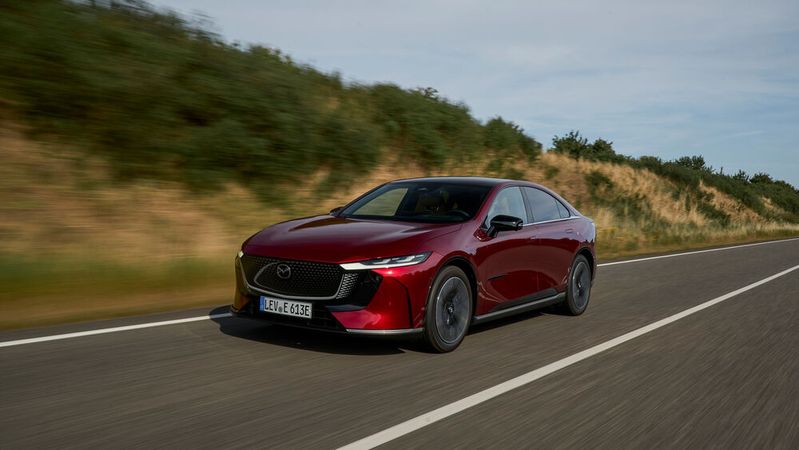
Until now, Mazda's electric range has been limited to the MX-30, followed in September by the Mazda 6e, a mid-size sedan with arguably the best price-performance ratio in the segment.
Mazda puts another e-car on the road.
(Image: Mazda)
Mazda finally has a genuine electric car in its range. Of course, the manufacturer already had a battery-electric model in its range with the MX 30, but with a meagre WLTP range of just 200 kilometers (approx. 125 miles), it was hardly competitive. This is now changing fundamentally with the new Mazda 6e. Because this car has what it takes to be at the forefront of the electrically powered mid-size class. There are several reasons for this:
The price: Even in the basic “Takumi” trim level, the Mazda 6e is almost fully equipped. And with a base price of 44,900 Euros (approx. 52, 700 USD), the car is cheaper than its competitors, the Hyundai Ionic 6 and VW ID 7, when adjusted for equipment. Even fully equipped with the most expensive paint job and trailer hitch, the price only rises to 51,050 Euros (approx. 60,000 USD). This is rather rare in this vehicle class.
The look: Of course, design is a matter of taste. But with the 6e, Mazda's designers have undoubtedly scored a hit that will appeal to many drivers. Visually, the 6e is in the upper mid-range class.
Appearance and quality: After initial test drives around Mazda's European headquarters in Leverkusen (Germany), it is still too early to comment on the long-term quality of the 6e, but both the exterior and interior of the car appear to be of extremely high quality and designed with great attention to detail.
Suitability for everyday use: Both battery variants offer decent ranges, and consumption also appears to be reasonable. In addition to the trunk, the car offers a 72-liter frunk under the front hood.
Good Standard Equipment
But now in detail. As soon as you get into the car, you notice the high-quality workmanship. There is only hard plastic in the interior in places that you don't have to touch very often. And its appearance looks anything but cheap. Everything is designed with great attention to detail. You feel comfortable here, even on long journeys.
Mazda offers the 6e in two trim levels—Takumi and Takumi Plus—and with two battery sizes: The Mazda 6e EV with 68.8 kWh and the Mazda 6e Long Range with 80 kWh. For the first test drives, the Mazda 6e EV was available with the higher of the two trims, i.e. Takumi Plus. This differs from the Takumi equipment mainly by a few elements in the interior, for example a two-tone instead of a monochrome design and an electrically adjustable sunblind instead of an (optional) manually operated one. The price difference is 2,000 euros (approx. 2,300 USD).
Important equipment details such as the heat pump, the head-up display, the 10.25-inch digital instrument cluster and the 14.6-inch touchscreen in the center console, the large glass roof, the heated and ventilated front seats and the inductive charging cradle with cooling function for the smartphone are included as standard in both variants. Just like the 360° display, which not only shows the car from above when maneuvering and parking, but also provides a precise view of the wheels on both sides of the vehicle.
The Sony sound system with fourteen loudspeakers, two of which are in the headrest of the driver's seat, is also always on board as standard. This not only has an excellent sound, but also a so-called private call mode. This hides call information and, for reasons of discretion, only transmits the sound via the two loudspeakers in the driver's seat headrest.
However, the operating concept takes some getting used to, as you have to operate many functions via the touchscreen in the center console. For example, the windshield wiper. The operating system allows frequently used functions to be assigned to freely assignable buttons on the steering wheel so that this function does not always have to be carried out in the rain with a long distraction. The menu with speed-dial buttons at the bottom of the screen can also be easily configured to suit individual preferences. Mazda emphasizes that the 6e is the model with the most extensive operating and configuration options that the Japanese company has ever launched on the market.
For example, the model offers six preconfigured vehicle modes designed to make life easier for drivers:
"Leaving Mode": If the vehicle is left temporarily, Leaving Mode ensures a constant interior temperature for passengers, pets or food left in the vehicle. It then shows information on the central display that the driver will be returning soon.
"Rest Mode": Rest Mode prepares the vehicle for a rest period of several hours by adjusting the seat position and switching off the exterior and interior lighting.
"Relax Mode": Relax Mode prepares the interior for a short rest by adjusting the seat position, air conditioning, windows, interior lighting and the volume of the audio system according to the driver's and passengers' preferences. It is also possible to trigger a wake-up call after a preset time.
"Car Wash Mode": Car Wash Mode helps to prevent damage to the outer skin and the ingress of water when washing the vehicle: The automatic windshield wipers are switched off, the side mirrors are folded in, the rear spoiler is retracted and the windows are closed.
"Private Call Mode": Private Call Mode hides call information and, for reasons of discretion, only transmits the sound via the two loudspeakers in the driver's seat headrest.
"Fresh Air Mode": Fresh Air Mode opens the driver's side window and activates the air purification mode.
This is probably where the collaboration with the Chinese manufacturer Changan, in which the model was created, is most noticeable. As a result, the sales staff will also have a lot of new things to learn so that they can explain the operating concept and functions to their customers.
Date: 08.12.2025
Naturally, we always handle your personal data responsibly. Any personal data we receive from you is processed in accordance with applicable data protection legislation. For detailed information please see our privacy policy.
Consent to the use of data for promotional purposes
I hereby consent to Vogel Communications Group GmbH & Co. KG, Max-Planck-Str. 7-9, 97082 Würzburg including any affiliated companies according to §§ 15 et seq. AktG (hereafter: Vogel Communications Group) using my e-mail address to send editorial newsletters. A list of all affiliated companies can be found here
Newsletter content may include all products and services of any companies mentioned above, including for example specialist journals and books, events and fairs as well as event-related products and services, print and digital media offers and services such as additional (editorial) newsletters, raffles, lead campaigns, market research both online and offline, specialist webportals and e-learning offers. In case my personal telephone number has also been collected, it may be used for offers of aforementioned products, for services of the companies mentioned above, and market research purposes.
Additionally, my consent also includes the processing of my email address and telephone number for data matching for marketing purposes with select advertising partners such as LinkedIn, Google, and Meta. For this, Vogel Communications Group may transmit said data in hashed form to the advertising partners who then use said data to determine whether I am also a member of the mentioned advertising partner portals. Vogel Communications Group uses this feature for the purposes of re-targeting (up-selling, cross-selling, and customer loyalty), generating so-called look-alike audiences for acquisition of new customers, and as basis for exclusion for on-going advertising campaigns. Further information can be found in section “data matching for marketing purposes”.
In case I access protected data on Internet portals of Vogel Communications Group including any affiliated companies according to §§ 15 et seq. AktG, I need to provide further data in order to register for the access to such content. In return for this free access to editorial content, my data may be used in accordance with this consent for the purposes stated here. This does not apply to data matching for marketing purposes.
Right of revocation
I understand that I can revoke my consent at will. My revocation does not change the lawfulness of data processing that was conducted based on my consent leading up to my revocation. One option to declare my revocation is to use the contact form found at https://contact.vogel.de. In case I no longer wish to receive certain newsletters, I have subscribed to, I can also click on the unsubscribe link included at the end of a newsletter. Further information regarding my right of revocation and the implementation of it as well as the consequences of my revocation can be found in the data protection declaration, section editorial newsletter.
Very Different Loading Times
There are major differences between the two battery variants. The 68.8 kWh LFP battery should enable a WLTP range of 479 kilometers (approx. 300 miles), the 80 kWh NMC battery with 552 kilometers (approx 345 miles), 73 kilometers (approx. 45 miles) more. So far so good. As the fuel consumption on the first test laps was always below the WLTP consumption of 16.6 or 16.5 kWh per 100 kilometers (approx. 62 miles), it can be expected that these ranges are quite realistic in practice. However, the weather at the presentation was ideal for an electric car at over 20°C (68°F) and the proportion of highways on the test route was not particularly high.
However, when it comes to recharging the battery, drivers need to allow significantly more time for the large battery than for the small one. While the 68.8 kWh battery can be charged from 10 percent SoC to 80 percent in 24 minutes with up to 165 kW according to the factory specifications, the same charging stroke for the 80 kWh battery takes 47 minutes due to the maximum possible charging power of just 90 kW.
According to Mazda, these seemingly absurd characteristics came about because the car was originally planned with the large battery in order to achieve a range of more than 500 kilometers (approx. 310 miles). In the course of vehicle development, however, the developers then brought the LFP battery to series production maturity so that the Japanese could also include it in the range. According to the Mazda press documents, the Mazda 6e EV is the best choice for drivers who value minimal charging times, while the long-range variant is predestined for long-distance drivers. However, Mazda itself probably doesn't really believe this linguistic crutch and assumes that 90 percent of customers will opt for the 68.8 kWh battery and only 10 percent will invest the extra 2,000 euros (approx. 2,300 USD) for the supposedly older battery chemistry.
Superior Drive
This will not make a big difference to the driving performance. The drive in the Mazda 6e EV has a maximum output of 190 kW and a maximum torque of 320 Nm. The Mazda 6e LongRange has a similar drive power of 180 kW and the same maximum torque. Overall, the car has a decent engine, especially as the well-balanced chassis is more conducive to relaxed cruising than wild cornering.
The new electric Mazda will be available at German dealerships from September. The importer has set itself the target of putting 2,500 vehicles on the road this year. The plan for 2026 is 5,000 units. If Mazda manages to make customers aware of the great progress the manufacturer has made in terms of electromobility, this plan should be easy to implement. This will be even easier for Mazda dealers in the coming year. At the end of 2025, Mazda plans to present a crossover model based on the 6e. This should attract even more attention.



:quality(80)/p7i.vogel.de/wcms/dd/08/dd086510d9ae7b50181f6070e4463b44/0129363730v1.jpeg "Typical application for ionizing devices: Wrapping films. (Picture: ©Adobe Stock/SMC)")
:quality(80)/p7i.vogel.de/wcms/35/57/3557c819943c53acec41a0ccba87da4f/0130049064v1.jpeg "Researchers at the Fraunhofer IWU in Chemnitz have long known that many typical sheet metal parts can be manufactured more cost-effectively using hollow embossing rollers. Now there is news to report ... (Image:Fraunhofer IWU)")
:quality(80)/p7i.vogel.de/wcms/59/02/590246e3b3f415c65edbee377c14ca77/26-06-pi-fraunhofer-iws-41450-direktplattieren-pic-01-7771x4369v1v1.jpeg "The Fraunhofer IWS has developed the new \"direct laser cladding\" process, which creates a functional layer directly on the base body by applying a strip-shaped metal to rotationally symmetrical components in a spiral and bonding it locally by laser. (Image:Christoph Wilsnack/Fraunhofer IWS)")
:quality(80)/p7i.vogel.de/wcms/73/60/73608418789b1d9c393f5e2fa974eda2/0130209906v1.jpeg "The robots of the X6 generation from b+m enable very high painting quality and are also particularly compact and easy to maintain. (Image:Beckhoff)")
:quality(80)/p7i.vogel.de/wcms/78/e9/78e9188c25a8a94e67c34c9bf8ffe495/visual-agile-20robots-20and-20google-20deepmind-20partner-20to-20bring-20intelligence-20to-20robotics-2500x1406v1v1.jpeg "Together, the partners are developing adaptable, intelligent robots for a wide range of applications (Image:Agile Robots SE)")
:quality(80)/p7i.vogel.de/wcms/e7/66/e7669ecf0260ae8fc54c214e34e4902a/0130316817v1.jpeg "Siemens and Palo Alto Networks offer tested cybersecurity solution for industrial 5G. (Image:Siemens)")
:quality(80)/p7i.vogel.de/wcms/9f/55/9f55324832c4f426958031375124d9de/siemens-20ubtech-20hmnd-1920x1079v1v1.png "Ready for the factory floor: While Ubtech is planning mass production, Siemens is already testing humanoids in real factory applications in Erlangen. (Image:Siemens)")
:quality(80)/p7i.vogel.de/wcms/11/36/113695ed260e29c8c2d9d39dc5f9d869/0130213768v1.jpeg "AI can work cheaply in China and deliver the results rapidly all over the world. (Image:Dall-E / AI-generated)")
:quality(80)/p7i.vogel.de/wcms/62/5f/625f41e87ebfef156a98c8e6393e32fd/0130211654v1.jpeg "Axial flux motors have some advantages over radial flux motor—but their production is currently still expensive. (Image:RWTH Aachen University)")
:quality(80)/p7i.vogel.de/wcms/77/9b/779b0685d010dfe45c9c2cb1cfecd467/0128886425v1.jpeg "The BlueEye is the first \"real\" hyperspectral camera for the UV range and covers the wavelength range from 220 to 380nm. (Image:Inno-spec GmbH)")
:quality(80)/p7i.vogel.de/wcms/e4/51/e451d52ce0182fb0aaa46a5774f832ef/26-04-pi-fraunhofer-iws-21160-bioslide-pic-01-4128x2321v1v1.jpeg "With the BioSlide research project, the Fraunhofer IWS is investigating how sliding systems can be designed to be more sustainable and energy-efficient. New materials can be tested in a particularly application-oriented manner on this plain bearing test stand. (Image:Fraunhofer IWS)")
![Thanks to advanced 3D printing technology, a more efficient use of resources should contribute to lower-emission aviation—this is the goal of ['skai]-lab. (Image:Oleksandr Pashchenko - stock.adobe.com / AI-generated)](https://cdn1.vogel.de/nghHNSbySccfOjG3n1qCA-FVOjQ=/288x162/smart/filters:format(jpg):quality(80)/p7i.vogel.de/wcms/62/64/626424c97a16e69f871bf216c9629c2a/adobestock-1927043193--c2-a9-20oleksandr-20pashchenko-20-e2-80-93-20stock-adobe-com-ki-generiertv1v1.jpeg "Thanks to advanced 3D printing technology, a more efficient use of resources should contribute to lower-emission aviation—this is the goal of ['skai]-lab. (Image:Oleksandr Pashchenko - stock.adobe.com / AI-generated)")
:quality(80)/p7i.vogel.de/wcms/c3/c4/c3c4ce270b083eeac55654148611f064/0130237945v1.jpeg "China is not giving up on hydrogen, but is intensifying its efforts. (Image:freely licensed from Pixabay)")
:quality(80)/p7i.vogel.de/wcms/4e/c0/4ec0bd19390b169edfa23677373dcdf1/0130260089v1.jpeg "Renewable fuels can supply European road traffic, according to a study. (Image:Aral)")
:quality(80)/p7i.vogel.de/wcms/6f/c9/6fc9050301d745cad25585c6780f8f51/0130197341v1.jpeg "Production facilities are a worthwhile target and are therefore at risk. (Image:ABB Robotics)")
:quality(80)/p7i.vogel.de/wcms/b6/62/b662adc2cec8227d8172509bbfb6ee42/25c0207-107-4961x2789v1v1.jpeg "The GLB is the second model based on Mercedes' new MMA platform. Apparently, Geely's platform is better and cheaper, which is why the two companies are negotiating a partnership. (Image:Mercedes-Benz)")
:quality(80)/p7i.vogel.de/wcms/4d/dd/4dddf438e91f394c04a095dbfd109d1c/0130236430v1.jpeg "Measurement modules: The 720301 module in combination with the SL2000 enables RMS and power calculations, among other things. (Image:Yokogawa)")
:quality(80)/p7i.vogel.de/wcms/61/fc/61fcf95f5cca15494ad18343901ae585/0130317237v1.jpeg "With the AGI CPU, Arm says it is taking a \"historic step\": With the processor aimed at AI in data centers, the company is presenting itself for the first time as a provider of its own chips, not just as a pure IP licensor. (Image:Arm)")
:quality(80)/p7i.vogel.de/wcms/82/90/8290dfe3595b6c6b33726ae8b76172c7/0130319587v1.jpeg "The concept image illustrates how the pattern of tiny protrusions and depressions created on the substrate (MgO, bottom) controls the arrangement of atoms in the superconducting material (YBCO, top). At the interface between the two layers, an electronic structure enables superconductivity to occur at higher temperatures than previously possible. (Image:Chalmers University of Technology / Riccardo Arpaia)")
:fill(fff,0)/p7i.vogel.de/companies/67/eb/67eba621ef6ea/logo2.png "logo2 (Wuxi InfiMotion)")
:quality(80)/p7i.vogel.de/wcms/cb/bf/cbbf2b462b2698f5ad3e10a5282410f8/0124176815v1.jpeg "Mazda MX-30 E-REV (Image:Sven Prawitz/VCG)")
:quality(80)/p7i.vogel.de/wcms/e0/c4/e0c42434fe97265b926210ac1be68543/0125560360v1.jpeg "The saloon was developed with Chinese assistance.(Image: Mazda)")
:quality(80)/p7i.vogel.de/wcms/15/f5/15f54db031b076231b79067ce0e6e10b/0125560365v1.jpeg "The Mazda 6e competes in the mid-size class.(Image: Mazda)")
:quality(80)/p7i.vogel.de/wcms/b1/41/b141c6248744a6941a13781826d9bc1b/0125560370v1.jpeg "In terms of operation, the new model differs from the familiar Mazda logic.(Image: Mazda)")
:quality(80)/p7i.vogel.de/wcms/cb/0d/cb0de6b274da2b4b80a59d9712451789/0125560371v1.jpeg "It is also very airy in the back.(Image: Mazda)")
:quality(80):fill(efefef,0)/p7i.vogel.de/wcms/67/ad/67adf4a647532/elatec-wp-machine-authentication.png "Elatec WP Machine Authentication")
:quality(80)/p7i.vogel.de/wcms/c4/76/c47699813b548dfa894a603a27350a38/0124272828v1.jpeg "Xpeng's model range could quickly grow. However, the Chinese have not yet confirmed whether they will bring their new flagship X9 to Europe. (Image:Xpeng)")
:quality(80)/p7i.vogel.de/wcms/25/c6/25c6f47fcadcaa82105c5e18c61b11c6/0125505785v1.jpeg "The VW Multivan is also available as a hybrid with all-wheel drive. (Image:VWN)")