Niles-Simmons and Mapal are bringing their jointly developed process for the complete machining of stator housings for electric motors into series production. This allows suppliers and OEMs to efficiently manufacture components for electric and hybrid vehicles of major manufacturers.
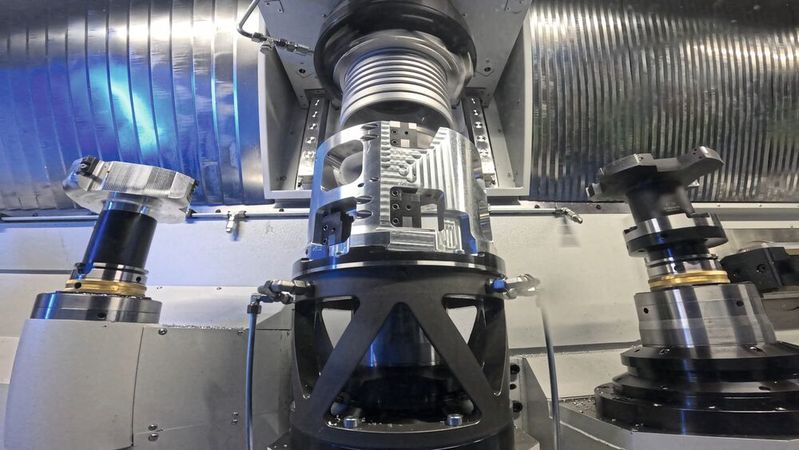
For the second machining step, the thin-walled component is moved into the gap between the inner and outer tool.
(Image: Mapal)
The two manufacturers have demonstrated in a development project that a very economical and highly precise production of stator housings is possible on a pick-up lathe. The thin-walled aluminum components are needed for the drive in electric vehicles. They are equipped with fins on the outside for the cooling circuit and are installed in the larger motor housings.
During the development phase at Niles-Simmons, a modular lathe that had been converted for this purpose was still used, but now a machine specifically designed for stator production has entered the market. The development foundation was the vertical machining center of the Rasoma brand, which, like Niles-Simmons, is a brand of the NSH Group (Niles-Simmons-Hegenscheidt GmbH). Both brands are jointly organized under the NSH Group subsidiary NSH Technology and have advanced the development together. The designation Rasoma DZS 400-2 indicates that it operates with two workpiece spindles.
For use in series production, the machine was equipped on the sides with a pick-up area for raw parts and a dropdown area for the finished parts. The feeding and removal of the components are carried out via conveyor belts. During manual loading, a buffer of ten to up to 20 components can be utilized through automation. This allows the operation of multiple systems, while the employee can attend to other processes accompanying production.
We have thus implemented a standard simple automation that does not require robots or barriers on the machine. The operator can place the parts directly on a pallet conveyor.
Thomas Lötzsch, Sales Manager at NSH Technology
A fully automated workpiece loading and unloading system for multiple machines with a central conveyor system is optionally available. The machine is easy to integrate into an existing production environment, supported by its relatively compact footprint of 24.6 feet × 8.5 feet. The design foundation of the Rasoma DZS 400-2 was developed in collaboration with LTH Castings, a partner with extensive experience in casting and a specialist in machining complex, high-quality, and thin-walled components made of die-cast aluminum. The design thus directly incorporated practical experiences and user requirements.
Complete Machining in Two Clamping Operations
Between pick-up and dropdown, the complete machining of the components takes place on the vertical machine in two clamping operations. From above, a clamping device initially picks up the workpiece and moves it sequentially to various machining stations within the machine. At a reclamping station in the work area, the part is rotated 180 degrees and taken up by the second workpiece spindle for finishing. During the second clamping, the machining of the next component begins simultaneously on the first clamping position.
Like on a miniature transfer line, the machining steps are lined up consecutively. The process begins with the rough pre-machining of the various inner diameters of the component. In this process, the tool remains stationary while the workpiece rotates.
Machining with a four-edged ISO boring tool on an HSK-A 100 spindle requires only a quarter of the main time compared to conventional turning with a single edge.
André Ranke, Area Sales Manager Mapal
The next machining step, in which the rotating stator housing is simultaneously machined inside and outside with four cutting edges each, is also highly efficient. The internal tool also rotates. The difference between the tool's rotational speed and the workpiece's rotational speed determines the cutting speed at the internal cutting edges. The bell-shaped external tool remains stationary. For machining, the component is positioned in the gap between the internal and external tools. This patented process reduces the forces acting on the clamping device. To precisely machine the thin-walled components, it eliminates the need for a complex workpiece clamping device with vibration damping.
Special attention was paid to the large chip volume and the high forces during tool design, as machining is atypically performed simultaneously on the inner and outer diameters.
Michael Kucher, Component Manager E-Mobility at Mapal
During the finishing process, only the fine boring tool is powered, while the component remains stationary. This prevents imbalances in the material caused by non-rotationally symmetric workpiece shapes, which could have a negative impact. Afterwards, the workpiece is reclamped in the machine, and the outer area that was previously clamped in the flange section is machined. The reclamping station can also be used for another purpose: the workpiece is laid down here to relieve material stress before fine boring. Additionally, the machine features two tool turrets for driven tools, which perform further machining operations based on part requirements.
Date: 08.12.2025
Naturally, we always handle your personal data responsibly. Any personal data we receive from you is processed in accordance with applicable data protection legislation. For detailed information please see our privacy policy.
Consent to the use of data for promotional purposes
I hereby consent to Vogel Communications Group GmbH & Co. KG, Max-Planck-Str. 7-9, 97082 Würzburg including any affiliated companies according to §§ 15 et seq. AktG (hereafter: Vogel Communications Group) using my e-mail address to send editorial newsletters. A list of all affiliated companies can be found here
Newsletter content may include all products and services of any companies mentioned above, including for example specialist journals and books, events and fairs as well as event-related products and services, print and digital media offers and services such as additional (editorial) newsletters, raffles, lead campaigns, market research both online and offline, specialist webportals and e-learning offers. In case my personal telephone number has also been collected, it may be used for offers of aforementioned products, for services of the companies mentioned above, and market research purposes.
Additionally, my consent also includes the processing of my email address and telephone number for data matching for marketing purposes with select advertising partners such as LinkedIn, Google, and Meta. For this, Vogel Communications Group may transmit said data in hashed form to the advertising partners who then use said data to determine whether I am also a member of the mentioned advertising partner portals. Vogel Communications Group uses this feature for the purposes of re-targeting (up-selling, cross-selling, and customer loyalty), generating so-called look-alike audiences for acquisition of new customers, and as basis for exclusion for on-going advertising campaigns. Further information can be found in section “data matching for marketing purposes”.
In case I access protected data on Internet portals of Vogel Communications Group including any affiliated companies according to §§ 15 et seq. AktG, I need to provide further data in order to register for the access to such content. In return for this free access to editorial content, my data may be used in accordance with this consent for the purposes stated here. This does not apply to data matching for marketing purposes.
Right of revocation
I understand that I can revoke my consent at will. My revocation does not change the lawfulness of data processing that was conducted based on my consent leading up to my revocation. One option to declare my revocation is to use the contact form found at https://contact.vogel.de. In case I no longer wish to receive certain newsletters, I have subscribed to, I can also click on the unsubscribe link included at the end of a newsletter. Further information regarding my right of revocation and the implementation of it as well as the consequences of my revocation can be found in the data protection declaration, section editorial newsletter.
In summary, the Rasoma DZS 400-2 combines the best of both worlds: the speed of turning for the pre-machining of the inner and outer contours with the precision of fine boring for finishing the inner contour.
Daniel Pilz, Project Leader from NSH Technology
The machine tool manufacturer and Mapal have contributed their respective core competencies to this complete solution. By serializing the machine, tool technology, and process, the good results of the prototype were further improved. The achieved process stability even exceeded expectations, allowing the targeted cutting speed of 2,297 feet per minute to be increased further.
The experiences that Niles-Simmons brings from the variety of technologies positively impact the overall stability of the tool technology and machine in this aluminum machining.
Michael Kucher, Component Manager E-Mobility at Mapal
The Rasoma DZS 400-2 achieves significantly shorter chip-to-chip time compared to a milling machining center. This is because all tools are already in the work area and only need to be brought into the working position by swiveling the turret disk. This eliminates any tool changes, which greatly reduces idle time. With the described technology, studies already anticipated a 50 percent reduction in cycle time compared to standard turning operations. Increasing the cutting speeds to 3,281 feet per minute using optimally suited cutting materials and optimizing the idle times resulted in an additional 20 percent time savings.
The process runs so stably that random sampling for quality assurance is sufficient. While initially all manufactured components were measured, the recommendation now is to measure only one part per shift. Daniel Pilz supports this with figures: “The Rasoma DZS 400-2 with the special tools from Mapal achieves a process capability index of over 1.67 for critical features such as cylindricity, diameter, and concentricity, thus meeting industrial requirements.” Customers already using the machine achieve an annual output of up to 180,000 produced components in three-shift operations.
Successful in Large-Scale Production
One of the first users of the series process for stator production on the Rasoma DZS 400-2 is LTH Castings in Slovenia. The long-established foundry company operates more than 100 casting cells and processes the raw parts on over 250 CNC machining centers. Around 3,800 employees work at a total of six locations.
With our all-in-one solutions from design to series production, we are an important strategic partner of the automotive industry. Our range of components includes parts for transmissions, engines for battery-electric and hybrid vehicles, as well as steering and braking systems.
Dr. Primož Ogrinec, CTO von LTH Castings
The Rasoma DZS 400-2 machines are loaded and unloaded in the state-of-the-art production using robots.
Like most automotive suppliers, LTH Castings manufactures components for different vehicle models. The flexibility of the Rasoma DZS 400-2 is helpful in the production of stator housings, as only the clamping devices and tools need to be reconfigured. “With a single system and by applying the new process, an optimal solution was developed and brought to series production, tailored to specific manufacturers in both quantity and quality,” explains André Ranke. The production of stator housings is thus possible with a diameter of up to 19.7 inches and a component length of 19.7 inches.
On the Rasoma DZS 400-2, all housings that we have seen so far can be produced, and we have seen very many already.
Thomas Lötzsch, Sales Manager at NSH Technology
The project team also encountered a surprise when a major automotive manufacturer required an undercut on the inside of the component for the housing design. The sample component from Mapal, which was specifically designed and manufactured for the process setup, did not include this challenge. However, Mapal, together with the specialists from the NSH Group, quickly provided a joint solution: instead of the practically proven fine boring tool, a highly precise compensating tool with four slides from Mapal's product portfolio was used to create the desired inner contour. On the machine side, an interface coordinated with Mapal was designed within a few days, achieving series readiness even during the ongoing project. Thanks to the now very closely networked design development, the two companies are able to respond quickly to newly developed contours.
New Benchmark for Low Cost Per Part
The Rasoma DZS 400-2 with Mapal's tool technology has established itself for series production and resolves quality issues that occur with conventional turn-milling machines and horizontal transfer lines. Thomas Lötzsch is aware of cases where the required form and positional tolerances were not reliably achieved, resulting in scrap rates of up to 50 percent. Where the quality was satisfactory, the cycle times, in turn, were inadequate and caused higher component costs. A reliable process for the production of the components was missing.
Because there is intense price competition among automotive suppliers, the focus from the beginning in the development of the Rasoma DZS 400-2 was on achieving the lowest possible cost per piece. This goal was achieved through the combination of high machine availability, short cycle times, the quality of the machined components, and process-reliable production. According to current calculations, this results in particularly economical cost per part for machining, including tool costs.



:quality(80)/p7i.vogel.de/wcms/53/f7/53f7dadbe4d656a3fd4f4077445f29f6/0129828707v1.jpeg "Thanks to its compact design and drilling/unscrewing function, the Fire Birdie is suitable for applications with limited installation space and frequent tool changes. (Image:Marcel Kraibühler)")
:quality(80)/p7i.vogel.de/wcms/da/4d/da4da8d34671dc6bce80e496212de877/0129850788v1.jpeg "Mate-XT Go supports the arms and shoulders during overhead work and repetitive tasks and is designed to significantly reduce muscle strain in everyday working life. (Image:Comau)")
:quality(80)/p7i.vogel.de/wcms/95/97/95976dbaac68b249eb65e74c5aad5300/0129651893v1.jpeg "The C2.0 centric clamps, the S2 fixed jaw clamps and the \"gredoc\" zero-point clamping systems are used for machining the raw parts. Fastening is carried out with width across flats 27. (Image:Gressel)")
:quality(80)/p7i.vogel.de/wcms/57/1b/571b8895efb299d70846bbdbd7af2338/0130043886v1.jpeg "Servo hydraulics independent of the control system: The servo hydraulics software module is integrated directly into the b Maxx 5500 servo drive (pictured: Mehmet Sari, Export Sales Manager at Hürsan Pres (left), Özgür Deniz Demirbaş, Country Manager at Baumüller Turkey) (Image:Baumüller)")
:quality(80)/p7i.vogel.de/wcms/3b/27/3b27f6c5848be73acecb04054bf0a146/0130115209v1.jpeg "Spectroscopic glucose measurement with infrared spectroscopy enables more regular measurements without physical strain. (Image:Endrich)")
:quality(80)/p7i.vogel.de/wcms/3f/cc/3fccb748b0fe16f1f61249d94c72f126/0130149439v1.jpeg "Requirements for integrated power supply systems: Precise AC and DC power supply systems that not only provide energy, but also reliably combine measurement, analysis and system integration. (Image:Schulz Electronic)")
:quality(80)/p7i.vogel.de/wcms/fd/93/fd93e01c16f5a4709278499d981a459c/0130061090v1.jpeg "Revealed: These servo drives are assembled at Aerotech in Fürth. (Image:Aerotech)")
:quality(80)/p7i.vogel.de/wcms/cb/8a/cb8ae7f5205365efce3e7285154fc3cf/0130132198v1.jpeg "Markus Huber (left) and Nicolai Friis from TU Wien know how to make quantum computers multidimensional in order to perform computing operations even better. (Image:TU Vienna / A. Rommel)")
:quality(80)/p7i.vogel.de/wcms/63/21/6321beb732bf7d92640df46d7aa77573/0130125122v1.jpeg "As part of the Carbon Lab Factory Lausitz, a pilot plant for the production of sustainable, cost-effective and competitive carbon fibers will be built at the Guben site. (Image:Fraunhofer IAP / Kristin Stein)")
:quality(80)/p7i.vogel.de/wcms/53/4f/534fe0f168f6ee070ded4a48faca4cef/business-wire-main-image-1103x620v1.jpeg "The new UR AI Trainer, developed by Universal Robots and Scale AI, is the first direct lab-to-factory solution for AI model training.
(Source: Universal Robots)")
:quality(80)/p7i.vogel.de/wcms/08/70/087062e2e1a9b9add5777410dd746ee9/adobestock-1923991605-5607x3156v1v1.jpeg "A new type of tactile sensor, inspired by human skin, even recognizes grains of sand. (Image:Curioso.Photography - stock.adobe.com)")
:quality(80)/p7i.vogel.de/wcms/7f/08/7f087d7013424d123ab7275cd2e3fe55/adobestock-809456218--c2-a9-20degimages-20-e2-80-93-20stock-adobe-com-ki-generiert-4179x2351v1v1.jpeg "The digital upgrading of existing machines conserves resources, saves energy and reduces the need for new production. (Image:Degimages - stock.adobe.com/AI-generated)")
:quality(80)/p7i.vogel.de/wcms/90/db/90db3087d3af0560fcdb4dbc42443ce1/0130157448v1.jpeg "The switch to SDV is the most complex transformation the industry has ever had to master. The end consumer gets a vehicle that gains rather than loses value over its lifetime. (Image:Sonatus)")
:quality(80)/p7i.vogel.de/wcms/73/f0/73f00bb99a23197db05bb584fe78f20f/0130080581v1.jpeg "The \"China Speed\" analysis by Roland Berger shows that the speed of development has only a limited connection with labor costs. (Image:freely licensed at Pexels)")
:quality(80)/p7i.vogel.de/wcms/2f/5b/2f5ba6a150b52c2b8efada560c5cdafe/0130143442v1.jpeg "Automotive suppliers are facing a severe crisis, which is primarily due to a combination of structural change and economic problems. (Image:freely licensed at Pexels)")
:quality(80)/p7i.vogel.de/wcms/22/d0/22d03cd48e992435338b59464c428d41/0129739814v1.jpeg "More electric vehicles on the roads mean a higher demand for electricity - which should ideally be covered by renewable energies. (Image:BMW)")
:quality(80)/p7i.vogel.de/wcms/94/7a/947ac066b98cbcd3470e83ff9da3e25f/0130096114v1.jpeg "The use of amorphous steels in the stator enables a significant reduction in losses and increases the efficiency of modern electric motors in vehicle drives. (Image:Horse Powertrain)")
:quality(80)/p7i.vogel.de/wcms/e5/f1/e5f171d3d7ae021332cc0aeae4d6e299/0130127049v1.jpeg "In collaboration with Shanghai Jiao Tong University, Lenovo has presented a silicon anode battery under the name \"ED1000\" as a proof of concept for mobile workstations. (Image:Lenovo)")
:quality(80)/p7i.vogel.de/wcms/fa/69/fa696e59706b96fff02283dd74cc2398/0130129635v1.jpeg "Samsung Co-CEO Jun Young-hyun wants to respond to the AI-driven boom in demand in the memory market with contracts for up to five years. This should provide more planning security in the traditionally volatile storage business. At the same time, however, this is likely to increase the pressure on customers to secure precise long-term requirements, prices and supply chains. (Image:Samsung)")
:quality(80)/p7i.vogel.de/wcms/31/a8/31a883a47b86634c382923e78fd9a4c9/0130133225v1.jpeg "Figure 1: GMSL-capable point-to-point connection. (Image:ADI)")
:fill(fff,0)/images.vogel.de/vogelonline/companyimg/76800/76895/65.jpg "FAULHABER_120mm.jpg ()")
:fill(fff,0)/p7i.vogel.de/companies/67/eb/67eba621ef6ea/logo2.png "logo2 (Wuxi InfiMotion)")
:quality(80)/p7i.vogel.de/wcms/bf/54/bf54e8b188d96cccb8654bdc52a18f44/0127912141v1.jpeg "While OP 20 is performed on the second spindle after flipping the component, OP 10 of the next stator housing can begin on the first spindle.(Image: Mapal)")
:quality(80)/p7i.vogel.de/wcms/cb/8c/cb8cf154b37c8aee334560dcb5813400/0127912126v1.jpeg "The first machining step is the rough pre-machining of the various inner diameters of the component. In this process, the tool remains stationary, and only the workpiece rotates.(Image: Mapal)")
:quality(80)/p7i.vogel.de/wcms/f5/00/f5006d1f027c6bd9e99b23ed50929c30/0127912135v1.jpeg "The difference between the tool rotation speed and the workpiece rotation speed generates the cutting speed on the inner cutting edges. The bell-shaped outer tool remains stationary.(Image: Mapal)")
:quality(80)/p7i.vogel.de/wcms/19/9e/199e3ba714d6aefe686f8000c70de44f/0127912138v1.jpeg "At the clamping station, the workpiece is rotated by 180 degrees and prepared for spindle clamping.(Image: Mapal)")
:quality(80):fill(efefef,0)/p7i.vogel.de/wcms/65/f0/65f0715271f4e/dassault-wpcover-mm.png "Dassault_WPCover_MM")
:quality(80)/p7i.vogel.de/wcms/19/32/193281d281e697f7e7ed1e59beebbc8a/0127912129v1.jpeg "For the second processing step, the thin-walled component is moved into the gap between the inner and outer tool. (Image:Mapal)")
:quality(80)/p7i.vogel.de/wcms/80/e0/80e0f72546bc65aedffc632541f4e7b7/0125884949v1.jpeg "The third generation of the solid carbide milling cutter OptiMill-Uni-HPC was specifically developed for modern, automated manufacturing processes. The focus is on maximum process reliability. (Image:Mapal)")