The expansion of the charging infrastructure for electric vehicles is progressing inexorably. The corporate start-up Lapp Mobility GmbH of the Lapp Group supplies accessories for this dynamic market. The two managing directors highlight challenges and opportunities.
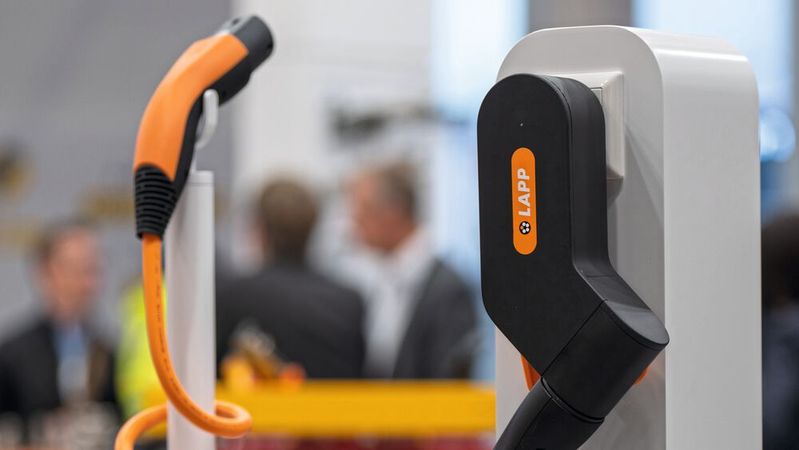
The image shows the Lapp Helix charging cable (left) and the Mobility Dock (right) at a Lapp trade show booth.
(Image: Lapp)
In 2023, around 2.3 million electric vehicles were on the roads in Germany. Worldwide, the number is estimated to be about 42 million electric cars, according to the Centre for Solar Energy and Hydrogen Research. Thus, they make up a small but steadily growing share of the more than 1.5 billion motor vehicles. Nevertheless, the situation remains challenging. "And not just in Germany," emphasizes Dr. Simon Alig, who, along with Miro Ivankovich, forms the management of Lapp Mobility GmbH. "The market is very legislation-driven. Additionally, the requirements for manufacturers and suppliers are increasing."
"The e-mobility market is very legislation-driven. Additionally, the requirements for manufacturers and suppliers are increasing," says Dr. Simon Alig, Managing Director of Lapp Mobility GmbH.
(Image: Lapp)
At the same time, many countries are reducing or completely abolishing their government subsidies for electric vehicles. In Germany, for example, the subsidies for electric cars and plug-in hybrids were abruptly cut at the end of 2023. This reduces attractiveness for consumers, particularly in price-sensitive markets. For companies like Lapp Mobility GmbH, this means adapting flexibly to the changing conditions to remain competitive. The market is fiercely contested, and numerous promising start-ups have already been pushed out in recent years.
E-Mobility Indispensable for Energy Transition
E-mobility is indispensable for the urgently needed energy transition. It is considered a central component for a sustainable and climate-friendly transport system based on renewable energies. Norway is already leading the way: around 90 percent of newly registered cars are fully electric there.
Road traffic continues to account for the majority of transport-related CO2, air pollutant, and noise emissions. Therefore, it is clear that traffic must become more environmentally friendly. According to the Intergovernmental Panel on Climate Change (IPCC), electric vehicles powered by electricity from low-emission sources offer the greatest climate protection potential over their entire lifecycle among all land-based transport technologies. Even with today's electricity mix, their carbon footprint is better than that of all gasoline and diesel vehicles.
However, the transition requires bright minds among infrastructure operators, charging station and vehicle manufacturers, and solution providers. They must rely on the right ideas to continue on the right path in the faltering market.
Lapp Mobility GmbH, a company of the Lapp Group, specializes in the development and production of solutions for electromobility and now offers products for electric car manufacturers, private electric car drivers, charging station manufacturers, infrastructure operators, and other companies active in the e-mobility sector. "Our portfolio includes AC charging solutions such as Mode 3 charging cables for charging at columns and wall boxes, but also Mode 2 solutions suitable for industrial and household sockets, as well as complete solutions for the entire cabling of AC and DC charging infrastructures," summarizes Miro Ivankovic. A particular challenge here: "The technical development in this area is rapid, and the market shares are fiercely contested."
"How quickly all this has developed can be compared to the evolution of our cell phones and smartphones," explains Simon Alig. "An old Nokia phone seemed primitive to us just a few years later, and the same goes for the batteries of e-vehicles: they are becoming cheaper, and charging is getting faster." This means that it makes a big difference to consumers which vehicle they buy. It is true: a newer vehicle has significantly better charging technology and battery. This also strongly influences consumers' purchasing decisions and thus the market.
Expertise for Custom AC Charging Solutions
"The charging infrastructure is such an exciting area for us because we naturally have comprehensive expertise in connection solutions," says Miro Ivankovic, Managing Director of Lapp Mobility GmbH.
(Image: Lapp)
Currently, Lapp Mobility GmbH primarily offers AC charging solutions. "Our current portfolio focuses on alternating current (AC) charging solutions with charging capacities of up to 22 kW," describes Miro Ivankovic. "Among the most popular products at the moment is our Mode 3 charging cable with the patented Helix design." Lapp's charging cable allows for easy, independent coiling due to the cable's shape memory. By preventing cumbersome cable tangles, it is especially suitable for carrying in the vehicle itself and for on-the-go charging at charging stations. The corporate start-up has also developed a solution for the conventional Schuko socket: the Mobility Dock with a charging capacity of 2.4 kW, which serves as an emergency charger for the road in combination with a standard Mode 3 cable. Additionally, the range includes two mobile Mode 2 wallboxes, covering flexible charging capacities from 2.4 kW to 22 kW.
The Mobility Dock with a charging capacity of 2.4 kW serves as an emergency charger for on-the-go when combined with a standard Mode 3 cable.
(Image: Lapp)
"The market has changed here with the end of the KfW wallbox subsidy, so our focus has since been on such flexible AC solutions," explains Simon Alig. The products target both private car drivers and providers of charging infrastructure. "Our unique selling point lies in our expertise and customer service. We develop customized solutions that are precisely tailored to the needs of our partners," says Alig. In this way, the corporate start-up was able to once again win over a large automobile manufacturer for a project on custom development. The specially developed chargers from Lapp will soon be found in all models.
Date: 08.12.2025
Naturally, we always handle your personal data responsibly. Any personal data we receive from you is processed in accordance with applicable data protection legislation. For detailed information please see our privacy policy.
Consent to the use of data for promotional purposes
I hereby consent to Vogel Communications Group GmbH & Co. KG, Max-Planck-Str. 7-9, 97082 Würzburg including any affiliated companies according to §§ 15 et seq. AktG (hereafter: Vogel Communications Group) using my e-mail address to send editorial newsletters. A list of all affiliated companies can be found here
Newsletter content may include all products and services of any companies mentioned above, including for example specialist journals and books, events and fairs as well as event-related products and services, print and digital media offers and services such as additional (editorial) newsletters, raffles, lead campaigns, market research both online and offline, specialist webportals and e-learning offers. In case my personal telephone number has also been collected, it may be used for offers of aforementioned products, for services of the companies mentioned above, and market research purposes.
Additionally, my consent also includes the processing of my email address and telephone number for data matching for marketing purposes with select advertising partners such as LinkedIn, Google, and Meta. For this, Vogel Communications Group may transmit said data in hashed form to the advertising partners who then use said data to determine whether I am also a member of the mentioned advertising partner portals. Vogel Communications Group uses this feature for the purposes of re-targeting (up-selling, cross-selling, and customer loyalty), generating so-called look-alike audiences for acquisition of new customers, and as basis for exclusion for on-going advertising campaigns. Further information can be found in section “data matching for marketing purposes”.
In case I access protected data on Internet portals of Vogel Communications Group including any affiliated companies according to §§ 15 et seq. AktG, I need to provide further data in order to register for the access to such content. In return for this free access to editorial content, my data may be used in accordance with this consent for the purposes stated here. This does not apply to data matching for marketing purposes.
Right of revocation
I understand that I can revoke my consent at will. My revocation does not change the lawfulness of data processing that was conducted based on my consent leading up to my revocation. One option to declare my revocation is to use the contact form found at https://contact.vogel.de. In case I no longer wish to receive certain newsletters, I have subscribed to, I can also click on the unsubscribe link included at the end of a newsletter. Further information regarding my right of revocation and the implementation of it as well as the consequences of my revocation can be found in the data protection declaration, section editorial newsletter.
Complete Solutions for Convenient Charging
The charging infrastructure is an increasingly important market for Lapp Mobility GmbH. "This is such an exciting area for us because we inherently possess comprehensive expertise in connection solutions," says Miro Ivankovic. After all, Lapp specializes in all challenges related to connection solutions. "And that is precisely what sets us apart from the competition," Ivankovic continues. "Among our market peers, we are the expert company for cables. By cleverly utilizing our internal synergies, we can work much more flexibly and with far more concentrated expertise than other companies. While we started with charging cables, we quickly realized that we can do much more."
Thus, infrastructure providers can easily integrate components from Lapp Mobility GmbH into existing systems, including standardized components like cables that are also suitable for applications outside of electromobility, such as in packaging systems. For EV ecosystems, Lapp and thus also Lapp Mobility GmbH offer everything necessary to provide complete solutions for the entire cabling of AC and DC charging infrastructures. This includes both the cabling within charging boxes and supply lines for charging stations and parks.
Moreover, Lapp Mobility GmbH leverages internal synergies not only for production but also for the development of new products and solutions, including battery technology. An in-house development team works closely on industry trends and focuses on optimizing and newly developing core products for e-mobility. Soon, a new DC solution will expand the portfolio. The goal is always to combine durable products, optimized handling, sound expertise, and thoughtful design. "Our vision is to make charging e-cars easier and more convenient," explains Simon Alig. "The simpler the overall handling, the more people we can inspire for a sustainable transition."
Future-Proof Authentication with Universal RFID Readers



:quality(80)/p7i.vogel.de/wcms/9d/2b/9d2b802f800e5caf17b2831e74228cd3/screenshot-202026-03-03-20103822-609x343v1v1.png "Visual comparison: on the left, a clean, burr-free cut edge; on the right, typical burr formation with oxidation discoloration. This illustrates how strongly parameter control and gas management influence the quality of the result. (CO₂ laser, oxygen cutting gas, sheet thickness approx. 15 mm). (Image:Picture: Rime)")
:quality(80)/p7i.vogel.de/wcms/dd/08/dd086510d9ae7b50181f6070e4463b44/0129363730v1.jpeg "Typical application for ionizing devices: Wrapping films. (Picture: ©Adobe Stock/SMC)")
:quality(80)/p7i.vogel.de/wcms/35/57/3557c819943c53acec41a0ccba87da4f/0130049064v1.jpeg "Researchers at the Fraunhofer IWU in Chemnitz have long known that many typical sheet metal parts can be manufactured more cost-effectively using hollow embossing rollers. Now there is news to report ... (Image:Fraunhofer IWU)")
:quality(80)/p7i.vogel.de/wcms/59/02/590246e3b3f415c65edbee377c14ca77/26-06-pi-fraunhofer-iws-41450-direktplattieren-pic-01-7771x4369v1v1.jpeg "The Fraunhofer IWS has developed the new \"direct laser cladding\" process, which creates a functional layer directly on the base body by applying a strip-shaped metal to rotationally symmetrical components in a spiral and bonding it locally by laser. (Image:Christoph Wilsnack/Fraunhofer IWS)")
:quality(80)/p7i.vogel.de/wcms/78/e9/78e9188c25a8a94e67c34c9bf8ffe495/visual-agile-20robots-20and-20google-20deepmind-20partner-20to-20bring-20intelligence-20to-20robotics-2500x1406v1v1.jpeg "Together, the partners are developing adaptable, intelligent robots for a wide range of applications (Image:Agile Robots SE)")
:quality(80)/p7i.vogel.de/wcms/e7/66/e7669ecf0260ae8fc54c214e34e4902a/0130316817v1.jpeg "Siemens and Palo Alto Networks offer tested cybersecurity solution for industrial 5G. (Image:Siemens)")
:quality(80)/p7i.vogel.de/wcms/9f/55/9f55324832c4f426958031375124d9de/siemens-20ubtech-20hmnd-1920x1079v1v1.png "Ready for the factory floor: While Ubtech is planning mass production, Siemens is already testing humanoids in real factory applications in Erlangen. (Image:Siemens)")
:quality(80)/p7i.vogel.de/wcms/11/36/113695ed260e29c8c2d9d39dc5f9d869/0130213768v1.jpeg "AI can work cheaply in China and deliver the results rapidly all over the world. (Image:Dall-E / AI-generated)")
:quality(80)/p7i.vogel.de/wcms/62/5f/625f41e87ebfef156a98c8e6393e32fd/0130211654v1.jpeg "Axial flux motors have some advantages over radial flux motor—but their production is currently still expensive. (Image:RWTH Aachen University)")
:quality(80)/p7i.vogel.de/wcms/77/9b/779b0685d010dfe45c9c2cb1cfecd467/0128886425v1.jpeg "The BlueEye is the first \"real\" hyperspectral camera for the UV range and covers the wavelength range from 220 to 380nm. (Image:Inno-spec GmbH)")
:quality(80)/p7i.vogel.de/wcms/e4/51/e451d52ce0182fb0aaa46a5774f832ef/26-04-pi-fraunhofer-iws-21160-bioslide-pic-01-4128x2321v1v1.jpeg "With the BioSlide research project, the Fraunhofer IWS is investigating how sliding systems can be designed to be more sustainable and energy-efficient. New materials can be tested in a particularly application-oriented manner on this plain bearing test stand. (Image:Fraunhofer IWS)")
![Thanks to advanced 3D printing technology, a more efficient use of resources should contribute to lower-emission aviation—this is the goal of ['skai]-lab. (Image:Oleksandr Pashchenko - stock.adobe.com / AI-generated)](https://cdn1.vogel.de/nghHNSbySccfOjG3n1qCA-FVOjQ=/288x162/smart/filters:format(jpg):quality(80)/p7i.vogel.de/wcms/62/64/626424c97a16e69f871bf216c9629c2a/adobestock-1927043193--c2-a9-20oleksandr-20pashchenko-20-e2-80-93-20stock-adobe-com-ki-generiertv1v1.jpeg "Thanks to advanced 3D printing technology, a more efficient use of resources should contribute to lower-emission aviation—this is the goal of ['skai]-lab. (Image:Oleksandr Pashchenko - stock.adobe.com / AI-generated)")
:quality(80)/p7i.vogel.de/wcms/c3/c4/c3c4ce270b083eeac55654148611f064/0130237945v1.jpeg "China is not giving up on hydrogen, but is intensifying its efforts. (Image:freely licensed from Pixabay)")
:quality(80)/p7i.vogel.de/wcms/4e/c0/4ec0bd19390b169edfa23677373dcdf1/0130260089v1.jpeg "Renewable fuels can supply European road traffic, according to a study. (Image:Aral)")
:quality(80)/p7i.vogel.de/wcms/6f/c9/6fc9050301d745cad25585c6780f8f51/0130197341v1.jpeg "Production facilities are a worthwhile target and are therefore at risk. (Image:ABB Robotics)")
:quality(80)/p7i.vogel.de/wcms/b6/62/b662adc2cec8227d8172509bbfb6ee42/25c0207-107-4961x2789v1v1.jpeg "The GLB is the second model based on Mercedes' new MMA platform. Apparently, Geely's platform is better and cheaper, which is why the two companies are negotiating a partnership. (Image:Mercedes-Benz)")
:quality(80)/p7i.vogel.de/wcms/4d/dd/4dddf438e91f394c04a095dbfd109d1c/0130236430v1.jpeg "Measurement modules: The 720301 module in combination with the SL2000 enables RMS and power calculations, among other things. (Image:Yokogawa)")
:quality(80)/p7i.vogel.de/wcms/61/fc/61fcf95f5cca15494ad18343901ae585/0130317237v1.jpeg "With the AGI CPU, Arm says it is taking a \"historic step\": With the processor aimed at AI in data centers, the company is presenting itself for the first time as a provider of its own chips, not just as a pure IP licensor. (Image:Arm)")
:quality(80)/p7i.vogel.de/wcms/82/90/8290dfe3595b6c6b33726ae8b76172c7/0130319587v1.jpeg "The concept image illustrates how the pattern of tiny protrusions and depressions created on the substrate (MgO, bottom) controls the arrangement of atoms in the superconducting material (YBCO, top). At the interface between the two layers, an electronic structure enables superconductivity to occur at higher temperatures than previously possible. (Image:Chalmers University of Technology / Riccardo Arpaia)")
:fill(fff,0)/p7i.vogel.de/companies/68/a4/68a47beec75ce/logo-cmyk-de.jpeg "logo-cmyk-de (https://www.datatec.eu/)")


:quality(80):fill(efefef,0)/p7i.vogel.de/wcms/67/ae/67ae0b9ac31f8/elatec-wp-universal-reader.png "Elatec WP Universal Reader")
:quality(80)/p7i.vogel.de/wcms/64/58/6458db94787b01848c81935cfe592bcd/0127358378v1.jpeg "Reducing long charging times for commercial vehicles and cars: Fast charging stations replenish several hundred kilometers of range within a few minutes with the megawatt charging cable Charx connect professional. (Image:Phoenix Contact)")
:quality(80)/p7i.vogel.de/wcms/a7/4b/a74b254d79e89d1343f55d6e24354bae/0126076155v1.jpeg "The cycler and emulation systems from AEC can simulate the behavior of a real vehicle battery on a test bench. (Image:Helukabel)")