Lithium-ion batteriesImprove battery production through digitalization strategies
From
Klaus Petersen, Director Automotive & Lithium Battery Industries, Factory Automation EMEA at Mitsubishi Electric | Translated by AI
7 min Reading Time
The future of lithium-ion battery production is golden. But with growing demand, the pressure on manufacturers is also increasing. How can they effectively scale and improve their processes to turn the challenges they face into opportunities?
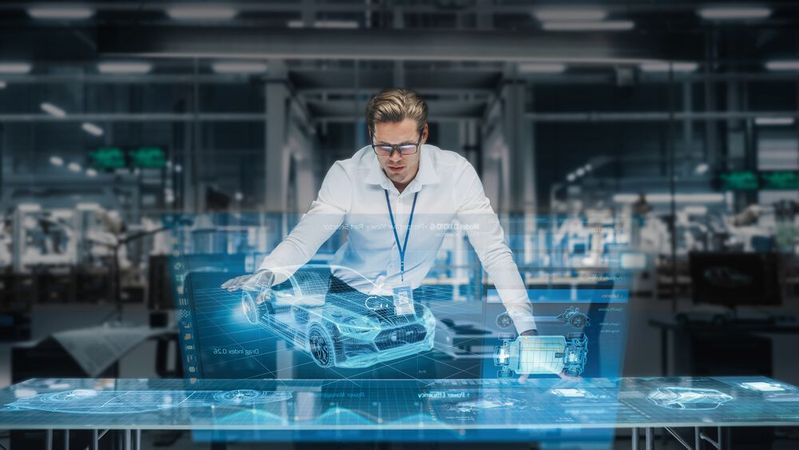
Digital technologies can capture and process the vast amounts of data generated in modern manufacturing, providing insights to improve production processes.
(Image: Gorodenkoff Productions OU via Getty Images)
It is well known that lithium-ion batteries require expensive raw materials and undergo a particularly complex production process with unfortunately very high scrap rates. If manufacturers are to expand their activities and help electric vehicles take their place at the center of the transport sector, they need every possible advantage. They must use all available resources at their disposal.
An approach that can help achieve this advantage is digitalization—the implementation of digital technologies to capture and process the vast amounts of data generated in modern manufacturing. This data serves to gain insights that bring tangible benefits to the production process.
Meeting the increasing demand
It can only be estimated how dramatically the lithium-ion battery sector will grow in the next ten years. The increasing demand from the electric vehicle sector has already helped the global market grow from around 40 billion US dollars in 2018 to more than 60 billion US dollars in 2022. And this is far from the end of the tunnel, as the growth trend is expected to accelerate further. Forecasts suggest that the market will be worth more than a quarter of a trillion dollars by the end of the decade.
However, the sheer scale of this expansion brings with it some demands. Not only will the competition increase incredibly, but the raw materials used for manufacturing lithium-ion batteries will become scarcer and more expensive with rising demand. Lithium, cobalt, and nickel must be mined and processed before they can be used for production. The IEA predicts that the total demand for minerals needed for electric vehicle production will increase 30-fold between 2020 and 2040.
Very high rejection rates
To meet the increasing demand for electric vehicles, production must be made as efficient as possible. A bottleneck in production is the implementation of effective quality control and the reduction of high scrap rates. Despite working with valuable materials, the scrap rates are extremely high. About 10% of finished products do not meet minimum requirements and end up as waste. In many cases, this rate can rise to an incredible 30%. This high rate is not only incredibly costly and one reason why the battery typically accounts for up to 60% of the total cost of an electric vehicle, but it is also unacceptable for sustainability reasons.
However, to be fair, these rates are not due to negligence or irresponsible behavior by manufacturers. Rather, it is because the manufacturing process itself makes it extremely difficult to carry out conventional quality control measures.
Why the production of lithium-ion batteries is so complex
The production of lithium-ion batteries begins with the manufacturing of strips (or foils) of metal—copper for the anode and aluminum for the cathode. The size of these strips can vary greatly depending on the design and specifications of the batteries being produced, but they are typically several hundred meters long—often over a kilometer at larger production sites—and between a few centimeters and over a meter wide.
To convert them into batteries, the foils are coated with a thin layer of active material slurries. For the cathode, materials such as lithium cobalt oxide, lithium iron phosphate, or other lithium metal oxides are typically used, while the anode is coated with graphite or silicon-based materials.
Neither too thick nor too thin coating
Regardless of the materials used, the thickness of these coatings has a significant impact on the energy capacity and ion transport efficiency of the finished battery. Thicker coatings can store more active material, potentially increasing the overall energy storage capacity of the battery. However, this advantage comes with a downside. Coatings that are too thick can impede the movement of lithium ions between the electrodes, reducing the battery's charge and discharge speed.
This balance between thickness for increased energy storage and the need for efficient ion transport is crucial. It directly affects the battery's performance, especially in EV applications that require rapid energy delivery. If a coating is too thick or too thin, large sections of a strip may be unsuitable for use in a finished product.
Challenging: produce a consistently thin foil
Although the ideal thickness varies depending on the manufacturer's exact requirements, cathode coatings typically range from 100 to 200 μm, while anode coatings are usually somewhat thinner, generally around 70 to 120 μm. This is roughly the thickness of a human hair.
It is not surprising that maintaining a consistently thin foil over an area of up to hundreds of square meters is an incredible challenge. Dozens of factors can affect the thickness of the final product, from the temperature of the foil to the humidity in the facility.
Date: 08.12.2025
Naturally, we always handle your personal data responsibly. Any personal data we receive from you is processed in accordance with applicable data protection legislation. For detailed information please see our privacy policy.
Consent to the use of data for promotional purposes
I hereby consent to Vogel Communications Group GmbH & Co. KG, Max-Planck-Str. 7-9, 97082 Würzburg including any affiliated companies according to §§ 15 et seq. AktG (hereafter: Vogel Communications Group) using my e-mail address to send editorial newsletters. A list of all affiliated companies can be found here
Newsletter content may include all products and services of any companies mentioned above, including for example specialist journals and books, events and fairs as well as event-related products and services, print and digital media offers and services such as additional (editorial) newsletters, raffles, lead campaigns, market research both online and offline, specialist webportals and e-learning offers. In case my personal telephone number has also been collected, it may be used for offers of aforementioned products, for services of the companies mentioned above, and market research purposes.
Additionally, my consent also includes the processing of my email address and telephone number for data matching for marketing purposes with select advertising partners such as LinkedIn, Google, and Meta. For this, Vogel Communications Group may transmit said data in hashed form to the advertising partners who then use said data to determine whether I am also a member of the mentioned advertising partner portals. Vogel Communications Group uses this feature for the purposes of re-targeting (up-selling, cross-selling, and customer loyalty), generating so-called look-alike audiences for acquisition of new customers, and as basis for exclusion for on-going advertising campaigns. Further information can be found in section “data matching for marketing purposes”.
In case I access protected data on Internet portals of Vogel Communications Group including any affiliated companies according to §§ 15 et seq. AktG, I need to provide further data in order to register for the access to such content. In return for this free access to editorial content, my data may be used in accordance with this consent for the purposes stated here. This does not apply to data matching for marketing purposes.
Right of revocation
I understand that I can revoke my consent at will. My revocation does not change the lawfulness of data processing that was conducted based on my consent leading up to my revocation. One option to declare my revocation is to use the contact form found at https://contact.vogel.de. In case I no longer wish to receive certain newsletters, I have subscribed to, I can also click on the unsubscribe link included at the end of a newsletter. Further information regarding my right of revocation and the implementation of it as well as the consequences of my revocation can be found in the data protection declaration, section editorial newsletter.
Capturing this complex, ever-changing data is nearly impossible for conventional manufacturing facilities. Yet, it is precisely here that the right implementation of digital manufacturing technologies can help companies excel.
From raw data to results
Modern production lines are equipped with a multitude of sensors that generate vast amounts of data. When this data is effectively analyzed, it can lead to significant improvements in the manufacturing process.
A common application is predictive maintenance. By analyzing data trends, it is possible to predict, for example, when a machine needs targeted maintenance because the drive is drawing slightly more power than usual or the amplitude of vibrations is increasing. This allows operators to address the issue long before actual problems arise, preventing unexpected downtime and increasing efficiency.
Companies can use the same principle to improve the state of lithium-ion battery manufacturing. Not only by implementing predictive maintenance but also by identifying which factors correlate with cell quality. This way, it can be determined which parameters can be controlled to achieve high-quality cells. This increases the value of functional batteries and reduces the amount of material that needs to be scrapped.
Mitsubishi Electric has already applied this knowledge to real production lines for lithium-ion batteries—with impressive results. The team focused on the issue of uneven layer thickness, collecting data from 127 different parameters to determine which might be correlated.



:quality(80)/p7i.vogel.de/wcms/9f/7b/9f7be35880605811e045acd3af8b571b/0129558586v1.jpeg "An example of the V210 processing machine, which, according to Voortman, supplements the laser cutting of the V353 with drilling, thread cutting and milling. (Image:Voortman)")
:quality(80)/p7i.vogel.de/wcms/b0/41/b041264d931df4347bc760fff1c7cb7b/0129439236v1.jpeg "The circular milling system proves to be a problem solver in the numerous standard variants, as well as in special shapes for some other milling processes. (Image:Horn/Sauermann)")
:quality(80)/p7i.vogel.de/wcms/33/ab/33abf15b4b5625a8904cb57c51597709/0129982307v1.jpeg "This is a new development from Fraunhofer IFAM and partners: an automated adhesive splitting system for the reliable and more productive bonding of composite parts. Here, a frame for an airplane window is measured in real time and a precise amount of adhesive is applied. (Image:Fraunhofer IFAM)")
:quality(80)/p7i.vogel.de/wcms/df/26/df26e72a2f7c890171a1059b48eef68e/0129962397v1.jpeg "The Swedish cutting tool manufacturer Sandvik Coromant now has two additional geometries for its Corodrill DE10 replaceable head drilling system, which it says will further expand the already wide range of applications - for example for cast materials ... (Image:Sandvik Coromant)")
:quality(80)/p7i.vogel.de/wcms/92/5e/925ee98ea36ad9bd574fa1cea11d0e53/0129964352v1.jpeg "The production of hardware components for humanoid robots offers great market potential. (Image:Fraunhofer IPA)")
:quality(80)/p7i.vogel.de/wcms/08/72/0872dd2dd119a54824c41e0e580e45a8/0129576591v1.jpeg "The Rose enclosure systems can be customized on request. (Image:Rose Systemtechnik GmbH)")
:quality(80)/p7i.vogel.de/wcms/73/17/7317794432521bf911711b91287cfc28/0129961259v1.jpeg "ABB Robotics and Nvidia are enabling the widespread use of physical AI in the world of robotics. This means that systems can be created virtually and with high precision and optimized much more cost-effectively. In the large image the virtual system, next to it the real robot cell ... (Image:ABB)")
:quality(80)/p7i.vogel.de/wcms/09/a2/09a2e832b1c0271d299fc130201e5717/adobestock-1767409934-4191x2360v1.jpeg "(Source: © ImageFlow - stock.adobe.com)")
:quality(80)/p7i.vogel.de/wcms/68/89/688937087188b77da95b2079399ca862/0130009534v1.jpeg "Here you can see the Dualis layout configurator in use at Montratec. (Picture: ©Gorodenkoff - stock.adobe.com)")
:quality(80)/p7i.vogel.de/wcms/9e/98/9e984afbf9c6f2bcc8963bd13465b180/26-02-pi-fraunhofer-iws-41300-ultragrain-project-closing-pic-02-1562x878v1v1.png "The process of laser wire build-up welding (DED-LB) with pulse laser-induced plasma, which contributed to the success of the Ultra Grain project, is shown at high speed. (Image:Fraunhofer IWS)")
:quality(80)/p7i.vogel.de/wcms/28/00/28008d9477bb07daa3b28ce4ac0ae907/newsimage418436-1536x864v1v1.jpeg "Researchers have produced elastic ear cartilage from human cells in the laboratory, which remains dimensionally stable in animal models. (Image:ETH Zurich)")
:quality(80)/p7i.vogel.de/wcms/1e/7d/1e7d6a316cdd7a7ba5e84d7c9a3efb80/newsimage418837-3000x1687v1v1.jpeg "Driverless shuttles can strengthen public transport, especially in rural areas. (Image:ZF Friedrichshafen)")
:quality(80)/p7i.vogel.de/wcms/c5/d2/c5d2655e427c7cbfe2f537dccfbd06e3/0129971639v1.jpeg "Volkswagen Group Charging, Elli, has connected its first electricity storage system to the grid. (Image:Elli)")
:quality(80)/p7i.vogel.de/wcms/b4/fc/b4fc9420fca6915b291eca0ae2532688/0129978040v1.jpeg "MAN has completed winter tests with nine buses. (Image:Bulent Camci)")
:quality(80)/p7i.vogel.de/wcms/a7/22/a722a06c823b5d7405eb9fb15a0b4e7d/0129931201v1.jpeg "The company offers access to its charging network, which now has more than 1,000,000 charging points across Europe, via the Elli app. (Image:Elli | Volkswagen)")
:quality(80)/p7i.vogel.de/wcms/89/5d/895dfb4fb9a90c33ddd287c7d09c9ffd/0129938355v1.jpeg "Ganfeng Lithium has developed semi-solid batteries for eVTOLs together with Geely subsidiary Aerofugia. (Image:Aerofugia)")
:quality(80)/p7i.vogel.de/wcms/c2/a8/c2a8a93f306c1475489dff074ad59731/0129967672v1.jpeg "Figure 1: Imec's logic technology roadmap showing the extension of the nanosheet era from 2nm to the A10 node with the outer-wall forksheet, before the transition to CFET for A7 and beyond. (Image:imec)")
:quality(80)/p7i.vogel.de/wcms/07/79/0779a3ba2b38d583fc9b515900be2add/0129957428v1.jpeg "If the Chinese government has its way, domestic data centers full of Nvidia hardware will be a thing of the past. (Image:Nvidia)")
:quality(80)/p7i.vogel.de/wcms/aa/4c/aa4cd2c6c10199015d47caf72eca2115/0129962687v1.jpeg "Bosch Rexroth and AMD are working together on Software-Defined Automation: ctrlX OS now also supports AMD Embedded x86 CPUs and adaptive SoCs, promising even greater hardware design flexibility, seamless scalability and a secure, modular operating system foundation. (Image:Bosch Rexroth AG)")
:quality(80)/p7i.vogel.de/wcms/7b/10/7b108d8ec7bf09cb1a20998364483525/0129923685v1.jpeg "The concept of the blade battery. (Image:BYD Europe B.V.)")
:fill(fff,0)/p7i.vogel.de/companies/69/88/69882c428938e/tmts2026-ticec-banner-en-2000px.png "tmts2026-ticec-banner-en-2000px (https://www.tmts.tw/en)")
:fill(fff,0)/p7i.vogel.de/companies/67/eb/67eba621ef6ea/logo2.png "logo2 (Wuxi InfiMotion)")
:quality(80)/p7i.vogel.de/wcms/00/90/00907b4860e11d3060011778c1244187/0125027192v1.jpeg "The calendars from Dürr Ingecal are used for film compaction in both wet and dry coating. (Image:Dürr Systems AG)")
:quality(80)/p7i.vogel.de/wcms/95/9a/959aa9590fd5a3954ab0ab2a6edfbec9/0128962648v1.jpeg "Electrochemical analysis: With the help of slurry analysis, efficiency in the development of lithium-ion batteries can be increased. Using suitable hardware, developers can determine the ideal ratio between active material and conductive additives. (Image:Hioki)")