Automated driving and thus sensor technology has come to a standstill. Opsys Tech aims to improve the performance and economic feasibility of sensor technology with its solid-state lidar sensors, thereby giving renewed momentum to automated environment recognition.
Opsys Tech intends to enhance sensor technology's performance and cost-effectiveness with its compact solid-state lidar sensors, thereby giving automated environment recognition a renewed push.
(Image: Opsys)
*Hartmut Hammer has been writing about automotive technology and mobility as a journalist for B2B magazines for more than two decades.
The Lidar technology is currently sailing in rough waters. Traditional Lidar sensors with rotating mirrors still cost a high three-digit euro amount. Automated driving from Level 3 onwards is dependent on Lidar sensors, but after the hype has entered the phase of disillusionment. Therefore, the number of units sold is lagging behind the forecasts and the field of Lidar sensor suppliers—see Bosch's withdrawal, as well as ZF at Ibeo is consolidating. In addition, there is the 4D imaging radar technology as a more cost-effective and technically potentially dangerous competitor in object detection.
A way out of the difficult market environment could be solid-state lidar technology. Because they are fully integrated in electronic modules, these sensors do not require moving parts. This makes them less complex, smaller, more cost-effective and more robust than previous lidar sensors. The noise production and heat emissions are also said to be significantly lower.
Clear vision in focus
However: "Currently there are no really functioning solid-state lidar sensors on the market, because they are simply not mature enough," claimed Geoffrey Bouquot, former Chief Technology Officer and Executive Vice President Strategy of the Valeo Group, at the IAA 2023 in a conversation with the sister magazine 'Automotive Industry' (German language).
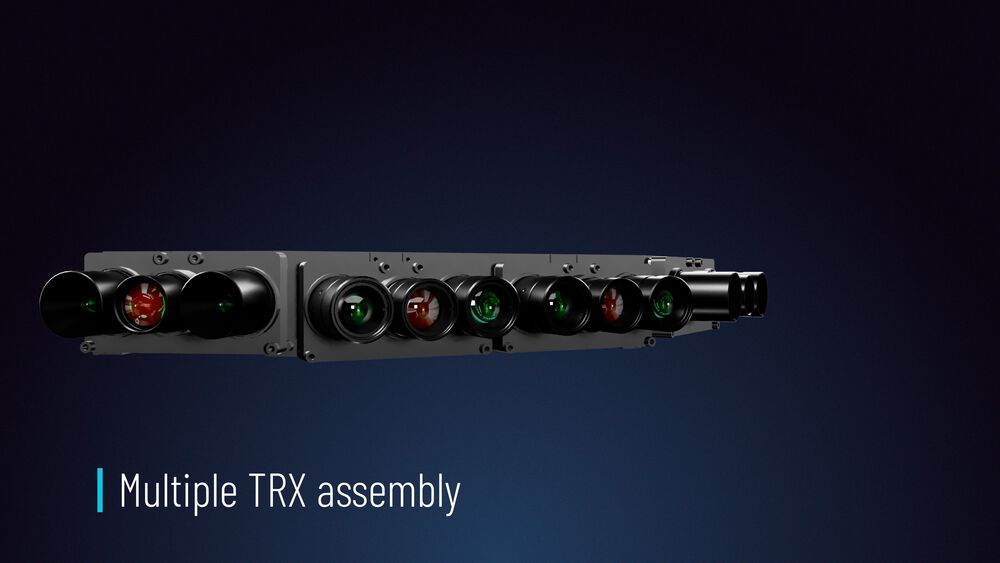
Among others, the Israeli start-up Opsys Tech wants to change this situation. The company has teamed up with several partners to accelerate the industrialization of solid-state technology. Since 2023, they have been working with the Wideye product line of Japanese glass specialist AGC on integrating the Lidar sensors in a module behind the windshield and aim to achieve series production readiness by 2024. They see the position in the area of the interior mirror as ideal for capturing the vehicle's forward field and expect synergy effects from integrating multiple sensor technologies into a compact cluster. For example, they have already combined two separate Lidar modules - specifically high and low resolution sensors for long and short range detection - with multiple cameras, a rain sensor, and an RFID antenna in a space-saving manner.
A lidar stack in the windshield can contain multiple solid-state lidar sensors.
(Image:Opsys)
A major challenge, according to Opsys and Wideye, is the deflection of the laser beams when passing through the windshield. Opsys relies on a precise beam pattern to compensate for potential distortions caused by glass. In addition, the solid-state lidar sensor can compensate for minor irregularities through calibration. According to the Israeli company, this makes this technology the first sensor system that can counteract aging processes. Together with the robustness due to the absence of moving components, this should significantly increase the sensor's service life. Among other things, thanks to the compensation measures, the Lidar sensor remains sufficiently precise according to Opsys, even at a windshield angle of 70 degrees, to detect small debris on the road according to the required specifications. According to the manufacturer, Wideye's glass, which is transparent for near-infrared, is another prerequisite for the seamless installation of optical sensors such as lidar and cameras in the windshield area.
Opsys and Wideye are optimizing the integration of Lidar sensors in the windshield.
(Image:Opsys)
Pool resources
Furthermore, the Chinese supplier Hasco and Opsys entered into a partnership in 2023 with the aim of advancing the development and production of solid-state lidar sensors for Hasco's ADAS systems. Another goal was to start serial production of the lidar sensors mainly for ADAS solutions in the Chinese market in 2024. Hasco has been developing suitable software for object detection and perception of the sensor data from the Opsys lidar sensor since 2021.
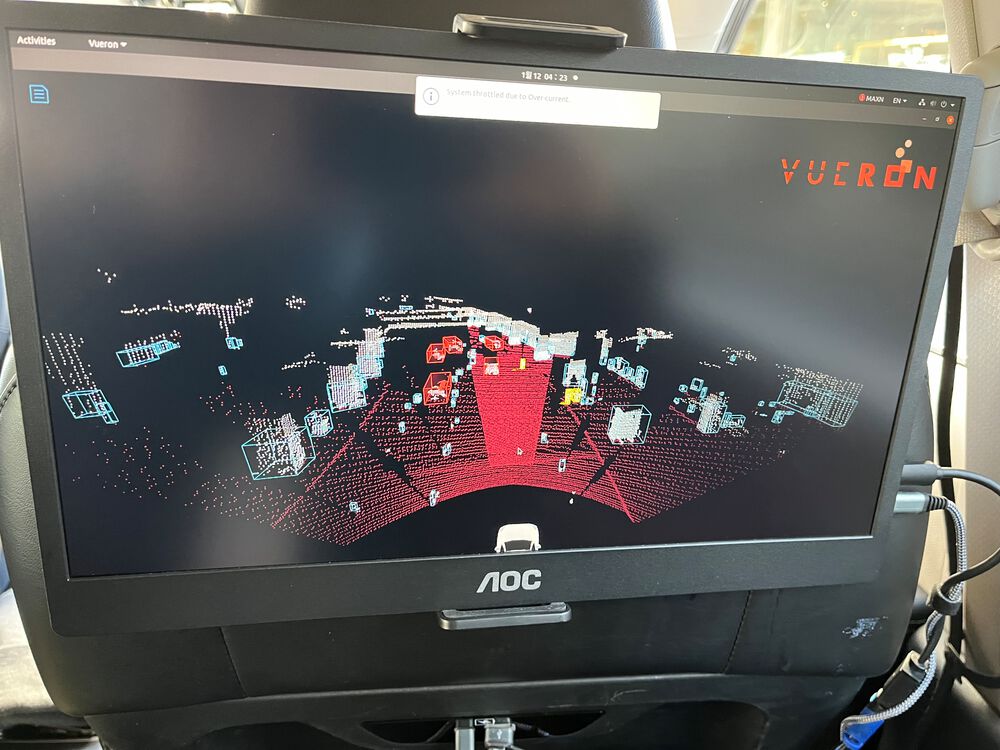
Opsys also entered into another partnership in 2024 with Vueron, a South Korean provider of AI-based perception software. Together, they are developing a software stack that is also specifically optimized for the Opsys solid-state lidar sensor. The "Vue-One" software is supposed to determine relevant motion patterns and object information from the sensor information and then process it for ADAS functions.
Opsys and Vueron are developing a perception software for the data from solid-state lidar sensors.
(Picture:Thomas Aurich)
Adapted to the environment
The Opsys lidar sensor resembles a camera and operates in principle like a 3D camera. The system consists of a central light detector with two emitters on either side and "sees" up to 300 m away. Equipped with Vertical Cavity Surface-Emitting Lasers (VCSEL) and Single-Photon-Avalanche-Diode chips (SPAD), the sensor can scan a field of view of 110 degrees horizontally and 13 degrees vertically without moving parts. The detection range is 200 m for a target with a ten percent reflectivity and a detection probability of over 90 percent. Each transmitter scans the entire field of view at 1000 frames per second, with the system computing an average of 30 frames per second from the data. Thanks to the high number of sampling processes per point, possible interference errors can be avoided by forming averages, thus improving the detection probability.
Date: 08.12.2025
Naturally, we always handle your personal data responsibly. Any personal data we receive from you is processed in accordance with applicable data protection legislation. For detailed information please see our privacy policy.
Consent to the use of data for promotional purposes
I hereby consent to Vogel Communications Group GmbH & Co. KG, Max-Planck-Str. 7-9, 97082 Würzburg including any affiliated companies according to §§ 15 et seq. AktG (hereafter: Vogel Communications Group) using my e-mail address to send editorial newsletters. A list of all affiliated companies can be found here
Newsletter content may include all products and services of any companies mentioned above, including for example specialist journals and books, events and fairs as well as event-related products and services, print and digital media offers and services such as additional (editorial) newsletters, raffles, lead campaigns, market research both online and offline, specialist webportals and e-learning offers. In case my personal telephone number has also been collected, it may be used for offers of aforementioned products, for services of the companies mentioned above, and market research purposes.
Additionally, my consent also includes the processing of my email address and telephone number for data matching for marketing purposes with select advertising partners such as LinkedIn, Google, and Meta. For this, Vogel Communications Group may transmit said data in hashed form to the advertising partners who then use said data to determine whether I am also a member of the mentioned advertising partner portals. Vogel Communications Group uses this feature for the purposes of re-targeting (up-selling, cross-selling, and customer loyalty), generating so-called look-alike audiences for acquisition of new customers, and as basis for exclusion for on-going advertising campaigns. Further information can be found in section “data matching for marketing purposes”.
In case I access protected data on Internet portals of Vogel Communications Group including any affiliated companies according to §§ 15 et seq. AktG, I need to provide further data in order to register for the access to such content. In return for this free access to editorial content, my data may be used in accordance with this consent for the purposes stated here. This does not apply to data matching for marketing purposes.
Right of revocation
I understand that I can revoke my consent at will. My revocation does not change the lawfulness of data processing that was conducted based on my consent leading up to my revocation. One option to declare my revocation is to use the contact form found at https://contact.vogel.de. In case I no longer wish to receive certain newsletters, I have subscribed to, I can also click on the unsubscribe link included at the end of a newsletter. Further information regarding my right of revocation and the implementation of it as well as the consequences of my revocation can be found in the data protection declaration, section editorial newsletter.
Opsys deliberately chose wavelengths in the 900 nm range for the lidar sensors. Although a wavelength of up to 1550 nm is allowed to achieve the highest possible optical performance and thus range of the sensors. However, a disadvantage is that there is considerable absorption of the lidar sensor's optical power in the 1550 nm spectrum during rain, fog or snow. "In extreme cases, the damping is in the range of 15 to 20 db, that is, with a damping of 20 db, the transmitted power is damped by 99 percent," says Eitan Gertel, Executive Chairman of Opsys Technologies. "Our system with a wavelength of 900 nm has only negligible water absorption and is minimally affected by weather conditions."
Fits in well
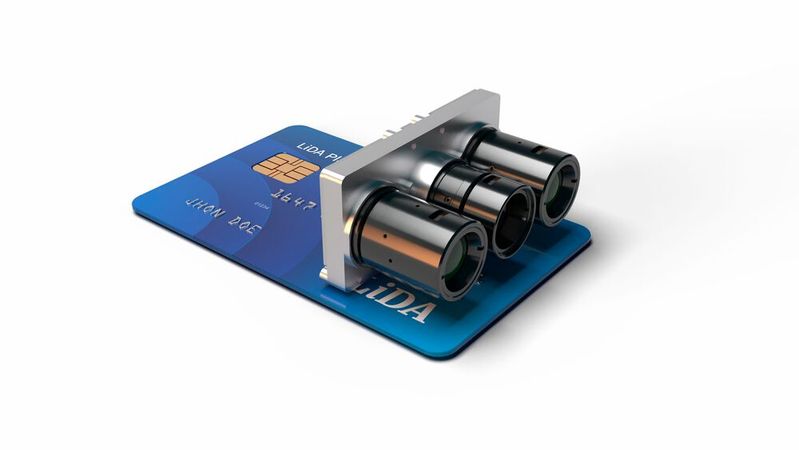
The complete technical concept and laser beams with slightly different wavelengths allow, according to Eitan Gertel, the trouble-free combination of several sensors into a lidar system. Because the individual sensors are very small—two sensors fit on the base of a credit card—their integration into the headlights or in the roof module behind the windscreen is possible. Eitan Gertel: "Our solid-state technology is therefore suitable for different vehicle types in different application areas."
Further pluses: The Opsys lidar sensor has a low power consumption and operates over the entire temperature range without external heating or cooling. Since the solid-state scanning sensor does not have to interpret the raw data like other sensors before evaluating them, the system provides original data that is also valid for other tasks.
By dispensing with moving parts, the lidar sensor from Opsys can be manufactured in fully automated processes. Even the final alignment is done in an automated process based on software and does not require movement of the physical components. Therefore, according to Eitan Gertel, about 90 % of the manufacturing costs are for material and only about ten percent for personnel. (se)
This article was first published on our sister brand 'Next Mobility' (German language), Vogel Communications Group



:quality(80)/p7i.vogel.de/wcms/dd/08/dd086510d9ae7b50181f6070e4463b44/0129363730v1.jpeg "Typical application for ionizing devices: Wrapping films. (Picture: ©Adobe Stock/SMC)")
:quality(80)/p7i.vogel.de/wcms/35/57/3557c819943c53acec41a0ccba87da4f/0130049064v1.jpeg "Researchers at the Fraunhofer IWU in Chemnitz have long known that many typical sheet metal parts can be manufactured more cost-effectively using hollow embossing rollers. Now there is news to report ... (Image:Fraunhofer IWU)")
:quality(80)/p7i.vogel.de/wcms/59/02/590246e3b3f415c65edbee377c14ca77/26-06-pi-fraunhofer-iws-41450-direktplattieren-pic-01-7771x4369v1v1.jpeg "The Fraunhofer IWS has developed the new \"direct laser cladding\" process, which creates a functional layer directly on the base body by applying a strip-shaped metal to rotationally symmetrical components in a spiral and bonding it locally by laser. (Image:Christoph Wilsnack/Fraunhofer IWS)")
:quality(80)/p7i.vogel.de/wcms/73/60/73608418789b1d9c393f5e2fa974eda2/0130209906v1.jpeg "The robots of the X6 generation from b+m enable very high painting quality and are also particularly compact and easy to maintain. (Image:Beckhoff)")
:quality(80)/p7i.vogel.de/wcms/78/e9/78e9188c25a8a94e67c34c9bf8ffe495/visual-agile-20robots-20and-20google-20deepmind-20partner-20to-20bring-20intelligence-20to-20robotics-2500x1406v1v1.jpeg "Together, the partners are developing adaptable, intelligent robots for a wide range of applications (Image:Agile Robots SE)")
:quality(80)/p7i.vogel.de/wcms/e7/66/e7669ecf0260ae8fc54c214e34e4902a/0130316817v1.jpeg "Siemens and Palo Alto Networks offer tested cybersecurity solution for industrial 5G. (Image:Siemens)")
:quality(80)/p7i.vogel.de/wcms/9f/55/9f55324832c4f426958031375124d9de/siemens-20ubtech-20hmnd-1920x1079v1v1.png "Ready for the factory floor: While Ubtech is planning mass production, Siemens is already testing humanoids in real factory applications in Erlangen. (Image:Siemens)")
:quality(80)/p7i.vogel.de/wcms/11/36/113695ed260e29c8c2d9d39dc5f9d869/0130213768v1.jpeg "AI can work cheaply in China and deliver the results rapidly all over the world. (Image:Dall-E / AI-generated)")
:quality(80)/p7i.vogel.de/wcms/62/5f/625f41e87ebfef156a98c8e6393e32fd/0130211654v1.jpeg "Axial flux motors have some advantages over radial flux motor—but their production is currently still expensive. (Image:RWTH Aachen University)")
:quality(80)/p7i.vogel.de/wcms/77/9b/779b0685d010dfe45c9c2cb1cfecd467/0128886425v1.jpeg "The BlueEye is the first \"real\" hyperspectral camera for the UV range and covers the wavelength range from 220 to 380nm. (Image:Inno-spec GmbH)")
:quality(80)/p7i.vogel.de/wcms/e4/51/e451d52ce0182fb0aaa46a5774f832ef/26-04-pi-fraunhofer-iws-21160-bioslide-pic-01-4128x2321v1v1.jpeg "With the BioSlide research project, the Fraunhofer IWS is investigating how sliding systems can be designed to be more sustainable and energy-efficient. New materials can be tested in a particularly application-oriented manner on this plain bearing test stand. (Image:Fraunhofer IWS)")
![Thanks to advanced 3D printing technology, a more efficient use of resources should contribute to lower-emission aviation—this is the goal of ['skai]-lab. (Image:Oleksandr Pashchenko - stock.adobe.com / AI-generated)](https://cdn1.vogel.de/nghHNSbySccfOjG3n1qCA-FVOjQ=/288x162/smart/filters:format(jpg):quality(80)/p7i.vogel.de/wcms/62/64/626424c97a16e69f871bf216c9629c2a/adobestock-1927043193--c2-a9-20oleksandr-20pashchenko-20-e2-80-93-20stock-adobe-com-ki-generiertv1v1.jpeg "Thanks to advanced 3D printing technology, a more efficient use of resources should contribute to lower-emission aviation—this is the goal of ['skai]-lab. (Image:Oleksandr Pashchenko - stock.adobe.com / AI-generated)")
:quality(80)/p7i.vogel.de/wcms/c3/c4/c3c4ce270b083eeac55654148611f064/0130237945v1.jpeg "China is not giving up on hydrogen, but is intensifying its efforts. (Image:freely licensed from Pixabay)")
:quality(80)/p7i.vogel.de/wcms/4e/c0/4ec0bd19390b169edfa23677373dcdf1/0130260089v1.jpeg "Renewable fuels can supply European road traffic, according to a study. (Image:Aral)")
:quality(80)/p7i.vogel.de/wcms/6f/c9/6fc9050301d745cad25585c6780f8f51/0130197341v1.jpeg "Production facilities are a worthwhile target and are therefore at risk. (Image:ABB Robotics)")
:quality(80)/p7i.vogel.de/wcms/b6/62/b662adc2cec8227d8172509bbfb6ee42/25c0207-107-4961x2789v1v1.jpeg "The GLB is the second model based on Mercedes' new MMA platform. Apparently, Geely's platform is better and cheaper, which is why the two companies are negotiating a partnership. (Image:Mercedes-Benz)")
:quality(80)/p7i.vogel.de/wcms/4d/dd/4dddf438e91f394c04a095dbfd109d1c/0130236430v1.jpeg "Measurement modules: The 720301 module in combination with the SL2000 enables RMS and power calculations, among other things. (Image:Yokogawa)")
:quality(80)/p7i.vogel.de/wcms/61/fc/61fcf95f5cca15494ad18343901ae585/0130317237v1.jpeg "With the AGI CPU, Arm says it is taking a \"historic step\": With the processor aimed at AI in data centers, the company is presenting itself for the first time as a provider of its own chips, not just as a pure IP licensor. (Image:Arm)")
:quality(80)/p7i.vogel.de/wcms/82/90/8290dfe3595b6c6b33726ae8b76172c7/0130319587v1.jpeg "The concept image illustrates how the pattern of tiny protrusions and depressions created on the substrate (MgO, bottom) controls the arrangement of atoms in the superconducting material (YBCO, top). At the interface between the two layers, an electronic structure enables superconductivity to occur at higher temperatures than previously possible. (Image:Chalmers University of Technology / Riccardo Arpaia)")
:fill(fff,0)/images.vogel.de/vogelonline/companyimg/76800/76895/65.jpg "FAULHABER_120mm.jpg ()")
:fill(fff,0)/p7i.vogel.de/companies/67/eb/67eba621ef6ea/logo2.png "logo2 (Wuxi InfiMotion)")

:quality(80)/p7i.vogel.de/wcms/2a/07/2a073e8a9e28e1e3c335fe5d1aa9afc2/0118087598.jpeg "Marelli showcases its electronics expertise at Auto China in Beijing. This includes a headlight with a Lidar sensor. (Image:Marelli)")
:quality(80)/p7i.vogel.de/wcms/15/a4/15a42a6ac313c4fc0942c5aa225bddae/0117331435.jpeg "Steer Light is working on the so-called lidar-on-a-chip technology. (Image:Stellantis)")
:quality(80)/p7i.vogel.de/wcms/d8/30/d8302c08c290d4f9ea6f68e99eaf6c74/0126237240v1.jpeg "Glass in and on vehicles: From solar roofs to windshields to special glass for radar and lidar. (Image:AGC)")
:quality(80)/p7i.vogel.de/wcms/20/44/2044f216e994ea7dedf81c17e1a35b8f/0129067812v1.jpeg "The Ophir SP301Q CQD uses koolidal quantum dots. Thanks to its customized optical properties, the beam profile measuring device is an alternative to InGaAs sensors. (Image:MKS)")