The lidar industry has experienced hype and crashes. Microvision boss Glen de Vos opts for the classic approach: standardized architecture and simplified specifications instead of all-in-one sensors.
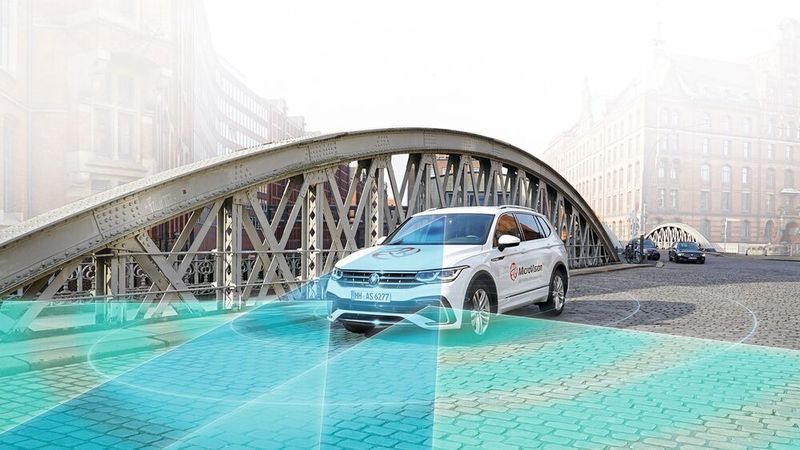
Lidar sensors in a satellite arrangement: in the corners for the close range and in the top center for the distance.
(Image: Microvision)
Less than ten years ago, the lidar industry was really heating up. At the time, management consultancy Yole Développement estimated that private investment in lidar companies would increase from eight million US dollars in 2015 to 400 million US dollars in both 2016 and 2017.
There was a lot of media attention because several things came together. A new technology was about to go into series production and many investors did not want to miss the opportunity of a newly emerging market. Added to this was the euphoria surrounding self-driving cars. The biggest problem at the time was the unit cost of the lidar sensors.
Suppliers Withdrew
The major German suppliers were also investing in start-ups at the time. ZF acquired a stake in Ibeo in 2016 and intensified the business relationship three years later. Rumor has it that ZF owned up to 40 percent of the shares in the Hamburg-based company. Together, they had achieved remarkable things: Ibeo developed the laser technology for the lidar sensor, which Valeo first brought into series production for the Audi A8 in 2017.
"The lidar industry relied too heavily on economies of scale to reduce costs," Glen de Vos recalls in an interview at the IAA Mobility. The industry veteran with over 30 years of automotive experience - mainly at Delphi/Aptiv - has been working for Microvision since April 2025, first as CTO and now as CEO. The car industry doesn't work like this, he continues his point. "The focus has to be on costs right from the start, otherwise the numbers won't increase." It used to be the same with radar and cameras.
Gallery
In his opinion, another reason why lidar sensors are still expensive is the wrong response from sensor manufacturers to the lack of unit sales: "More content was packed into the lidar sensor and the suppliers welcomed this."
Today, lidar is "a premium option for a premium vehicle from a premium OEM". This makes it a niche technology with very low unit numbers.
Implementation Similar to That of Cameras and Radar
De Vos is certain that the path to success for lidar sensors is similar to that of radar and camera devices. He believes it is wrong to equip one sensor for all tasks. This would make the devices large, energy-hungry and expensive. "With radar, you now have three to five sensors in every car. Lidar has to go the same way."
Microvision has therefore split its product line for the automotive sector. For the close range (product name "Movia S"), the focus is on a range of 30 to 50 meters (~98 to 164 Feet) and a field of view of 90° x 67°. Flash technology from Ibeo is used here. De Vos calls it "pure solid state": no moving parts, no mirrors, no rotating elements.
No Market for All-Round Lidar Sensors
The lidar sensor for the long range is called "Mavin". De Vos speaks of a range of over 220 meters (~722 Feet) and a narrower field of vision compared to the all-in-one approach. This makes the device smaller and more efficient. The MEMS technology developed by Microvision is used here.
The Microvision lidars are therefore a good 130 cubic centimetres (~8 Cubic Inches) in size, which is roughly equivalent to a cube with an edge length of 5.1 cm (~2 inches). De Vos puts the energy consumption at ten watts. The costs are 40 to 50 percent lower with the same performance.
De Vos quotes around 200 US dollars per unit for Movia. The product should be ready for series production in 2028. Unit prices of around 100 dollars are the target for the next generation. In terms of orders, the company is currently in a critical window: a number of series orders for cars will be placed in the coming months.
Date: 08.12.2025
Naturally, we always handle your personal data responsibly. Any personal data we receive from you is processed in accordance with applicable data protection legislation. For detailed information please see our privacy policy.
Consent to the use of data for promotional purposes
I hereby consent to Vogel Communications Group GmbH & Co. KG, Max-Planck-Str. 7-9, 97082 Würzburg including any affiliated companies according to §§ 15 et seq. AktG (hereafter: Vogel Communications Group) using my e-mail address to send editorial newsletters. A list of all affiliated companies can be found here
Newsletter content may include all products and services of any companies mentioned above, including for example specialist journals and books, events and fairs as well as event-related products and services, print and digital media offers and services such as additional (editorial) newsletters, raffles, lead campaigns, market research both online and offline, specialist webportals and e-learning offers. In case my personal telephone number has also been collected, it may be used for offers of aforementioned products, for services of the companies mentioned above, and market research purposes.
Additionally, my consent also includes the processing of my email address and telephone number for data matching for marketing purposes with select advertising partners such as LinkedIn, Google, and Meta. For this, Vogel Communications Group may transmit said data in hashed form to the advertising partners who then use said data to determine whether I am also a member of the mentioned advertising partner portals. Vogel Communications Group uses this feature for the purposes of re-targeting (up-selling, cross-selling, and customer loyalty), generating so-called look-alike audiences for acquisition of new customers, and as basis for exclusion for on-going advertising campaigns. Further information can be found in section “data matching for marketing purposes”.
In case I access protected data on Internet portals of Vogel Communications Group including any affiliated companies according to §§ 15 et seq. AktG, I need to provide further data in order to register for the access to such content. In return for this free access to editorial content, my data may be used in accordance with this consent for the purposes stated here. This does not apply to data matching for marketing purposes.
Right of revocation
I understand that I can revoke my consent at will. My revocation does not change the lawfulness of data processing that was conducted based on my consent leading up to my revocation. One option to declare my revocation is to use the contact form found at https://contact.vogel.de. In case I no longer wish to receive certain newsletters, I have subscribed to, I can also click on the unsubscribe link included at the end of a newsletter. Further information regarding my right of revocation and the implementation of it as well as the consequences of my revocation can be found in the data protection declaration, section editorial newsletter.
Lidar: It's Still About Costs
Mavin currently costs around 300 US dollars. The long-range lidar is designed in such a way that it is also suitable for use in heavy trucks. However, de Vos sees too much competition here at the moment. Microvision wants to serve the truck sector downstream of the passenger car projects, before improving the costs and performance of the sensor.
In general, the supplier is focusing on a standardized architecture for all applications in the mobility and manufacturing industries. The third market is the defense sector. This approach is intended to exploit the necessary economies of scale. According to de Vos, while vehicle manufacturers expect a point cloud from the sensors and carry out data processing in domain computers, a complete software stack is offered for the other markets.
At the IAA in Munich, de Vos had sensors with him that corresponded to the A sample status. He announced B samples for validation at the end of 2025.



:quality(80)/p7i.vogel.de/wcms/51/1b/511b420dbcc296aec09e3bffb051b8a8/0133581587v1.jpeg "The cables connect numerous machine components—often in confined spaces. (Image:Helu)")
:quality(80)/p7i.vogel.de/wcms/b5/67/b5676f3bfb36251ed31f9a0cccf650b6/0133167827v1.jpeg "Thanks to JumboFlex Generation 2, employees can effortlessly move wheelchairs weighing as much as 40 kilograms. (Image:Lard)")
:quality(80)/p7i.vogel.de/wcms/5e/c6/5ec615b7a51440f668259f2af9158cb9/0132654694v1.jpeg "Strategic Partnerships in Industry: As buyers and restructuring partners, Chinese investors are increasingly helping to preserve jobs in Germany. (Image: ©Anatolii Rymarchuk - stock.adobe.com)")
:quality(80)/p7i.vogel.de/wcms/eb/2b/eb2bd1b8487afe577b37363cd02f16ff/0113143253v1.jpeg "In our China Market Insider, we regularly provide you with relevant information straight from China. (Image:© Eisenhans - stock.adobe.com)")
:quality(80)/p7i.vogel.de/wcms/aa/3e/aa3e2603a812f8e7d33c00ba8ae28c9f/0133507886v1.jpeg "With the Iggy Rob, igus is bringing a humanoid robot into factories for a price of 47,999 euros ($54,718). (Image: igus)")
:quality(80)/p7i.vogel.de/wcms/92/64/92645c64ffbb6980976d39102388d120/0113143253v1.jpeg "In our China Market Insider, we regularly provide you with relevant information straight from China. (Image:© Eisenhans - stock.adobe.com)")
:quality(80)/p7i.vogel.de/wcms/c7/05/c70542511e0824ee491f7b55e21fa429/0133598424v1.jpeg "In logistics, AI is often implemented only on a case-by-case basis; data is stored in separate systems, and inventory levels, status values, and priorities are not defined consistently. (Image: ©m-project - stock.adobe.com)")
:quality(80)/p7i.vogel.de/wcms/3a/9c/3a9c1fd546e1f041b86bb1d03cf39101/0133610524v1.jpeg "The Mason W-01 combines industrial-grade humanoid hardware, Physical AI-based perception, and autonomous task planning. (Image:Nova X Robotics)")
:quality(80)/p7i.vogel.de/wcms/e7/94/e794290f265afbd0ffc7a06c4fe9d425/adobestock-1887113836--hypnotics-14-stock-adobe-com-ki-generiertv1.jpeg "In both autonomous driving and industrial production, there is growing skepticism as to whether full autonomy is always desirable. (Source: © Hypnotics 14 – stock.adobe.com / AI-generated)")
:quality(80)/p7i.vogel.de/wcms/a8/71/a8712e5c6ef536228444ab5275cedfe2/adobestock-340905887--gorodenkoff-stock-adobe-comv1.jpeg "A new position paper outlines the conditions that the business community, academia, and policymakers must jointly establish in order to ensure the long-term viability of industry in Germany and Europe. (Source: © Gorodenkoff – stock.adobe.com)")
:quality(80)/p7i.vogel.de/wcms/7d/eb/7deb25ca674fa4c781a9d1fab083f7cf/parker-entwicklungszentrum-hresv1.jpeg "The centerpiece of the Parker Center for Drive and Control Technology in Offenbach is the exhibition area. (Source: Parker Hannifin)")
:quality(80)/p7i.vogel.de/wcms/3d/ff/3dff5e51c24b30c8dc37c1d024887157/0133602931v1.jpeg "Just a few years ago, SpaceX specialists were working on the world’s largest rocket—the Starship. Now, Elon Musk’s company has reached a milestone during a test flight: Earth’s orbit! But there was also a downside... (Image: SpaceX)")
:quality(80)/p7i.vogel.de/wcms/78/ab/78abbfbab0565fabb19efe637aea30e8/nio-power-swap-station-4-china-guangzhou-2024-1400x933-jpgv1.webp "Nio and Geely are collaborating on battery replacement for electric cars. (Source: Nio)")
:quality(80)/p7i.vogel.de/wcms/2e/58/2e58c664e733dd182666606f850c5da4/0133400664v1.jpeg "The IM6 is sort of the crossover version of the IM5. (Image:MG Motor)")
:quality(80)/p7i.vogel.de/wcms/40/5f/405f41f4075e8798878011f0932a8195/0133509065v1.jpeg "Caruso has integrated Hyundai into its platform. (Image:Hyundai)")
:quality(80)/p7i.vogel.de/wcms/06/98/06989beb3f95b8fb06d71190c86cffde/tabletv1.jpeg "The cockpit view during a test drive in the simulator. (Source: Uccello et al., IEEE OJITS 2026)")
:quality(80)/p7i.vogel.de/wcms/40/34/4034915f85470ad8264659267e4f02d0/0133655653v1.jpeg "Cariad, Volkswagen's software subsidiary, continues to struggle. Now, another round of layoffs has been announced, which will result in the loss of many jobs ... (Image:Cariad)")
:quality(80)/p7i.vogel.de/wcms/e4/2a/e42af12e2a0816bb3d25fac9932903e9/0133646920v1.jpeg "TSMC's U.S. headquarters in Arizona: According to various media reports, the world's largest contract semiconductor manufacturer may be planning to build up to six additional fabs in the state of Texas. (Image:TSMC)")
:quality(80)/p7i.vogel.de/wcms/de/8c/de8c694e560ce8e8d7d43fa5b91917b3/0133668420v1.jpeg "Open-source AI tools: DeepSeek and Huawei are making programming tools for Ascend processors available, with the aim of simplifying development, chip communication, and AI computations on Huawei's hardware—and thereby intensifying competition with Nvidia. (Image:Dall-E / AI-generated)")
:quality(80)/p7i.vogel.de/wcms/86/25/8625a62499a6e70e629a2ddde2f01dcb/0133671173v1.jpeg "\"OpenAI\" has repeatedly experienced problems in which AI models have accessed the internet without authorization in order to carry out their tasks. The company has now fired three people whom it no longer trusts ... (Image:AI-generated)")
:fill(fff,0)/images.vogel.de/vogelonline/companyimg/76800/76895/65.jpg "FAULHABER_120mm.jpg ()")
:fill(fff,0)/p7i.vogel.de/companies/69/de/69de1b7403b0d/simtos-logo.jpeg "simtos-logo (SIMTOS)")
:quality(80)/p7i.vogel.de/wcms/d8/37/d837b8315e3b571973c5528c9bb32cc9/0127863309v1.jpeg "The long-range lidar \"Mavin\" is expected to cost around 300 US dollars.(Image: Microvision)")
:quality(80)/p7i.vogel.de/wcms/73/4b/734b76d5cf5701f6a348a2d9583a4d72/0127863305v1.jpeg "Glen de Vos, CEO of Microvision, at the IAA 2025 with a lidar sensor from the supplier.(Image: Microvision GmbH)")
:quality(80)/p7i.vogel.de/wcms/1f/71/1f71268b89a76b1fd5e1e12a39b9be82/0127863313v1.jpeg "Movia is more compact and a third cheaper. This device should be ready for series production in 2028 and be used for close-range applications. It could become Microvision's volume model.(Image: Microvision)")
:quality(80)/p7i.vogel.de/wcms/8b/55/8b55d2017806b1f7d9211e4ad5afa780/0127863317v1.jpeg "Instead of an \"all-in-one lidar\", Microvision separates the functions and proposes a so-called tri-lidar architecture.(Image: VDA/Messe München)")
:quality(80)/p7i.vogel.de/wcms/9d/bd/9dbdfc63746e479b9953a18c6bbb3b29/0130572603v1.jpeg "Suppliers and start-ups are constantly improving sensor technology. But much of it does not make it into series production (Image:Steve Fecht)")
:quality(80)/p7i.vogel.de/wcms/18/08/1808907403afe9f5d8ca10c89afdc5ed/0127861992v1.jpeg "Robotaxi from Motional, a joint venture between Hyundai and Aptiv: Chinese global market leader Hesai supplies the short-range lidar sensors for the vehicle based on a Hyundai Ioniq 5. (Image:Hesai)")