To network laser triangulation sensors, Micro-Epsilon equips its products with the IO-Link interface. Their advantages are demonstrated, for example, when measuring board contours in a sawmill.
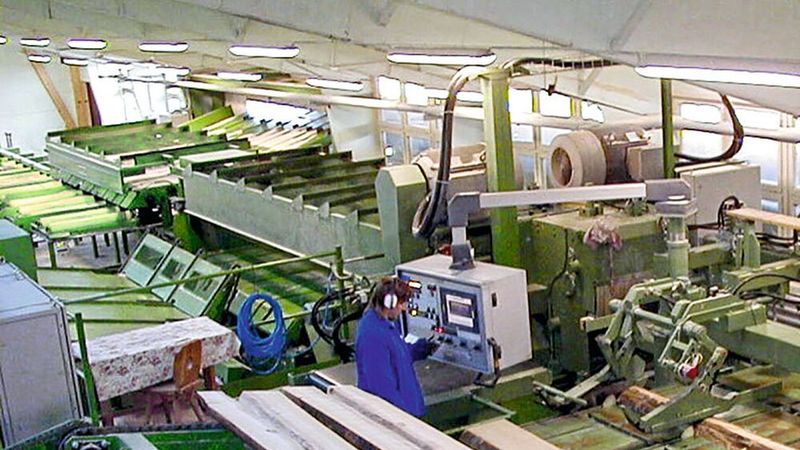
The Opto NCDT 1220 laser triangulation sensor from Micro-Epsilon is used for measuring board contours.
(Image: Micro-Epsilon Messtechnik GmbH & Co. KG)
With the help of laser triangulation sensors, parameters such as displacement, distance, and position can be measured non-contact and wear-free. The most important features of the sensors are high performance, a compact design, and the ability to stabilize the signal on changing surfaces.
The laser triangulation sensors in Micro-Epsilon's portfolio combine a compact design with an integrated controller and operation via a web interface. High-precision measurement is achieved through the smallest light spot on the measurement object. These properties open up numerous application fields for the sensors in factory automation, electronics manufacturing, robotics, or automotive engineering. Currently, Micro-Epsilon's product portfolio includes the Opto NCDT families 1220, 1320, 1420, 1900, 2300, and 5500. These sensors are available based on various technologies such as blue laser, laser line, and long-range laser.
Laser triangulation sensors—often referred to simply as laser sensors—are primarily used for measurements requiring high accuracy and resolution. The measurement principle of laser triangulation is based on a simple geometric relationship. A laser diode emits a laser beam directed at the measurement object. An optic on a receiving element captures the reflected radiation. The distance to the measurement object can then be determined via the triangular relationship between the laser diode, the measurement point on the object, and the image on the receiving element. Depending on the object's surface, the reflected radiation is more or less intense.
Precisely Detect Even Small Parts
The optical principle allows measuring distances ranging from a few millimeters to over one meter (About 1/8 inch to over 3 feet), depending on the design. Laser optical displacement sensors measure from a relatively large distance to the object and with a very small light spot, enabling the measurement of extremely small parts. The distance to the measuring object also allows measurements against critical surfaces, such as very hot surfaces.
Sensors in the Opto NCDT series are equipped with various interfaces, including RS422 as well as EtherCAT, Profinet, and EthernetIP via an external interface module. The Opto NCDT 1220 model series now also features an IO-Link interface. Sensors in the Opto NCDT 1220 series offer high measurement accuracy and are particularly suited for displacement, distance, and position measurements in OEM and series applications in automation technology. They deliver precise measurement results with a measurement rate of up to 2 kHz. Thanks to Active Surface Compensation (ASC), the distance signal is stably regulated regardless of the color and brightness of the measurement object.
Interface With Numerous Advantages
IO-Link is a fieldbus-independent interface that enables manufacturer-independent, digital, and bidirectional point-to-point communication. IO-Link devices can be connected to the IO-Link master via 3-wire connectors and integrated into all common fieldbus and automation systems. To make data from the IO-Link level usable in higher-level systems or cloud-based services, IO-Link masters are used, which perform protocol conversion according to predefined rules. Users benefit from low costs due to simple installation, minimal programming effort through predefined function blocks, and quick commissioning. Additionally, troubleshooting can be simplified with consistent diagnostic information down to the sensor level.
IO-Link devices can provide information about the device status at any time. An error message provides clues about the cause of the issue. This enables users to narrow down the problem in the system more quickly or optimize the sensor's settings for the given measurement object.
IO-Link—at a glance
Uniform interface standard according to IEC 61131-9 as Single-drop digital communication interface for small sensors and actuators (SDCI)
System consisting of IO-Link devices and master
Specification available for free download
No different wiring and connection options as with conventional fieldbuses/interfaces
Low costs
Low programming effort
Fast commissioning
Seamless communication between sensor and control system
Low effort for troubleshooting due to seamless diagnostic information down to the sensor level
Reduced downtime as sensor parameters can be adjusted via the control system or operator
Easy device replacement during operation through automatic re-parameterization
Seamless device information
Measure Board Profiles With the Highest Precision
An application example for Micro-Epsilon sensors with high speed and precision in confined spaces is measuring board contours. In a sawmill, the tree trunk, stripped of its bark, is first cut into boards using a frame, circular, or band saw. These boards still have what is called a wane on their narrow sides—the original surface of the round tree trunk. In the subsequent edger, the wanes are to be removed. Depending on the position of the board within the original tree trunk, the wane is flatter or steeper, and the board itself is wider or narrower. To achieve the highest possible yield during edging, the width of the wane must be determined so that it can be sawed off at the appropriate width. If too much is cut, valuable material is wasted; if the cut is too small, remnants of the wane will remain on the finished board.
Date: 08.12.2025
Naturally, we always handle your personal data responsibly. Any personal data we receive from you is processed in accordance with applicable data protection legislation. For detailed information please see our privacy policy.
Consent to the use of data for promotional purposes
I hereby consent to Vogel Communications Group GmbH & Co. KG, Max-Planck-Str. 7-9, 97082 Würzburg including any affiliated companies according to §§ 15 et seq. AktG (hereafter: Vogel Communications Group) using my e-mail address to send editorial newsletters. A list of all affiliated companies can be found here
Newsletter content may include all products and services of any companies mentioned above, including for example specialist journals and books, events and fairs as well as event-related products and services, print and digital media offers and services such as additional (editorial) newsletters, raffles, lead campaigns, market research both online and offline, specialist webportals and e-learning offers. In case my personal telephone number has also been collected, it may be used for offers of aforementioned products, for services of the companies mentioned above, and market research purposes.
Additionally, my consent also includes the processing of my email address and telephone number for data matching for marketing purposes with select advertising partners such as LinkedIn, Google, and Meta. For this, Vogel Communications Group may transmit said data in hashed form to the advertising partners who then use said data to determine whether I am also a member of the mentioned advertising partner portals. Vogel Communications Group uses this feature for the purposes of re-targeting (up-selling, cross-selling, and customer loyalty), generating so-called look-alike audiences for acquisition of new customers, and as basis for exclusion for on-going advertising campaigns. Further information can be found in section “data matching for marketing purposes”.
In case I access protected data on Internet portals of Vogel Communications Group including any affiliated companies according to §§ 15 et seq. AktG, I need to provide further data in order to register for the access to such content. In return for this free access to editorial content, my data may be used in accordance with this consent for the purposes stated here. This does not apply to data matching for marketing purposes.
Right of revocation
I understand that I can revoke my consent at will. My revocation does not change the lawfulness of data processing that was conducted based on my consent leading up to my revocation. One option to declare my revocation is to use the contact form found at https://contact.vogel.de. In case I no longer wish to receive certain newsletters, I have subscribed to, I can also click on the unsubscribe link included at the end of a newsletter. Further information regarding my right of revocation and the implementation of it as well as the consequences of my revocation can be found in the data protection declaration, section editorial newsletter.
To address this task, sawmill operators use the Opto NCDT 1220 laser sensors with IO-Link from Micro-Epsilon. The challenge: Particularly when the wood is wet, it becomes shiny, which poses difficulties for conventional optical sensors. The boards enter the edger transversely and are measured during the process. Every 12 to 20 inches, an Opto NCDT 1220 sensor with a 8 inches measuring range is installed to measure the profile of the board in the transverse run. By default, the measurement is performed from above. Optionally, the edger can also be equipped with optical sensors on both the top and the underside, allowing the position of the boards—wane up or down—to be freely chosen. Thanks to the advanced IO-Link interface, sawmill operators can also network multiple sensors and implement predictive maintenance.
Specifically Compensate for Surface Reflections
In this specific application, the Active Surface Compensation ensures rapid adjustment to varying reflections and allows for a smooth distance signal. Due to the saw cut and the so-called wane, constantly changing surfaces are created, ranging from glossy to matte to partially reflective, and from light to dark. The ASC ensures that the exposure time adapts to these conditions.
To determine the measurements, the laser sensor projects a red laser point with a wavelength of 26 microinches onto the target. The laser light is reflected at a specific angle and imaged onto a CMOS line within the sensor through optics. During a rapid transition from a bright to a dark object, insufficient light would initially reach the receiver matrix without ASC. Conversely, during a quick switch from a dark surface to a shiny object, the intensity would initially be far too high. In both cases, the result would be inaccurate or even unusable. For this reason, the Micro-Epsilon sensor uses ASC to adjust the exposure time and thus the intensity of the emitted light during the measurement task, ensuring that the reflection on the CMOS line remains in the optimal range. The sensor then calculates the distance values with micrometer accuracy. The determined values can be fed into the system and machine control as analog or digital output signals.
Easily Integrate Sensors
The use of modern sensors—such as the laser triangulation sensors from Micro-Epsilon—increases quality and reduces waste, allowing companies to save on production costs. The compact design and integrated controller enable easy integration into machines and systems, even in confined spaces. Additionally, the IO-Link interface allows the sensors to be easily integrated into the field level.
Two questions for Erich Winkler
Mr. Winkler, the Opto NCDT 1220 laser sensors from Micro-Epsilon are now available with an IO-Link interface. Why was this communication standard chosen?
Erich Winkler: IO-Link sensors can be built very compactly due to the components used. The IO-Link interface ultimately consists of only a switchable digital input and output. This makes IO-Link so attractive for a compact sensor like the Micro-Epsilon ILD1220.
Can you name three advantages that users gain when using IO-Link?
On the one hand, there are lower costs, as the communication interface is much cheaper compared to Industrial Ethernet. Additionally, unshielded cables can be used, which are less expensive and have a longer service life when used in drag chains or on robots. Moreover, the IO-Link master can be installed decentrally in the machine and communicates with the control system.



:quality(80)/p7i.vogel.de/wcms/53/f7/53f7dadbe4d656a3fd4f4077445f29f6/0129828707v1.jpeg "Thanks to its compact design and drilling/unscrewing function, the Fire Birdie is suitable for applications with limited installation space and frequent tool changes. (Image:Marcel Kraibühler)")
:quality(80)/p7i.vogel.de/wcms/da/4d/da4da8d34671dc6bce80e496212de877/0129850788v1.jpeg "Mate-XT Go supports the arms and shoulders during overhead work and repetitive tasks and is designed to significantly reduce muscle strain in everyday working life. (Image:Comau)")
:quality(80)/p7i.vogel.de/wcms/95/97/95976dbaac68b249eb65e74c5aad5300/0129651893v1.jpeg "The C2.0 centric clamps, the S2 fixed jaw clamps and the \"gredoc\" zero-point clamping systems are used for machining the raw parts. Fastening is carried out with width across flats 27. (Image:Gressel)")
:quality(80)/p7i.vogel.de/wcms/57/1b/571b8895efb299d70846bbdbd7af2338/0130043886v1.jpeg "Servo hydraulics independent of the control system: The servo hydraulics software module is integrated directly into the b Maxx 5500 servo drive (pictured: Mehmet Sari, Export Sales Manager at Hürsan Pres (left), Özgür Deniz Demirbaş, Country Manager at Baumüller Turkey) (Image:Baumüller)")
:quality(80)/p7i.vogel.de/wcms/3b/27/3b27f6c5848be73acecb04054bf0a146/0130115209v1.jpeg "Spectroscopic glucose measurement with infrared spectroscopy enables more regular measurements without physical strain. (Image:Endrich)")
:quality(80)/p7i.vogel.de/wcms/3f/cc/3fccb748b0fe16f1f61249d94c72f126/0130149439v1.jpeg "Requirements for integrated power supply systems: Precise AC and DC power supply systems that not only provide energy, but also reliably combine measurement, analysis and system integration. (Image:Schulz Electronic)")
:quality(80)/p7i.vogel.de/wcms/fd/93/fd93e01c16f5a4709278499d981a459c/0130061090v1.jpeg "Revealed: These servo drives are assembled at Aerotech in Fürth. (Image:Aerotech)")
:quality(80)/p7i.vogel.de/wcms/cb/8a/cb8ae7f5205365efce3e7285154fc3cf/0130132198v1.jpeg "Markus Huber (left) and Nicolai Friis from TU Wien know how to make quantum computers multidimensional in order to perform computing operations even better. (Image:TU Vienna / A. Rommel)")
:quality(80)/p7i.vogel.de/wcms/63/21/6321beb732bf7d92640df46d7aa77573/0130125122v1.jpeg "As part of the Carbon Lab Factory Lausitz, a pilot plant for the production of sustainable, cost-effective and competitive carbon fibers will be built at the Guben site. (Image:Fraunhofer IAP / Kristin Stein)")
:quality(80)/p7i.vogel.de/wcms/53/4f/534fe0f168f6ee070ded4a48faca4cef/business-wire-main-image-1103x620v1.jpeg "The new UR AI Trainer, developed by Universal Robots and Scale AI, is the first direct lab-to-factory solution for AI model training.
(Source: Universal Robots)")
:quality(80)/p7i.vogel.de/wcms/08/70/087062e2e1a9b9add5777410dd746ee9/adobestock-1923991605-5607x3156v1v1.jpeg "A new type of tactile sensor, inspired by human skin, even recognizes grains of sand. (Image:Curioso.Photography - stock.adobe.com)")
:quality(80)/p7i.vogel.de/wcms/7f/08/7f087d7013424d123ab7275cd2e3fe55/adobestock-809456218--c2-a9-20degimages-20-e2-80-93-20stock-adobe-com-ki-generiert-4179x2351v1v1.jpeg "The digital upgrading of existing machines conserves resources, saves energy and reduces the need for new production. (Image:Degimages - stock.adobe.com/AI-generated)")
:quality(80)/p7i.vogel.de/wcms/90/db/90db3087d3af0560fcdb4dbc42443ce1/0130157448v1.jpeg "The switch to SDV is the most complex transformation the industry has ever had to master. The end consumer gets a vehicle that gains rather than loses value over its lifetime. (Image:Sonatus)")
:quality(80)/p7i.vogel.de/wcms/73/f0/73f00bb99a23197db05bb584fe78f20f/0130080581v1.jpeg "The \"China Speed\" analysis by Roland Berger shows that the speed of development has only a limited connection with labor costs. (Image:freely licensed at Pexels)")
:quality(80)/p7i.vogel.de/wcms/2f/5b/2f5ba6a150b52c2b8efada560c5cdafe/0130143442v1.jpeg "Automotive suppliers are facing a severe crisis, which is primarily due to a combination of structural change and economic problems. (Image:freely licensed at Pexels)")
:quality(80)/p7i.vogel.de/wcms/22/d0/22d03cd48e992435338b59464c428d41/0129739814v1.jpeg "More electric vehicles on the roads mean a higher demand for electricity - which should ideally be covered by renewable energies. (Image:BMW)")
:quality(80)/p7i.vogel.de/wcms/94/7a/947ac066b98cbcd3470e83ff9da3e25f/0130096114v1.jpeg "The use of amorphous steels in the stator enables a significant reduction in losses and increases the efficiency of modern electric motors in vehicle drives. (Image:Horse Powertrain)")
:quality(80)/p7i.vogel.de/wcms/e5/f1/e5f171d3d7ae021332cc0aeae4d6e299/0130127049v1.jpeg "In collaboration with Shanghai Jiao Tong University, Lenovo has presented a silicon anode battery under the name \"ED1000\" as a proof of concept for mobile workstations. (Image:Lenovo)")
:quality(80)/p7i.vogel.de/wcms/fa/69/fa696e59706b96fff02283dd74cc2398/0130129635v1.jpeg "Samsung Co-CEO Jun Young-hyun wants to respond to the AI-driven boom in demand in the memory market with contracts for up to five years. This should provide more planning security in the traditionally volatile storage business. At the same time, however, this is likely to increase the pressure on customers to secure precise long-term requirements, prices and supply chains. (Image:Samsung)")
:quality(80)/p7i.vogel.de/wcms/31/a8/31a883a47b86634c382923e78fd9a4c9/0130133225v1.jpeg "Figure 1: GMSL-capable point-to-point connection. (Image:ADI)")
:fill(fff,0)/images.vogel.de/vogelonline/companyimg/76800/76895/65.jpg "FAULHABER_120mm.jpg ()")
:fill(fff,0)/p7i.vogel.de/companies/67/eb/67eba621ef6ea/logo2.png "logo2 (Wuxi InfiMotion)")
:quality(80)/p7i.vogel.de/wcms/5c/e3/5ce30fa18800a3e9784f26a755ee8370/0126934150v1.jpeg "The Opto NCDT 1220 laser triangulation sensor from Micro-Epsilon is used for measuring board contours.(Image: Micro-Epsilon Messtechnik GmbH & Co. KG)")
:quality(80)/p7i.vogel.de/wcms/a7/bb/a7bbec8f01e8dc63d94354d23711547a/0121914381v1.jpeg "The OptoNCDT 1220 laser sensor from Micro-Epsilon is now equipped with an IO-Link interface.(Image: Micro-Epsilon Messtechnik GmbH & Co. KG)")
:quality(80)/p7i.vogel.de/wcms/fe/37/fe3718f539bdc6f135a4f4583ad21fc6/0121914387v1.jpeg "When multiple Opto-NCDT 1220 laser sensors are used, the complete geometry of beams can be determined.(Image: Micro-Epsilon Messtechnik GmbH & Co. KG)")
:quality(80)/p7i.vogel.de/wcms/cd/c5/cdc5e0ac7f50d259d3d44a89d81d534b/0126934169v1.jpeg "The compact design in combination with the IO-Link interface makes the Opto-NCDT 1220 sensors ideal for measurement tasks in vehicle assembly.(Image: Micro-Epsilon Messtechnik GmbH & Co. KG)")
:quality(80)/p7i.vogel.de/wcms/4e/34/4e346f6c19f4dde6673e2d8cd0f8cc84/0124429447v1.jpeg "The integration of drive systems into existing industrial IT and OT landscapes is easily achieved through the innovative plug-and-play concept of the Drivetrain Analyzer Cloud. (Image:Siemens)")
:quality(80)/p7i.vogel.de/wcms/6b/13/6b13416a7bde25cee8f238a685d10677/0125363149v1.jpeg "The laser triangulation sensors are ideal for numerous applications, including factory automation, electronics manufacturing, and robotics. (Image:Micro-Epsilon Messtechnik GmbH & Co. KG)")
:quality(80)/p7i.vogel.de/wcms/dd/4e/dd4e6ce73e0e700dcc0f0584813ef47f/0128875162v1.jpeg "Thanks to their high precision, robustness and integration capability, Micro-Epsilon's measurement technology solutions are not only suitable for new systems, but also ideal for retrofit applications. (Image:Micro-Epsilon Messtechnik GmbH & Co. KG)")