Labels that do without liners not only reduce waste but also optimize logistics. The example of the Hermes QL system from Cab shows how this can work.
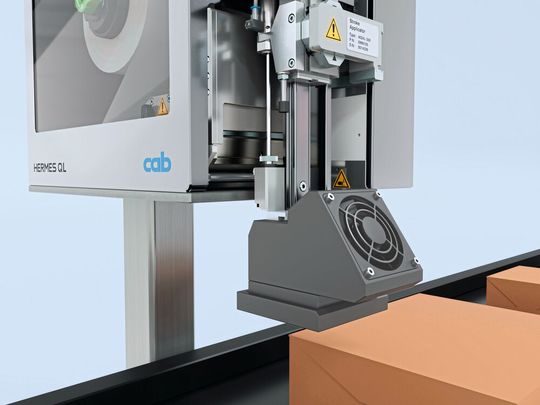
The hub applicator on the Hermes QL in detail view.
(Image: Cab product technology)
For self-adhesive labels traditionally wound on rolls, liners are used. These are specially coated papers from which labels can be easily removed. After the labels are dispensed, the carriers result in tons of waste worldwide each year. To conserve natural resources and reduce negative environmental impacts, Cab has further developed its proven Hermes Q printing and labeling system into the Hermes QL models. These allow for the printing of logistics labels without backing material. The industry refers to this as linerless. The disposal of carriers is eliminated. This means more labels fit on rolls, making them lighter to transport. Downtime in systems is reduced due to fewer roll changes. Labels in different designs and sizes can be printed with the same roll. At the Hermes QL, a cutter trims the labels to the desired length. Both industry and the environment benefit.
"Most of our customers know us and simply expect us to solve every task economically," says Dirk Roland, Cab's International Sales Manager for labeling systems. "In this case, we evaluated the comprehensive modular system of our Hermes systems and transferred the requirements of linerless to the specifications of our printers and peripherals."
Flexible because modular
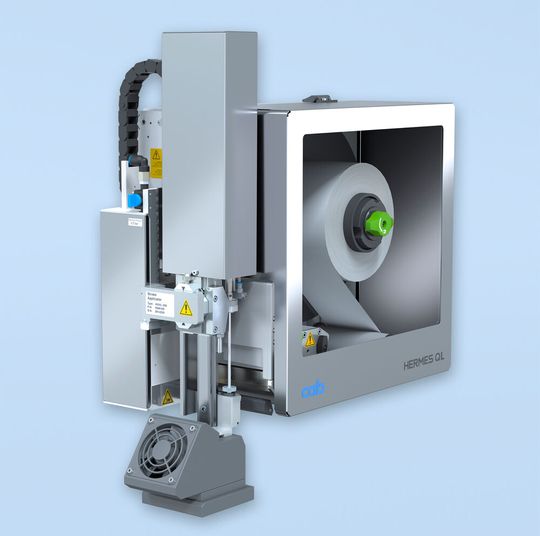
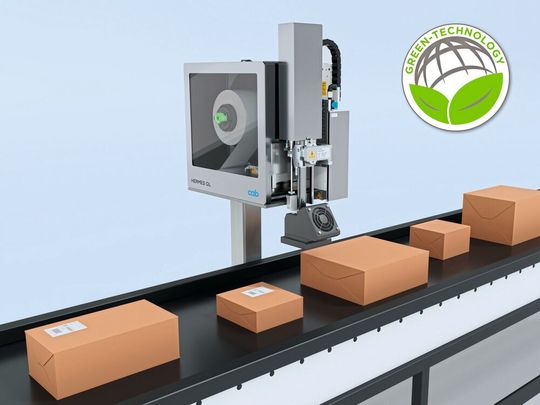
The classic use of the Hermes QL is wherever companies label shipping cartons with information. The printheads are designed for direct thermal printing. With the HQ 4024 hub applicator, Hermes QL addresses up to 25 cartons per minute. An electrically driven fan sucks the labels on. Compressed air is only needed for the lift cylinder.
Single view of the Hermes QL.
(Image: Cab product technology)
The functions, dimensions, and installation positions of the Hermes QL are compatible with the Hermes Q. Applicators and mounting aids can continue to be used, making it easy to interchange Hermes Q and QL linerless printers. Whether labeling around corners, on flat surfaces or cylinders, in transit or at a standstill, from all sides on cardboard—the Cab modular system makes everything possible. For integration into networks or automation solutions, all Hermes Q devices provide the necessary interfaces, including Industry 4.0 protocols.
Even more sustainable?
Inno-Liner is a linerless adhesive material from Herma. Unlike conventional linerless products, the outer layer of adhesive remains deactivated until dispensing is activated. This means the material does not stick together on the roll and does not require silicone. Instead, vaporized steam at the applicator activates the adhesive in a matter of milliseconds when dispensing a label. Inno-Liner strongly adheres to absorbent cardboard or similar paper-like substrates. It is free from bisphenol and allows labeling even on food packaging.
Whether the product is moving or stationary at the time of labeling and from which side labels are applied are important factors in choosing the right labeling system.
(Image: Cab product technology)
In a specially initiated cooperation with Herma, Cab is further developing Hermes QL for applications with Inno-Liner adhesive material. The aim is to provide a device that allows Inno-Liner adhesive material to be printed at variable heights in fully automated packing lines, separated with a cutting knife after printing, and applied using a hub applicator.
Proven base system
Industrial companies value the Hermes Q printing and labeling systems for their diverse applications. Each model combines a printing and labeling system, allowing logistics labels to be individually printed and positioned on goods in a single operation. Various options for applying the labels arise depending on the chosen applicator and its transfer unit:
Pressing: Labels are applied to an object when triggered by a signal. Cab provides transfer units universally or specifically sprung, damped, or with label stops according to the size or consistency of the object.
Roll labels onto a product during transport in a conveyor line
Blow on with compressed air without mechanical contact: This allows labels to be shot through the air up to 20 centimeters before landing accurately on the object and sticking there.
Wrap labels around cylindrical bodies using an applicator with a form stamp
Each application is unique. Print volumes and widths, label sizes, and print quality play major roles. High processing speeds, variable data, and tight product sequences on a conveyor belt are important factors when transferring printed labels to goods. Whether the item is moving or stationary at the time of labeling and from which side labels are applied are additional considerations. Cab has nearly 50 years of experience in this sector and offers solutions for every requirement. Mounting aids and stands facilitate the flexible installation of the systems in machinery. For network integration, all necessary interfaces, including Industry 4.0 protocols, are available. Standards and norms such as OPC-UA and MQTT ensure safe communication between humans and machines. Labels applied to surfaces with Hermes Q/QL are information carriers. They enable correct distribution, ensuring smooth processes at the entry and exit of goods, their picking, storage, and transport, traceability from origin to destination, and economic calculability.
Date: 08.12.2025
Naturally, we always handle your personal data responsibly. Any personal data we receive from you is processed in accordance with applicable data protection legislation. For detailed information please see our privacy policy.
Consent to the use of data for promotional purposes
I hereby consent to Vogel Communications Group GmbH & Co. KG, Max-Planck-Str. 7-9, 97082 Würzburg including any affiliated companies according to §§ 15 et seq. AktG (hereafter: Vogel Communications Group) using my e-mail address to send editorial newsletters. A list of all affiliated companies can be found here
Newsletter content may include all products and services of any companies mentioned above, including for example specialist journals and books, events and fairs as well as event-related products and services, print and digital media offers and services such as additional (editorial) newsletters, raffles, lead campaigns, market research both online and offline, specialist webportals and e-learning offers. In case my personal telephone number has also been collected, it may be used for offers of aforementioned products, for services of the companies mentioned above, and market research purposes.
Additionally, my consent also includes the processing of my email address and telephone number for data matching for marketing purposes with select advertising partners such as LinkedIn, Google, and Meta. For this, Vogel Communications Group may transmit said data in hashed form to the advertising partners who then use said data to determine whether I am also a member of the mentioned advertising partner portals. Vogel Communications Group uses this feature for the purposes of re-targeting (up-selling, cross-selling, and customer loyalty), generating so-called look-alike audiences for acquisition of new customers, and as basis for exclusion for on-going advertising campaigns. Further information can be found in section “data matching for marketing purposes”.
In case I access protected data on Internet portals of Vogel Communications Group including any affiliated companies according to §§ 15 et seq. AktG, I need to provide further data in order to register for the access to such content. In return for this free access to editorial content, my data may be used in accordance with this consent for the purposes stated here. This does not apply to data matching for marketing purposes.
Right of revocation
I understand that I can revoke my consent at will. My revocation does not change the lawfulness of data processing that was conducted based on my consent leading up to my revocation. One option to declare my revocation is to use the contact form found at https://contact.vogel.de. In case I no longer wish to receive certain newsletters, I have subscribed to, I can also click on the unsubscribe link included at the end of a newsletter. Further information regarding my right of revocation and the implementation of it as well as the consequences of my revocation can be found in the data protection declaration, section editorial newsletter.
Optimized control
Cab is gradually equipping the applicators for Hermes Q with new electronics and firmware. Proven functions are retained, and new ones are added. For example, the applicators can be adjusted more granularly at the printer, directly via the control panel or remotely through its web interface. Various calibration and learning options facilitate any requirement. Firmware updates can be installed much faster, and settings can be exported and imported, for instance, when switching to another printer or applicator. In the event of malfunctions, workers receive detailed information to quickly return to normal operations. (bh)
* Guntram Stadelmann is a technical editor at Cab Produkttechnik GmbH & Co. KG in 76131 Karlsruhe (Germany), Tel. +49 721 66260, info@cabgmbh.com



:quality(80)/p7i.vogel.de/wcms/c2/57/c257474faf6095a24bacfd98524bc7f8/0130090188v1.jpeg "With the Coromill MR20 milling system, the cutting tool specialist Sandvik Coromant is bringing a product that should make a name for itself in tool and mold making, as well as in aerospace components, to what the manufacturer claims it can do ... (Image:Sandvik Coromant)")
:quality(80)/p7i.vogel.de/wcms/87/f8/87f88a6b4e47ea77b22b1eb88db533a8/0130110840v1.jpeg "Zenadrone, a subsidiary of Zenatec, is in the process of developing an operational low-cost drone as a disposable concept (symbolic image). The first prototype already exists. The aim is to counter the increasing number of enemy drone attacks in the future without spending a lot of money ... (Image:Cenadrone)")
:quality(80)/p7i.vogel.de/wcms/c4/8f/c48fdd4e437b1bca2b0a2d3e77ec74ad/0130015902v1.jpeg "AI will gain importance in manufacturing in 2026. (Picture: ©miss irine - stock.adobe.com / AI-generated)")
:quality(80)/p7i.vogel.de/wcms/eb/9f/eb9f3da11ab6e979c15c195ff516b2ec/0130128194v1.jpeg "Clamping force 110,000 kilonewtons! This is the largest injection molding machine in the world currently under construction. It is being built at Engel in Austria and bears the name Duo 1200 US. Eight tie bars ensure stability. Find out more about this giant of plastics processing ... (Image:Angels)")
:quality(80)/p7i.vogel.de/wcms/ad/9d/ad9d709c690b7420468ea3d935a1c97f/fairground1-webp-2560-2560x1440v1.jpeg "(Source: Messe Frankfurt (HK) Ltd Taiwan Branch)")
:quality(80)/p7i.vogel.de/wcms/f0/35/f035afad8613734aaefe4d6778d21309/0129554823v1.jpeg "The Aquis Touch S multi-channel measuring, control and recording device ensures that the quality parameters of the cooling media are correct. (Image:Jumo)")
:quality(80)/p7i.vogel.de/wcms/ab/23/ab2371c186380215b8311d1aeb4e47df/0130095643v1.jpeg "Geointelligent supply chain management provides valuable information, for example, about which control unit a microchip is installed in. (Picture: ©Aleksandr Matveev - stock.adobe.com)")
:quality(80)/p7i.vogel.de/wcms/b4/01/b401c197e3591f2bec3fb84ae810ac80/0130096280v1.jpeg "Only prophecies of doom! Jensen Huang, the head of chip giant Nvidia, dismisses any concerns that the huge sums currently being invested in AI data centers will not turn a profit one day ... (Image:Nvidia)")
:quality(80)/p7i.vogel.de/wcms/63/21/6321beb732bf7d92640df46d7aa77573/0130125122v1.jpeg "As part of the Carbon Lab Factory Lausitz, a pilot plant for the production of sustainable, cost-effective and competitive carbon fibers will be built at the Guben site. (Image:Fraunhofer IAP / Kristin Stein)")
:quality(80)/p7i.vogel.de/wcms/53/4f/534fe0f168f6ee070ded4a48faca4cef/business-wire-main-image-1103x620v1.jpeg "The new UR AI Trainer, developed by Universal Robots and Scale AI, is the first direct lab-to-factory solution for AI model training.
(Source: Universal Robots)")
:quality(80)/p7i.vogel.de/wcms/08/70/087062e2e1a9b9add5777410dd746ee9/adobestock-1923991605-5607x3156v1v1.jpeg "A new type of tactile sensor, inspired by human skin, even recognizes grains of sand. (Image:Curioso.Photography - stock.adobe.com)")
:quality(80)/p7i.vogel.de/wcms/7f/08/7f087d7013424d123ab7275cd2e3fe55/adobestock-809456218--c2-a9-20degimages-20-e2-80-93-20stock-adobe-com-ki-generiert-4179x2351v1v1.jpeg "The digital upgrading of existing machines conserves resources, saves energy and reduces the need for new production. (Image:Degimages - stock.adobe.com/AI-generated)")
:quality(80)/p7i.vogel.de/wcms/24/1b/241b271e20d9171e063a4f284a748ee9/0130115596v1.jpeg "(Image:Chery)")
:quality(80)/p7i.vogel.de/wcms/5e/11/5e11044efcf1b31e6dd361b293587cbc/0130110355v1.jpeg "Lotus boss Qingfeng Feng wants to continue to offer exclusive models. (Image:Lotus)")
:quality(80)/p7i.vogel.de/wcms/95/48/954885de5a930b6770191d7f35b477c4/0130110863v1.jpeg "Honda will not be launching the two electric cars 0 Saloon and 0 SUV presented in 2025 after all (Image:Honda)")
:quality(80)/p7i.vogel.de/wcms/34/e2/34e2a9e46e59eb28f09f9a5fdf41ff9a/0130091813v1.jpeg "Electrical drive trains require a multidimensional concept of performance characterization. Rohde & Schwarz has developed the MXO 3 oscilloscope series for this purpose. (Image:Rohde & Schwarz)")
:quality(80)/p7i.vogel.de/wcms/f2/48/f24888ee4cf187dcaf569ede74cdec14/0130104146v1.jpeg "Compact AI power: The SIM8668 and SIM8666 smart modules from Simcom combine a quad-core CPU with an integrated NPU for resource-saving industrial and robotics applications in the smallest of spaces. (Image:Chip: Simcom/Background: AI-generated)")
:quality(80)/p7i.vogel.de/wcms/33/4a/334a40bdce62798bd6eb90957e222d6a/0130085649v1.jpeg "From hardware manufacturer to software provider: Neocortec is increasingly licensing its NeoMesh protocol stack directly to OEMs and third-party manufacturers instead of relying exclusively on selling its own radio modules. (Image:mc/VCG)")
:quality(80)/p7i.vogel.de/wcms/5f/4a/5f4aae3a1c19fb2b1a2df58925afeca1/0130111244v1.jpeg "Power saver for the IoT: The Npzero module takes over sensor monitoring and sends the main processor into deep sleep. (Image:Manuel Christa)")
:quality(80)/p7i.vogel.de/wcms/0c/ac/0cacda94ed641488ba0ac4b9daa2bce5/0130073615v1.jpeg "Part of the experimental set-up for a quantum physics experiment in the laboratory of the Institute of Physics at Humboldt-Universität zu Berlin, Adlershof (Germany) campus. (Image:HU Berlin/S. Klenke)")
:fill(fff,0)/images.vogel.de/vogelonline/companyimg/76800/76895/65.jpg "FAULHABER_120mm.jpg ()")
:fill(fff,0)/p7i.vogel.de/companies/67/eb/67eba621ef6ea/logo2.png "logo2 (Wuxi InfiMotion)")
:quality(80)/p7i.vogel.de/wcms/40/c5/40c5051cebdb10fdee9a283303434d9d/0129881741v1.jpeg "3D-printed tools and other components contribute to energy-saving, precise processes. (Image:Gerhard Schubert GmbH)")
:quality(80)/p7i.vogel.de/wcms/c0/25/c0251239b740212809202566eaed06b0/0126413019v1.jpeg "A key requirement is that the Leibinger marking systems print both bottle caps and beverage cans precisely and reliably. (Image:Leibinger)")