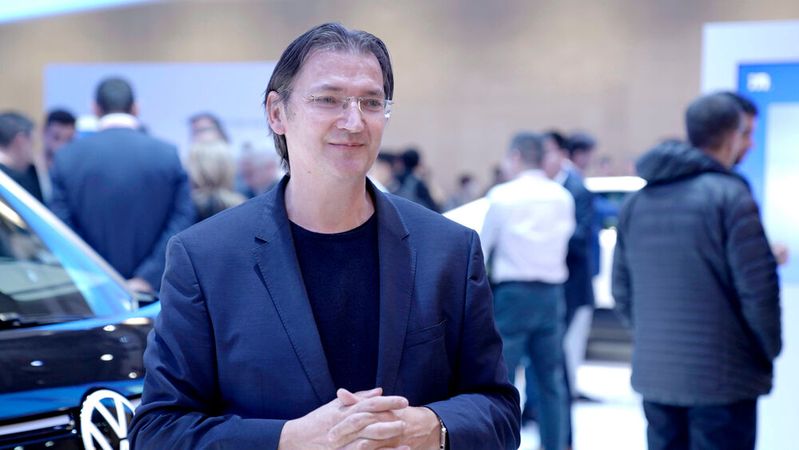
Johann Jungwirth is convinced of the future of autonomous driving. Comfort and especially safety for users are crucial to him.
At CES 2024, Johann Jungwirth and Mobileye presented their Driving Experience platform. The idea: all essential driving functions are developed universally.
(Image: Mobileye)
Johann Jungwirth, Senior Vice President Autonomous Vehicles at Mobileye, enjoys driving autonomously himself and is convinced of the safety and comfort. He believes that private customers will also be willing to pay the high price.
Mr. Jungwirth, with the Drive Pilot by Mercedes-Benz there is already a Level-3 system on the market. However, these are fair-weather pilots that only work during the day in good visibility up to 60 km/h. The feature costs around 7,000 Euros. Do you see a willingness in the market to pay this price?
From our perspective, it is important to reduce limitations and also make speeds up to 130 km/h possible. This means that the operating range must be broad enough to also handle darkness and light rain. As a driver, one has to feel that the system actually always works and that one only needs to intervene in exceptional situations. These are the solutions we are working on.
What makes the case for the assistants, more the argument of comfort or safety?
It's both. Safety is a basic requirement; without it, no approval from regulatory authorities is received. If you drive 10 times or 100 times safer than a human, then it's a strong argument to activate the system. Being able to use time differently is an aspect of comfort: reading, working, learning – even before level 4.
The price of the systems suggests that level 4 functions will mainly be used in commercial vehicles, or is this assumption incorrect?
No, probably not at the moment. We are witnessing the development towards the robotaxi, for example with the VW ID Buzz AD at Moia. They already face the challenge of not finding enough drivers today. To offer such a service, you need a network effect, meaning a certain density of vehicles on the road, so that customers do not have to wait long. Also, spontaneously reacting to changes in demand is only possible with autonomously driving vehicles.
Moia aims to be autonomous in Hamburg by 2025. Do you consider this timeframe realistic?
Yes, I consider that realistic. In Oslo, our partners Holo and Ruter are pursuing a similar goal. Norway was also a leader in the introduction of electromobility, thus creating the right framework conditions. Oslo is planning with up to 30,000 autonomously driving vehicles, three times more than in Hamburg. That's how you get the desired network effects. For users, this primarily means: no long waiting times.
Do you really believe that a private customer will buy a level 4 car? The price will be significantly higher.
Definitely. If there will be the option to simply enter the destination and the car drives you there independently, then this can be appealing for some users. Even today, there are people who afford such a luxury – just with a human chauffeur instead.
I was thinking more of average earners as the target group. The car is likely to be the most expensive investment after the house and is usually only used for a short period of time.
We will see. That's why we at Mobileye are very broadly positioned and say: the market will regulate this. Whether it will be fleet vehicles or rather private vehicles in the long term, nobody knows today.
At this year's CES, the Software Defined Vehicle was the common thread among exhibitors. Car manufacturers must become masters of every line of code in the car. Can the established manufacturers do this?
That's why we introduced our Driving Experience platform at CES 2024. The idea: We develop all essential driving functions universally. Everything that does not differentiate from the competition is used by all OEMs together. This includes, for example, the environmental detection of the sensors. It has to work perfectly.
Everything that is unique to the manufacturer can be customized on our platform. OEMs thus have access to the application layer, libraries, and tools. In principle, this allows the driving style of a vehicle to be completely individualized. Every car must stop at a red light, but how exactly the vehicle approaches and performs the braking process is up to the manufacturers. In the end, the car drives as if the manufacturer had programmed the entire system themselves. We see this as the golden mean between an open and a closed system. After all, one does not need to reprogram iOS from scratch for a phone app each time.
Date: 08.12.2025
Naturally, we always handle your personal data responsibly. Any personal data we receive from you is processed in accordance with applicable data protection legislation. For detailed information please see our privacy policy.
Consent to the use of data for promotional purposes
I hereby consent to Vogel Communications Group GmbH & Co. KG, Max-Planck-Str. 7-9, 97082 Würzburg including any affiliated companies according to §§ 15 et seq. AktG (hereafter: Vogel Communications Group) using my e-mail address to send editorial newsletters. A list of all affiliated companies can be found here
Newsletter content may include all products and services of any companies mentioned above, including for example specialist journals and books, events and fairs as well as event-related products and services, print and digital media offers and services such as additional (editorial) newsletters, raffles, lead campaigns, market research both online and offline, specialist webportals and e-learning offers. In case my personal telephone number has also been collected, it may be used for offers of aforementioned products, for services of the companies mentioned above, and market research purposes.
Additionally, my consent also includes the processing of my email address and telephone number for data matching for marketing purposes with select advertising partners such as LinkedIn, Google, and Meta. For this, Vogel Communications Group may transmit said data in hashed form to the advertising partners who then use said data to determine whether I am also a member of the mentioned advertising partner portals. Vogel Communications Group uses this feature for the purposes of re-targeting (up-selling, cross-selling, and customer loyalty), generating so-called look-alike audiences for acquisition of new customers, and as basis for exclusion for on-going advertising campaigns. Further information can be found in section “data matching for marketing purposes”.
In case I access protected data on Internet portals of Vogel Communications Group including any affiliated companies according to §§ 15 et seq. AktG, I need to provide further data in order to register for the access to such content. In return for this free access to editorial content, my data may be used in accordance with this consent for the purposes stated here. This does not apply to data matching for marketing purposes.
Right of revocation
I understand that I can revoke my consent at will. My revocation does not change the lawfulness of data processing that was conducted based on my consent leading up to my revocation. One option to declare my revocation is to use the contact form found at https://contact.vogel.de. In case I no longer wish to receive certain newsletters, I have subscribed to, I can also click on the unsubscribe link included at the end of a newsletter. Further information regarding my right of revocation and the implementation of it as well as the consequences of my revocation can be found in the data protection declaration, section editorial newsletter.
How do you see the public acceptance of robotaxis? Has it suffered due to the license revocation for Cruise in the US following an accident involving an injured woman?
The entire industry above all must draw the right conclusions from this and continue to work focused. Today, 94 percent of all accidents are caused by human error, namely inattention, fatigue, alcohol, or drugs at the wheel. With robotaxis, all these reasons for accidents are eliminated. What is essential is that no new reasons are added due to the technology. Ultimately, it is a matter of testing. Therefore, the main task for the coming years is: testing, testing, testing. Especially those rare and unexpected cases, which we call corner cases.
This brings us to the area where it can be proven that the machine drives safer than a human. First, it's factor two, then ten, and eventually factor 100. In addition, the reaction speed of the systems is much faster than that of humans. The machine reacts within 100 to 200 milliseconds, while a human has a moment of shock, needing 800 milliseconds to a second to properly assess the situation and then react. And the sensors also see well at night. We rely on triple redundancy in our sensor set: cameras, radar, and lidar.
Are you sticking with the trio of sensors, meaning camera, lidar, and radar?
As of today, we are starting with cameras, lidar, and radar. So, imaging radar sensors, for example, can be seen on the second generation of the ID Buzz AD. We offer 1,536 virtual channels in the front imaging radar sensors and 384 virtual channels on the sensors at the sides and in the rear area. This means we have a radar with a resolution similar to a lidar sensor. At the same time, radar technology is more robust and less expensive.
What do you think of thermal imaging cameras that very reliably detect people and animals on the road?
Sensor technology will continue to evolve; there will be many new things, new frequency ranges, black light, and so on. These will all be improvements and further developments of the existing sensor technology. We are very focused on making the cost factor of the systems attractive – also with regard to level 4 for private users.
When you drive, what has been the longest distance so far that you have allowed the assistant to drive with a clear conscience?
The longest distance must have been the two and a half hours from Jerusalem to Haifa via Tel Aviv. I live with my family in Israel. On weekends, we often drive to the Dead Sea and back, which I drive almost completely autonomously.
Are we talking about a level 2 plus system or higher?
I have to try out all of our products, from Supervision to Chauffeur to Drive. I really enjoy experiencing it for myself. I am a combination of a technology and car guy.
ABOUT THE PERSON
Dipl.-Ing. Johann Jungwirth, 47, studied electrical engineering in Stuttgart. He then worked for about 20 years at Daimler and Mercedes-Benz, the last five years as CEO of Mercedes-Benz R&D North America in Silicon Valley. After a stint at Apple, Jungwirth moved to Volkswagen, where he spent about four years as Chief Digital Officer of the Volkswagen Group and Executive Vice President Mobility Services in Wolfsburg and Silicon Valley. In 2019, he joined Mobileye in Jerusalem; initially as Vice President of the Mobility-as-a-Service division. In July 2022, he took over the AV business unit as Senior Vice President. He is responsible for the supplier's assistance systems. Jungwirth is married and has four children.



:quality(80)/p7i.vogel.de/wcms/a0/47/a04725ef9bd09fb6c9341a1bea1b5d93/0130443083v1.jpeg "Here, a type of plastic pallet is produced by thermoforming (vacuum forming or deep drawing) at the corresponding division of New England Plastics in the USA. This division, which specializes in so-called liners, is now part of Ringmetall ... (Image:New England Plastics)")
:quality(80)/p7i.vogel.de/wcms/e3/42/e342b3c593ea92d56604d3be969e9c9a/0130437231v1.jpeg "Daimler Truck will be building even more trucks at its Czech plant in Cheb in the future. This is because it is now being expanded for strategic cost-saving reasons ... (Image:Daimler Truck)")
:quality(80)/p7i.vogel.de/wcms/23/99/23992bf2dcdc432c9b7209c34a4a7c48/0129733089v1.jpeg "Stork relies on the modular Neoswiss turning system from Iscar to shorten the set-up times for its sliding headstock lathes and work more productively. (Image:Iscar)")
:quality(80)/p7i.vogel.de/wcms/7d/e2/7de2923434b2f1a78ba5482d8d335269/0113143253v1.jpeg "In our China Market Insider we regularly provide you with relevant information directly from China. (Image:© Eisenhans - stock.adobe.com)")
:quality(80)/p7i.vogel.de/wcms/b7/36/b736dfebc16c42d6901d0d0e1f390493/3d-druck-20factory-20--20ki-20generiert-1920x1079v1.png "(Source: AI-generated)")
:quality(80)/p7i.vogel.de/wcms/79/b2/79b21aad663f4a7bd4472afc1c1afc62/0130433994v1.jpeg "Mission Joyride: The free-flying robot (shown here in the rendering) will relieve the ISS crew of logistics tasks from 2027 with its two mechanical arms. (Image:Icarus Robotics)")
:quality(80)/p7i.vogel.de/wcms/6b/45/6b4546fa6ebf305c3660326909363f32/0130437089v1.jpeg "Industrial AI in action: Rockwell Automation presents practical solutions for self-controlling production systems at the Hannover Messe. (Image:Rainer Jensen, Deutsche Messe)")
:quality(80)/p7i.vogel.de/wcms/78/e9/78e9188c25a8a94e67c34c9bf8ffe495/visual-agile-20robots-20and-20google-20deepmind-20partner-20to-20bring-20intelligence-20to-20robotics-2500x1406v1v1.jpeg "Together, the partners are developing adaptable, intelligent robots for a wide range of applications (Image:Agile Robots SE)")
:quality(80)/p7i.vogel.de/wcms/59/a2/59a2b11f0aa1b700eff02addd5de8703/adobestock-1788280853--c2-a9-20satria-20-e2-80-93-20stock-adobe-com-5081x2860v1v1.jpeg "Quantum computers require extreme cooling to temperatures close to absolute zero in order to keep qubits stable. (Image:satria - stock.adobe.com)")
:quality(80)/p7i.vogel.de/wcms/62/5f/625f41e87ebfef156a98c8e6393e32fd/0130211654v1.jpeg "Axial flux motors have some advantages over radial flux motor—but their production is currently still expensive. (Image:RWTH Aachen University)")
:quality(80)/p7i.vogel.de/wcms/f6/ae/f6aec4f6241b36ed5e3a990ac9176b42/0130429460v1.jpeg "Verne, Pony.ai and Uber want to launch a robotaxi service in Europe. (Image:Verne)")
:quality(80)/p7i.vogel.de/wcms/d7/88/d788699f2974708a332baa4e7a62fa9e/0130438967v1.jpeg "Skoda is withdrawing from China. The brand has produced well over three million vehicles there. (Image:Skoda car)")
:quality(80)/p7i.vogel.de/wcms/b0/43/b043b86899837532aad62d63368a917a/0130371361v1.jpeg "Skoda leaves the chinese market.
(Image:Skoda)")
:quality(80)/p7i.vogel.de/wcms/c3/c4/c3c4ce270b083eeac55654148611f064/0130237945v1.jpeg "China is not giving up on hydrogen, but is intensifying its efforts. (Image:freely licensed from Pixabay)")
:quality(80)/p7i.vogel.de/wcms/ee/09/ee09acbd6dc896df25affaa9e871e6e5/0130440053v1.jpeg "IMS chip module for simple system integration into an ion mobility spectrometer. (Image:Fraunhofer IPMS)")
:quality(80)/p7i.vogel.de/wcms/10/6c/106cd22de5f68a0f74639d654827228c/0130345302v1.jpeg "Made in India: According to the India Electronics and Semiconductor Association (IESA), the country should be able to produce between 75 and 80 million chips by the beginning of 2027, once the plants currently under construction become operational. (Image:Pixabay (Montage: Sebastian Gerstl))")
:quality(80)/p7i.vogel.de/wcms/a5/ed/a5ed6fda029d362732a293d6b19d74c4/0130444216v1.jpeg "Thirteen executives from the Chinese chip industry have drawn up a plan to achieve an 80% self-sufficiency rate for semiconductors by 2030. (Image:Maxim_Kazmin - stock.adobe.com)")
:quality(80)/p7i.vogel.de/wcms/31/a6/31a646018b34d8e0a44bfc8bf17837f6/0130361632v1.jpeg "For many companies, PFAS are considered indispensable in electronics production. (Image:freely licensed)")
:fill(fff,0)/images.vogel.de/vogelonline/companyimg/76800/76895/65.jpg "FAULHABER_120mm.jpg ()")
:quality(80)/p7i.vogel.de/wcms/de/d6/ded641c0d57f9de47645d1bbab396905/b02-25c0327-001-copy-mercedes-benz-4957x2790v1v1.jpeg "Robotaxi service in Abu Dhabi: With Momenta, a Chinese AI specialist for autonomous driving, and the local partner Lumo, Mercedes-Benz aims to establish a shuttle service with highly automated S-Class vehicles in the United Arab Emirates. (Image:Mercedes-Benz)")
:quality(80)/p7i.vogel.de/wcms/18/08/1808907403afe9f5d8ca10c89afdc5ed/0127861992v1.jpeg "Robotaxi from Motional, a joint venture between Hyundai and Aptiv: Chinese global market leader Hesai supplies the short-range lidar sensors for the vehicle based on a Hyundai Ioniq 5. (Image:Hesai)")