Staying objective is key when examining China’s e-car sector, yet Chery’s October 18 press event truly was an “innovation showcase.” At the "Chery Global Innovation Conference 2024," China’s fourth-largest electric and hybrid vehicle manufacturer unveiled a lineup of new developments, leaving the trade press impressed.
The Chinese car manufacturer Chery wants to be "rude" and "heat up" the competition with new NEV models and technologies.
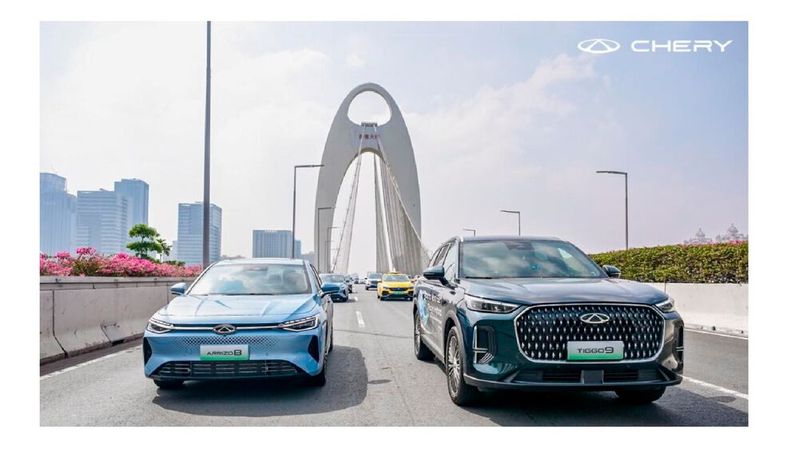
(Image: Chery)
Chery made headlines with the announcement of its first solid-state battery in development, promising to extend the range of electric vehicles to an impressive 1,500 kilometers. According to Gao Xinhua, Chery's Executive VP, the battery could hit the roads by 2026, with full-scale production anticipated by 2027. A prototype showcased at the conference in Wuhu, Anhui Province, demonstrated resilience, remaining operational even after a section was removed. Solid-state batteries are viewed as the “next generation” for EV power, expected to surpass conventional lithium-ion technology with higher energy density and enhanced safety, making them a compelling option for future EV innovation.
Still in 2024: solid-state batteries with an energy density of 400 Wh/kg
Technically, however, it is anything but easy to develop solid-state batteries and get them ready for series production. Toyota, which was said to be the global technology leader, has pushed back its timetable for the mass production of solid-state batteries to 2027. Volkswagen and BMW ditto. And even CATL is still struggling with the development of solid-state batteries.
Chery's announcement must therefore still be greeted with a dash of skepticism. "Chery has not revealed many specific parameters and we are unable to conduct a detailed analysis," commented the Chinese tech portal "Autolab". However, Chery did specify that its solid-state batteries would reach an energy density of 400 Wh/kg this year, which is expected to rise to 600 Wh/kg by next year. That is a lot.
The company appears committed to its bold ambitions. Last year, Chery's CEO Yin Tongyue unveiled a series of innovations at the annual conference, emphatically stating that Chery would be “rude”—or "bu keqi" in Chinese—signaling that they intend to ramp up competition aggressively in both electric and hybrid vehicle markets. This phrase reflects Chery's resolve to push boundaries and challenge industry standards, emphasizing their intention to lead in automotive innovation and keep competitors on their toes.
Rising sales figures
And so it has come to pass. Not least due to many innovations that are well received by China's car buyers, the monthly Chery sales figures for "New Energy Vehicles" (NEV), i.e. electric and hybrid vehicles of all kinds, have risen from 30,000 to 40,000 to 50,000 and most recently in September to almost 60,000 units—58,941 to be exact.
This was an increase in Chery sales in the e-mobility segment of more than 183 percent year-on-year. In September, Chery had thus risen to fourth place among the most successful Chinese NEV manufacturers in terms of unit sales.
Chery will be "bu keqi" again this year, the company boss shouted once more from the stage of his own car show in the Chinese province. Chery is owned by the city government of Wuhu. The shrewd industry veteran Yin Tongyue learned his trade at FAW-Volkswagen, among others. He plans to sell 100,000 NEVs per month by the end of this year, he said.
Up in the air
The second eye-catcher at Mr. Yin's innovation conference this year was the presentation of Chery's first flying car. Although it is still a prototype, it has already successfully completed an 50 miles (approx. 80-kilometer) test flight. The futuristic-looking two-seater can take off and land vertically and is designed for two passengers who, according to the company, will take off in the vehicle whenever a traffic jam gets on their nerves. And that is often the case in China.
As soon as it has landed again, the flying Chery car can then continue driving completely autonomously. It has neither a steering wheel nor an accelerator pedal. The maximum flight altitude is less than one kilometer. The maximum flight speed is 120 km/h (approx. 75 mph). The Chery flying car can currently fly for up to 40 minutes—but Chery is already working on the solid-state batteries of the future.
So now that Xpeng, GAC, SAIC, Geely and, more recently, Chery have unveiled flying cars, things are starting to get serious in China. "Judging from the current development trend, the commercialization of flying cars could come faster than the public expects, similar to autonomous driving vehicles, even if there are safety concerns," says the specialist portal CarNewsChina after the Chery conference in Wuhu.
Battery developments
Oh yes, there were also a whole host of other product presentations at the innovation conference. Chery presented the next generation of its autopilot, the "Zdrive C-Pilot 5.0". Plus a new, cloud-controlled "VLA Large Model". And three new battery types from the newly created "Kunpeng" brand: a "square lithium iron phosphate battery", a "square ternary battery" and a "large cylindrical ternary battery".
Date: 08.12.2025
Naturally, we always handle your personal data responsibly. Any personal data we receive from you is processed in accordance with applicable data protection legislation. For detailed information please see our privacy policy.
Consent to the use of data for promotional purposes
I hereby consent to Vogel Communications Group GmbH & Co. KG, Max-Planck-Str. 7-9, 97082 Würzburg including any affiliated companies according to §§ 15 et seq. AktG (hereafter: Vogel Communications Group) using my e-mail address to send editorial newsletters. A list of all affiliated companies can be found here
Newsletter content may include all products and services of any companies mentioned above, including for example specialist journals and books, events and fairs as well as event-related products and services, print and digital media offers and services such as additional (editorial) newsletters, raffles, lead campaigns, market research both online and offline, specialist webportals and e-learning offers. In case my personal telephone number has also been collected, it may be used for offers of aforementioned products, for services of the companies mentioned above, and market research purposes.
Additionally, my consent also includes the processing of my email address and telephone number for data matching for marketing purposes with select advertising partners such as LinkedIn, Google, and Meta. For this, Vogel Communications Group may transmit said data in hashed form to the advertising partners who then use said data to determine whether I am also a member of the mentioned advertising partner portals. Vogel Communications Group uses this feature for the purposes of re-targeting (up-selling, cross-selling, and customer loyalty), generating so-called look-alike audiences for acquisition of new customers, and as basis for exclusion for on-going advertising campaigns. Further information can be found in section “data matching for marketing purposes”.
In case I access protected data on Internet portals of Vogel Communications Group including any affiliated companies according to §§ 15 et seq. AktG, I need to provide further data in order to register for the access to such content. In return for this free access to editorial content, my data may be used in accordance with this consent for the purposes stated here. This does not apply to data matching for marketing purposes.
Right of revocation
I understand that I can revoke my consent at will. My revocation does not change the lawfulness of data processing that was conducted based on my consent leading up to my revocation. One option to declare my revocation is to use the contact form found at https://contact.vogel.de. In case I no longer wish to receive certain newsletters, I have subscribed to, I can also click on the unsubscribe link included at the end of a newsletter. Further information regarding my right of revocation and the implementation of it as well as the consequences of my revocation can be found in the data protection declaration, section editorial newsletter.
All three battery innovations enable very fast charging times with the 6C standard. Five minutes of charging should be enough for a range of 400 kilometers (almost 250 miles). The batteries are to be launched on the market this year in Chery's first NEV brands (Omoda, iCar, Exeed).
It can therefore be stated quite objectively and soberly that this year's Chery Innovation Conference was a good example of how strongly Chinese car manufacturers are currently relying on innovations in order to achieve unique selling points in the fierce competition in the world's largest car market.
FrFrom a European perspective, the rapid pace of technological advancements in areas such as power batteries, intelligent driving solutions, and even flying cars from China warrants close attention. It is not solely price that allows China to dominate the global automotive market. Chery, for example, has already become the largest car exporter in China. Furthermore, China has surpassed both Japan and Germany to become the world’s largest car-exporting nation, highlighting its growing influence in the automotive industry. These developments indicate that China is not just competing on price but also driving innovation, positioning itself as a global leader in the automotive sector. With major strides in technology, China is shaping the future of mobility.om a European perspective, all these innovations, these astonishingly fast technological iterations in power batteries or intelligent driving solutions or flying cars should be watched closely. It is by no means just the price that China is using to conquer the global market for cars. Chery is already China's largest car exporter. And China has overtaken both Japan and Germany in terms of exports, making it the world's largest car exporting nation. (se)



:quality(80)/p7i.vogel.de/wcms/7c/06/7c0604c44d4b96508af8c24641ea3c99/0132136237v1.jpeg "Some may already be familiar with friction stir welding. It can even join different metals together. Researchers now have a new approach to this type of joining in mind, which could bring new advantages to the industry ... (Image: IKT)")
:quality(80)/p7i.vogel.de/wcms/18/6d/186db3fe269627eaeace471ea2f56b55/0132123312v1.jpeg "Proven laser cladding processes are now being optimized by Fraunhofer ILT from Aachen and Etxetar from Spain to help meet new requirements in additional industrial sectors. Here, a railway axle is being repaired using LMD. (Image: Etxetar)")
:quality(80)/p7i.vogel.de/wcms/45/2e/452ebe27b324cc535db2760946dfd15d/0131742792v1.jpeg "A major advantage of the new system is, on the one hand, the stability of the holder system and, on the other hand, the internal coolant supply directly to the working area. (Image:Horn/Sauermann)")
:quality(80)/p7i.vogel.de/wcms/d1/6c/d16c902c1311170a225c4e1b7db7bd4b/0132073916v1.jpeg "Now there is finally a saw with an XXL rotating table, so that ton-heavy plastic or fiber composite material panels can be cut gently and quickly. It is called FK-6, and it was built by IMA Schelling Precision. Read here what has been done ... (Image:IMA Schelling Precision)")
:quality(80)/p7i.vogel.de/wcms/f0/d2/f0d2f7a2e8426bd146c7dd1627bce04d/image-20--20schneider-20electric-20joins-20the-20world-20economic-20forum-20lighthouse-20operating-20system-20advisory-20board-20to-20create-20an-20open-source-20manufacturing-20blueprint-20for-20companies-20of-20all-20sizes-jpgv1.jpeg "Schneider Electric expands its industrial AI business with a billion-euro acquisition. (Image:Schneider Electric)")
:quality(80)/p7i.vogel.de/wcms/f6/9e/f69e31ab5afdd0e20e72f1e60bcac86b/datenauswertung-mg-2703v1.jpeg "Production and machine data are to become more easily accessible through generative artificial intelligence. (Source: University of Stuttgart IFF | Fraunhofer IPA | Rainer Bez)")
:quality(80)/p7i.vogel.de/wcms/e9/31/e93160c28d8262bbfb486b9b4568c751/adobestock-1877003493-puhimecv1.jpeg "The electrification of industry is becoming a business necessity. It allows energy to be sourced from a system that can be better controlled, predicted, and optimized than fossil alternatives. (Source: © puhimec – stock.adobe.com)")
:quality(80)/p7i.vogel.de/wcms/f1/a8/f1a8487a3107019f251569661b4f3867/inovance-20x-20vascat-203v1.jpeg "David Bedford Guaus (right), Country Manager at Inovance Technology Spain and Technical Director for Inovance in the Europe and North America regions, says: \"The joint search for a solution to integrate our drives into the system has further enhanced our collaboration with Vascat, and we very much hope to work together again in the future.\" (Image: Inovance)")
:quality(80)/p7i.vogel.de/wcms/23/b7/23b7c94b680b588e6a782720cc06900b/newsimage424308v1.jpeg "Left: Injection-molded test specimen with conventional platelet-shaped metallic effect pigments. Right: Injection-molded test specimen with novel tetrahedral pigment particles. (Image: Fraunhofer IAP)")
:quality(80)/p7i.vogel.de/wcms/40/0d/400df72efc5f3a38cd9ee532027309e5/june12finals-8-bncrop-2048x1170v1.jpeg "An \"electronic nose\" developed by researchers at UC Berkeley can detect gases emitted by spoiled food and food allergens better than the human nose. (Image: Brandon Sánchez-Mejia/UC Berkeley)")
:quality(80)/p7i.vogel.de/wcms/04/eb/04ebee99febeb716da7782b9e42d78b8/0132051842v1.jpeg "The Basic Day Thermal Management is an essential part of the \"Power of Electronics\" conference and originally evolved from the \"Cooling Days.\" (Image: Stefan Bausewein)")
:quality(80)/p7i.vogel.de/wcms/19/27/1927ccde4c7d25ce6f4e274a06bfc06c/cover-20imagev1.jpeg "Additive manufacturing has established itself as a complementary alternative to traditional machining for automotive tools, offering greater speed and flexibility. (Source: Stratasys)")
:quality(80)/p7i.vogel.de/wcms/82/77/8277f2b357418cecb2c9875271c5d1e2/freightliner-20m2-20106-20plus-20utilityv1.jpeg "Daimler Truck North America and Allison Transmission collaborate on the two powertrain solutions for the Freightliner M2 106 Plus. (Source: Clint Davis)")
:quality(80)/p7i.vogel.de/wcms/fa/3e/fa3e28db3a7aacf8fa268271193cd7f2/continental-unternehmenszentrale--2025-2-v1.jpeg "Continental has sold the Contitech division and is now solely a tire manufacturer. (Source: Continental)")
:quality(80)/p7i.vogel.de/wcms/16/a8/16a83b69fc74edb2ea0446cdd52d77a0/26c0162-508v1.jpeg "Vattenfall and Wireless Car aim to offer automated charging processes: without a card or charging app. (Source: Mercedes-Benz)")
:quality(80)/p7i.vogel.de/wcms/16/3c/163c1e300ce18f4afae03345f2ee567c/opening-20benteler-20kenitra-plantv1.png "The new plant in Kenitra is Benteler's first location in Morocco. (Image:Benteler)")
:quality(80)/p7i.vogel.de/wcms/77/15/7715aab3d27cae68e7ff6e2b802668d2/0132070881v1.jpeg "Innodisk's HDR cameras are intended to deliver usable image data for embedded vision and edge AI applications even with significant brightness differences. (Image:Innodisk)")
:quality(80)/p7i.vogel.de/wcms/64/43/6443737124d870de11c81bd7636fa646/0132086586v1.jpeg "Symbolic image: RAM (Image: freely licensed)")
:quality(80)/p7i.vogel.de/wcms/7a/b8/7ab83a5250152fbfd1b6bf7e35a2b50b/0132065385v1.jpeg "Pilot S20: It entered the market in the late 1990s and was the direct evolution of the very first Pilot system from 1995. With this model, Seica achieved an international breakthrough against major players like GenRad or Teradyne. (Image:Seica)")
:quality(80)/p7i.vogel.de/wcms/52/07/52071244e4b5cc28a8834b26ae30eee6/0132094074v1.jpeg "Symbol image: Photonics. (Image: Dall-E / AI-generated)")
:fill(fff,0)/p7i.vogel.de/companies/69/de/69de1b7403b0d/simtos-logo.jpeg "simtos-logo (SIMTOS)")
:quality(80)/p7i.vogel.de/wcms/48/dc/48dcd893a09cc8c7b23b131a9a51f332/0119445058v1.jpeg "In China, solid-state batteries for electric vehicles could soon be as cost-effective as their semi-liquid predecessors. At least that's what Chinese battery manufacturer Sunwoda thinks. (Image:phonlamaiphoto - stock.adobe.com)")
:quality(80)/p7i.vogel.de/wcms/0c/36/0c3626426f151ff82e5babd9b52b58e3/0121266667v1.jpeg "Is Tesla a nose ahead: Just as Musk presented his Cybercab in Hollywood, Baidu announced its first expansion outside of China. (Image:Baidu)")
:quality(80)/p7i.vogel.de/wcms/cd/ff/cdff8e0ba245e820c96c1cb8782a5c18/leapmotor-br-c3-bcssel-2026-4096x2302v1v1.jpeg "Japanese and Korean manufacturers once came to Europe. Now a wave of new brands from China is following (pictured: Leapmotor). (Image:Wehner - VCG)")
:quality(80)/p7i.vogel.de/wcms/c0/b5/c0b5c793fad862e3220d289a22a0ec01/0131054939v1.jpeg "Auto China in Beijing showed which trends will shape the automotive industry in the coming years. (Picture:Wehner - VCG)")