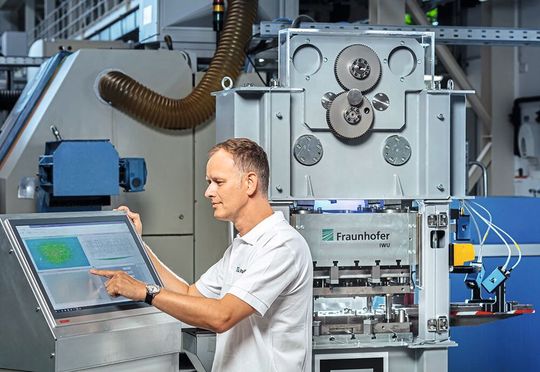
The intelligent groove stone Smartnotch is directly installed in the T-slots of presses and measures forces on the workpiece. The sensor technology is intended to enable condition monitoring and predictive maintenance, among other things.
Intelligent sensors can be used in the T-slots of presses.
(Image: Fraunhofer IWU, Dirk Hanus)
For mechanical engineers, the year 2025 will be about investing in future-proof technologies despite declining orders and sales figures. The modernization of manufacturing contributes to greater competitiveness and economic stability. The intelligent groove stone Smartnotch, a development of the Fraunhofer Cluster of Excellence Cognitive Internet Technologies CCIT, provides the basis for efficiency improvements with its sensors.
As part of the research project "Edge Cloud Continuum for Production" (ECC4P) by CCIT, sensor data along the entire processing chain is aggregated, analyzed, and transformed into valuable insights for more efficient operations using learning systems such as artificial intelligence—combining the benefits of retrofitting and cognitive internet technologies. Smartnotch is a key component for sensory data acquisition.
Forming machines such as presses and rollers are fundamental components of the industrial manufacturing process. However, they are very expensive to purchase and require significant time for setup and adjustment, leading to high investment costs. This poses a challenge for users and manufacturers: reconciling efficiency, cost savings, quality, and the durability of the machines with the considerable initial costs.
Retrofitting, i.e., the modernization, technological enhancement or conversion of existing systems, allows
to specifically increase efficiency,
to extend the lifespan,
to implement new functions,
without having to invest in completely new systems.
In addition, current standards and technologies can be utilized to meet new regulations and, if necessary, address required safety requirements.
Smart Sensor Technology for Agile And Successful Manufacturing Companies
An example of such retrofit technology is the intelligent groove stone Smartnotch from Fraunhofer CCIT. This is an innovative sensor that is directly installed in the standardized T-slots of a press and measures the applied force on the workpiece. The groove stone is therefore used directly at the site of the forming process without disrupting the established workflow. The sensor system is being developed in several sizes, allowing it to be installed in both large and small slots.
Smartnotch continuously monitors and automates production processes within the press. Classic use cases for Smartnotch include condition monitoring and predictive maintenance. The groove stone is installed, for example, at the interface to the tool and in the T-slots of the press table and ram. This turns machine components, which previously had no specific function, into valuable data sources for condition monitoring and predictive maintenance.
The responsible parties receive transparent information, enabling them, with the help of artificial intelligence, to detect wear, predict failures, and identify production errors at an early stage. This makes it possible to plan maintenance work proactively to avoid downtime, material damage, and consequently, revenue losses.
With the groove stone Smartnotch, machines can also be prepared for a new project in a resource-efficient way. An example can be found in research on market-ready hydrogen production. To achieve the status of industrial-scale series production, cost-effective materials, high-quality components for innovative electrolyzers, as well as the scalability and networking of production processes, are essential.
Smartnotch makes an important contribution to quality monitoring by complementing and aggregating data on system and process conditions with the measurement results of the sensor technology. This increases transparency in times of growing complexity, making production more efficient and agile—both factors impacting product costs. Challenges such as high demands on production facilities due to new materials, complex geometries, or small batch sizes thus become manageable.
Trustworthy Data Spaces As A Foundation
The sensor system Smartnotch is part of the research and development project "Edge Cloud Continuum for Production" (ECC4P) by Fraunhofer CCIT. ECC4P combines the advantages of edge and cloud computing—low latency on the one hand and scalable computing capacities on the other—thereby providing manufacturing companies with the possibilities of a closed and sovereign data space.
Date: 08.12.2025
Naturally, we always handle your personal data responsibly. Any personal data we receive from you is processed in accordance with applicable data protection legislation. For detailed information please see our privacy policy.
Consent to the use of data for promotional purposes
I hereby consent to Vogel Communications Group GmbH & Co. KG, Max-Planck-Str. 7-9, 97082 Würzburg including any affiliated companies according to §§ 15 et seq. AktG (hereafter: Vogel Communications Group) using my e-mail address to send editorial newsletters. A list of all affiliated companies can be found here
Newsletter content may include all products and services of any companies mentioned above, including for example specialist journals and books, events and fairs as well as event-related products and services, print and digital media offers and services such as additional (editorial) newsletters, raffles, lead campaigns, market research both online and offline, specialist webportals and e-learning offers. In case my personal telephone number has also been collected, it may be used for offers of aforementioned products, for services of the companies mentioned above, and market research purposes.
Additionally, my consent also includes the processing of my email address and telephone number for data matching for marketing purposes with select advertising partners such as LinkedIn, Google, and Meta. For this, Vogel Communications Group may transmit said data in hashed form to the advertising partners who then use said data to determine whether I am also a member of the mentioned advertising partner portals. Vogel Communications Group uses this feature for the purposes of re-targeting (up-selling, cross-selling, and customer loyalty), generating so-called look-alike audiences for acquisition of new customers, and as basis for exclusion for on-going advertising campaigns. Further information can be found in section “data matching for marketing purposes”.
In case I access protected data on Internet portals of Vogel Communications Group including any affiliated companies according to §§ 15 et seq. AktG, I need to provide further data in order to register for the access to such content. In return for this free access to editorial content, my data may be used in accordance with this consent for the purposes stated here. This does not apply to data matching for marketing purposes.
Right of revocation
I understand that I can revoke my consent at will. My revocation does not change the lawfulness of data processing that was conducted based on my consent leading up to my revocation. One option to declare my revocation is to use the contact form found at https://contact.vogel.de. In case I no longer wish to receive certain newsletters, I have subscribed to, I can also click on the unsubscribe link included at the end of a newsletter. Further information regarding my right of revocation and the implementation of it as well as the consequences of my revocation can be found in the data protection declaration, section editorial newsletter.
In practice, this means: On the one hand, the implemented sensor technology, Smartnotch, is used for data acquisition. Parameters such as temperature, vibration, process force, or pressure are recorded there.
Augmented by data from machine sensors and other sources (forming force, stroke rate, operating time, error messages, or material consumption), comprehensive information about the entire processing chain can be collected. A new added value for factory operators arises when data from the various sources is consolidated, structurally analyzed, and evaluated on an Edge IPC (Industrial PC). This allows processes to be optimized more easily and precisely and, if necessary, shared with other involved stakeholders (manufacturers, suppliers, service providers, etc.)—a demand that is increasingly coming to the forefront when considering the entire value chain.
The results obtained are already suitable for regulating machines without latency and drawing general conclusions about production processes. Only through the combination with machine learning (ML) technologies do manufacturing companies fully benefit from all advantages. ML models analyze and interpret the data to detect and prevent production waste, process anomalies, or tool wear. This process takes place in the cloud, where the necessary computing power is available.
For further use, the insights are fed back to the local IPCs in the form of specifically trained models. The transfer takes place in a sovereign data space, meaning third parties do not have uncontrolled access to the information. This creates a continuous and seamless processing of data in the so-called Machine Learning Operations (MLOps) pipeline.
Future-Proofing With Industry 4.0
Cognitive internet technologies such as the intelligent groove stone Smartnotch form the foundation for the competitiveness of industrial companies. They not only enable existing systems to be prepared for the demands of digitalized production instead of making costly new purchases but also increase the efficiency, transparency, and agility of production, among other things, through condition monitoring and predictive maintenance.
The combination of robust sensor concepts with sovereign data processing and intelligent analysis significantly expands the functionality of forming machines and makes them valuable data sources. Artificial intelligence and machine learning play a crucial role in deriving insights from the data and using them for process optimization.
A trustworthy data space, where cognitive internet technologies operate, is thus the key to agile and resilient production systems.
Michael Fritz is the head of the office of the Fraunhofer Cluster of Excellence Cognitive Internet Technologies CCIT.



:quality(80)/p7i.vogel.de/wcms/31/84/3184f9ac736d8df7c2e934593684bc74/0130024314v1.jpeg "Here, the Bavarian car manufacturer BMW looks ahead to 2025: business was sluggish due to US tariffs and weakening sales in China ... (Image:BMW)")
:quality(80)/p7i.vogel.de/wcms/49/09/49095c6192a6c46d47b567e1def31ea6/0130024626v1.jpeg "The new TUM \"RoboGym\" (powered by Neura) is Europe's largest training center for next-generation humanoid robots. It focuses on the implementation of artificial intelligence in robotic systems. At the same time, it is a forge for AI experts ... (Image:Neura Robotics)")
:quality(80)/p7i.vogel.de/wcms/fe/8a/fe8af1b829b085210fef4c1fa8abddb5/0129784389v1.jpeg "As an integral part of Koch Pac-Systeme's Predictive Pack digital service product, the gearboxes with Cynapse and Wittenstein's Smart Services make it possible to detect damage risks in the packaging specialist's machines at an early stage. (Image:Koch Pac systems)")
:quality(80)/p7i.vogel.de/wcms/9f/7b/9f7be35880605811e045acd3af8b571b/0129558586v1.jpeg "An example of the V210 processing machine, which, according to Voortman, supplements the laser cutting of the V353 with drilling, thread cutting and milling. (Image:Voortman)")
:quality(80)/p7i.vogel.de/wcms/db/68/db689490e348201603dd30447711ea2b/0129578734v1.jpeg "With three-axis vibration measurement (X, Y and Z axes) and temperature detection, the CMSVT38 condition monitoring sensor provides detailed status information that helps to detect machine damage at an early stage. (Image:Kübler)")
:quality(80)/p7i.vogel.de/wcms/92/5e/925ee98ea36ad9bd574fa1cea11d0e53/0129964352v1.jpeg "The production of hardware components for humanoid robots offers great market potential. (Image:Fraunhofer IPA)")
:quality(80)/p7i.vogel.de/wcms/08/72/0872dd2dd119a54824c41e0e580e45a8/0129576591v1.jpeg "The Rose enclosure systems can be customized on request. (Image:Rose Systemtechnik GmbH)")
:quality(80)/p7i.vogel.de/wcms/73/17/7317794432521bf911711b91287cfc28/0129961259v1.jpeg "ABB Robotics and Nvidia are enabling the widespread use of physical AI in the world of robotics. This means that systems can be created virtually and with high precision and optimized much more cost-effectively. In the large image the virtual system, next to it the real robot cell ... (Image:ABB)")
:quality(80)/p7i.vogel.de/wcms/cb/fe/cbfe2741917274bbbf93d5b93e47a4f5/contact-software-launcht-fourier-20aiv1v1.png "Fourier AI combines AI models with AI applications developed for demanding engineering tasks. (Image:Contact Software)")
:quality(80)/p7i.vogel.de/wcms/bc/f7/bcf7a56980850be13ed37d220cd514bc/elchinator-security-5042249-1280-1280x720v1v1.jpeg "The HP Wolf Security Report shows: Attackers use AI for speed, modularity and automation, while the quality of campaigns is low. (Image:Picture: Pixabay)")
:quality(80)/p7i.vogel.de/wcms/68/89/688937087188b77da95b2079399ca862/0130009534v1.jpeg "Here you can see the Dualis layout configurator in use at Montratec. (Picture: ©Gorodenkoff - stock.adobe.com)")
:quality(80)/p7i.vogel.de/wcms/9e/98/9e984afbf9c6f2bcc8963bd13465b180/26-02-pi-fraunhofer-iws-41300-ultragrain-project-closing-pic-02-1562x878v1v1.png "The process of laser wire build-up welding (DED-LB) with pulse laser-induced plasma, which contributed to the success of the Ultra Grain project, is shown at high speed. (Image:Fraunhofer IWS)")
:quality(80)/p7i.vogel.de/wcms/69/f5/69f516f07a0ba999c5ba8763891853f1/0130030553v1.jpeg "Can be reloaded in 210 seconds for a return trip on the Greenford branch line: the GWR's 230001. (Image:Jack Boskett Media | GWR)")
:quality(80)/p7i.vogel.de/wcms/f0/5e/f05e720c52f757660ddbf7c410074f64/adobestock-222131875-5616x3157v1.jpeg "(Source: © jeson - stock.adobe.com)")
:quality(80)/p7i.vogel.de/wcms/b2/64/b2641254fef5afa15645cefc37089c88/0130021093v1.jpeg "Daimler Truck and Quantum Systems are jointly developing unmanned military vehicles. (Image:Quantum Systems)")
:quality(80)/p7i.vogel.de/wcms/30/7e/307e71ec64f7c52c29458544ca29adf1/org-blobs-user-response-file-output-799034cb-2ad7-4031-859a-15013f5b78e3-plugin-output-toolu-01vwfuenhw3cadvud7pddgyq-1536x864v1v1.png "China's government is debating the contents of the 15th five-year plan. The focus will change for the automotive industry. (Image:AI-generated)")
:quality(80)/p7i.vogel.de/wcms/61/8f/618f16f8fa95ec6cc838ca9bfb5dbaf1/0130027046v1.jpeg "The Belgian Research Institute has set up a European university consortium on the subject of CMOS 2.0. It brings together 26 university groups to research chip technologies that go beyond conventional transistor scaling. (Image:Imec)")
:quality(80)/p7i.vogel.de/wcms/db/a2/dba29322d0934dea1bbc4b31df80e392/0129953760v1.jpeg "SEM image: High-density electrode array with 128 nm dots. (Image:imec)")
:quality(80)/p7i.vogel.de/wcms/c2/a8/c2a8a93f306c1475489dff074ad59731/0129967672v1.jpeg "Figure 1: Imec's logic technology roadmap showing the extension of the nanosheet era from 2nm to the A10 node with the outer-wall forksheet, before the transition to CFET for A7 and beyond. (Image:imec)")
:quality(80)/p7i.vogel.de/wcms/07/79/0779a3ba2b38d583fc9b515900be2add/0129957428v1.jpeg "If the Chinese government has its way, domestic data centers full of Nvidia hardware will be a thing of the past. (Image:Nvidia)")
:fill(fff,0)/images.vogel.de/vogelonline/companyimg/76800/76895/65.jpg "FAULHABER_120mm.jpg ()")
:fill(fff,0)/p7i.vogel.de/companies/69/88/69882c428938e/tmts2026-ticec-banner-en-2000px.png "tmts2026-ticec-banner-en-2000px (https://www.tmts.tw/en)")
:fill(fff,0)/p7i.vogel.de/companies/67/eb/67eba621ef6ea/logo2.png "logo2 (Wuxi InfiMotion)")
:quality(80):fill(efefef,0)/p7i.vogel.de/wcms/67/ad/67adf92d254d2/elatec-wp-smart-factory.png "Elatec WP Smart Factory")
:quality(80)/p7i.vogel.de/wcms/64/9b/649b068b198ca4e9b54d578140255183/0128002936v1.jpeg "Cognitive Cities: Connected transportation, energy, and industrial infrastructures respond to data streams in real-time, creating the foundation for a learning, adaptive city. (Image:AI-generated)")
:quality(80)/p7i.vogel.de/wcms/2e/d4/2ed4912f1b0fab416d5cfe5c0c7b94f6/0127832864v1.jpeg "Smart Notch—robust and highly precise, smartNOTCH measures the smallest elastic deformations of the T-slots of a press during operation. This allows processes to be monitored and errors to be detected. (Image:Fraunhofer IWU)")