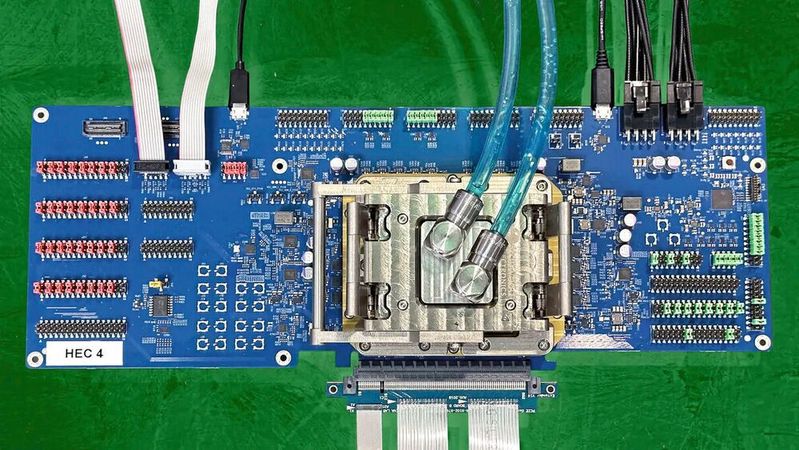
With Heracles, Intel is demonstrating a special accelerator for Fully Homomorphic Encryption, which processes encrypted data directly without decryption and significantly accelerates FHE operations. Sensitive data also remains securely protected during the processing procedure.
The Heracles chip from Intel calculates fully encrypted data without decrypting it. According to the company, the chip is 1,074 to 1,547 times faster than an Intel Xeon with 24 cores in FHE (Fully Homomorphic Encryption) computing operations.
(Image: Intel)
Intel has presented Heracles, a special chip that performs calculations on fully encrypted data without having to decrypt the data during processing. The accelerator was presented at the ISSCC and is designed for Fully Homomorphic Encryption, or FHE for short. The aim is to protect sensitive data from attacks even during the actual processing.
For years, FHE has been considered a promising approach for data protection-critical applications, such as cloud services, medical analyses or secure database queries. However, practical use has often failed to date due to the high computing costs. Compared to processing unencrypted data, today's CPUs and GPUs require many times more time for FHE operations.
According to Intel, Heracles achieves an acceleration by a factor of 1074 to 5547 for seven central FHE operations compared to a 24-core Xeon of the Sapphire Rapids generation. In a demo shown, an encrypted query on a Xeon server took 15 milliseconds, while Heracles completed the same task in 14 microseconds. Extrapolated to large amounts of data, the difference would be significant.
Architecture for A Narrowly Defined Application
Heracles is not a general-purpose processor or x86 system, but a dedicated accelerator for FHE math. The chip does not run general-purpose software or an operating system. It is designed to efficiently map precisely those operations that cause the greatest effort in homomorphic encryption.
Technically, Intel relies on a highly parallelized architecture with 64 so-called tile pairs, which are arranged in an 8×8 mesh. Each tile pair contains 128 parallel computing paths, resulting in an 8192-fold SIMD computing network. The units are optimized for modular addition, subtraction, multiplication and butterfly operations for number-theoretic transforms and inverse transforms.
Heracles uses 32-bit arithmetic slices for the calculations. According to Intel, this decision was an essential architectural approach to keep precision and parallelism in a practicable ratio. Since FHE works with very large numbers, polynomial arithmetic, automorphisms and bootstrapping, the aim is to improve speed and scalability without losing sight of the mathematical requirements.
Data Movement Becomes the Central Bottleneck
A significant part of the challenge lies not only in the computing logic, but also in the data movement. FHE typically increases data volumes by orders of magnitude compared to plain text. This significantly increases the requirements for memory connection, intermediate storage and internal data paths.
Heracles is therefore equipped with 48 GByte HBM3, distributed across two memory stacks, and connects these to the processor at 819 GByte/s. In addition, there are 64 MB of internal scratchpad or cache memory, large register files and dedicated buffers. Within the chip, data is transported between the computing units via wide connections and with a throughput in the terabyte range per second.
In order to decouple computing and data traffic from each other, the accelerator works with three synchronized instruction streams simultaneously: one for data transfer to and from the chip, one for internal data movement and a third for the actual computing operations. Intel sees this as a decisive factor for the acceleration achieved, as FHE workloads are heavily dependent on the balance between computing load and memory accesses.
Start-Ups Are Working on Comparable Solutions
Heracles is manufactured using the Intel 3 process. The chip occupies 0.31 in², clocks at 1.2 GHz, operates within a power range of 176 watts and is designed as a liquid-cooled PCIe accelerator card for use alongside standard servers. Several important FHE schemes are supported, including BGV, BFV and CKKS, as well as different parameter sets and security levels.
Intel classifies Heracles as the result of a multi-year DARPA program that was specifically designed to accelerate FHE with custom hardware. The company particularly emphasizes the scaling achieved, both in terms of chip size and computing power. According to the project team, Heracles thus marks an early but important step towards practically usable encrypted data processing.
At the same time, the market is still open. Start-ups such as Niobium Microsystems, Fabric Cryptography, Cornami and Optalysys are also working on FHE accelerators, partly with digital and partly with photonic approaches. While Intel has not yet mentioned any specific commercialization plans, other providers are already explicitly targeting cloud and AI infrastructures. Heracles thus shows above all that specialized hardware can significantly push the performance limits of FHE, even if it remains to be seen which architecture will prevail in practical use.(sg)
Date: 08.12.2025
Naturally, we always handle your personal data responsibly. Any personal data we receive from you is processed in accordance with applicable data protection legislation. For detailed information please see our privacy policy.
Consent to the use of data for promotional purposes
I hereby consent to Vogel Communications Group GmbH & Co. KG, Max-Planck-Str. 7-9, 97082 Würzburg including any affiliated companies according to §§ 15 et seq. AktG (hereafter: Vogel Communications Group) using my e-mail address to send editorial newsletters. A list of all affiliated companies can be found here
Newsletter content may include all products and services of any companies mentioned above, including for example specialist journals and books, events and fairs as well as event-related products and services, print and digital media offers and services such as additional (editorial) newsletters, raffles, lead campaigns, market research both online and offline, specialist webportals and e-learning offers. In case my personal telephone number has also been collected, it may be used for offers of aforementioned products, for services of the companies mentioned above, and market research purposes.
Additionally, my consent also includes the processing of my email address and telephone number for data matching for marketing purposes with select advertising partners such as LinkedIn, Google, and Meta. For this, Vogel Communications Group may transmit said data in hashed form to the advertising partners who then use said data to determine whether I am also a member of the mentioned advertising partner portals. Vogel Communications Group uses this feature for the purposes of re-targeting (up-selling, cross-selling, and customer loyalty), generating so-called look-alike audiences for acquisition of new customers, and as basis for exclusion for on-going advertising campaigns. Further information can be found in section “data matching for marketing purposes”.
In case I access protected data on Internet portals of Vogel Communications Group including any affiliated companies according to §§ 15 et seq. AktG, I need to provide further data in order to register for the access to such content. In return for this free access to editorial content, my data may be used in accordance with this consent for the purposes stated here. This does not apply to data matching for marketing purposes.
Right of revocation
I understand that I can revoke my consent at will. My revocation does not change the lawfulness of data processing that was conducted based on my consent leading up to my revocation. One option to declare my revocation is to use the contact form found at https://contact.vogel.de. In case I no longer wish to receive certain newsletters, I have subscribed to, I can also click on the unsubscribe link included at the end of a newsletter. Further information regarding my right of revocation and the implementation of it as well as the consequences of my revocation can be found in the data protection declaration, section editorial newsletter.



:quality(80)/p7i.vogel.de/wcms/31/1f/311fb5b8aa1683b31cca284c8d33f443/0130073373v1.jpeg "Ceratizit has forged a very stable supply chain through a sophisticated and comprehensive recycling concept as well as through its holdings in tungsten mines. Here are some details ... (Image:Ceratite)")
:quality(80)/p7i.vogel.de/wcms/4c/49/4c49ab206af08de47d42c35bacc89c1d/0129539746v1.jpeg "With CPQ software, sales staff can create quotes for complex heavy-duty vehicles in minutes. (Image:TII Scheuerle)")
:quality(80)/p7i.vogel.de/wcms/bc/29/bc29ee18ce776b1915e10e07c1525f3a/0129766196v1.jpeg "The control cabinet is integrated into the rear of the press frame and offers accessibility with a small overhang thanks to the variable door opening. (Image:Tox)")
:quality(80)/p7i.vogel.de/wcms/fe/8a/fe8af1b829b085210fef4c1fa8abddb5/0129784389v1.jpeg "As an integral part of Koch Pac-Systeme's Predictive Pack digital service product, the gearboxes with Cynapse and Wittenstein's Smart Services make it possible to detect damage risks in the packaging specialist's machines at an early stage. (Image:Koch Pac systems)")
:quality(80)/p7i.vogel.de/wcms/b5/34/b534e64b2db218cdb5ad938898cbed56/0130044810v1.jpeg "The magnet of the torus-shaped tokamak reactor will generate magnetic pulses lasting up to 500 seconds and heat the enclosed plasma to a temperature of 150 million degrees. (Image:Iter)")
:quality(80)/p7i.vogel.de/wcms/97/28/9728e560d751dd54acd8b88a82ff7330/0129610882v1.jpeg "Temperature measuring devices are essential for monitoring industrial processes and thus ensuring high product quality. (Image:Micro-Epsilon)")
:quality(80)/p7i.vogel.de/wcms/6b/0d/6b0d694b060190016a4db18401fa55eb/0129937458v1.jpeg "(Picture: ©AI-generated)")
:quality(80)/p7i.vogel.de/wcms/db/68/db689490e348201603dd30447711ea2b/0129578734v1.jpeg "With three-axis vibration measurement (X, Y and Z axes) and temperature detection, the CMSVT38 condition monitoring sensor provides detailed status information that helps to detect machine damage at an early stage. (Image:Kübler)")
:quality(80)/p7i.vogel.de/wcms/48/8a/488afa7c9416394023a5ea1095f4ee4b/rfc4800-1-787x443v1v1.jpeg "Precise, intelligent and robust sensors will play a key role in an increasingly automated and data-driven world. (Image:Novotechnology)")
:quality(80)/p7i.vogel.de/wcms/08/70/087062e2e1a9b9add5777410dd746ee9/adobestock-1923991605-5607x3156v1v1.jpeg "A new type of tactile sensor, inspired by human skin, even recognizes grains of sand. (Image:Curioso.Photography - stock.adobe.com)")
:quality(80)/p7i.vogel.de/wcms/7f/08/7f087d7013424d123ab7275cd2e3fe55/adobestock-809456218--c2-a9-20degimages-20-e2-80-93-20stock-adobe-com-ki-generiert-4179x2351v1v1.jpeg "The digital upgrading of existing machines conserves resources, saves energy and reduces the need for new production. (Image:Degimages - stock.adobe.com/AI-generated)")
:quality(80)/p7i.vogel.de/wcms/dd/ce/ddcef80b290218276bf857cdb64a45e1/finkel-stephan-4162x2341v1.jpeg "Stephan Finkel, Partner and Industry Lead Defence & Security at 3DSE (Source: 3DSE)")
:quality(80)/p7i.vogel.de/wcms/34/e2/34e2a9e46e59eb28f09f9a5fdf41ff9a/0130091813v1.jpeg "Electrical drive trains require a multidimensional concept of performance characterization. Rohde & Schwarz has developed the MXO 3 oscilloscope series for this purpose. (Image:Rohde & Schwarz)")
:quality(80)/p7i.vogel.de/wcms/c9/2a/c92af18e41b077a518994a2ba60eb09f/0130037726v1.jpeg "The Renault subsidiary has presented a new brand strategy (Image:Alpine)")
:quality(80)/p7i.vogel.de/wcms/d8/fc/d8fc13ba0ae6e2180b3954cb1f1bd34c/0130060162v1.jpeg "Volkswagen has started series production of the ID Unyx 08. The model was developed in collaboration with Xpeng. (Image:Volkswagen)")
:quality(80)/p7i.vogel.de/wcms/f5/80/f5809e877017e40b413b48fcd8452246/cefmof-hydrogen-station-29-2048x1366-2048x1152v1v1.jpeg "The hydrogen filling station in Jyväskylä. The electrolyzer is installed in the fenced area at the top right. (Image:Cefmof Hydrogen)")
:quality(80)/p7i.vogel.de/wcms/3d/f2/3df286b8c62e72218e4ea42dcd959ee1/0130050208v1.jpeg "The Heracles chip from Intel calculates fully encrypted data without decrypting it. According to the company, the chip is 1,074 to 1,547 times faster than an Intel Xeon with 24 cores in FHE (Fully Homomorphic Encryption) computing operations. (Image:Intel)")
:quality(80)/p7i.vogel.de/wcms/f6/a5/f6a587801c676040f1e6413a7d305e33/0130062380v1.jpeg "Nvidia is investing 4 billion US dollars in silicon photonics. The aim is to avoid an impending bottleneck in the AI infrastructure. (Image:freely licensed)")
:quality(80)/p7i.vogel.de/wcms/02/36/02364f083b3023cee3b3f0893ea3f859/0129857003v1.jpeg "AI will continue to drive growth in the semiconductor market in 2026. (Image:Dall-E / AI-generated)")
:quality(80)/p7i.vogel.de/wcms/61/8f/618f16f8fa95ec6cc838ca9bfb5dbaf1/0130027046v1.jpeg "The Belgian Research Institute has set up a European university consortium on the subject of CMOS 2.0. It brings together 26 university groups to research chip technologies that go beyond conventional transistor scaling. (Image:Imec)")
:fill(fff,0)/p7i.vogel.de/companies/69/88/69882c428938e/tmts2026-ticec-banner-en-2000px.png "tmts2026-ticec-banner-en-2000px (https://www.tmts.tw/en)")
:fill(fff,0)/p7i.vogel.de/companies/67/eb/67eba621ef6ea/logo2.png "logo2 (Wuxi InfiMotion)")
:quality(80):fill(efefef,0)/p7i.vogel.de/wcms/67/ad/67adf92d254d2/elatec-wp-smart-factory.png "Elatec WP Smart Factory")
:quality(80)/p7i.vogel.de/wcms/c9/c4/c9c4e42b9b054ec7ae0a3045170c07b6/0128162746v1.jpeg "Development workflow with Renesas e² studio: With Renesas e² studio, IoT applications can be downloaded from GitHub, configured, developed, and deployed on RA, RX, or RZ controllers – including connectivity to AWS and Microsoft Azure. (Image:Renesas Electronics Corporation)")
:quality(80)/p7i.vogel.de/wcms/33/94/339421aa5a946da29da42255fcb3371c/0127286415v1.jpeg "Intel's CEO Lip-Bu Tan: 18A production starts at Fab 52 in Arizona. (Image:Intel)")