Miniaturization, dense assembly and increasing quality requirements are pushing electronics production to its limits. The solution: integrated system solutions that consider vision, precision handling, testing and IT networking as an end-to-end process.
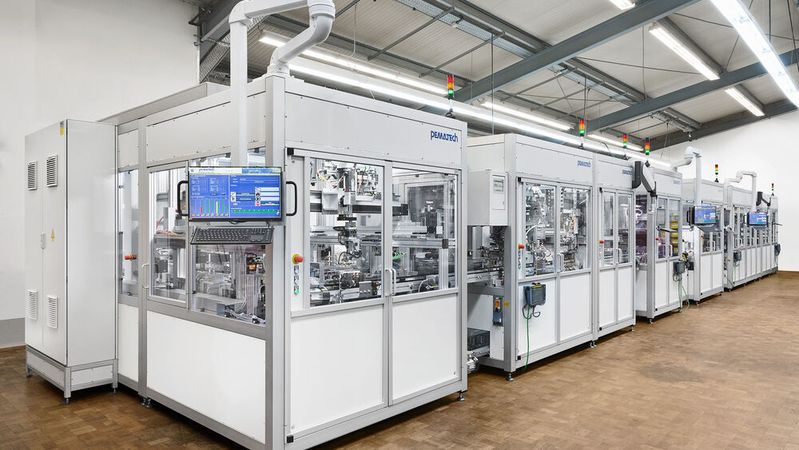
Efficiency in series production: Pematech's highly automated production line combines precision, speed and data intelligence.
(Image: Pematech)
Electronics are becoming smaller, denser and more sensitive. At the same time, production needs to be faster, more stable and fully traceable. These are a number of requirements that classic stand-alone systems in production can hardly cope with without integrated automation. Many factories therefore rely on integrated automation solutions: Camera systems that check position and quality in real time; grippers and axes that reliably hit the micrometer; test cells that bundle several processes into one cycle chain.
The combination of mechanics, software and data management plays a central role here: only when handling, testing and the IT layer are linked together can processes be created that are reproducible, efficient and future-proof.
For this purpose, an IT layer merges the data from the line, MES and ERP. The effect is measurable: processes are reproducible, noticeably less rework is required and valid data for quality, service and management is also generated.
Vision Systems & Precision Handling
The biggest challenge with PCBs with high packing density (HDI) and embedded technologies as well as sensitive substrates is to position the components gently, quickly and with repeat accuracy. Practical solutions therefore combine camera-based position detection with vacuum or special grippers and dynamic axis systems. In highly automated environments, Scara robots and linear positioning axes are also used, which enable precise part handling with high cycle performance.
One practical example realized by Pematech is the automated parts handling and logistics for DBC substrates (Direct Bonded Copper). The sensitive ceramic circuit boards are moved precisely and gently using vacuum grippers. Camera systems record the position of the substrates and correct them in real time if necessary before they are transferred to the next station. All process steps are simultaneously linked via the MES system, ensuring transparency, traceability and consistently high process quality.
Control and data flow are coordinated centrally via the LineManager, which connects inspection cells, handling modules and camera systems, thus enabling end-to-end monitoring and communication with the MES. In this way, a fully integrated, digitally controlled production step is created from detection and gripping—from the tray to the next processing module.
Automated Test Solutions for Complex Assemblies
Dense assembly and multiple interfaces require a high level of test coverage. While manual test adapters and individual stations were sufficient in the past, flexible, integrated test cells that can be modularly adapted to different assemblies and ensure complete test coverage are in demand today. At the same time, they combine in-circuit (ICT) and functional tests (FKT) and fit seamlessly into the line. Modern systems cover a broad spectrum—from compact individual cells to highly integrated robot solutions. Pematech, a specialist in automation solutions, develops customized solutions for customers that meet the requirements of their products. The developers use standard modules that can be adapted precisely in the next step. Pematech has implemented numerous projects in recent years, including the following three application examples.
Compact Test Cell for Series Production
A compact TCIL test cell is used in classic series applications. A robust toggle mechanism with spindle drive (AC servo motor) contacts up to 3,060 test points with 3-N pins in a handling time of around six seconds. Several contacting levels enable the combination of ICT and FKT; if required, also with additional functions such as "pusher" or step mode for testing and programming. The strength of this solution lies in its throughput. Short cycle times are combined with a compact footprint and reproducible test results for medium to high quantities with a homogeneous assembly structure.
Multilevel System for A Wide Range of Variants
A multilevel test cell (ML-TCIL) comes into its own when product variety and quantities increase in equal measure. It allows up to eight pneumatic or six servo-electric contacts to be made simultaneously and automatically distributes the PCBs to the respective levels using a lift. This allows ICT, FKT and flash programming to be carried out in parallel. The cycle time remains short even with longer test sequences.
A key advantage is the modular scalability, as the test systems can be changed quickly so that new product families or variants can be integrated without major modifications. Such a solution is ideal for medium to large series with frequent product changes.
Robot Cell for Fully Automated Lines
A modular robot cell adapted to customer requirements offers the highest level of integration. A solution implemented by Pematech includes ICT, flash, end-of-line (EOL), laser marking and packaging in customer containers in a continuous process. Pematech is also able to implement complete inspection lines consisting of a combination of standard modules and comprising process steps such as magazine storage, depaneling, robot cell, optical measurement of the saw cut, FKT/ICT, laser marking, manual workstation and product carrier return transport.
Date: 08.12.2025
Naturally, we always handle your personal data responsibly. Any personal data we receive from you is processed in accordance with applicable data protection legislation. For detailed information please see our privacy policy.
Consent to the use of data for promotional purposes
I hereby consent to Vogel Communications Group GmbH & Co. KG, Max-Planck-Str. 7-9, 97082 Würzburg including any affiliated companies according to §§ 15 et seq. AktG (hereafter: Vogel Communications Group) using my e-mail address to send editorial newsletters. A list of all affiliated companies can be found here
Newsletter content may include all products and services of any companies mentioned above, including for example specialist journals and books, events and fairs as well as event-related products and services, print and digital media offers and services such as additional (editorial) newsletters, raffles, lead campaigns, market research both online and offline, specialist webportals and e-learning offers. In case my personal telephone number has also been collected, it may be used for offers of aforementioned products, for services of the companies mentioned above, and market research purposes.
Additionally, my consent also includes the processing of my email address and telephone number for data matching for marketing purposes with select advertising partners such as LinkedIn, Google, and Meta. For this, Vogel Communications Group may transmit said data in hashed form to the advertising partners who then use said data to determine whether I am also a member of the mentioned advertising partner portals. Vogel Communications Group uses this feature for the purposes of re-targeting (up-selling, cross-selling, and customer loyalty), generating so-called look-alike audiences for acquisition of new customers, and as basis for exclusion for on-going advertising campaigns. Further information can be found in section “data matching for marketing purposes”.
In case I access protected data on Internet portals of Vogel Communications Group including any affiliated companies according to §§ 15 et seq. AktG, I need to provide further data in order to register for the access to such content. In return for this free access to editorial content, my data may be used in accordance with this consent for the purposes stated here. This does not apply to data matching for marketing purposes.
Right of revocation
I understand that I can revoke my consent at will. My revocation does not change the lawfulness of data processing that was conducted based on my consent leading up to my revocation. One option to declare my revocation is to use the contact form found at https://contact.vogel.de. In case I no longer wish to receive certain newsletters, I have subscribed to, I can also click on the unsubscribe link included at the end of a newsletter. Further information regarding my right of revocation and the implementation of it as well as the consequences of my revocation can be found in the data protection declaration, section editorial newsletter.
This makes the test an integral part of the line: programming, testing and marking run as a closed, highly productive process from the infeed to the customer-specific container. All process modules—from the robot controller to the laser unit—are connected via the Pematech LineManager.
Integration in Smart Factory Environments
With all integrated automation solutions, there is one key element that holds everything together, namely the intelligent handling of data. Although large amounts of data are already being generated in modern production processes, they rarely reach the places where they create real added value. The key lies in the consistent connection to MES and ERP systems via standardized interfaces, such as SECS/GEM. Only when production, inspection and logistics data are linked together can the full potential be exploited. The LineManager acts as a central data and communication interface within the line. It connects robots, cameras, inspection cells and handling modules and provides process data in real time for quality management and maintenance strategies.
In practice, this means automatic distribution of recipes and test programs, seamless traceability down to serial number and test step level, as well as the use of real measured values for SPC analyses and quality rules. In addition, systems and axes provide comprehensive status data that can be evaluated for predictive maintenance. This creates a closed information loop with transparency at all levels—from the line to management. This turns test and handling systems into active data suppliers within the smart factory.
Interaction Creates the Real Added Value
Integrated solutions are most effective when their components work together. The vision system records the position and quality of the assembly, and the handling system converts this data into precise movements in the micrometer range. The test cell checks electrical functions, programs components and transfers the results to the IT layer, which consolidates all process data. As a higher-level control instance, the LineManager ensures the synchronization of all processes and thus enables the close integration of hardware, software and quality assurance.
This creates a continuous, traceable and audit-proof production flow that can be optimized at any time if required. Whether compact TCIL cell, scalable ML-TCIL, modular test line with magazine, depaneling, measuring and laser marking or fully automated robot cell with end-of-line test—integrated automation reduces rejects, shortens test times and provides reliable process data. This is not some unproven dream of the future, as many of these solutions are already in use in series production today. (sb)
Secure and Compliant Authentication in Laboratories



:quality(80)/p7i.vogel.de/wcms/f9/7d/f97deef8fde21c8630d76411b18a20a7/0129803665v1.jpeg "Skoda has invested well over 220 million US dollars in the high-tech battery plant that has now opened in Mlada Boleslav. It has now started its work, which is highly automated ... (Image:Skoda)")
:quality(80)/p7i.vogel.de/wcms/f5/61/f561ad7c72ed41fd7a67ad9c481cb15d/0129799343v1.jpeg "Engine-generator units (MGU) from Steyr Motors are at work in the Leopard 2 main battle tank and the Leguan bridge vehicle (pictured). An extended contract is now to secure at least 500 more systems of this type for the Bundeswehr ... (Image:German Armed Forces)")
:quality(80)/p7i.vogel.de/wcms/6c/b5/6cb5ce2155433f6e73b16399adc4c561/0113143253v1.jpeg "In our China Market Insider we regularly provide you with relevant information directly from China. (Image:© Eisenhans - stock.adobe.com)")
:quality(80)/p7i.vogel.de/wcms/7f/fd/7ffd32863352c40f562f4245e4766e61/0129745849v1.jpeg "After US President Donald Trump once again resorted to his favorite weapon, tariffs, concerns rose in the EU that the so-called tariff deal could become invalid. But it looks as if the sea remains relatively calm ... (Image:F. Schneidler)")
:quality(80)/p7i.vogel.de/wcms/6b/e2/6be235b5ad8a442ccd9d164b0b300d8b/0129763992v1.jpeg "As early as 2020, the Zimmer Group announced that it would convert its production to be sustainably CO2-neutral. (Image:Zimmer Group)")
:quality(80)/p7i.vogel.de/wcms/d4/ba/d4bab9481e66f8570f40eb8ef2a90198/0129795613v1.jpeg "A camera inspection during removal ensures that the components are placed correctly in the KLTs. (Image:Yaskawa Europe)")
:quality(80)/p7i.vogel.de/wcms/cb/56/cb56e42b01638b618e8d1b9b38f32faa/0129810132v1.jpeg "From summer 2026, \"AEON\" will support people at the BMW plant in Leipzig. (Image:diephotodesigner.de/BMW)")
:quality(80)/p7i.vogel.de/wcms/f5/ec/f5ece650750781c91c73c307085de7c5/0129778970v1.jpeg "Structured automation: The new 11-layer reference model of the ISA-112 is designed to bring order to complex SCADA architectures and standardize the integration of field devices through to the cloud. (Image:Nano Banana / AI-generated)")
:quality(80)/p7i.vogel.de/wcms/f5/7e/f57ef535ee35e7b3b7ff15a8a63cef10/eds-keyvisual-8000x4496v1.jpeg "(Source: European Defence Supply)")
:quality(80)/p7i.vogel.de/wcms/af/a3/afa312176d956068af20491957eef642/newsimage418262-3100x1745v1v1.jpeg "The autonomous shuttle of the Aula AI project during a demonstration of sensor data with artificial fog. (Image:University of Magdeburg)")
:quality(80)/p7i.vogel.de/wcms/84/2d/842d51915fa4fe69c72da5cc4ba52ed1/newsimage418103-3408x1917v1v1.jpeg "3 Printing can also be sustainable—if recyclable ink is used. (Image:Hereon/Steffen Niemann)")
:quality(80)/p7i.vogel.de/wcms/b0/78/b078e07634ffd4d5ee6b73af42cc7c55/newsimage418259-1000x563v1v1.jpeg "Magnesium during forming. (Image:TU Bergakademie Freiberg)")
:quality(80)/p7i.vogel.de/wcms/ca/14/ca142d9d19c3fa714a28af5df8288d33/0129781016v1.jpeg "Holon and Charterup have entered into a partnership to put autonomous mobility on the road in the USA. (Image:Holon)")
:quality(80)/p7i.vogel.de/wcms/c7/5e/c75e5942cd1d7e6bce973391af6dafe8/0129757614v1.jpeg "Pony.ai is cooperating with Moore Threads to bring Level 4 autonomous driving to the roads in China more quickly. (Image:Pony.ai)")
:quality(80)/p7i.vogel.de/wcms/a8/9f/a89ff7a3e28a19c03a22fd16cf3404b4/0129761837v1.jpeg "KD and Hitachi High-Tech have concluded a distribution agreement. (Image:KD)")
:quality(80)/p7i.vogel.de/wcms/7f/c1/7fc1c83b8509df676d27518b82aaef02/0129764984v1.jpeg "China Resources Microelectronics (CR Micro) has announced its intention to increase the prices of its own products. (Image:China Resources Microelectronics)")
:quality(80)/p7i.vogel.de/wcms/eb/4e/eb4e449562174ec95a5b3d30fb0137a2/0129648135v1.jpeg "The III-V germanium PV module with an efficiency of 34.2% is currently the most efficient solar module in the world. (Image:Jacob Forster)")
:quality(80)/p7i.vogel.de/wcms/92/c2/92c23fd5d95286c8c8c634314f6b22f8/0129722027v1.jpeg "The Meta Group has signed a five-year contract for GPU and CPU deliveries to expand its AI capacities. The agreement covers the delivery of up to 6 gigawatts of GPU computing power with a total value of around USD 60 billion. (Image:freely licensed)")
:quality(80)/p7i.vogel.de/wcms/01/77/017742db7d5eb5964c297bb8917df701/0129696639v1.jpeg "Mini-STX K3921-N: The motherboard masters Intel's Core i3 and N-Series processors and can connect multiple monitors with Full HD. (Image:Kontron)")
:fill(fff,0)/images.vogel.de/vogelonline/companyimg/76800/76895/65.jpg "FAULHABER_120mm.jpg ()")
:fill(fff,0)/p7i.vogel.de/companies/69/88/69882c428938e/tmts2026-ticec-banner-en-2000px.png "tmts2026-ticec-banner-en-2000px (https://www.tmts.tw/en)")
:fill(fff,0)/p7i.vogel.de/companies/67/eb/67eba621ef6ea/logo2.png "logo2 (Wuxi InfiMotion)")
:quality(80)/p7i.vogel.de/wcms/04/d5/04d5709122cdc02b2d33a38518a579e7/0127459904v1.jpeg "Scalable: Thanks to its high scalability, the robot cell can be individually adapted to customer requirements.(Image: Nico Pudimat)")
:quality(80)/p7i.vogel.de/wcms/23/4b/234b4414d2a4be955f10d0659f25e7c3/0127459906v1.jpeg "(Image: Pematech)")
:quality(80)/p7i.vogel.de/wcms/5f/a4/5fa47e854201a54d9765c36b47a212b9/0127459910v1.jpeg "Parts handling: Vacuum suction pads enable careful and precise parts handling with fast cycle times.(Image: Pematech)")
:quality(80)/p7i.vogel.de/wcms/a6/fc/a6fc20d939bc33d9f5d081357c2478c9/0127459913v1.jpeg "Precision and speed: A SCARA robot is the specialist for fast, precise and flat handling - ideal when components have to be picked up, positioned or assembled with high repeat accuracy.(Image: Pematech)")
:quality(80):fill(efefef,0)/p7i.vogel.de/wcms/67/ac/67acb931a438c/elatec-wp-gmp.png "Elatec WP GMP")
:quality(80)/p7i.vogel.de/wcms/97/30/973070ec16cf21f7a1a7fa2e7ca4a017/0127798518v1.jpeg "The electric servo press AM-ESP S is equipped with sensors and intelligent drive control. This allows force and displacement to be precisely controlled and documented. (Image:Delta Electronics)")
:quality(80)/p7i.vogel.de/wcms/76/74/76741895df02ffd13e8844aee3572155/0128805929v1.jpeg "The KMP 1500P is used in the Krone plant in Werlte to minimize forklift traffic. (Image:Kuka)")