Exciting times lie ahead for designers and engineers: Traditional and generative AI will provide relief in daily tasks while simultaneously fostering groundbreaking ideas. For this, companies now need to establish the right foundation.
In engineering, powerful workstations are the be-all and end-all to be well-prepared for the AI era.
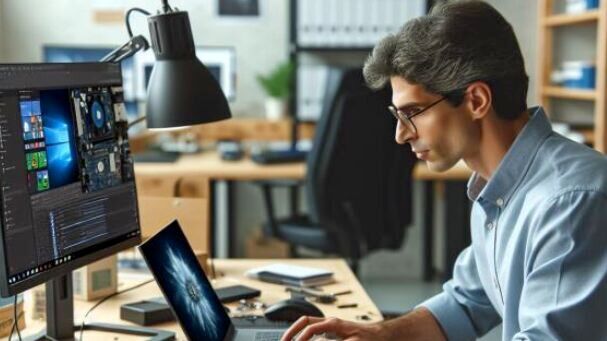
(Image: Dell Technologies)
Despite the general AI euphoria, artificial intelligence (AI) is still in its infancy, especially in engineering. It is undisputed that CAD software and design processes will fundamentally change through AI. Above all, routine tasks will become easier for engineers in the future. In this way, they can then focus more on the creative and strategic aspects of their work. However, it will take a little longer before the even more powerful generative AI or AI agents, as assumed by specialists, have penetrated all subfields. Then, however, the diverse possibilities of (generative) AI and newer technologies based on it will not only lead to efficiency improvements but also bring about a completely new way of designing and developing.
AI can now do more than just take over monotonous and redundant tasks.
Because artificial intelligence can now do more than just take over monotonous and redundant tasks. Experts also agree that, particularly in the form of generative AI, it will elevate the creative potential of engineers to a whole new level. A relatively new development is AI agents (Agentic AI), which are also causing disruption. They can not only act as assistants on users' commands but also interact socially in an autonomous manner, meaning they can receive, process, and handle information. Analyzing or generating data and passing the conclusions drawn from investigations on to other AI agents or human engineers are also among their capabilities.
AI is Making Its Way Into Everyday Design Tasks
Even today, there are initial applications of artificial intelligence in design that offer a glimpse into the future.
One example is the automated dimensioning of 3D models according to DIN standards. AI can provide precise dimensions within seconds. This task alone has previously cost designers a lot of time: either because they had to set the dimensions manually or had to subsequently check tools that only sporadically worked flawlessly until now.
AI can also be used in the preparation of simulation models, for example, to filter out irrelevant details and thus optimize working time. For instance, if an engineer designs an exhaust and wants to simulate the exhaust gas circulation within the structure, it is unnecessary to consider the strength or the exact nature of an external bracket. However, these values are stored in the model, and it would take a lot of time to remove them manually for the simulation. Artificial intelligence can do this reliably in a matter of seconds.
Similarly helpful is AI in the visualization of 3D models. For virtual prototypes and CAD models, it is important in the design process that the representation is not only extremely detailed but also that the workstation can render the components in real-time. For this purpose, Nvidia's DLSS (Deep Learning Super Sampling) technology is used, for example. It utilizes AI to render images in low resolution and then upscale them via a neural network. The image quality does not suffer from this type of upscaling, but the graphics card requires less power compared to traditional methods. DLSS can also enhance image output in flow simulations and crash analyses and visualize movements, such as for 360-degree views, more smoothly.
The Boundaries of What is Possible in Design and Development are Shifting
Far-reaching applications are already emerging for the near future. Generative AI will, for example, be able to design components that are entirely novel in form and function. The creativity and analytical abilities of designers are based—just like those of artificial intelligence—on what has existed so far. However, humans limit themselves by always keeping in mind how components are manufactured. Even five-dimensional milling has its limits, which generative AI does not need to consider. Through sintering, modern 3D printing, and additive manufacturing methods, designers may in the future be able to develop and produce organic structures and components that exceed the performance of classical designs and defy current imagination.
Another fascinating future scenario is AI-supported optimization of existing designs. Here, AI could independently identify weaknesses, suggest alternative solutions, and improve the efficiency of final products. The designer would thus become the "curator" of various AI-generated options, representing a completely new type of creative process.
"Trust me, Bro": The Eternal Question of Trust in AI
Despite the enormous potential, several hurdles still stand in the way of the widespread introduction of AI in design and engineering. A central challenge is the question of trust: Can engineers and companies trust the results of AI blindly? The answer is short and clear: No. Therefore, the verification and validation of AI-generated designs will initially mean additional effort. However, this effort will decrease as AI models mature. Furthermore, it is possible that companies or software providers may offer their own AI tools in the future to verify specific calculations and models—essentially an AI that checks the design AI based on specialized data foundations.
Can engineers and companies blindly trust the results of an AI? The answer is short and clear: No.
Legal questions also remain unresolved. In principle, it is possible to feed an AI model with all the knowledge from all patents and developments that are publicly accessible. This would make a lot of sense, as it is the only way a company can avoid reinventing the proverbial wheel. However, the question arises whether a component based on such a wealth of data might violate patent rights. This is a problem that remains unresolved and one that lawyers are currently finding difficult to assess—simply because the necessary legal precedents are lacking. Although the EU is working on corresponding regulations to create legal certainty, they have not yet come into effect.
Creating the Right Foundation for AI
To use AI profitably and effectively in design, companies must first establish the right data foundation. This is perhaps the greatest challenge. However, this does not only involve collecting data but also selecting and curating it: not all information is truly relevant for training a highly specialized AI. Above all, it is essential to incorporate the specific knowledge and experience of employees. At the same time, the data must also be regularly updated, ideally in real time. The good news, however, is that it is becoming increasingly easier for small and medium-sized enterprises to train their artificial intelligence.
Using the Right Hardware for the AI Era
In addition to these software-related challenges, integrating AI into design processes also places new demands on hardware. Companies need not only new workstations to accelerate processes for the AI era of engineering. Powerful work devices are, moreover, the key to fully leveraging the potential of AI-supported CAD software. Workstation manufacturers like Dell Technologies rely on a combination of high-clocked CPUs and high-performance GPUs with large graphics memory to achieve this. The reason lies in the architecture of modern CAD software, which still primarily benefits from processors with fast single cores. Over the past decades, functions that benefit from multi-core processors have only been introduced sporadically to the market and have yet to gain widespread adoption. GPUs have proven effective for AI-based features, as they are also essential for visualization and rendering. Neural Processing Units (NPUs) could become more important in the future, but so far there are no applications in the CAD field that would benefit more from a Neural Processing Unit than from a GPU.
Date: 08.12.2025
Naturally, we always handle your personal data responsibly. Any personal data we receive from you is processed in accordance with applicable data protection legislation. For detailed information please see our privacy policy.
Consent to the use of data for promotional purposes
I hereby consent to Vogel Communications Group GmbH & Co. KG, Max-Planck-Str. 7-9, 97082 Würzburg including any affiliated companies according to §§ 15 et seq. AktG (hereafter: Vogel Communications Group) using my e-mail address to send editorial newsletters. A list of all affiliated companies can be found here
Newsletter content may include all products and services of any companies mentioned above, including for example specialist journals and books, events and fairs as well as event-related products and services, print and digital media offers and services such as additional (editorial) newsletters, raffles, lead campaigns, market research both online and offline, specialist webportals and e-learning offers. In case my personal telephone number has also been collected, it may be used for offers of aforementioned products, for services of the companies mentioned above, and market research purposes.
Additionally, my consent also includes the processing of my email address and telephone number for data matching for marketing purposes with select advertising partners such as LinkedIn, Google, and Meta. For this, Vogel Communications Group may transmit said data in hashed form to the advertising partners who then use said data to determine whether I am also a member of the mentioned advertising partner portals. Vogel Communications Group uses this feature for the purposes of re-targeting (up-selling, cross-selling, and customer loyalty), generating so-called look-alike audiences for acquisition of new customers, and as basis for exclusion for on-going advertising campaigns. Further information can be found in section “data matching for marketing purposes”.
In case I access protected data on Internet portals of Vogel Communications Group including any affiliated companies according to §§ 15 et seq. AktG, I need to provide further data in order to register for the access to such content. In return for this free access to editorial content, my data may be used in accordance with this consent for the purposes stated here. This does not apply to data matching for marketing purposes.
Right of revocation
I understand that I can revoke my consent at will. My revocation does not change the lawfulness of data processing that was conducted based on my consent leading up to my revocation. One option to declare my revocation is to use the contact form found at https://contact.vogel.de. In case I no longer wish to receive certain newsletters, I have subscribed to, I can also click on the unsubscribe link included at the end of a newsletter. Further information regarding my right of revocation and the implementation of it as well as the consequences of my revocation can be found in the data protection declaration, section editorial newsletter.
The Daily Work of Engineers Will Change
All these technological advancements in the field of AI will have a tremendous impact on the daily work of designers and engineers in the future. Theoretically, highly specialized AI agents are already capable of processing information, making a decision, and passing it on to another AI agent or a human designer.
Example: If a brake pedal for a new electric vehicle is to be developed, it usually takes weeks from concept to simulation. This time could be shortened with today's technology by providing an AI agent with specific information about the maximum pedal force required, the length of the travel, the material, the mount, the target weight, and the bore for sensors. Once the CAD AI agent has completed its work and created the concept, it passes the results to the CAE AI agent, which subjects the model to a simulated durability test with 800,000 cycles and then returns this result to the human engineer for review. While this is still theoretical, the only remaining obstacle is that selecting the data and training these AIs is currently not possible without highly specialized experts.
AI Acts as a Source of Inspiration for the Engineer
Currently, there is still a shortage of such specialized personnel in engineering. In the long run, however, companies in design will definitely have to address the development of AI expertise. Only in this way can they remain competitive and likely innovative in the long term. AI-supported designs certainly have potential, even if they serve "only" as a foundation and inspiration for human engineers. But engineers need not worry about their jobs in the future: AI is and will remain a tool that supports them in solving complex problems and enables new approaches. It cannot replace them. Harnessing and leveraging the synergies between human and artificial intelligence is the key to success in the industry.
AI remains a tool that supports solving complex problems and enables new approaches. It cannot replace them.



:quality(80)/p7i.vogel.de/wcms/31/84/3184f9ac736d8df7c2e934593684bc74/0130024314v1.jpeg "Here, the Bavarian car manufacturer BMW looks ahead to 2025: business was sluggish due to US tariffs and weakening sales in China ... (Image:BMW)")
:quality(80)/p7i.vogel.de/wcms/49/09/49095c6192a6c46d47b567e1def31ea6/0130024626v1.jpeg "The new TUM \"RoboGym\" (powered by Neura) is Europe's largest training center for next-generation humanoid robots. It focuses on the implementation of artificial intelligence in robotic systems. At the same time, it is a forge for AI experts ... (Image:Neura Robotics)")
:quality(80)/p7i.vogel.de/wcms/fe/8a/fe8af1b829b085210fef4c1fa8abddb5/0129784389v1.jpeg "As an integral part of Koch Pac-Systeme's Predictive Pack digital service product, the gearboxes with Cynapse and Wittenstein's Smart Services make it possible to detect damage risks in the packaging specialist's machines at an early stage. (Image:Koch Pac systems)")
:quality(80)/p7i.vogel.de/wcms/9f/7b/9f7be35880605811e045acd3af8b571b/0129558586v1.jpeg "An example of the V210 processing machine, which, according to Voortman, supplements the laser cutting of the V353 with drilling, thread cutting and milling. (Image:Voortman)")
:quality(80)/p7i.vogel.de/wcms/db/68/db689490e348201603dd30447711ea2b/0129578734v1.jpeg "With three-axis vibration measurement (X, Y and Z axes) and temperature detection, the CMSVT38 condition monitoring sensor provides detailed status information that helps to detect machine damage at an early stage. (Image:Kübler)")
:quality(80)/p7i.vogel.de/wcms/92/5e/925ee98ea36ad9bd574fa1cea11d0e53/0129964352v1.jpeg "The production of hardware components for humanoid robots offers great market potential. (Image:Fraunhofer IPA)")
:quality(80)/p7i.vogel.de/wcms/08/72/0872dd2dd119a54824c41e0e580e45a8/0129576591v1.jpeg "The Rose enclosure systems can be customized on request. (Image:Rose Systemtechnik GmbH)")
:quality(80)/p7i.vogel.de/wcms/73/17/7317794432521bf911711b91287cfc28/0129961259v1.jpeg "ABB Robotics and Nvidia are enabling the widespread use of physical AI in the world of robotics. This means that systems can be created virtually and with high precision and optimized much more cost-effectively. In the large image the virtual system, next to it the real robot cell ... (Image:ABB)")
:quality(80)/p7i.vogel.de/wcms/cb/fe/cbfe2741917274bbbf93d5b93e47a4f5/contact-software-launcht-fourier-20aiv1v1.png "Fourier AI combines AI models with AI applications developed for demanding engineering tasks. (Image:Contact Software)")
:quality(80)/p7i.vogel.de/wcms/bc/f7/bcf7a56980850be13ed37d220cd514bc/elchinator-security-5042249-1280-1280x720v1v1.jpeg "The HP Wolf Security Report shows: Attackers use AI for speed, modularity and automation, while the quality of campaigns is low. (Image:Picture: Pixabay)")
:quality(80)/p7i.vogel.de/wcms/68/89/688937087188b77da95b2079399ca862/0130009534v1.jpeg "Here you can see the Dualis layout configurator in use at Montratec. (Picture: ©Gorodenkoff - stock.adobe.com)")
:quality(80)/p7i.vogel.de/wcms/9e/98/9e984afbf9c6f2bcc8963bd13465b180/26-02-pi-fraunhofer-iws-41300-ultragrain-project-closing-pic-02-1562x878v1v1.png "The process of laser wire build-up welding (DED-LB) with pulse laser-induced plasma, which contributed to the success of the Ultra Grain project, is shown at high speed. (Image:Fraunhofer IWS)")
:quality(80)/p7i.vogel.de/wcms/69/f5/69f516f07a0ba999c5ba8763891853f1/0130030553v1.jpeg "Can be reloaded in 210 seconds for a return trip on the Greenford branch line: the GWR's 230001. (Image:Jack Boskett Media | GWR)")
:quality(80)/p7i.vogel.de/wcms/f0/5e/f05e720c52f757660ddbf7c410074f64/adobestock-222131875-5616x3157v1.jpeg "(Source: © jeson - stock.adobe.com)")
:quality(80)/p7i.vogel.de/wcms/b2/64/b2641254fef5afa15645cefc37089c88/0130021093v1.jpeg "Daimler Truck and Quantum Systems are jointly developing unmanned military vehicles. (Image:Quantum Systems)")
:quality(80)/p7i.vogel.de/wcms/30/7e/307e71ec64f7c52c29458544ca29adf1/org-blobs-user-response-file-output-799034cb-2ad7-4031-859a-15013f5b78e3-plugin-output-toolu-01vwfuenhw3cadvud7pddgyq-1536x864v1v1.png "China's government is debating the contents of the 15th five-year plan. The focus will change for the automotive industry. (Image:AI-generated)")
:quality(80)/p7i.vogel.de/wcms/61/8f/618f16f8fa95ec6cc838ca9bfb5dbaf1/0130027046v1.jpeg "The Belgian Research Institute has set up a European university consortium on the subject of CMOS 2.0. It brings together 26 university groups to research chip technologies that go beyond conventional transistor scaling. (Image:Imec)")
:quality(80)/p7i.vogel.de/wcms/db/a2/dba29322d0934dea1bbc4b31df80e392/0129953760v1.jpeg "SEM image: High-density electrode array with 128 nm dots. (Image:imec)")
:quality(80)/p7i.vogel.de/wcms/c2/a8/c2a8a93f306c1475489dff074ad59731/0129967672v1.jpeg "Figure 1: Imec's logic technology roadmap showing the extension of the nanosheet era from 2nm to the A10 node with the outer-wall forksheet, before the transition to CFET for A7 and beyond. (Image:imec)")
:quality(80)/p7i.vogel.de/wcms/07/79/0779a3ba2b38d583fc9b515900be2add/0129957428v1.jpeg "If the Chinese government has its way, domestic data centers full of Nvidia hardware will be a thing of the past. (Image:Nvidia)")
:fill(fff,0)/p7i.vogel.de/companies/67/eb/67eba621ef6ea/logo2.png "logo2 (Wuxi InfiMotion)")
:quality(80)/p7i.vogel.de/wcms/96/e0/96e03845d40ff0fbf82494b9205f5caa/0124307414v1.jpeg "The innovative design-space-exploration tool Neural-Shipper understands the semantics of the shape of moving objects, evaluates performance, and optimizes hulls in terms of flow. (Image:Compute Maritime)")
:quality(80)/p7i.vogel.de/wcms/4d/74/4d745446555110ca9797db1eabb7c9d3/0129551585v1.jpeg "Jochen Gemeinhardt is responsible for NTT Data's AI business in the DACH region as Head of Production & Supply Chain and Head of Industry Line Global Business. (Image:NTT Data)")
:quality(80)/p7i.vogel.de/wcms/b0/0d/b00dcac5c7e9aaeed281ee2bb4b1e45e/0124187260v1.jpeg "The AI systems technician: An example of a future AI occupation. They ensure that intelligent technologies operate smoothly. (Image:Gorodenkoff - stock.adobe.com)")