Lightweight materials such as sandwich structures have been difficult to join with conventional connection techniques so far. Bossard has now developed a solution for this problem with multi-material welding.
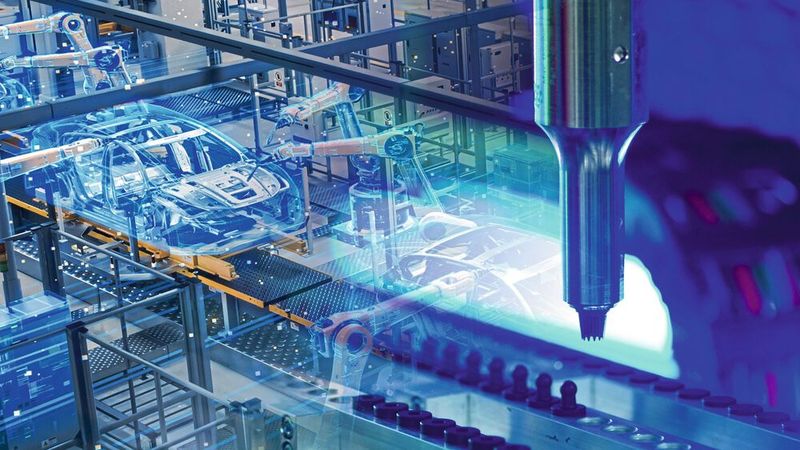
The multi-material welding technology is a fastening technique that uses ultrasonic energy to form a force-fit and form-fit bond in porous materials, sheet metal structures, sandwich materials, injection-molded, and pressed parts. It is used, among other things, in the automotive industry.
(Image: Bossard)
The topic of "lightweight construction" is one of the most important and innovative drivers in development and production across almost all industries. The focus everywhere is on reducing weight, resources (sustainability), and costs, and on recycling. Not least in the broad field of the automotive industry and especially in e-mobility, lightweight materials such as porous fiber composites, expanded polypropylene (EPP), or sandwich constructions (with honeycomb or foam cores) are increasingly being used.
EPP foam, in addition to providing high structural strength at low weight, good energy absorption, and thermal insulation capabilities, offers especially numerous design options.
Gallery
How to connect sandwich structures?
What to do, however, when lightweight materials need to be joined? Especially when some of the strictest requirements and regulations for fastening and connection technology must be met in the tension between "maximally safe" and "as light as possible"?
The goal is to process plastics (almost) like regular sheet metal, but: Lightweight materials make it challenging to either join them together or attach a solid mounting or connecting element to them. With compact materials, conventional connections, such as classic screw fittings usually with pre-drilling, are often used. However, in a sandwich construction, it is much more difficult to anchor a screw, for example, due to its core structure.
With our modern alternative to adhesives, rotation welding and embedding, we offer an innovative solution for joints in lightweight construction.
Christian Busch, Business Development Manager Bossard Germany
The solution: Multi-material welding
"The answer is provided by Multi-Material Welding technology," says Christian Busch. The Business Development Manager responsible for Multi-Material (MM) Welding technology at Bossard Germany continues: "With our modern alternative to adhesives, friction welding, and embedding, we offer an innovative solution for connections in lightweight construction. We are not only optimizing production processes but also saving effort, time, and especially costs – without having to compromise on quality, durability, and reliability."
Connection process takes less than 1 second
Keyword EPP foam: MM-Welding technology also enables the creation of new designs and constructions by directly integrating the connection geometry into the component. But how does this technology work? The principle: insulating, waterproof, dirt-repellent, robust, flexible, lightweight, cost-effective, and recyclable - with the Multi-Material-Welding technique, the specially developed polymer fastener is partially liquefied by ultrasound. In a sandwich construction, it then creates a form-fit connection on the top side through an undercut – on the core and the underside, a kind of "micro-clawing" occurs. After the connection element immediately solidifies, it forms a solid screw point with the entire structure. And this is durable and immediately able to bear loads right after the joining process. This process takes literally only one second or less than 0.7 seconds, which in turn results in very favorable production processes with very short cycle times.
AI software ensures quality
Important: The quality of the connection is measured during the connection process itself. This is ensured by Big Data, artificial intelligence, and the software "MM-Welding Smart-Solutions," which guarantees seamless process monitoring. According to Christian Busch: "Thanks to this approach, testing through destructive examination is no longer necessary."
In focus: Customer-specific solutions and further developments
To increasingly serve customer-specific demands individually, Bossard continues to work on new technologies for multi-material welding. To date, there are seven:
The LiteWWeight Pin for fast and strong fixing on sandwich structures. This is a family of fasteners with a lightweight one-sided accessible assembly process, designed for fast and strong fixing on sandwich structures with internal honeycomb patterns or similar.
The LiteWWeight Lotus is a fast and secure connection concept for fiber components and textile structures. Typical applications include: car floor coverings, heat shields, wheel arch linings, roof linings, NVH (Noise, Vibration, and Harshness).
The LiteWWeight Lotus Abalone significantly accelerates the assembly of the male clip component of floor mat fastenings. No punching or cutting is required, and the joining of two separate components is eliminated. This clip can also be attached to the floor/carpet after the sound insulation has been applied to the back of the floor/carpet.
The LiteWWeight zEPP is a fast and efficient connection technology for all EPP materials.
The LiteWWeight Double Pin is designed for fast and strong fixing, suitable for plastic direct screw connections with metric internal thread or even with a through hole. The fastener consists of a sleeve, as a slider, and optionally a metallic insert, which can be selected depending on the application.
Date: 08.12.2025
Naturally, we always handle your personal data responsibly. Any personal data we receive from you is processed in accordance with applicable data protection legislation. For detailed information please see our privacy policy.
Consent to the use of data for promotional purposes
I hereby consent to Vogel Communications Group GmbH & Co. KG, Max-Planck-Str. 7-9, 97082 Würzburg including any affiliated companies according to §§ 15 et seq. AktG (hereafter: Vogel Communications Group) using my e-mail address to send editorial newsletters. A list of all affiliated companies can be found here
Newsletter content may include all products and services of any companies mentioned above, including for example specialist journals and books, events and fairs as well as event-related products and services, print and digital media offers and services such as additional (editorial) newsletters, raffles, lead campaigns, market research both online and offline, specialist webportals and e-learning offers. In case my personal telephone number has also been collected, it may be used for offers of aforementioned products, for services of the companies mentioned above, and market research purposes.
Additionally, my consent also includes the processing of my email address and telephone number for data matching for marketing purposes with select advertising partners such as LinkedIn, Google, and Meta. For this, Vogel Communications Group may transmit said data in hashed form to the advertising partners who then use said data to determine whether I am also a member of the mentioned advertising partner portals. Vogel Communications Group uses this feature for the purposes of re-targeting (up-selling, cross-selling, and customer loyalty), generating so-called look-alike audiences for acquisition of new customers, and as basis for exclusion for on-going advertising campaigns. Further information can be found in section “data matching for marketing purposes”.
In case I access protected data on Internet portals of Vogel Communications Group including any affiliated companies according to §§ 15 et seq. AktG, I need to provide further data in order to register for the access to such content. In return for this free access to editorial content, my data may be used in accordance with this consent for the purposes stated here. This does not apply to data matching for marketing purposes.
Right of revocation
I understand that I can revoke my consent at will. My revocation does not change the lawfulness of data processing that was conducted based on my consent leading up to my revocation. One option to declare my revocation is to use the contact form found at https://contact.vogel.de. In case I no longer wish to receive certain newsletters, I have subscribed to, I can also click on the unsubscribe link included at the end of a newsletter. Further information regarding my right of revocation and the implementation of it as well as the consequences of my revocation can be found in the data protection declaration, section editorial newsletter.
The InWWerse Fastener: Based on MM-Welding ultrasonic technology, threaded carriers with InWWerse Fastener are securely anchored on thermoplastic materials. Here, the substrate material, fastening element, and process control can be adjusted so that even with thin wall thicknesses, no visible markings are detectable on the opposite side. The anchoring is not based on adhesion but on a micro-positive connection with the thermoplastic component material. This ensures the fastest possible further processing, and complex pretreatment processes can be avoided. These connecting elements are used, for example, in the exterior cladding of electric vehicles. During production, adhesives can be omitted, and surface cleaning with environmentally problematic products is no longer necessary – fully in line with the sustainability goals of an automotive manufacturer.
The InWWerse Disc is a connection solution for the fast and secure joining of traditionally non-weldable plastic components.
Even thin wall thicknesses can be securely joined without creating a "read-through effect." Minimal penetration depth and preservation of Class-A surfaces.



:quality(80)/p7i.vogel.de/wcms/53/f7/53f7dadbe4d656a3fd4f4077445f29f6/0129828707v1.jpeg "Thanks to its compact design and drilling/unscrewing function, the Fire Birdie is suitable for applications with limited installation space and frequent tool changes. (Image:Marcel Kraibühler)")
:quality(80)/p7i.vogel.de/wcms/da/4d/da4da8d34671dc6bce80e496212de877/0129850788v1.jpeg "Mate-XT Go supports the arms and shoulders during overhead work and repetitive tasks and is designed to significantly reduce muscle strain in everyday working life. (Image:Comau)")
:quality(80)/p7i.vogel.de/wcms/95/97/95976dbaac68b249eb65e74c5aad5300/0129651893v1.jpeg "The C2.0 centric clamps, the S2 fixed jaw clamps and the \"gredoc\" zero-point clamping systems are used for machining the raw parts. Fastening is carried out with width across flats 27. (Image:Gressel)")
:quality(80)/p7i.vogel.de/wcms/57/1b/571b8895efb299d70846bbdbd7af2338/0130043886v1.jpeg "Servo hydraulics independent of the control system: The servo hydraulics software module is integrated directly into the b Maxx 5500 servo drive (pictured: Mehmet Sari, Export Sales Manager at Hürsan Pres (left), Özgür Deniz Demirbaş, Country Manager at Baumüller Turkey) (Image:Baumüller)")
:quality(80)/p7i.vogel.de/wcms/3b/27/3b27f6c5848be73acecb04054bf0a146/0130115209v1.jpeg "Spectroscopic glucose measurement with infrared spectroscopy enables more regular measurements without physical strain. (Image:Endrich)")
:quality(80)/p7i.vogel.de/wcms/3f/cc/3fccb748b0fe16f1f61249d94c72f126/0130149439v1.jpeg "Requirements for integrated power supply systems: Precise AC and DC power supply systems that not only provide energy, but also reliably combine measurement, analysis and system integration. (Image:Schulz Electronic)")
:quality(80)/p7i.vogel.de/wcms/fd/93/fd93e01c16f5a4709278499d981a459c/0130061090v1.jpeg "Revealed: These servo drives are assembled at Aerotech in Fürth. (Image:Aerotech)")
:quality(80)/p7i.vogel.de/wcms/cb/8a/cb8ae7f5205365efce3e7285154fc3cf/0130132198v1.jpeg "Markus Huber (left) and Nicolai Friis from TU Wien know how to make quantum computers multidimensional in order to perform computing operations even better. (Image:TU Vienna / A. Rommel)")
:quality(80)/p7i.vogel.de/wcms/63/21/6321beb732bf7d92640df46d7aa77573/0130125122v1.jpeg "As part of the Carbon Lab Factory Lausitz, a pilot plant for the production of sustainable, cost-effective and competitive carbon fibers will be built at the Guben site. (Image:Fraunhofer IAP / Kristin Stein)")
:quality(80)/p7i.vogel.de/wcms/53/4f/534fe0f168f6ee070ded4a48faca4cef/business-wire-main-image-1103x620v1.jpeg "The new UR AI Trainer, developed by Universal Robots and Scale AI, is the first direct lab-to-factory solution for AI model training.
(Source: Universal Robots)")
:quality(80)/p7i.vogel.de/wcms/08/70/087062e2e1a9b9add5777410dd746ee9/adobestock-1923991605-5607x3156v1v1.jpeg "A new type of tactile sensor, inspired by human skin, even recognizes grains of sand. (Image:Curioso.Photography - stock.adobe.com)")
:quality(80)/p7i.vogel.de/wcms/7f/08/7f087d7013424d123ab7275cd2e3fe55/adobestock-809456218--c2-a9-20degimages-20-e2-80-93-20stock-adobe-com-ki-generiert-4179x2351v1v1.jpeg "The digital upgrading of existing machines conserves resources, saves energy and reduces the need for new production. (Image:Degimages - stock.adobe.com/AI-generated)")
:quality(80)/p7i.vogel.de/wcms/90/db/90db3087d3af0560fcdb4dbc42443ce1/0130157448v1.jpeg "The switch to SDV is the most complex transformation the industry has ever had to master. The end consumer gets a vehicle that gains rather than loses value over its lifetime. (Image:Sonatus)")
:quality(80)/p7i.vogel.de/wcms/73/f0/73f00bb99a23197db05bb584fe78f20f/0130080581v1.jpeg "The \"China Speed\" analysis by Roland Berger shows that the speed of development has only a limited connection with labor costs. (Image:freely licensed at Pexels)")
:quality(80)/p7i.vogel.de/wcms/2f/5b/2f5ba6a150b52c2b8efada560c5cdafe/0130143442v1.jpeg "Automotive suppliers are facing a severe crisis, which is primarily due to a combination of structural change and economic problems. (Image:freely licensed at Pexels)")
:quality(80)/p7i.vogel.de/wcms/22/d0/22d03cd48e992435338b59464c428d41/0129739814v1.jpeg "More electric vehicles on the roads mean a higher demand for electricity - which should ideally be covered by renewable energies. (Image:BMW)")
:quality(80)/p7i.vogel.de/wcms/94/7a/947ac066b98cbcd3470e83ff9da3e25f/0130096114v1.jpeg "The use of amorphous steels in the stator enables a significant reduction in losses and increases the efficiency of modern electric motors in vehicle drives. (Image:Horse Powertrain)")
:quality(80)/p7i.vogel.de/wcms/e5/f1/e5f171d3d7ae021332cc0aeae4d6e299/0130127049v1.jpeg "In collaboration with Shanghai Jiao Tong University, Lenovo has presented a silicon anode battery under the name \"ED1000\" as a proof of concept for mobile workstations. (Image:Lenovo)")
:quality(80)/p7i.vogel.de/wcms/fa/69/fa696e59706b96fff02283dd74cc2398/0130129635v1.jpeg "Samsung Co-CEO Jun Young-hyun wants to respond to the AI-driven boom in demand in the memory market with contracts for up to five years. This should provide more planning security in the traditionally volatile storage business. At the same time, however, this is likely to increase the pressure on customers to secure precise long-term requirements, prices and supply chains. (Image:Samsung)")
:quality(80)/p7i.vogel.de/wcms/31/a8/31a883a47b86634c382923e78fd9a4c9/0130133225v1.jpeg "Figure 1: GMSL-capable point-to-point connection. (Image:ADI)")
:fill(fff,0)/images.vogel.de/vogelonline/companyimg/76800/76895/65.jpg "FAULHABER_120mm.jpg ()")
:fill(fff,0)/p7i.vogel.de/companies/67/eb/67eba621ef6ea/logo2.png "logo2 (Wuxi InfiMotion)")
:quality(80)/p7i.vogel.de/wcms/c4/00/c400b45c331dc32dc70f3d700034d4df/0116522809.jpeg "Der LiteWWeight zEPP ist eine schnelle Verbindungstechnologie für alle EPP-Materialien.(Bild: Bossard)")
:quality(80)/p7i.vogel.de/wcms/ba/ca/baca108d3dde0b1964645fb14b8c6e4b/0116541685.jpeg "Die Multi-Material-Welding-Technologie ist eine Befestigungstechnik, die Ultraschallenergie zur Bildung einer kraft- und formschlüssigen Bindung in porösen Materialien, Blechstrukturen, Sandwich-Materialien, Spritzguss- und Pressformteilen verwendet. Sie findet ihren Einsatz u.a. in der Automobil- industrie.(Bild: Bossard)")
:quality(80)/p7i.vogel.de/wcms/f8/82/f882f6165fc612bfd975bfd04d50a4a1/0116522812.jpeg "Basierend auf der schnellen Multi-Material-Welding Ultraschalltechnologie werden Gewindeträger mit InWWerse Fastener sicher auf thermoplastischen Materialien verankert.(Bild: Bossard)")
:quality(80)/p7i.vogel.de/wcms/48/28/4828a3911d84ff3b438a279a81a435b2/0128555915v1.jpeg "Thermoplastic sandwich structures are intended to enable the efficient production of luggage compartments in aircraft cabins, such as this overhead storage bin. (Image:Diehl Aviation Laupheim GmbH)")
:quality(80)/p7i.vogel.de/wcms/71/a3/71a376f07227de76312124224ec16398/0125078217v1.jpeg "Metal foam contains up to 90 percent air and helps to make machines more efficient, lighter and at the same time more stable. Aluminum foam can be produced in a process that is similar in principle to baking bread. Powder, blowing agent and heat are required. (Image:VDW)")