From July 2026, China will allow electronic steering systems without mechanical backup. The new standard is considered a breakthrough for autonomous driving – and a multi-billion market for ZF and Bosch.
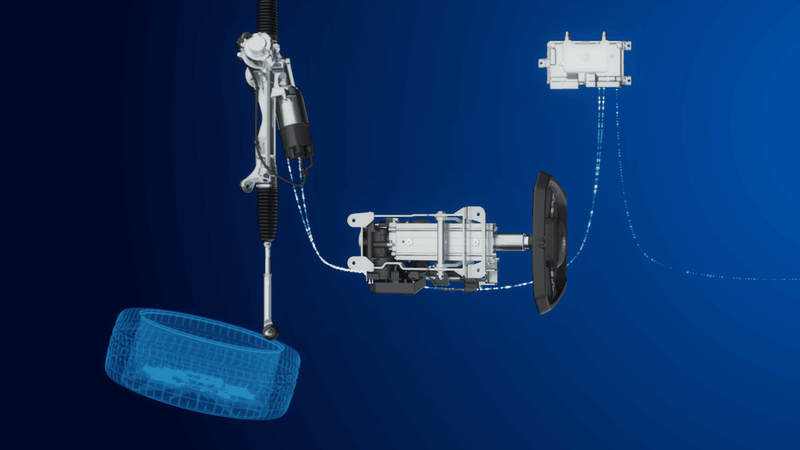
Allowed in China from July 2026: Steer-by-wire steering systems without a mechanical connection between the steering wheel and steering gear.
(Image: ZF)
China has legally regulated digital steering. A new industry standard for steer-by-wire systems (SBW) has been published, which will officially come into force on July 1, 2026. The steering column and any mechanical connection between the steering wheel and tires will only be an option in the People's Republic from this date, no longer a mandatory requirement.
This gives the new technology, in which ZF from Friedrichshafen and other pioneers have already invested substantial funds in their Chinese plants, a sort of quality seal from Beijing and a significant commercial boost.
The electric vehicle Nio "ET9," featuring a steer-by-wire (SBW) system from ZF, is already being produced in series in the People's Republic and has been on the market since this year. A generous interpretation of older standards and a special government approval made this possible. Now, it is expected that the standardization will accelerate the introduction of additional vehicle models with SBW in the world's largest automotive market.
From Joystick to Retractable Steering
This technology allows electronic control impulses and actuators to take over the work. Chips, software, and a few cables replace everything that is currently still typically done by complex mechanical steering columns with electronic assistance. The steering wheel then operates similarly to a joystick and can later be completely folded away or retracted into the cockpit when the vehicle is fully autonomous.
On December 3, the Standardization Administration of the People’s Republic of China (SAC), the central standardization authority in Beijing, published the industrial standard GB17675-2025 titled “Automotive Steering Systems – Basic Requirements.” This now officially allows OEMs to develop electronic steering systems where mechanical components are not even required as a "backup" for system failures. Dual systems combining electronics and mechanics remain permitted but are no longer mandatory.
The Chinese standard defines the functional safety of steer-by-wire (SBW) systems considering the latest advancements in other international standards such as UN R79 and ISO 26262, particularly regarding system redundancy to mitigate risks associated with power failure and signal transmission errors.
Electronic Instead of Mechanical Fail-Safe
The steering systems must operate reliably even under extreme temperatures, strong vibrations, and disturbances from electromagnetic waves. Manufacturers are required to document and obtain approval for their safety measures, such as technical redundancy through dual ECUs, dual sensors, or dual power supplies. The authority conducts random inspections.
"These requirements represent a transition from mechanical fail-safe to electronic fail-safe and compel manufacturers to develop highly reliable systems," states the Chinese automotive portal Wangtongshe.
Despite some drivers' concerns about removing any mechanical connection between the steering wheel and the wheels, the rise of steer-by-wire (SBW) systems is considered unstoppable among experts in China.
This is largely because SBW is a key technology for software-defined vehicles, making truly autonomous driving and advanced driver-assistance systems possible.
As automated driving at Level 2 and above increasingly replaces the driver with onboard computers and AI, chips and algorithms must be able to quickly access the steering and braking systems. Developers argue that this can be achieved much better and safer with purely electric and electronic architectures.
Tesla as a Pioneer, China as a Mass Market
Tesla was the first automaker to launch a production model with steer-by-wire (SBW) in December 2023 with its Cybertruck. However, the massive scaling of electromobility and automated driving functions in China is now creating the foundation for the definitive and likely global rise of steering without a steering column. SBW is expected to gradually spread from expensive luxury cars like the ET9 to more affordable segments of the Chinese automotive market as component prices decrease due to mass production.
Date: 08.12.2025
Naturally, we always handle your personal data responsibly. Any personal data we receive from you is processed in accordance with applicable data protection legislation. For detailed information please see our privacy policy.
Consent to the use of data for promotional purposes
I hereby consent to Vogel Communications Group GmbH & Co. KG, Max-Planck-Str. 7-9, 97082 Würzburg including any affiliated companies according to §§ 15 et seq. AktG (hereafter: Vogel Communications Group) using my e-mail address to send editorial newsletters. A list of all affiliated companies can be found here
Newsletter content may include all products and services of any companies mentioned above, including for example specialist journals and books, events and fairs as well as event-related products and services, print and digital media offers and services such as additional (editorial) newsletters, raffles, lead campaigns, market research both online and offline, specialist webportals and e-learning offers. In case my personal telephone number has also been collected, it may be used for offers of aforementioned products, for services of the companies mentioned above, and market research purposes.
Additionally, my consent also includes the processing of my email address and telephone number for data matching for marketing purposes with select advertising partners such as LinkedIn, Google, and Meta. For this, Vogel Communications Group may transmit said data in hashed form to the advertising partners who then use said data to determine whether I am also a member of the mentioned advertising partner portals. Vogel Communications Group uses this feature for the purposes of re-targeting (up-selling, cross-selling, and customer loyalty), generating so-called look-alike audiences for acquisition of new customers, and as basis for exclusion for on-going advertising campaigns. Further information can be found in section “data matching for marketing purposes”.
In case I access protected data on Internet portals of Vogel Communications Group including any affiliated companies according to §§ 15 et seq. AktG, I need to provide further data in order to register for the access to such content. In return for this free access to editorial content, my data may be used in accordance with this consent for the purposes stated here. This does not apply to data matching for marketing purposes.
Right of revocation
I understand that I can revoke my consent at will. My revocation does not change the lawfulness of data processing that was conducted based on my consent leading up to my revocation. One option to declare my revocation is to use the contact form found at https://contact.vogel.de. In case I no longer wish to receive certain newsletters, I have subscribed to, I can also click on the unsubscribe link included at the end of a newsletter. Further information regarding my right of revocation and the implementation of it as well as the consequences of my revocation can be found in the data protection declaration, section editorial newsletter.
Consequently, a new billion-dollar market for SBW is emerging in China, which is likely to provide significant earnings for the two German suppliers Bosch and ZF. ZF, based in Friedrichshafen, is considered a pioneer in this area and has collaborated with the start-up Nio to bring "the first series-produced model with full SBW technology without mechanical backup for the Chinese mass market" to the road in its electric vehicle ET9.
Besides ZF, it is one of the few manufacturers in the People's Republic that has the potential for comprehensive "X-by-Wire" expertise, meaning an integrated chassis with electronic control of "X" or "everything": from steering to brakes to shock absorbers.
"Today, we are already delivering customers the steering of the future. With our production-ready steer-by-wire steering system, we are ushering in the era of the software-defined vehicle," said Peter Holdmann, a board member responsible for "Chassis Solutions" at ZF, during the presentation of the Nio model featuring ZF steering in the spring.
Bosch has developed a BHSS through its joint venture "Bosch Huayu" in China, which is currently being produced in initial series. Additionally, Chinese manufacturers Nexteer, Yubei Steering, and Huawei are also working on SBW products. Smaller Chinese competitors are likewise showing ambitions.
Billion-Dollar Market with 67 Percent CAGR Growth
Currently, electronic power steering (EPS) clearly dominates the Chinese automotive market. However, this may not be the case for much longer. The rapid acceptance of highly automated driving and robotaxis, along with the recent standardization, is likely to lead to significant market gains for steer-by-wire (SBW) systems.
The market penetration of steer-by-wire in China is expected to grow from about two percent in 2025 to "30 percent by 2030," predicts the Chinese trade publication for autonomous driving, Zhineng Qiche Sheji.
For this to happen, the Chinese SBW market would need to grow from 2.3 billion yuan to approximately 30 billion yuan (around €3.6/$4.1 billion), which corresponds to an average growth rate of 67 percent per year (CAGR).
The exact figures remain to be seen, but the general direction appears to be correct. This wouldn't be the first boom of a new technology transforming the automotive industry from China. However, it could be the first in a long time where German pioneers are involved from the outset.



:quality(80)/p7i.vogel.de/wcms/51/1b/511b420dbcc296aec09e3bffb051b8a8/0133581587v1.jpeg "The cables connect numerous machine components—often in confined spaces. (Image:Helu)")
:quality(80)/p7i.vogel.de/wcms/b5/67/b5676f3bfb36251ed31f9a0cccf650b6/0133167827v1.jpeg "Thanks to JumboFlex Generation 2, employees can effortlessly move wheelchairs weighing as much as 40 kilograms. (Image:Lard)")
:quality(80)/p7i.vogel.de/wcms/5e/c6/5ec615b7a51440f668259f2af9158cb9/0132654694v1.jpeg "Strategic Partnerships in Industry: As buyers and restructuring partners, Chinese investors are increasingly helping to preserve jobs in Germany. (Image: ©Anatolii Rymarchuk - stock.adobe.com)")
:quality(80)/p7i.vogel.de/wcms/eb/2b/eb2bd1b8487afe577b37363cd02f16ff/0113143253v1.jpeg "In our China Market Insider, we regularly provide you with relevant information straight from China. (Image:© Eisenhans - stock.adobe.com)")
:quality(80)/p7i.vogel.de/wcms/aa/3e/aa3e2603a812f8e7d33c00ba8ae28c9f/0133507886v1.jpeg "With the Iggy Rob, igus is bringing a humanoid robot into factories for a price of 47,999 euros ($54,718). (Image: igus)")
:quality(80)/p7i.vogel.de/wcms/92/64/92645c64ffbb6980976d39102388d120/0113143253v1.jpeg "In our China Market Insider, we regularly provide you with relevant information straight from China. (Image:© Eisenhans - stock.adobe.com)")
:quality(80)/p7i.vogel.de/wcms/c7/05/c70542511e0824ee491f7b55e21fa429/0133598424v1.jpeg "In logistics, AI is often implemented only on a case-by-case basis; data is stored in separate systems, and inventory levels, status values, and priorities are not defined consistently. (Image: ©m-project - stock.adobe.com)")
:quality(80)/p7i.vogel.de/wcms/3a/9c/3a9c1fd546e1f041b86bb1d03cf39101/0133610524v1.jpeg "The Mason W-01 combines industrial-grade humanoid hardware, Physical AI-based perception, and autonomous task planning. (Image:Nova X Robotics)")
:quality(80)/p7i.vogel.de/wcms/e7/94/e794290f265afbd0ffc7a06c4fe9d425/adobestock-1887113836--hypnotics-14-stock-adobe-com-ki-generiertv1.jpeg "In both autonomous driving and industrial production, there is growing skepticism as to whether full autonomy is always desirable. (Source: © Hypnotics 14 – stock.adobe.com / AI-generated)")
:quality(80)/p7i.vogel.de/wcms/a8/71/a8712e5c6ef536228444ab5275cedfe2/adobestock-340905887--gorodenkoff-stock-adobe-comv1.jpeg "A new position paper outlines the conditions that the business community, academia, and policymakers must jointly establish in order to ensure the long-term viability of industry in Germany and Europe. (Source: © Gorodenkoff – stock.adobe.com)")
:quality(80)/p7i.vogel.de/wcms/7d/eb/7deb25ca674fa4c781a9d1fab083f7cf/parker-entwicklungszentrum-hresv1.jpeg "The centerpiece of the Parker Center for Drive and Control Technology in Offenbach is the exhibition area. (Source: Parker Hannifin)")
:quality(80)/p7i.vogel.de/wcms/3d/ff/3dff5e51c24b30c8dc37c1d024887157/0133602931v1.jpeg "Just a few years ago, SpaceX specialists were working on the world’s largest rocket—the Starship. Now, Elon Musk’s company has reached a milestone during a test flight: Earth’s orbit! But there was also a downside... (Image: SpaceX)")
:quality(80)/p7i.vogel.de/wcms/78/ab/78abbfbab0565fabb19efe637aea30e8/nio-power-swap-station-4-china-guangzhou-2024-1400x933-jpgv1.webp "Nio and Geely are collaborating on battery replacement for electric cars. (Source: Nio)")
:quality(80)/p7i.vogel.de/wcms/2e/58/2e58c664e733dd182666606f850c5da4/0133400664v1.jpeg "The IM6 is sort of the crossover version of the IM5. (Image:MG Motor)")
:quality(80)/p7i.vogel.de/wcms/40/5f/405f41f4075e8798878011f0932a8195/0133509065v1.jpeg "Caruso has integrated Hyundai into its platform. (Image:Hyundai)")
:quality(80)/p7i.vogel.de/wcms/06/98/06989beb3f95b8fb06d71190c86cffde/tabletv1.jpeg "The cockpit view during a test drive in the simulator. (Source: Uccello et al., IEEE OJITS 2026)")
:quality(80)/p7i.vogel.de/wcms/40/34/4034915f85470ad8264659267e4f02d0/0133655653v1.jpeg "Cariad, Volkswagen's software subsidiary, continues to struggle. Now, another round of layoffs has been announced, which will result in the loss of many jobs ... (Image:Cariad)")
:quality(80)/p7i.vogel.de/wcms/e4/2a/e42af12e2a0816bb3d25fac9932903e9/0133646920v1.jpeg "TSMC's U.S. headquarters in Arizona: According to various media reports, the world's largest contract semiconductor manufacturer may be planning to build up to six additional fabs in the state of Texas. (Image:TSMC)")
:quality(80)/p7i.vogel.de/wcms/de/8c/de8c694e560ce8e8d7d43fa5b91917b3/0133668420v1.jpeg "Open-source AI tools: DeepSeek and Huawei are making programming tools for Ascend processors available, with the aim of simplifying development, chip communication, and AI computations on Huawei's hardware—and thereby intensifying competition with Nvidia. (Image:Dall-E / AI-generated)")
:quality(80)/p7i.vogel.de/wcms/86/25/8625a62499a6e70e629a2ddde2f01dcb/0133671173v1.jpeg "\"OpenAI\" has repeatedly experienced problems in which AI models have accessed the internet without authorization in order to carry out their tasks. The company has now fired three people whom it no longer trusts ... (Image:AI-generated)")
:fill(fff,0)/images.vogel.de/vogelonline/companyimg/76800/76895/65.jpg "FAULHABER_120mm.jpg ()")
:fill(fff,0)/p7i.vogel.de/companies/69/de/69de1b7403b0d/simtos-logo.jpeg "simtos-logo (SIMTOS)")
:quality(80)/p7i.vogel.de/wcms/b6/29/b6294808fd80c68fe8e153645b12be55/0128088875v1.jpeg "In brake-by-wire systems, the pedal travel is electronically transmitted to the brake actuators. (Image:Bosch)")
:quality(80)/p7i.vogel.de/wcms/90/d8/90d81390b6739724628a4ed225ab7752/l9-outdoor03-800x450v1v1.jpeg "The L9 Livis model from Li Auto has both steer-by-wire and brake-by-wire. (Image:Li car)")