The increase in efficiency and automation will continue to play a role in the economy. Experts are now heralding the age of Industry 5.0, which also increasingly focuses on the needs of people and the planet. Family-owned companies like Lapp from Stuttgart play an important role in this transformation.
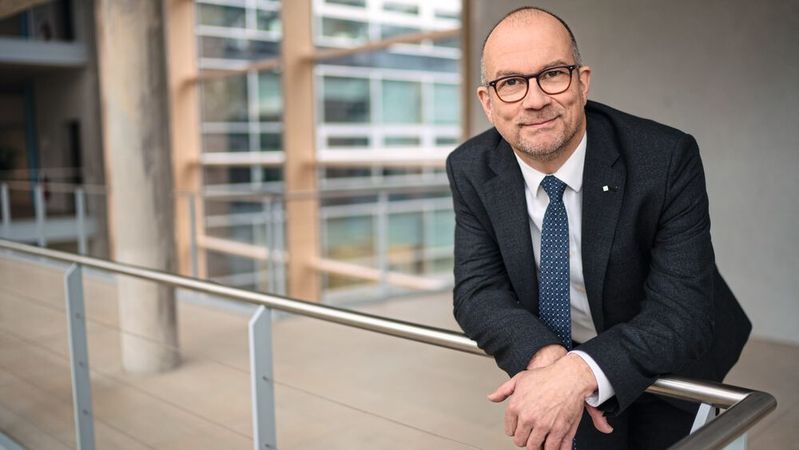
Prof. Oliver Riedel leads the Fraunhofer Institute for Industrial Engineering IAO as well as the University Institute for Control Engineering in Stuttgart.
(Image: ludmilla parsyak)
What is Industry 5.0? Professor Oliver Riedel, Director of the Fraunhofer Institute for Industrial Engineering IAO and Director of the University Institute for Control Engineering in Stuttgart, has been hearing this question more frequently lately. He likes to answer it with the following anecdote: About six years ago, an acquaintance from Japan asked him what Industry 4.0 was. Riedel explained the networking of things and cyber-physical systems, as envisioned by the Platform Industry 4.0 when it introduced the term to the public in 2011, sparking a real hype. The friend then wanted to know: "And where is the human in all this?" Riedel had to admit that in Germany, much attention was paid to how machines communicate with each other—but how they communicate with humans and what benefits it brings to people was not addressed. However, the IAO has never lost sight of this issue, emphasizes the Fraunhofer scientist.
With the guiding principle of human-technology-organization, the institute laid the foundation for the further development of Industry 4.0 as early as 1981—hence Industry 5.0: technology that serves people, takes social aspects into account, and promotes sustainable economic activity.
For the first time in the history of industrial revolutions, Industry 5.0 focuses on human well-being instead of solely on increased digitalization and machine networking to further boost efficiency, as was the case with Industry 4.0.
The fact that Riedel's friend confidently rubbed salt into the wound of Industry 4.0 is likely related to the Japanese concept of Society 5.0. This refers to "a human-centered society that balances economic progress with the resolution of social challenges through a system that highly integrates cyberspace and the physical space"—a Japanese perspective that is now gaining significance in Germany with Industry 5.0 and entering our industrial landscape.
In Industry 5.0, for the first time in the history of industrial revolutions, the focus is on the well-being of people rather than solely on increased digitization and machine networking to further enhance efficiency—as was still the case in Industry 4.0. Instead of replacing people with machines, the aim is to support people in performing their work better. Here, "better" doesn't simply mean "more efficient" again, but also work that is perceived as more meaningful and promotes the protection of both physical and mental health.
Artificial intelligence and humans complement each other
The biggest hurdle is the increasing technical complexity in factories, where humans can hardly keep up. Therefore, there is a need for filters to reduce complexity to the right level, demands Oliver Riedel. Artificial Intelligence (AI) and Machine Learning (ML) could be such filters that support people. But conversely, AI also relies on human assistance. With the new AI studios, the experimental environment in the model factory, and the topic-focused innovation networks, the IAO offers transformation formats for the industry.
Artificial intelligence and machine learning always need humans as the catalyst.
Prof. Oliver Riedel, Fraunhofer IAO
This is illustrated by the following example: A doctoral student of Mr. Riedel focused on arc welding in his dissertation and developed a method that uses machine learning with an acoustic sensor to determine the quality of welds. The goal is to improve quality and relieve employees from tedious inspection tasks. The question was how many welds the model needed for sufficient training. It was assumed that a few thousand would suffice. However, by the end of the dissertation, after many hours in the lab, the sobering result was that 120,000 welding processes were needed to feed into the model before it could accurately indicate quality. "AI and ML always need humans as an initial spark," says Riedel. For the IAO director, AI is neither a competitor for humans nor a threat to jobs. "AI is intended to reduce technical complexity for the benefit of humans, making it a good example of the Industry 5.0 concept."
In the eyes of the institute director at IAO, Industry 5.0 offers significant opportunities for companies like Lapp. He has been in contact with the CTO for years, discussing possibilities for the company. These exist internally—for example, in the development of products and their manufacturing. But also in the culture.
At Lapp, employees have always been at the forefront and are seen as part of the Lapp family. Now, the focus is particularly on placing those working in production at the center through innovations and optimizations. "Our employees are the most important success factor for Lapp. Therefore, our strategy emphasizes not only how new technologies can be used efficiently for our production but also how these technologies can best support our employees—that is, the interaction of humans with artificial intelligence in procedural workflows," explains Hubertus Breier, Board Member for Technology and Innovation at Lapp.
Date: 08.12.2025
Naturally, we always handle your personal data responsibly. Any personal data we receive from you is processed in accordance with applicable data protection legislation. For detailed information please see our privacy policy.
Consent to the use of data for promotional purposes
I hereby consent to Vogel Communications Group GmbH & Co. KG, Max-Planck-Str. 7-9, 97082 Würzburg including any affiliated companies according to §§ 15 et seq. AktG (hereafter: Vogel Communications Group) using my e-mail address to send editorial newsletters. A list of all affiliated companies can be found here
Newsletter content may include all products and services of any companies mentioned above, including for example specialist journals and books, events and fairs as well as event-related products and services, print and digital media offers and services such as additional (editorial) newsletters, raffles, lead campaigns, market research both online and offline, specialist webportals and e-learning offers. In case my personal telephone number has also been collected, it may be used for offers of aforementioned products, for services of the companies mentioned above, and market research purposes.
Additionally, my consent also includes the processing of my email address and telephone number for data matching for marketing purposes with select advertising partners such as LinkedIn, Google, and Meta. For this, Vogel Communications Group may transmit said data in hashed form to the advertising partners who then use said data to determine whether I am also a member of the mentioned advertising partner portals. Vogel Communications Group uses this feature for the purposes of re-targeting (up-selling, cross-selling, and customer loyalty), generating so-called look-alike audiences for acquisition of new customers, and as basis for exclusion for on-going advertising campaigns. Further information can be found in section “data matching for marketing purposes”.
In case I access protected data on Internet portals of Vogel Communications Group including any affiliated companies according to §§ 15 et seq. AktG, I need to provide further data in order to register for the access to such content. In return for this free access to editorial content, my data may be used in accordance with this consent for the purposes stated here. This does not apply to data matching for marketing purposes.
Right of revocation
I understand that I can revoke my consent at will. My revocation does not change the lawfulness of data processing that was conducted based on my consent leading up to my revocation. One option to declare my revocation is to use the contact form found at https://contact.vogel.de. In case I no longer wish to receive certain newsletters, I have subscribed to, I can also click on the unsubscribe link included at the end of a newsletter. Further information regarding my right of revocation and the implementation of it as well as the consequences of my revocation can be found in the data protection declaration, section editorial newsletter.
From Industry 4.0 to 5.0
In 2011, Henning Kagermann, President of the Research Council of the German Academy of Science and Engineering and former SAP board member, coined the now ubiquitous term Industry 4.0 at the Hannover Messe. Machines must continue to be networked and processes automated for greater efficiency and transparency. Just five years later, at the Hannover Messe in 2016, Kagermann used the term "Industry 5.0" for the first time, referring to an "intelligent, connected, and flexible production" that puts humans at the center. The European Commission adopted the concept of "Industry 5.0" in its white paper in 2021. "It takes into account the lessons from the pandemic and the need to develop an industrial system that is inherently more resilient to future shocks and stresses and truly integrates the social and ecological principles of the European Green Deal."
How medium-sized family businesses benefit from AI applications
The medium-sized family-owned company has been using AI applications in everyday work for several years—such as in the finance sector. In electronic bank statement processing, bank statements are now fully automatically interpreted in the cloud at Lapp during post-processing. The Supply Chain Management also relies on an AI application for finding new suppliers: the software used there can swiftly scour the internet, find suppliers worldwide, evaluate them, and generate a list of the most promising companies. The purchasing team can then target these companies specifically.
The focus on people is particularly evident at the French cable production plant of the Lapp Group in Forbach (Germany): The Câbleries Lapp SARL is the first plant to undergo extensive modernization as part of the optimization strategy within the Lapp Group's global production network. An example of this is the optimization of the wire production line: traditionally, the layout of such a production line is linear. This primarily means long walking distances for the employees. The new setup is arranged in a U-shape, centered around the people. The goal is to place all workstations of the facility as close to each other as possible. This reduces the walking distances for employees by 96 percent, cuts changeover times from ten to six minutes, and allows the machine to produce almost 50 percent faster—ultimately benefiting the customers.
Industry 5.0 also means focusing more on customer needs
Externally, the idea of Industry 5.0 is reflected in an even stronger focus on the needs of customers and their employees. For example: if a customer orders 12.4 miles of Ethernet cable, Lapp knows that the customer wants to ensure communication in their factory—preventing outages. As an industry partner in constant dialogue with customers, the connectivity specialist can therefore meet customer needs not only with cables but also through hubs and switches.
For Lapp, the idea of reducing complexity in highly automated and technological machine parks is not new. An example is Etherline Guard, a small box that assesses whether a data cable should be replaced soon based on its transmission quality. Or the Health Check Service for network security, which detects EMC problems, among other things, and suggests improvements. New from the innovation team at Lapp is the smart cable drum, which automatically orders replenishment when the cable runs out. This ties back to Industry 5.0 and Lapp's effort to always prioritize customer needs: "Our technology aims to reduce complexity and make life easier for people at the customer," says Dr. Susanne Krichel, Head of Innovation & Advanced Technology. "While this topic already seems to be 'old hat' in Japan, we still have some catching up to do—but the fact that this approach is now gaining so much importance in our industry as well shows me that Lapp is on the right path. To ultimately contribute to a more livable world."



:quality(80)/p7i.vogel.de/wcms/dd/08/dd086510d9ae7b50181f6070e4463b44/0129363730v1.jpeg "Typical application for ionizing devices: Wrapping films. (Picture: ©Adobe Stock/SMC)")
:quality(80)/p7i.vogel.de/wcms/35/57/3557c819943c53acec41a0ccba87da4f/0130049064v1.jpeg "Researchers at the Fraunhofer IWU in Chemnitz have long known that many typical sheet metal parts can be manufactured more cost-effectively using hollow embossing rollers. Now there is news to report ... (Image:Fraunhofer IWU)")
:quality(80)/p7i.vogel.de/wcms/59/02/590246e3b3f415c65edbee377c14ca77/26-06-pi-fraunhofer-iws-41450-direktplattieren-pic-01-7771x4369v1v1.jpeg "The Fraunhofer IWS has developed the new \"direct laser cladding\" process, which creates a functional layer directly on the base body by applying a strip-shaped metal to rotationally symmetrical components in a spiral and bonding it locally by laser. (Image:Christoph Wilsnack/Fraunhofer IWS)")
:quality(80)/p7i.vogel.de/wcms/73/60/73608418789b1d9c393f5e2fa974eda2/0130209906v1.jpeg "The robots of the X6 generation from b+m enable very high painting quality and are also particularly compact and easy to maintain. (Image:Beckhoff)")
:quality(80)/p7i.vogel.de/wcms/78/e9/78e9188c25a8a94e67c34c9bf8ffe495/visual-agile-20robots-20and-20google-20deepmind-20partner-20to-20bring-20intelligence-20to-20robotics-2500x1406v1v1.jpeg "Together, the partners are developing adaptable, intelligent robots for a wide range of applications (Image:Agile Robots SE)")
:quality(80)/p7i.vogel.de/wcms/e7/66/e7669ecf0260ae8fc54c214e34e4902a/0130316817v1.jpeg "Siemens and Palo Alto Networks offer tested cybersecurity solution for industrial 5G. (Image:Siemens)")
:quality(80)/p7i.vogel.de/wcms/9f/55/9f55324832c4f426958031375124d9de/siemens-20ubtech-20hmnd-1920x1079v1v1.png "Ready for the factory floor: While Ubtech is planning mass production, Siemens is already testing humanoids in real factory applications in Erlangen. (Image:Siemens)")
:quality(80)/p7i.vogel.de/wcms/11/36/113695ed260e29c8c2d9d39dc5f9d869/0130213768v1.jpeg "AI can work cheaply in China and deliver the results rapidly all over the world. (Image:Dall-E / AI-generated)")
:quality(80)/p7i.vogel.de/wcms/62/5f/625f41e87ebfef156a98c8e6393e32fd/0130211654v1.jpeg "Axial flux motors have some advantages over radial flux motor—but their production is currently still expensive. (Image:RWTH Aachen University)")
:quality(80)/p7i.vogel.de/wcms/77/9b/779b0685d010dfe45c9c2cb1cfecd467/0128886425v1.jpeg "The BlueEye is the first \"real\" hyperspectral camera for the UV range and covers the wavelength range from 220 to 380nm. (Image:Inno-spec GmbH)")
:quality(80)/p7i.vogel.de/wcms/e4/51/e451d52ce0182fb0aaa46a5774f832ef/26-04-pi-fraunhofer-iws-21160-bioslide-pic-01-4128x2321v1v1.jpeg "With the BioSlide research project, the Fraunhofer IWS is investigating how sliding systems can be designed to be more sustainable and energy-efficient. New materials can be tested in a particularly application-oriented manner on this plain bearing test stand. (Image:Fraunhofer IWS)")
![Thanks to advanced 3D printing technology, a more efficient use of resources should contribute to lower-emission aviation—this is the goal of ['skai]-lab. (Image:Oleksandr Pashchenko - stock.adobe.com / AI-generated)](https://cdn1.vogel.de/nghHNSbySccfOjG3n1qCA-FVOjQ=/288x162/smart/filters:format(jpg):quality(80)/p7i.vogel.de/wcms/62/64/626424c97a16e69f871bf216c9629c2a/adobestock-1927043193--c2-a9-20oleksandr-20pashchenko-20-e2-80-93-20stock-adobe-com-ki-generiertv1v1.jpeg "Thanks to advanced 3D printing technology, a more efficient use of resources should contribute to lower-emission aviation—this is the goal of ['skai]-lab. (Image:Oleksandr Pashchenko - stock.adobe.com / AI-generated)")
:quality(80)/p7i.vogel.de/wcms/c3/c4/c3c4ce270b083eeac55654148611f064/0130237945v1.jpeg "China is not giving up on hydrogen, but is intensifying its efforts. (Image:freely licensed from Pixabay)")
:quality(80)/p7i.vogel.de/wcms/4e/c0/4ec0bd19390b169edfa23677373dcdf1/0130260089v1.jpeg "Renewable fuels can supply European road traffic, according to a study. (Image:Aral)")
:quality(80)/p7i.vogel.de/wcms/6f/c9/6fc9050301d745cad25585c6780f8f51/0130197341v1.jpeg "Production facilities are a worthwhile target and are therefore at risk. (Image:ABB Robotics)")
:quality(80)/p7i.vogel.de/wcms/b6/62/b662adc2cec8227d8172509bbfb6ee42/25c0207-107-4961x2789v1v1.jpeg "The GLB is the second model based on Mercedes' new MMA platform. Apparently, Geely's platform is better and cheaper, which is why the two companies are negotiating a partnership. (Image:Mercedes-Benz)")
:quality(80)/p7i.vogel.de/wcms/4d/dd/4dddf438e91f394c04a095dbfd109d1c/0130236430v1.jpeg "Measurement modules: The 720301 module in combination with the SL2000 enables RMS and power calculations, among other things. (Image:Yokogawa)")
:quality(80)/p7i.vogel.de/wcms/61/fc/61fcf95f5cca15494ad18343901ae585/0130317237v1.jpeg "With the AGI CPU, Arm says it is taking a \"historic step\": With the processor aimed at AI in data centers, the company is presenting itself for the first time as a provider of its own chips, not just as a pure IP licensor. (Image:Arm)")
:quality(80)/p7i.vogel.de/wcms/82/90/8290dfe3595b6c6b33726ae8b76172c7/0130319587v1.jpeg "The concept image illustrates how the pattern of tiny protrusions and depressions created on the substrate (MgO, bottom) controls the arrangement of atoms in the superconducting material (YBCO, top). At the interface between the two layers, an electronic structure enables superconductivity to occur at higher temperatures than previously possible. (Image:Chalmers University of Technology / Riccardo Arpaia)")
:fill(fff,0)/images.vogel.de/vogelonline/companyimg/76800/76895/65.jpg "FAULHABER_120mm.jpg ()")
:fill(fff,0)/p7i.vogel.de/companies/69/88/69882c428938e/tmts2026-ticec-banner-en-2000px.png "tmts2026-ticec-banner-en-2000px (https://www.tmts.tw/en)")
:fill(fff,0)/p7i.vogel.de/companies/67/eb/67eba621ef6ea/logo2.png "logo2 (Wuxi InfiMotion)")
:quality(80)/p7i.vogel.de/wcms/c0/9a/c09aa2725ad9897c427be5da610667bd/0123591023v1.jpeg "Networking is a key characteristic of the Internet of Things (IoT). (Image:ipopba - stock.adobe.com)")
:quality(80)/p7i.vogel.de/wcms/0d/0e/0d0eb1b0fc691a47ef0a8342e318d6ad/0124368676v1.jpeg "With Modbus Cloud Connect from Grandcentrix, all devices running Modbus RTU can connect with the cloud via cellular-based IoT. (Image:Grandcentrix)")