How synchronous reluctance motors significantly impact energy efficiency while simultaneously reducing operating costs is well known to Stefan Flöck. The Division President at ABB also understands the challenges that still need to be addressed in implementing these sustainable drive solutions.
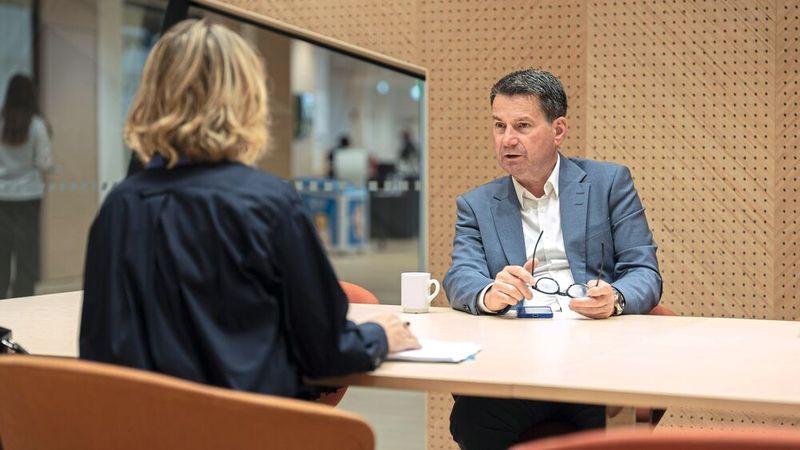
"A key to high savings is synchronous reluctance motors," says Stefan Flöck, Division President IEC Low Voltage Motors at ABB.
(Image: ABB)
ABB Relies On Synchronous Reluctance Technology for Motors, But Why?
Stefan Flöck: Energy efficiency is a driving topic for the industry for various reasons: many comply with regulations through energy-efficient production, while others aim to produce more sustainably. A key to significant savings lies in synchronous reluctance motors (SynRM). The technology itself is not new, but we have now perfected it to the extent that, in combination with a converter, it is available for a wide range of industrial applications. There is a high demand for permanent magnet motors in Asia, particularly in China, but we see SynRM as a future-oriented technology when it comes to developing a cost-effective, reliable motor.
We believe in this technology because it is very sustainable.
Stefan Flöck
We believe in this technology because it is very sustainable. The motor does not use permanent magnets made from rare earths. This offers advantages not only in terms of sustainability but also regarding supply chain availability.
Stefan Flöck
Stefan Flöck is President of the IEC Low Voltage Motors Division at ABB and has held this position since January 2021. With over two decades of experience within ABB, Flöck previously served as Global Product Group Manager and in other senior roles. Flöck's focus is on strategies for efficiency, innovation, and sustainability, particularly in high-performance motors for industrial decarbonization. As an advocate for energy-efficient and sustainable production models, Stefan Flöck supports ABB's commitment to CO₂ reduction worldwide.
So the Added Value for the User Lies Primarily in the Energy Efficiency Achieved?
Yes. And with rising energy costs, that is simply a strong argument. The return on investment can range from just a few months to up to three years, depending on the design. With a lifespan of 25 to 30 years, that is a compelling argument. Not only because of energy costs but also considering that we will need a lot of energy in the future. Data centers are a good example. They are energy guzzlers. We can't build or generate enough power plants to meet the energy demand over the next 10 or 20 years. The demand for motors alone will double in the next 15 years. The energy requirements of data centers, in particular, will grow significantly. There are vast numbers of motors in use there, just for pumps, fans, and air conditioning.
What Technical Requirements must Be in Place to Use Synchronous Reluctance Motors? Do Users Need to Make Special Adjustments?
First and foremost, a drive system is necessary. Operating motors with a frequency converter is sensible in any case. Even using a frequency converter in combination with an IE3 induction motor, which theoretically does not require a frequency converter, already offers energy-saving potential of up to 25 percent, depending on the process. Without a frequency converter, a motor always runs at its rated speed. The user either installs a mechanical component, such as a valve to regulate the water flow of a pump, or installs a frequency converter that simply adjusts as needed and only draws the required power. Additionally, SynRM delivers at least the same performance as traditional induction motors of the same size, allowing customers to replace an induction motor with a SynRM without requiring significant mechanical modifications.
Are There Also Motors that Have the Frequency Converter Integrated?
Yes, we also offer a motor—the LV Titanium—that has the frequency converter integrated. This motor is based on permanent magnet technology. Since the drive is integrated, no additional cabling is required. The user benefits from a highly efficient technology including the converter, which is designed for simple applications such as pumps and is very easy to maintain. This makes replacement very straightforward for the user.
You Manufacture the Synchronous Reluctance Motors at the ABB Factory in Vaasa, Finland. What Makes this Factory Special?
We are very proud of the high manufacturing flexibility at our plant in Vaasa. Hardly any motor is built the same way twice. Instead, we focus heavily on customer specifications. This ranges from simple aspects like painting to the dimensioning or performance design of the motors. There are no limits. This is unusual for a large manufacturer like ABB. Flexibility, customer focus, and project business define this plant. In addition, there is significant expertise in motor development, which has almost been passed down from generation to generation. The winding of the coils is even done largely by hand—allowing us to achieve a high degree of customer-oriented solutions.
The ABB plant in Vaasa, Finland, is a flagship for ABB in customized motor production and sustainable manufacturing. Since its founding in 1944, the plant has specialized in the production of IEC low-voltage motors, which are often individually configured according to customer requirements. With over 700 employees and more than 200 summer interns, the plant produces around 125,000 motors annually in 25,000 variants. Over 90 percent of the motors produced are custom-made, highlighting the site's innovation and flexibility.
The factory places great emphasis on sustainability, achieving savings of 15,000 MWh and a CO2 reduction of 6,500 tons through the use of energy-efficient technologies such as heat pumps, LED lighting, and SynRM motors. Additionally, local transport is handled with an electrified truck powered by a 225-kW motor.
Of course, there are also automated processes in this plant, such as the lamination of stator and rotor packs. In addition, we have automated many processes in logistics and made significant investments in the automation of the painting system. Painting motors, by the way, is a very sensitive process. We manufacture premium motors here, which are highly customized and also suitable for critical applications. These include ship winches, highly complex extruders, or ventilation systems in tunnels, which must, for instance, continue to function in the event of a fire.
Date: 08.12.2025
Naturally, we always handle your personal data responsibly. Any personal data we receive from you is processed in accordance with applicable data protection legislation. For detailed information please see our privacy policy.
Consent to the use of data for promotional purposes
I hereby consent to Vogel Communications Group GmbH & Co. KG, Max-Planck-Str. 7-9, 97082 Würzburg including any affiliated companies according to §§ 15 et seq. AktG (hereafter: Vogel Communications Group) using my e-mail address to send editorial newsletters. A list of all affiliated companies can be found here
Newsletter content may include all products and services of any companies mentioned above, including for example specialist journals and books, events and fairs as well as event-related products and services, print and digital media offers and services such as additional (editorial) newsletters, raffles, lead campaigns, market research both online and offline, specialist webportals and e-learning offers. In case my personal telephone number has also been collected, it may be used for offers of aforementioned products, for services of the companies mentioned above, and market research purposes.
Additionally, my consent also includes the processing of my email address and telephone number for data matching for marketing purposes with select advertising partners such as LinkedIn, Google, and Meta. For this, Vogel Communications Group may transmit said data in hashed form to the advertising partners who then use said data to determine whether I am also a member of the mentioned advertising partner portals. Vogel Communications Group uses this feature for the purposes of re-targeting (up-selling, cross-selling, and customer loyalty), generating so-called look-alike audiences for acquisition of new customers, and as basis for exclusion for on-going advertising campaigns. Further information can be found in section “data matching for marketing purposes”.
In case I access protected data on Internet portals of Vogel Communications Group including any affiliated companies according to §§ 15 et seq. AktG, I need to provide further data in order to register for the access to such content. In return for this free access to editorial content, my data may be used in accordance with this consent for the purposes stated here. This does not apply to data matching for marketing purposes.
Right of revocation
I understand that I can revoke my consent at will. My revocation does not change the lawfulness of data processing that was conducted based on my consent leading up to my revocation. One option to declare my revocation is to use the contact form found at https://contact.vogel.de. In case I no longer wish to receive certain newsletters, I have subscribed to, I can also click on the unsubscribe link included at the end of a newsletter. Further information regarding my right of revocation and the implementation of it as well as the consequences of my revocation can be found in the data protection declaration, section editorial newsletter.
Where Do You See the Strengths of ABB's Synchronous Reluctance Motors Compared to Those of Other Providers?
Synchronous reluctance technology is a proven and simple technology. Our strength lies in the experience and manufacturing expertise we have accumulated over the years. In addition, we have now built a complete portfolio that covers a wide performance range, including explosion-proof and water-cooled motors. This is unique. On top of that, we bring domain expertise.
In Which Markets And Applications Do You See the Greatest Potential for the Use of SynRM Technology?
From my perspective, the water/wastewater sector has enormous potential simply due to the high number of pumps used in this area. But I don’t want to focus solely on one sector. We are generally open and flexible. We even have applications with a constant speed, for example with extruders, especially after introducing the water-cooled motors. In this area, it’s not just about energy efficiency but also space requirements. The motor achieves the same performance with a smaller size and, thanks to water cooling, delivers better performance.
Is there A Personal Experience or Event that Convinced You of this Technology?
I am pleased when I hear from colleagues that they were able to convince a customer of the technology with arguments about energy efficiency and sustainability. It's simply a great story beyond the technical advantages that makes the difference.
Where Are the Challenges in the Technical Development of Synchronous Reluctance Motors?
The challenge lies in transitioning to series production amid increasing demand. Additionally, material innovations and cooling concepts are crucial for efficiency, ensuring that the motor runs cooler and thus more reliably. Perfecting the interplay between the converter and motor remains an important focus, as does smooth control and integration. While we are satisfied with the current state, there is room for improvement in manufacturing and user-friendliness. The technology will remain a robust "workhorse" in the long term, both affordable and durable. It is important that understanding and willingness to invest in energy efficiency continue to grow.



:quality(80)/p7i.vogel.de/wcms/dd/08/dd086510d9ae7b50181f6070e4463b44/0129363730v1.jpeg "Typical application for ionizing devices: Wrapping films. (Picture: ©Adobe Stock/SMC)")
:quality(80)/p7i.vogel.de/wcms/35/57/3557c819943c53acec41a0ccba87da4f/0130049064v1.jpeg "Researchers at the Fraunhofer IWU in Chemnitz have long known that many typical sheet metal parts can be manufactured more cost-effectively using hollow embossing rollers. Now there is news to report ... (Image:Fraunhofer IWU)")
:quality(80)/p7i.vogel.de/wcms/59/02/590246e3b3f415c65edbee377c14ca77/26-06-pi-fraunhofer-iws-41450-direktplattieren-pic-01-7771x4369v1v1.jpeg "The Fraunhofer IWS has developed the new \"direct laser cladding\" process, which creates a functional layer directly on the base body by applying a strip-shaped metal to rotationally symmetrical components in a spiral and bonding it locally by laser. (Image:Christoph Wilsnack/Fraunhofer IWS)")
:quality(80)/p7i.vogel.de/wcms/73/60/73608418789b1d9c393f5e2fa974eda2/0130209906v1.jpeg "The robots of the X6 generation from b+m enable very high painting quality and are also particularly compact and easy to maintain. (Image:Beckhoff)")
:quality(80)/p7i.vogel.de/wcms/78/e9/78e9188c25a8a94e67c34c9bf8ffe495/visual-agile-20robots-20and-20google-20deepmind-20partner-20to-20bring-20intelligence-20to-20robotics-2500x1406v1v1.jpeg "Together, the partners are developing adaptable, intelligent robots for a wide range of applications (Image:Agile Robots SE)")
:quality(80)/p7i.vogel.de/wcms/e7/66/e7669ecf0260ae8fc54c214e34e4902a/0130316817v1.jpeg "Siemens and Palo Alto Networks offer tested cybersecurity solution for industrial 5G. (Image:Siemens)")
:quality(80)/p7i.vogel.de/wcms/9f/55/9f55324832c4f426958031375124d9de/siemens-20ubtech-20hmnd-1920x1079v1v1.png "Ready for the factory floor: While Ubtech is planning mass production, Siemens is already testing humanoids in real factory applications in Erlangen. (Image:Siemens)")
:quality(80)/p7i.vogel.de/wcms/11/36/113695ed260e29c8c2d9d39dc5f9d869/0130213768v1.jpeg "AI can work cheaply in China and deliver the results rapidly all over the world. (Image:Dall-E / AI-generated)")
:quality(80)/p7i.vogel.de/wcms/62/5f/625f41e87ebfef156a98c8e6393e32fd/0130211654v1.jpeg "Axial flux motors have some advantages over radial flux motor—but their production is currently still expensive. (Image:RWTH Aachen University)")
:quality(80)/p7i.vogel.de/wcms/77/9b/779b0685d010dfe45c9c2cb1cfecd467/0128886425v1.jpeg "The BlueEye is the first \"real\" hyperspectral camera for the UV range and covers the wavelength range from 220 to 380nm. (Image:Inno-spec GmbH)")
:quality(80)/p7i.vogel.de/wcms/e4/51/e451d52ce0182fb0aaa46a5774f832ef/26-04-pi-fraunhofer-iws-21160-bioslide-pic-01-4128x2321v1v1.jpeg "With the BioSlide research project, the Fraunhofer IWS is investigating how sliding systems can be designed to be more sustainable and energy-efficient. New materials can be tested in a particularly application-oriented manner on this plain bearing test stand. (Image:Fraunhofer IWS)")
![Thanks to advanced 3D printing technology, a more efficient use of resources should contribute to lower-emission aviation—this is the goal of ['skai]-lab. (Image:Oleksandr Pashchenko - stock.adobe.com / AI-generated)](https://cdn1.vogel.de/nghHNSbySccfOjG3n1qCA-FVOjQ=/288x162/smart/filters:format(jpg):quality(80)/p7i.vogel.de/wcms/62/64/626424c97a16e69f871bf216c9629c2a/adobestock-1927043193--c2-a9-20oleksandr-20pashchenko-20-e2-80-93-20stock-adobe-com-ki-generiertv1v1.jpeg "Thanks to advanced 3D printing technology, a more efficient use of resources should contribute to lower-emission aviation—this is the goal of ['skai]-lab. (Image:Oleksandr Pashchenko - stock.adobe.com / AI-generated)")
:quality(80)/p7i.vogel.de/wcms/c3/c4/c3c4ce270b083eeac55654148611f064/0130237945v1.jpeg "China is not giving up on hydrogen, but is intensifying its efforts. (Image:freely licensed from Pixabay)")
:quality(80)/p7i.vogel.de/wcms/4e/c0/4ec0bd19390b169edfa23677373dcdf1/0130260089v1.jpeg "Renewable fuels can supply European road traffic, according to a study. (Image:Aral)")
:quality(80)/p7i.vogel.de/wcms/6f/c9/6fc9050301d745cad25585c6780f8f51/0130197341v1.jpeg "Production facilities are a worthwhile target and are therefore at risk. (Image:ABB Robotics)")
:quality(80)/p7i.vogel.de/wcms/b6/62/b662adc2cec8227d8172509bbfb6ee42/25c0207-107-4961x2789v1v1.jpeg "The GLB is the second model based on Mercedes' new MMA platform. Apparently, Geely's platform is better and cheaper, which is why the two companies are negotiating a partnership. (Image:Mercedes-Benz)")
:quality(80)/p7i.vogel.de/wcms/4d/dd/4dddf438e91f394c04a095dbfd109d1c/0130236430v1.jpeg "Measurement modules: The 720301 module in combination with the SL2000 enables RMS and power calculations, among other things. (Image:Yokogawa)")
:quality(80)/p7i.vogel.de/wcms/61/fc/61fcf95f5cca15494ad18343901ae585/0130317237v1.jpeg "With the AGI CPU, Arm says it is taking a \"historic step\": With the processor aimed at AI in data centers, the company is presenting itself for the first time as a provider of its own chips, not just as a pure IP licensor. (Image:Arm)")
:quality(80)/p7i.vogel.de/wcms/82/90/8290dfe3595b6c6b33726ae8b76172c7/0130319587v1.jpeg "The concept image illustrates how the pattern of tiny protrusions and depressions created on the substrate (MgO, bottom) controls the arrangement of atoms in the superconducting material (YBCO, top). At the interface between the two layers, an electronic structure enables superconductivity to occur at higher temperatures than previously possible. (Image:Chalmers University of Technology / Riccardo Arpaia)")
:fill(fff,0)/images.vogel.de/vogelonline/companyimg/76800/76895/65.jpg "FAULHABER_120mm.jpg ()")
:fill(fff,0)/p7i.vogel.de/companies/69/88/69882c428938e/tmts2026-ticec-banner-en-2000px.png "tmts2026-ticec-banner-en-2000px (https://www.tmts.tw/en)")
:fill(fff,0)/p7i.vogel.de/companies/67/eb/67eba621ef6ea/logo2.png "logo2 (Wuxi InfiMotion)")
:quality(80)/p7i.vogel.de/wcms/35/0b/350bdbd901e56c738bb0e8267b7640c9/0126975278v1.jpeg "\"A key to high savings is synchronous reluctance motors,\" says Stefan Flöck, Division President IEC Low Voltage Motors at ABB.(Image: ABB)")
:quality(80)/p7i.vogel.de/wcms/e8/ac/e8acee062a387ce3bd3d949e61151d30/0127235219v1.jpeg "ABB's SynRM motors impress with high energy efficiency and a magnet-free design that eliminates the use of rare earths.(Image: ABB)")
:quality(80)/p7i.vogel.de/wcms/38/67/38670eed8fa51c7dbf01812c5f671ec1/0127234901v1.jpeg "Motors drying in the high-bay warehouse of the paint shop: precise coating for optimal protection and durability in demanding applications.(Image: Marcin Malicki/ABB)")
:quality(80)/p7i.vogel.de/wcms/b0/c3/b0c34438a8edcd35271f6e6312dc50dc/0127235207v1.jpeg "A motor is carefully handcrafted to ensure high-quality standards and customized solutions for specific customer requirements.(Image: Marcin Malicki)")
:quality(80):fill(efefef,0)/p7i.vogel.de/wcms/67/ad/67adf4a647532/elatec-wp-machine-authentication.png "Elatec WP Machine Authentication")
:quality(80)/p7i.vogel.de/wcms/0f/56/0f566d957a53b5bdda658d3bcef90486/0127131321v1.jpeg "Modern injection molding machines come with either electric or hydraulic actuators, depending on the application. (Image: ©TongTa - stock.adobe.com)")
:quality(80)/p7i.vogel.de/wcms/58/0e/580ef3960af196a859f048c99127541e/0124563311v1.jpeg "Innomotics' HV-M motors for the world's largest industrial heat pump are being built at the Nuremberg plant. (Image:Innomotics)")