In China, a technology is being tested that is so new that legislators have not yet officially classified it as a New Energy Vehicle, or NEV for short. The "methanol-hydrogen-electric drive", which two Chinese manufacturers have just developed for heavy trucks, works like a range extender.
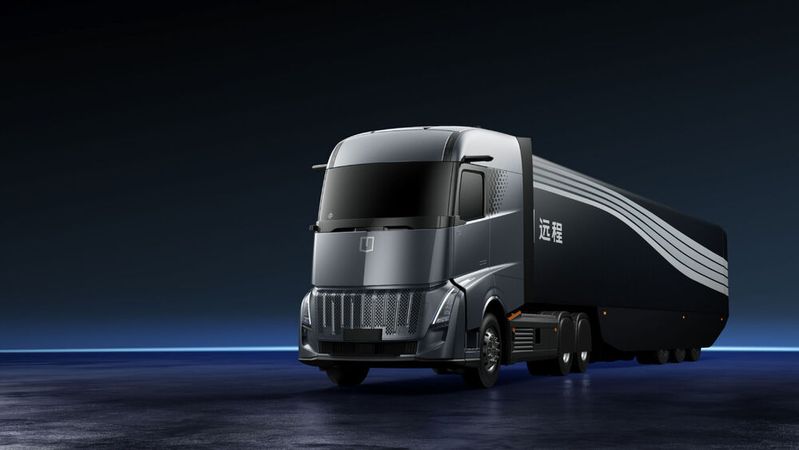
Farizon, the commercial vehicle division of Geely, and vehicle manufacturer Jinbei are working on methanol-hydrogen-electric drive systems for heavy commercial vehicles.
(Image: Farizon)
The heavy-duty truck is the product of a collaboration between Farizon, the commercial vehicle division of the Geely Group, and vehicle manufacturer Jinbei. One of the first models, the Farizon Xinghan G super-electric tractor, was presented to Chinese experts just a few days ago.
No NEV Alternative for Diesel Trucks yet
To understand how it works, you have to start with the initial idea. Geely and Farizon have been building methanol-powered vehicles for many years, as well as vehicles with fuel cells that run on hydrogen. And, of course, they also build purely electric trucks. All of these three technological routes fall into the category of New Electric Vehicles (NEVs), which are being promoted by the Beijing government to reduce emissions and slow down climate change.
However, in the cold north of China, where winter temperatures often drop to minus twenty degrees Celsius or even lower, none of these technologies has yet been able to really establish itself as a replacement for traditional diesel or gasoline-powered commercial vehicles.
There are many reasons for this. Either the electric cars won't start because it's too cold. Or the infrastructure for recharging the hydrogen tanks for vehicles with fuel cells is not developed well enough. Or there are reservations about the direct combustion of methanol. "The penetration rate of NEV in Northeast China was only 1.8 percent in 2023, far below the national average," writes the China Daily. The cold is the main reason why this region is not being electrified as quickly as other parts of the People's Republic.
Methanol in the Tank
In the new route called "methanol-hydrogen-electric", the tank of the commercial vehicles is not filled with hydrogen, but with liquid methanol, which is easier to transport. However, this is not used to power an engine directly, but is converted into hydrogen in the vehicle itself when required. This demand only arises when the battery that supplies the truck's electric drive with power is empty. In this respect, it is a new type of range extender (eREV technology). The eREV technology is already very popular in China for passenger cars, but works with gasoline.
The hydrogen produced under the hood of the new trucks is then converted into electricity as required with the help of a fuel cell, which can be used to recharge the battery while driving, i.e. independently of charging stations. With one tank of fuel, a Farizon Xinghan G has a combined range of 1,500 kilometers (approx. 932 miles). According to the manufacturers, the thermal efficiency of the entire system is around 50 percent One liter of methanol can generate 2.2 kW of electricity, they say.
Instead of just methanol, the tank of these new commercial vehicles can also be filled with a mixture of methanol and gasoline, in various mixing ratios.
Battery Exchange Stations in Use
The vehicles are equipped with a Shidai Qiji battery installed in the floor with a capacity of 513 kWh, which can be exchanged for a full battery at a battery exchange station as soon as it is empty. The battery alone has a range of 350 kilometers. The eDrive developed by the two manufacturers themselves has an output equivalent to 720 hp.
Farizon and Jinbei are convinced that there is a market for their invention, certainly in the cold north-east of China. However, two car models with such a methanol-hydrogen-electric drive system are also due to be launched on the Chinese market this year, an SUV and a sedan.
At the Asian Winter Games, which took place this winter in Harbin in the freezing cold north-east of China, Farizon and Jinbei have already demonstrated buses with their environmentally friendly new technology, which only emits water vapor from the exhaust—just like vehicles with traditional fuel cells.
Production of Methanol
Anyone looking at the conversions that take place before the e-drive of a Farizon Xinghan G starts moving could easily dismiss the method as too complicated. Methanol has recently been produced in China in a large plant with an annual capacity of 110,000 tons in Henan province, in which both the Geely Holding Group and the Shuncheng Group have invested.
There, hydrogen, which is a by-product of the Shuncheng coke ovens, is converted into methanol using captured carbon dioxide. There are also already completely "green" plants that produce methanol using solar or wind power via electrolysis. Either way, the methanol is then converted back into hydrogen in the vehicles of this new type.
Date: 08.12.2025
Naturally, we always handle your personal data responsibly. Any personal data we receive from you is processed in accordance with applicable data protection legislation. For detailed information please see our privacy policy.
Consent to the use of data for promotional purposes
I hereby consent to Vogel Communications Group GmbH & Co. KG, Max-Planck-Str. 7-9, 97082 Würzburg including any affiliated companies according to §§ 15 et seq. AktG (hereafter: Vogel Communications Group) using my e-mail address to send editorial newsletters. A list of all affiliated companies can be found here
Newsletter content may include all products and services of any companies mentioned above, including for example specialist journals and books, events and fairs as well as event-related products and services, print and digital media offers and services such as additional (editorial) newsletters, raffles, lead campaigns, market research both online and offline, specialist webportals and e-learning offers. In case my personal telephone number has also been collected, it may be used for offers of aforementioned products, for services of the companies mentioned above, and market research purposes.
Additionally, my consent also includes the processing of my email address and telephone number for data matching for marketing purposes with select advertising partners such as LinkedIn, Google, and Meta. For this, Vogel Communications Group may transmit said data in hashed form to the advertising partners who then use said data to determine whether I am also a member of the mentioned advertising partner portals. Vogel Communications Group uses this feature for the purposes of re-targeting (up-selling, cross-selling, and customer loyalty), generating so-called look-alike audiences for acquisition of new customers, and as basis for exclusion for on-going advertising campaigns. Further information can be found in section “data matching for marketing purposes”.
In case I access protected data on Internet portals of Vogel Communications Group including any affiliated companies according to §§ 15 et seq. AktG, I need to provide further data in order to register for the access to such content. In return for this free access to editorial content, my data may be used in accordance with this consent for the purposes stated here. This does not apply to data matching for marketing purposes.
Right of revocation
I understand that I can revoke my consent at will. My revocation does not change the lawfulness of data processing that was conducted based on my consent leading up to my revocation. One option to declare my revocation is to use the contact form found at https://contact.vogel.de. In case I no longer wish to receive certain newsletters, I have subscribed to, I can also click on the unsubscribe link included at the end of a newsletter. Further information regarding my right of revocation and the implementation of it as well as the consequences of my revocation can be found in the data protection declaration, section editorial newsletter.
The engineers at Farizon and Jin point out that transporting liquid methanol is much easier than transporting hydrogen. And they point to the other technical problems that have prevented the spread of existing alternative drives.
Retrofitting Filling Stations Quickly
Existing filling stations throughout the country can be quickly and cost-effectively retrofitted or converted for methanol. This would make environmentally friendly logistics much quicker and more cost-efficient than waiting for the expansion of the network of hydrogen filling stations that is currently being worked on in China.
The combined methanol-hydrogen-electric drives will then be cheaper to run than traditional combustion engines—and they will be completely climate-neutral on the road, emitting no greenhouse gases and being as clean as other vehicles with electric drives. From a Chinese perspective, methanol as a fuel also has the advantage that it does not have to be imported from abroad like oil. 60 percent of all methanol in the world is already produced in the People's Republic. "In the era of global competition for new energies, the development of multiple energy sources and multiple technical routes is a fundamental guarantee for energy security," writes the official news agency Xinhua about the new type of drive from Farizon and Jinbei. "Green methanol can be described as China's oil," Xinhua continues.
Last year, the new trucks from Farizon and Jinbei were already integrated into the vehicle fleets of companies in 12 Chinese provinces and 40 cities. From the fourth quarter of this year, according to Geely, the new commercial vehicles will also be available for private customers, including the two passenger car models. However, in order to give customers the choice of technology, Farizon and Jinbei are offering their trucks as methanol-hydrogen-powered models, as well as pure electric vehicles and plug-in hybrids. (se)



:quality(80)/p7i.vogel.de/wcms/dd/08/dd086510d9ae7b50181f6070e4463b44/0129363730v1.jpeg "Typical application for ionizing devices: Wrapping films. (Picture: ©Adobe Stock/SMC)")
:quality(80)/p7i.vogel.de/wcms/35/57/3557c819943c53acec41a0ccba87da4f/0130049064v1.jpeg "Researchers at the Fraunhofer IWU in Chemnitz have long known that many typical sheet metal parts can be manufactured more cost-effectively using hollow embossing rollers. Now there is news to report ... (Image:Fraunhofer IWU)")
:quality(80)/p7i.vogel.de/wcms/59/02/590246e3b3f415c65edbee377c14ca77/26-06-pi-fraunhofer-iws-41450-direktplattieren-pic-01-7771x4369v1v1.jpeg "The Fraunhofer IWS has developed the new \"direct laser cladding\" process, which creates a functional layer directly on the base body by applying a strip-shaped metal to rotationally symmetrical components in a spiral and bonding it locally by laser. (Image:Christoph Wilsnack/Fraunhofer IWS)")
:quality(80)/p7i.vogel.de/wcms/73/60/73608418789b1d9c393f5e2fa974eda2/0130209906v1.jpeg "The robots of the X6 generation from b+m enable very high painting quality and are also particularly compact and easy to maintain. (Image:Beckhoff)")
:quality(80)/p7i.vogel.de/wcms/78/e9/78e9188c25a8a94e67c34c9bf8ffe495/visual-agile-20robots-20and-20google-20deepmind-20partner-20to-20bring-20intelligence-20to-20robotics-2500x1406v1v1.jpeg "Together, the partners are developing adaptable, intelligent robots for a wide range of applications (Image:Agile Robots SE)")
:quality(80)/p7i.vogel.de/wcms/e7/66/e7669ecf0260ae8fc54c214e34e4902a/0130316817v1.jpeg "Siemens and Palo Alto Networks offer tested cybersecurity solution for industrial 5G. (Image:Siemens)")
:quality(80)/p7i.vogel.de/wcms/9f/55/9f55324832c4f426958031375124d9de/siemens-20ubtech-20hmnd-1920x1079v1v1.png "Ready for the factory floor: While Ubtech is planning mass production, Siemens is already testing humanoids in real factory applications in Erlangen. (Image:Siemens)")
:quality(80)/p7i.vogel.de/wcms/11/36/113695ed260e29c8c2d9d39dc5f9d869/0130213768v1.jpeg "AI can work cheaply in China and deliver the results rapidly all over the world. (Image:Dall-E / AI-generated)")
:quality(80)/p7i.vogel.de/wcms/62/5f/625f41e87ebfef156a98c8e6393e32fd/0130211654v1.jpeg "Axial flux motors have some advantages over radial flux motor—but their production is currently still expensive. (Image:RWTH Aachen University)")
:quality(80)/p7i.vogel.de/wcms/77/9b/779b0685d010dfe45c9c2cb1cfecd467/0128886425v1.jpeg "The BlueEye is the first \"real\" hyperspectral camera for the UV range and covers the wavelength range from 220 to 380nm. (Image:Inno-spec GmbH)")
:quality(80)/p7i.vogel.de/wcms/e4/51/e451d52ce0182fb0aaa46a5774f832ef/26-04-pi-fraunhofer-iws-21160-bioslide-pic-01-4128x2321v1v1.jpeg "With the BioSlide research project, the Fraunhofer IWS is investigating how sliding systems can be designed to be more sustainable and energy-efficient. New materials can be tested in a particularly application-oriented manner on this plain bearing test stand. (Image:Fraunhofer IWS)")
![Thanks to advanced 3D printing technology, a more efficient use of resources should contribute to lower-emission aviation—this is the goal of ['skai]-lab. (Image:Oleksandr Pashchenko - stock.adobe.com / AI-generated)](https://cdn1.vogel.de/nghHNSbySccfOjG3n1qCA-FVOjQ=/288x162/smart/filters:format(jpg):quality(80)/p7i.vogel.de/wcms/62/64/626424c97a16e69f871bf216c9629c2a/adobestock-1927043193--c2-a9-20oleksandr-20pashchenko-20-e2-80-93-20stock-adobe-com-ki-generiertv1v1.jpeg "Thanks to advanced 3D printing technology, a more efficient use of resources should contribute to lower-emission aviation—this is the goal of ['skai]-lab. (Image:Oleksandr Pashchenko - stock.adobe.com / AI-generated)")
:quality(80)/p7i.vogel.de/wcms/c3/c4/c3c4ce270b083eeac55654148611f064/0130237945v1.jpeg "China is not giving up on hydrogen, but is intensifying its efforts. (Image:freely licensed from Pixabay)")
:quality(80)/p7i.vogel.de/wcms/4e/c0/4ec0bd19390b169edfa23677373dcdf1/0130260089v1.jpeg "Renewable fuels can supply European road traffic, according to a study. (Image:Aral)")
:quality(80)/p7i.vogel.de/wcms/6f/c9/6fc9050301d745cad25585c6780f8f51/0130197341v1.jpeg "Production facilities are a worthwhile target and are therefore at risk. (Image:ABB Robotics)")
:quality(80)/p7i.vogel.de/wcms/b6/62/b662adc2cec8227d8172509bbfb6ee42/25c0207-107-4961x2789v1v1.jpeg "The GLB is the second model based on Mercedes' new MMA platform. Apparently, Geely's platform is better and cheaper, which is why the two companies are negotiating a partnership. (Image:Mercedes-Benz)")
:quality(80)/p7i.vogel.de/wcms/4d/dd/4dddf438e91f394c04a095dbfd109d1c/0130236430v1.jpeg "Measurement modules: The 720301 module in combination with the SL2000 enables RMS and power calculations, among other things. (Image:Yokogawa)")
:quality(80)/p7i.vogel.de/wcms/61/fc/61fcf95f5cca15494ad18343901ae585/0130317237v1.jpeg "With the AGI CPU, Arm says it is taking a \"historic step\": With the processor aimed at AI in data centers, the company is presenting itself for the first time as a provider of its own chips, not just as a pure IP licensor. (Image:Arm)")
:quality(80)/p7i.vogel.de/wcms/82/90/8290dfe3595b6c6b33726ae8b76172c7/0130319587v1.jpeg "The concept image illustrates how the pattern of tiny protrusions and depressions created on the substrate (MgO, bottom) controls the arrangement of atoms in the superconducting material (YBCO, top). At the interface between the two layers, an electronic structure enables superconductivity to occur at higher temperatures than previously possible. (Image:Chalmers University of Technology / Riccardo Arpaia)")
:fill(fff,0)/images.vogel.de/vogelonline/companyimg/76800/76895/65.jpg "FAULHABER_120mm.jpg ()")
:fill(fff,0)/p7i.vogel.de/companies/67/eb/67eba621ef6ea/logo2.png "logo2 (Wuxi InfiMotion)")
:quality(80)/p7i.vogel.de/wcms/0e/e2/0ee29098cc5c35211cdf0e7869f3ddc2/0122293897v1.jpeg "With the GOVY AirJet, GAC aims to meet various mobility needs, ranging from short commuting distances in the city to medium-distance intercity travel. (Image:GAC)")
:quality(80):fill(efefef,0)/p7i.vogel.de/wcms/67/ad/67adf92d254d2/elatec-wp-smart-factory.png "Elatec WP Smart Factory")
:quality(80)/p7i.vogel.de/wcms/a7/94/a7940c664f0e95780f99d00c1cb1578a/0124347490v1.jpeg "Hyundai has unveiled a new generation of the Nexo hydrogen SUV. (Image:Hyundai)")
:quality(80)/p7i.vogel.de/wcms/c3/c4/c3c4ce270b083eeac55654148611f064/0130237945v1.jpeg "China is not giving up on hydrogen, but is intensifying its efforts. (Image:freely licensed from Pixabay)")