In 2021, Hyundai provided a preview of a large electric SUV with the "Ioniq 7 Concept" at the LA Auto Show. Three years later, the series version, renamed Ioniq 9, follows on the same stage.
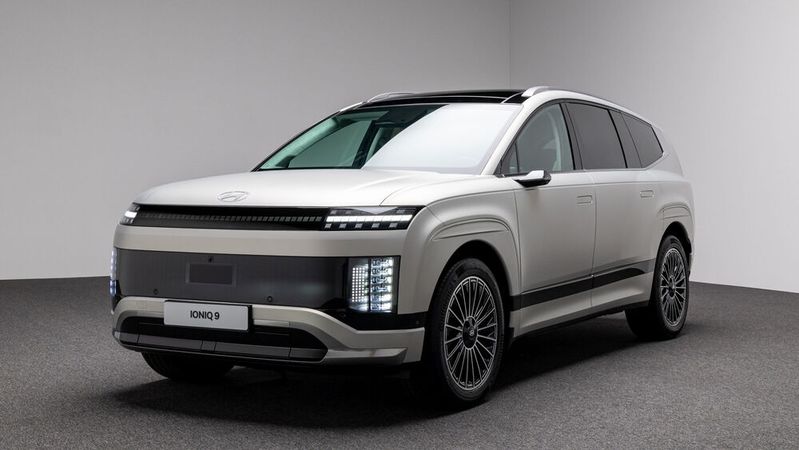
Hyundai showcases its new electric SUV Ioniq 9 in Los Angeles.
(Image: Hyundai)
Simply called Ioniq 9, the future largest model of the electric family based on the E-GMP modular platform used by Hyundai and Kia. Sometime between spring and summer 2025, the over five-meter-long SUV with van character and the largest battery of the Koreans to date is coming to Europe.
The Ioniq 9, which appears massive by European standards, will remain inconspicuous in terms of size in the USA, probably the most important sales market for this model. The front looks as bold as that of a Range Rover. There are also many lighting units in the brand's typical pixel style.
Aerodynamically optimized design
Anyone expecting a boxy format in the side view like the tech sibling Kia EV 9 will be surprised. In the Ioniq 9, the windshield rises comparatively flat. Additionally, the roof follows a wide arc that becomes significantly flatter towards the rear and drops vertically in the area of the tailgate. This shape and the slightly tapering flanks towards the back are part of the aerodynamically optimized design. Smooth surfaces and transitions, the absence of a physical antenna in the roof area, and digital side mirrors also contribute to this design. These measures reduce the drag coefficient cW to a low 0.26. With conventional side mirrors, it is still 0.27, which is at least 0.01 lower than that of the sibling model Kia EV 9.
Of course, the electrically extending door handles of the Ioniq 9 align flush with the door panel when closed. The letters of the Ioniq badge on the tailgate are also flush, where the pixel light elements typical of newer Hyundai models can be found.
As with the other Ioniq models, there are four additional pixel lights in the steering wheel hub, which serve, among other things, as a charging indicator. Further down, there is the accelerator pedal with the + symbol. Cheerful bright colors, the large panoramic glass roof, and the ambient lighting that warmly illuminates many areas give the interior a cozy lounge character. The large longitudinally movable center console is cleverly designed. It can be opened for passengers in the first two rows and has two storage compartments with volumes of 5.6 and 12.6 liters.
The tidy cockpit offers an XL display divided into two segments that surrounds the driver in an arc. The computing technology hidden behind the digital surface ensures fast, smooth operations and modern connectivity. In terms of AI integration, over-the-air updates, or features on demand, the infotainment platform does not need to shy away from comparison.
Relaxed charging breaks in the interior
With 3.13 meters (approx. 10,27 feet), the Ioniq 9 offers the longest wheelbase in the E-GMP world. The correspondingly spacious interior always features three rows of seats. Customers can choose between two individual seats or a three-seater bench in the middle row. The space in the first two rows is generous, especially since there is no driveshaft tunnel to interfere. The front four individual seats come with a reclining function, and the front two even have a fold-out footrest. This allows for relaxed charging breaks. Alternatively, the rotating seats in the second row can be oriented backward. Then, four people can sit facing each other during pauses in the rear.
A clever folding mechanism in the second row allows easy access to the third row. However, the room for movement is somewhat limited here. Behind the backrest, there is space for just under 340 liters of luggage. If the backrests of the third row are laid flat, the storage space increases to 900 liters according to the VDA standard. Additionally, there is a frunk with a capacity of about 50 to just under 90 liters.
Ioniq 9 with more power and battery capacity than EV 9
The Ioniq 9 is based on the well-known E-GMP platform, but Hyundai opts for more power and battery capacity than its modular sibling, the EV 9. A 110-kWh battery is housed in the vehicle floor, which can be combined with three drive variants. The entry-level model features the rear-wheel-drive version with 160 kW, along with two all-wheel-drive versions with either a 70 kW or 160 kW front motor. Thus, the top version delivers 320 kW, 37 kW more than the most powerful EV 9, which reaches a maximum of 283 kW and 100 kWh battery capacity.
The top version called Performance accelerates to 100 km/h in 5.2 seconds, with a top speed of 200 km/h. Thanks to the powerful battery, the RWD version offers a range of up to 620 kilometers. Hyundai states a preliminary consumption value of 19.4 kWh for the single-motor drive variant. With 800-volt architecture, the battery can be charged quickly: at 350 kW power, it takes 24 minutes (from 10% to 80%). The Ioniq 9 offers a Vehicle-to-Load function via a 230-volt socket.
Hyundai has not yet revealed what the Ioniq 9 will cost in Germany. However, the prices of the Kia EV 9, which currently start at 72,500 euros (approx. 76.669 USD), might give an approximate idea.
Date: 08.12.2025
Naturally, we always handle your personal data responsibly. Any personal data we receive from you is processed in accordance with applicable data protection legislation. For detailed information please see our privacy policy.
Consent to the use of data for promotional purposes
I hereby consent to Vogel Communications Group GmbH & Co. KG, Max-Planck-Str. 7-9, 97082 Würzburg including any affiliated companies according to §§ 15 et seq. AktG (hereafter: Vogel Communications Group) using my e-mail address to send editorial newsletters. A list of all affiliated companies can be found here
Newsletter content may include all products and services of any companies mentioned above, including for example specialist journals and books, events and fairs as well as event-related products and services, print and digital media offers and services such as additional (editorial) newsletters, raffles, lead campaigns, market research both online and offline, specialist webportals and e-learning offers. In case my personal telephone number has also been collected, it may be used for offers of aforementioned products, for services of the companies mentioned above, and market research purposes.
Additionally, my consent also includes the processing of my email address and telephone number for data matching for marketing purposes with select advertising partners such as LinkedIn, Google, and Meta. For this, Vogel Communications Group may transmit said data in hashed form to the advertising partners who then use said data to determine whether I am also a member of the mentioned advertising partner portals. Vogel Communications Group uses this feature for the purposes of re-targeting (up-selling, cross-selling, and customer loyalty), generating so-called look-alike audiences for acquisition of new customers, and as basis for exclusion for on-going advertising campaigns. Further information can be found in section “data matching for marketing purposes”.
In case I access protected data on Internet portals of Vogel Communications Group including any affiliated companies according to §§ 15 et seq. AktG, I need to provide further data in order to register for the access to such content. In return for this free access to editorial content, my data may be used in accordance with this consent for the purposes stated here. This does not apply to data matching for marketing purposes.
Right of revocation
I understand that I can revoke my consent at will. My revocation does not change the lawfulness of data processing that was conducted based on my consent leading up to my revocation. One option to declare my revocation is to use the contact form found at https://contact.vogel.de. In case I no longer wish to receive certain newsletters, I have subscribed to, I can also click on the unsubscribe link included at the end of a newsletter. Further information regarding my right of revocation and the implementation of it as well as the consequences of my revocation can be found in the data protection declaration, section editorial newsletter.



:quality(80)/p7i.vogel.de/wcms/7c/06/7c0604c44d4b96508af8c24641ea3c99/0132136237v1.jpeg "Some may already be familiar with friction stir welding. It can even join different metals together. Researchers now have a new approach to this type of joining in mind, which could bring new advantages to the industry ... (Image: IKT)")
:quality(80)/p7i.vogel.de/wcms/18/6d/186db3fe269627eaeace471ea2f56b55/0132123312v1.jpeg "Proven laser cladding processes are now being optimized by Fraunhofer ILT from Aachen and Etxetar from Spain to help meet new requirements in additional industrial sectors. Here, a railway axle is being repaired using LMD. (Image: Etxetar)")
:quality(80)/p7i.vogel.de/wcms/45/2e/452ebe27b324cc535db2760946dfd15d/0131742792v1.jpeg "A major advantage of the new system is, on the one hand, the stability of the holder system and, on the other hand, the internal coolant supply directly to the working area. (Image:Horn/Sauermann)")
:quality(80)/p7i.vogel.de/wcms/d1/6c/d16c902c1311170a225c4e1b7db7bd4b/0132073916v1.jpeg "Now there is finally a saw with an XXL rotating table, so that ton-heavy plastic or fiber composite material panels can be cut gently and quickly. It is called FK-6, and it was built by IMA Schelling Precision. Read here what has been done ... (Image:IMA Schelling Precision)")
:quality(80)/p7i.vogel.de/wcms/f0/d2/f0d2f7a2e8426bd146c7dd1627bce04d/image-20--20schneider-20electric-20joins-20the-20world-20economic-20forum-20lighthouse-20operating-20system-20advisory-20board-20to-20create-20an-20open-source-20manufacturing-20blueprint-20for-20companies-20of-20all-20sizes-jpgv1.jpeg "Schneider Electric expands its industrial AI business with a billion-euro acquisition. (Image:Schneider Electric)")
:quality(80)/p7i.vogel.de/wcms/f6/9e/f69e31ab5afdd0e20e72f1e60bcac86b/datenauswertung-mg-2703v1.jpeg "Production and machine data are to become more easily accessible through generative artificial intelligence. (Source: University of Stuttgart IFF | Fraunhofer IPA | Rainer Bez)")
:quality(80)/p7i.vogel.de/wcms/e9/31/e93160c28d8262bbfb486b9b4568c751/adobestock-1877003493-puhimecv1.jpeg "The electrification of industry is becoming a business necessity. It allows energy to be sourced from a system that can be better controlled, predicted, and optimized than fossil alternatives. (Source: © puhimec – stock.adobe.com)")
:quality(80)/p7i.vogel.de/wcms/f1/a8/f1a8487a3107019f251569661b4f3867/inovance-20x-20vascat-203v1.jpeg "David Bedford Guaus (right), Country Manager at Inovance Technology Spain and Technical Director for Inovance in the Europe and North America regions, says: \"The joint search for a solution to integrate our drives into the system has further enhanced our collaboration with Vascat, and we very much hope to work together again in the future.\" (Image: Inovance)")
:quality(80)/p7i.vogel.de/wcms/23/b7/23b7c94b680b588e6a782720cc06900b/newsimage424308v1.jpeg "Left: Injection-molded test specimen with conventional platelet-shaped metallic effect pigments. Right: Injection-molded test specimen with novel tetrahedral pigment particles. (Image: Fraunhofer IAP)")
:quality(80)/p7i.vogel.de/wcms/40/0d/400df72efc5f3a38cd9ee532027309e5/june12finals-8-bncrop-2048x1170v1.jpeg "An \"electronic nose\" developed by researchers at UC Berkeley can detect gases emitted by spoiled food and food allergens better than the human nose. (Image: Brandon Sánchez-Mejia/UC Berkeley)")
:quality(80)/p7i.vogel.de/wcms/04/eb/04ebee99febeb716da7782b9e42d78b8/0132051842v1.jpeg "The Basic Day Thermal Management is an essential part of the \"Power of Electronics\" conference and originally evolved from the \"Cooling Days.\" (Image: Stefan Bausewein)")
:quality(80)/p7i.vogel.de/wcms/19/27/1927ccde4c7d25ce6f4e274a06bfc06c/cover-20imagev1.jpeg "Additive manufacturing has established itself as a complementary alternative to traditional machining for automotive tools, offering greater speed and flexibility. (Source: Stratasys)")
:quality(80)/p7i.vogel.de/wcms/82/77/8277f2b357418cecb2c9875271c5d1e2/freightliner-20m2-20106-20plus-20utilityv1.jpeg "Daimler Truck North America and Allison Transmission collaborate on the two powertrain solutions for the Freightliner M2 106 Plus. (Source: Clint Davis)")
:quality(80)/p7i.vogel.de/wcms/fa/3e/fa3e28db3a7aacf8fa268271193cd7f2/continental-unternehmenszentrale--2025-2-v1.jpeg "Continental has sold the Contitech division and is now solely a tire manufacturer. (Source: Continental)")
:quality(80)/p7i.vogel.de/wcms/16/a8/16a83b69fc74edb2ea0446cdd52d77a0/26c0162-508v1.jpeg "Vattenfall and Wireless Car aim to offer automated charging processes: without a card or charging app. (Source: Mercedes-Benz)")
:quality(80)/p7i.vogel.de/wcms/16/3c/163c1e300ce18f4afae03345f2ee567c/opening-20benteler-20kenitra-plantv1.png "The new plant in Kenitra is Benteler's first location in Morocco. (Image:Benteler)")
:quality(80)/p7i.vogel.de/wcms/77/15/7715aab3d27cae68e7ff6e2b802668d2/0132070881v1.jpeg "Innodisk's HDR cameras are intended to deliver usable image data for embedded vision and edge AI applications even with significant brightness differences. (Image:Innodisk)")
:quality(80)/p7i.vogel.de/wcms/64/43/6443737124d870de11c81bd7636fa646/0132086586v1.jpeg "Symbolic image: RAM (Image: freely licensed)")
:quality(80)/p7i.vogel.de/wcms/7a/b8/7ab83a5250152fbfd1b6bf7e35a2b50b/0132065385v1.jpeg "Pilot S20: It entered the market in the late 1990s and was the direct evolution of the very first Pilot system from 1995. With this model, Seica achieved an international breakthrough against major players like GenRad or Teradyne. (Image:Seica)")
:quality(80)/p7i.vogel.de/wcms/52/07/52071244e4b5cc28a8834b26ae30eee6/0132094074v1.jpeg "Symbol image: Photonics. (Image: Dall-E / AI-generated)")
:fill(fff,0)/images.vogel.de/vogelonline/companyimg/76800/76895/65.jpg "FAULHABER_120mm.jpg ()")
:fill(fff,0)/p7i.vogel.de/companies/69/de/69de1b7403b0d/simtos-logo.jpeg "simtos-logo (SIMTOS)")
:quality(80)/p7i.vogel.de/wcms/86/f9/86f90f288148b6ef9dc508a9a633e2e6/0121908614v1.jpeg "No steering wheel: joysticks on the armrests instead. This and other concepts were investigated as part of the Rumba project. (Image:Bosch)")
:quality(80)/p7i.vogel.de/wcms/81/5b/815b3fa3a7b056063f0d57be18c21fc4/0121913165v1.jpeg "The digital exterior mirrors help increase aerodynamics.(Image: Hyundai)")
:quality(80)/p7i.vogel.de/wcms/c1/75/c1756e54ebbd90aacf1e84f8269af828/0121913176v1.jpeg "If the Ioniq 9 is ordered with digital exterior mirrors, there are corresponding displays on the inner door sides showing the image of an exterior mirror.(Image: Hyundai)")
:quality(80)/p7i.vogel.de/wcms/31/7b/317bd1c46229e12bb891994a847e54b6/0121913183v1.jpeg "Passengers in the second row can also access the storage compartments of the center console.(Image: Hyundai)")
:quality(80)/p7i.vogel.de/wcms/55/dd/55ddc59e9072ac9bad0a6987fd46c0ca/0121913185v1.jpeg "At the front, the Ioniq 9 offers plenty of space and a cozy atmosphere.(Image: Hyundai)")
:quality(80)/p7i.vogel.de/wcms/af/55/af55e6b602fb018044e59fc803a6d391/0121600843v1.jpeg "Claire Magne is the global product manager at TE Connectivity. (Image:Benjamin Schenk)")
:quality(80)/p7i.vogel.de/wcms/6e/b1/6eb167fde07444684634d4de51ec4f68/0125731800v1.jpeg "Hyundai has a new electric flagship with the Ioniq 9. (Image:Hyundai)")
:quality(80)/p7i.vogel.de/wcms/f7/f8/f7f8bcd6f4854df1b6555a0ff951b93e/0131493601v1.jpeg "Kia launches another SUV on the market with the Seltos. (Image:Kia)")