Is the ultimate automation solution coming with AI-driven humanoid robots? Some experts are skeptical and question the maturity of the robots.
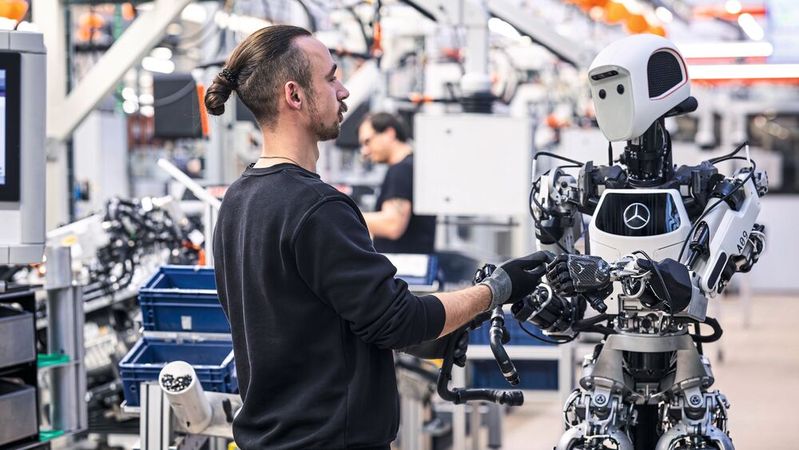
Model and replica: Humanoid robots, like here at Mercedes-Benz, are intended to automate nearly every task and assist humans.
(Image: Mercedes-Benz AG)
Audi, BMW, BYD, FAW-Volkswagen, Geely, Magna, Mercedes-Benz, Nio, Tesla, Schaeffler: These are some examples of automotive companies that have already tested or plan to test humanoid robots equipped with artificial intelligence. Why this rush for bipedal robots? If everything works as hoped, humanoids can economically automate almost any task—including activities that previously could only be performed by humans or whose automation was not cost-effective.
As bipeds, the robots can easily operate in environments designed for humans. Continuously improved sensor technology allows robots to "feel" and perceive their surroundings. And to perform varying tasks, the robot doesn't need to be redesigned but simply trained for new activities. Software, especially AI, makes this possible—following the software-defined vehicle comes software-defined automation.
Automakers Test Humanoid Robots
As the first OEM, BMW has gone public in a big way with the testing of humanoid robots at its Spartanburg plant in the U.S.. In mid-2024, humanoids of the Figure 02 type were tested there for several weeks, placing sheet metal parts into fixtures for welding in the body shop. Currently, the robots are back at the Spartanburg plant for another pilot deployment, with BMW and Figure experts continuously optimizing them.
A robot moves 1,000 sheets per day according to BMW. The machines, according to the manufacturer Figure, weigh 70 kilograms, are approximately 1.7 meters tall (approx. 5.5 ft), and can carry 20 kilograms. "We want to accompany this technology from development to industrialization," said BMW's Head of Production Milan Nedeljković.
Mercedes-Benz is testing several Apollo robots from the Texas-based company Apptronik at its Berlin Digital Factory Campus and in production plants. The humanoids are intended to learn to independently execute defined motion sequences. The OEM's initial target areas are intralogistics, including material transport, sorting, and component inspection. Once a certain level of maturity is reached, Apollo is expected to be "gradually more integrated into production."
The Apollos have similar key specifications to the Figure 02: about 1.73 meters tall (approx. 5.7 ft), weighing 73 kilograms, and capable of carrying around 25 kilograms. To strengthen collaboration with Apollo, Mercedes-Benz plans to invest "a low double-digit million amount" in Apptronik in 2025.
Several Humanoid Robots at Schaeffler
The supplier Schaeffler is already "deploying several humanoids in pilot phases within the global production network, including in Cheraw, USA," as a company spokeswoman told Automobil Industrie (German magazine). These include models from the US manufacturer Agility Robotics, in which Schaeffler holds a 1.1 percent stake, and robots from other manufacturers.
At the Hannover Messe (German trade fair), Schaeffler, together with IT service provider and consultant Accenture, demonstrated how the humanoid robots "Digit" from Agility Robotics and "Phoenix" from Sanctuary AI can be utilized in digitized factory environments. Accenture holds a minority stake in the Canadian company Sanctuary AI. Magna has also been involved with Sanctuary AI since 2021 and is expected to support the industrialization of the robots. Schaeffler aims to position itself as a component supplier for humanoid robots, providing items such as joints or drives.
Gallery
Environmental Sensors From the Car
The dimensions of computing power in humanoid robots are exemplified by Xpeng. The OEM, in which the Volkswagen brand holds a 4.99 percent stake, builds its own humanoid robots. In a video, Chairman and CEO He Xiapen emphasizes that the robots use the Eagle-Eye system for environmental perception, which is also deployed in the new P7+ sedan—and even more AI power than in the car.
However, a machine in human form is not necessarily the best solution for every automation task. For example, walking requires significantly more energy than rolling. The movement itself is more energy-intensive. Additionally, the robot requires a great deal of power-hungry computing resources to remain stable on two legs. This reduces the battery life of robots, which currently is usually a maximum of four hours.
Date: 08.12.2025
Naturally, we always handle your personal data responsibly. Any personal data we receive from you is processed in accordance with applicable data protection legislation. For detailed information please see our privacy policy.
Consent to the use of data for promotional purposes
I hereby consent to Vogel Communications Group GmbH & Co. KG, Max-Planck-Str. 7-9, 97082 Würzburg including any affiliated companies according to §§ 15 et seq. AktG (hereafter: Vogel Communications Group) using my e-mail address to send editorial newsletters. A list of all affiliated companies can be found here
Newsletter content may include all products and services of any companies mentioned above, including for example specialist journals and books, events and fairs as well as event-related products and services, print and digital media offers and services such as additional (editorial) newsletters, raffles, lead campaigns, market research both online and offline, specialist webportals and e-learning offers. In case my personal telephone number has also been collected, it may be used for offers of aforementioned products, for services of the companies mentioned above, and market research purposes.
Additionally, my consent also includes the processing of my email address and telephone number for data matching for marketing purposes with select advertising partners such as LinkedIn, Google, and Meta. For this, Vogel Communications Group may transmit said data in hashed form to the advertising partners who then use said data to determine whether I am also a member of the mentioned advertising partner portals. Vogel Communications Group uses this feature for the purposes of re-targeting (up-selling, cross-selling, and customer loyalty), generating so-called look-alike audiences for acquisition of new customers, and as basis for exclusion for on-going advertising campaigns. Further information can be found in section “data matching for marketing purposes”.
In case I access protected data on Internet portals of Vogel Communications Group including any affiliated companies according to §§ 15 et seq. AktG, I need to provide further data in order to register for the access to such content. In return for this free access to editorial content, my data may be used in accordance with this consent for the purposes stated here. This does not apply to data matching for marketing purposes.
Right of revocation
I understand that I can revoke my consent at will. My revocation does not change the lawfulness of data processing that was conducted based on my consent leading up to my revocation. One option to declare my revocation is to use the contact form found at https://contact.vogel.de. In case I no longer wish to receive certain newsletters, I have subscribed to, I can also click on the unsubscribe link included at the end of a newsletter. Further information regarding my right of revocation and the implementation of it as well as the consequences of my revocation can be found in the data protection declaration, section editorial newsletter.
Humans and robots also differ in the number of joints: Humans have 140 real joints, and including so-called pseudo joints, like intervertebral discs, the number rises to 212. Robots, on the other hand, have to make do with 25 to 30 joints. However, in other aspects, despite their human-like appearance, robots can surpass the original: for example, achieving 360-degree rotations at joints.
Two- or Four-Legged or on Wheels
Robot manufacturers are also thinking about such issues. Boston Dynamics, for example—80 percent owned by Hyundai—has the bipedal Atlas robot underway. However, while Atlas, like all humanoids, is still awaiting industrialization, the Spot robot from Boston Dynamics has been walking on four legs for some time now, including in plants operated by Audi and BMW. There, the robot dog scans the facilities to create digital twins or assists "as a watchdog for maintaining production equipment" at BMW's Hams Hall facility in the UK. Apptronik takes a different approach. Its Apollo robots are not only offered in fully humanoid form. Since two legs are often unnecessary, customers can also opt for the torso mounted on a mobile base with wheels or on a fixed platform.
What Jobs for Humanoid Robots?
What could the role of bipedal robots look like in the factory of the future? They are expected to relieve humans, free them from dangerous tasks, and collaborate with them, according to frequently mentioned scenarios. And they could counteract the skills shortage.
The extent to which they will replace humans remains to be seen. A study by market research company Nexery estimates a payback period of about 1.4 years for the first serially produced robots. In the short term, they could automate more than 40 percent of human activities. Author Tobias Bock anticipates declining costs and increasing capabilities. By 2030, he expects a return on investment within just over half a year or less.
Humanoid robots are also classified as one of the top five trends by the International Federation of Robotics. However, it remains "to be seen whether humanoid robots will represent an economically viable and scalable business case for broad industrial application." Fraunhofer researchers have also recently expressed significant caution. While they acknowledged the potential to "become a game changer in existing factories," based on feedback from 100 industry experts, they noted that, with the current level of technological maturity, the use of humanoid robots in production and logistics is "still to be considered a misguided path."
The robot manufacturers naturally believe in their success and are planning industrialization. Apptronik has recently entered into a partnership with the contract manufacturer Jabil from Florida, which also counts Apple among its clients. Figure has just announced plans to establish a robot manufacturing facility where humanoid robots will produce new humanoid robots. This is set to happen later this year. At the start of production (SOP), the capacity will be 12,000 robots per year.
Future-Proof Authentication with Universal RFID Readers



:quality(80)/p7i.vogel.de/wcms/f9/7d/f97deef8fde21c8630d76411b18a20a7/0129803665v1.jpeg "Skoda has invested well over 220 million US dollars in the high-tech battery plant that has now opened in Mlada Boleslav. It has now started its work, which is highly automated ... (Image:Skoda)")
:quality(80)/p7i.vogel.de/wcms/f5/61/f561ad7c72ed41fd7a67ad9c481cb15d/0129799343v1.jpeg "Engine-generator units (MGU) from Steyr Motors are at work in the Leopard 2 main battle tank and the Leguan bridge vehicle (pictured). An extended contract is now to secure at least 500 more systems of this type for the Bundeswehr ... (Image:German Armed Forces)")
:quality(80)/p7i.vogel.de/wcms/6c/b5/6cb5ce2155433f6e73b16399adc4c561/0113143253v1.jpeg "In our China Market Insider we regularly provide you with relevant information directly from China. (Image:© Eisenhans - stock.adobe.com)")
:quality(80)/p7i.vogel.de/wcms/7f/fd/7ffd32863352c40f562f4245e4766e61/0129745849v1.jpeg "After US President Donald Trump once again resorted to his favorite weapon, tariffs, concerns rose in the EU that the so-called tariff deal could become invalid. But it looks as if the sea remains relatively calm ... (Image:F. Schneidler)")
:quality(80)/p7i.vogel.de/wcms/9c/ac/9cac6246660e746c5a3989399ac4d250/0128561645v1.jpeg "Artificial intelligence can drive efficiency in smart factories through centralized data management and predictive maintenance. (Picture: ©Fardived - stock.adobe.com)")
:quality(80)/p7i.vogel.de/wcms/6b/e2/6be235b5ad8a442ccd9d164b0b300d8b/0129763992v1.jpeg "As early as 2020, the Zimmer Group announced that it would convert its production to be sustainably CO2-neutral. (Image:Zimmer Group)")
:quality(80)/p7i.vogel.de/wcms/d4/ba/d4bab9481e66f8570f40eb8ef2a90198/0129795613v1.jpeg "A camera inspection during removal ensures that the components are placed correctly in the KLTs. (Image:Yaskawa Europe)")
:quality(80)/p7i.vogel.de/wcms/cb/56/cb56e42b01638b618e8d1b9b38f32faa/0129810132v1.jpeg "From summer 2026, \"AEON\" will support people at the BMW plant in Leipzig. (Image:diephotodesigner.de/BMW)")
:quality(80)/p7i.vogel.de/wcms/b5/5e/b55ed9355e0395ec0caf111d6af6b494/adobestock-495980372--c2-a9-20natali-mis-20-e2-80-93-20stock-adobe-com-6720x3778v1v1.jpeg "Which engineering skills will be in vogue in 2026? (Image:natali_mis - stock.adobe.com)")
:quality(80)/p7i.vogel.de/wcms/bf/a5/bfa5d882e93f159ce93e933742272b00/nord-vibn-cmyk-2196x1235v1v1.jpeg "With digital twins for virtual commissioning, Nord supports customers in ensuring that systems are available more quickly, even with complex drive systems. (Image:Nord Drivesystems)")
:quality(80)/p7i.vogel.de/wcms/f5/7e/f57ef535ee35e7b3b7ff15a8a63cef10/eds-keyvisual-8000x4496v1.jpeg "(Source: European Defence Supply)")
:quality(80)/p7i.vogel.de/wcms/af/a3/afa312176d956068af20491957eef642/newsimage418262-3100x1745v1v1.jpeg "The autonomous shuttle of the Aula AI project during a demonstration of sensor data with artificial fog. (Image:University of Magdeburg)")
:quality(80)/p7i.vogel.de/wcms/cb/23/cb23acd8e9de969d52522692b62b1892/0129680605v1.jpeg "The Z22198 is an extremely compact, three-axis IEPE acceleration sensor for measuring oscillations (vibrations) and shocks in demanding applications. With an edge length of just 0.24 inches and a weight of 0.03 ounces, it is ideal for lightweight structures and confined spaces. (Image:Copyright 2020 ScROGERS,All Rights Reserved)")
:quality(80)/p7i.vogel.de/wcms/c4/40/c44043c61f9dd99b80ccca398c284018/0129795093v1.jpeg "Subaru manufactures the E-Outback at its Yajima plant, marking the first time it has produced an electric vehicle in-house. (Image:Subaru)")
:quality(80)/p7i.vogel.de/wcms/fe/18/fe1824e572677900655c854f6c92c391/0129811281v1.jpeg "BMW and CATL deepen their partnership and work together on the battery pass. (Image:BMW)")
:quality(80)/p7i.vogel.de/wcms/15/54/15546b27b3a679871325ef6d92509a95/0129750872v1.jpeg "Webasto plans to open its third plant for sunroofs in India. (Image:Webasto)")
:quality(80)/p7i.vogel.de/wcms/70/14/70142aa050f8d3f7784c5ddbb2aba5f1/0129778339v1.jpeg "The software investments in production have saved time in Lacon production. (Image:Lacon)")
:quality(80)/p7i.vogel.de/wcms/5c/0f/5c0fee074c4b6c8e8c0993f3217c2f5a/0129773718v1.jpeg "The General Fusion demonstration reactor. (Image:General Fusion)")
:quality(80)/p7i.vogel.de/wcms/7f/c1/7fc1c83b8509df676d27518b82aaef02/0129764984v1.jpeg "China Resources Microelectronics (CR Micro) has announced its intention to increase the prices of its own products. (Image:China Resources Microelectronics)")
:quality(80)/p7i.vogel.de/wcms/eb/4e/eb4e449562174ec95a5b3d30fb0137a2/0129648135v1.jpeg "The III-V germanium PV module with an efficiency of 34.2% is currently the most efficient solar module in the world. (Image:Jacob Forster)")
:fill(fff,0)/images.vogel.de/vogelonline/companyimg/76800/76895/65.jpg "FAULHABER_120mm.jpg ()")
:fill(fff,0)/p7i.vogel.de/companies/69/88/69882c428938e/tmts2026-ticec-banner-en-2000px.png "tmts2026-ticec-banner-en-2000px (https://www.tmts.tw/en)")
:fill(fff,0)/p7i.vogel.de/companies/67/eb/67eba621ef6ea/logo2.png "logo2 (Wuxi InfiMotion)")
:quality(80)/p7i.vogel.de/wcms/53/15/53156bd3f66992492e904fa47a9e526d/0124185697v1.jpeg "The vision of a humanless factory where thousands of robots move around daily does not exist, according to Mercedes Production Chief Jörg Burzer. The realistic goal: The robots are primarily meant to handle repetitive tasks.(Image: Mercedes-Benz AG)")
:quality(80)/p7i.vogel.de/wcms/02/01/02014685ef4dcfc9347df0b399bee3c0/0124107277v1.jpeg "The robot dog Spot: In the British BMW plant in Hams Hall, the machine from Boston Dynamics identifies, for example, overheating machines or leaking compressed air lines.(Image: BMW)")
:quality(80)/p7i.vogel.de/wcms/5f/6a/5f6a377e9d923b40c2a25da4d78a0201/0124107273v1.jpeg "Pilot project in Spartanburg: At its US plant, BMW uses humanoid robots to place sheet metal parts for the body into special fixtures.(Image: BMW)")
:quality(80)/p7i.vogel.de/wcms/87/20/8720bf2e95e8a4abb5bba5f488929569/0124121676v1.jpeg "Practical test: The automotive supplier Schaeffler tests humanoid robots from various manufacturers in its production network.(Image: Domink Obertreis/Schaeffler)")
:quality(80):fill(efefef,0)/p7i.vogel.de/wcms/67/ae/67ae0b9ac31f8/elatec-wp-universal-reader.png "Elatec WP Universal Reader")
:quality(80)/p7i.vogel.de/wcms/ea/c3/eac360b97418b741e49adc7fcf540459/mercedes-999x562v1.jpeg "Jeff Cardenas (l.), Co-Founder of Apptronik, and Jörg Burzer sign the symbolic agreement for collaboration at the Mercedes plant in Marienfelde, Germany. (Bild: Thomas Günnel – VCG)")
:quality(80)/p7i.vogel.de/wcms/57/b2/57b252ef7899835d27a3952a62026352/0124862617v1.jpeg "The humanoid Atlas from Boston Dynamics is among the most technologically advanced robots. (Image:Messe München GmbH)")