Humanoid robots are rare in manufacturing—but they have made this leap. The AI models are continually learning. However, industrial reliability is often still lacking.
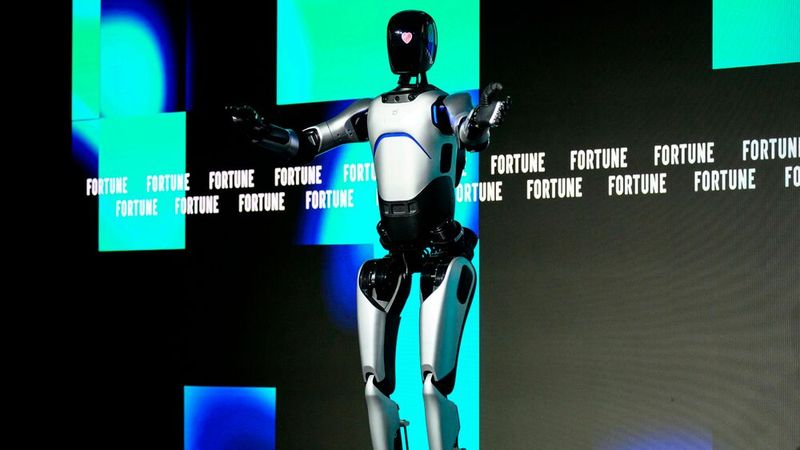
The Agibot A2 at a Fortune China event in December 2025.
(Image: Agibot)
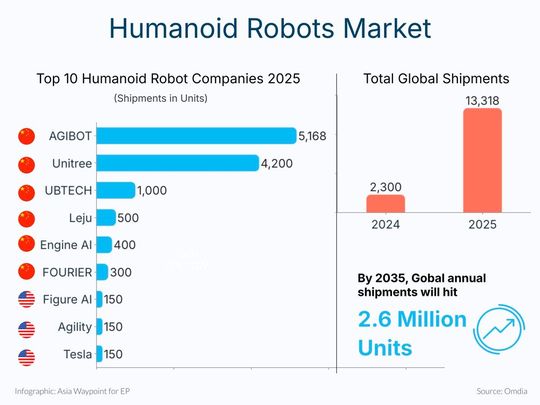
These dancing robots everywhere! The humanoids, the bipeds among the machines for automated actions, are currently conquering the media. And the social networks. Compared to this general interest, the statistics seem like a mistake: just 13,317 humanoid robots were delivered worldwide in 2025, according to a report by the British market research agency Omdia.
In China, many people are starting to get too much of the current hype. "We don't need a million dancing humanoid robots," was the headline of the Tencent Tech portal a few days ago.
Most of the humanoids actually sold currently come from China. Zhiyuan Robot delivered 5,168 units of its "AgiBot" to customers last year, Unitree Robotics 4,200 units and Ubtech around 1,000 units, Tencent Tech quotes from the Omdia report. Experts warn that the industry is so young that the statistics are still relatively immature. Some figures may include orders that will only be fulfilled in the coming years. Elsewhere, deliveries may not be recorded.
The sales figures for humanoid robots in 2025.
(Image: Asia Waypoint)
Humanoid Robots: Hype Versus Reality
Be that as it may, the reality is that "most companies have yet to deliver relevant production capacity for humanoid robots", comments the Chinese technology portal. This is particularly true if you compare the figures for humanoids with those for industrial robots. These are cobots and all the models that work in factories around the world instead of dancing on TV or shining with flip-flops on TikTok.
Complete figures for 2025 are not yet available, but the International Federation of Robotics in Frankfurt predicts that around 575,000 industrial robots will be installed worldwide last year. So is it all just hype with the humanoids? Not that either. But individual company founders have made public statements that have fueled expectations regarding the arrival of humanoids in everyday life.
Scaling Humanoids Commercially
Elon Musk said in an interview last May that he wanted to produce "one million" of his Optimus robots within the next five years. According to Omdia, his company delivered 150 units last year. Nevertheless, deliveries of humanoids worldwide have risen sharply within a year, from only around 2,000 units in 2024. And from now on, commercial scaling is expected to increase rapidly according to many observers.
Positive Forecasts for Humanoid Robots
At the end of January 2026, the investment bank Morgan Stanley doubled its previous forecast for global sales of humanoids for the current year from 14,000 to 28,000. Omdia predicts that around 2.6 million humanoids will be sold annually in 2035.
A fair analysis is therefore that the humanoid industry is still in its infancy, but has great potential for growth. It was similar with electric cars at the very beginning. Sales grew from a few thousand a year to hundreds of thousands and then millions.
Hardware and Software Still Unreliable
The reason why more dancing is currently being done and fewer dishwashers are being emptied or electric cars assembled is due to the fact that the hardware is not yet fully developed and the intelligence is still inadequate. The large AI models still have a lot to learn.
After Wang Zhongyuan from the Beijing Institute for General Artificial Intelligence bought ten humanoid robots for his team of researchers, five of them were broken again after two months. "The hardware stability is still at the research stage," Wang told Tencent Tech. Because the robot arms often overheated quickly, he had to buy them fans, "like assigning them a babysitter."
Other observers believe that the "intelligence" of humanoids also still has a long learning curve ahead of it. Making a robot dance for a few minutes or having it perform complex tasks on an assembly line for several hours is a different matter. However, there are also initial breakthroughs in this area.
Elsewhere, humanoids are appearing in Midea's first washing machine factories in central China or on the production lines of electric car manufacturers in southern China. Small series are still being incorporated everywhere. But with every gigabyte of "experience" they store, the vertical AI models get better.
Date: 08.12.2025
Naturally, we always handle your personal data responsibly. Any personal data we receive from you is processed in accordance with applicable data protection legislation. For detailed information please see our privacy policy.
Consent to the use of data for promotional purposes
I hereby consent to Vogel Communications Group GmbH & Co. KG, Max-Planck-Str. 7-9, 97082 Würzburg including any affiliated companies according to §§ 15 et seq. AktG (hereafter: Vogel Communications Group) using my e-mail address to send editorial newsletters. A list of all affiliated companies can be found here
Newsletter content may include all products and services of any companies mentioned above, including for example specialist journals and books, events and fairs as well as event-related products and services, print and digital media offers and services such as additional (editorial) newsletters, raffles, lead campaigns, market research both online and offline, specialist webportals and e-learning offers. In case my personal telephone number has also been collected, it may be used for offers of aforementioned products, for services of the companies mentioned above, and market research purposes.
Additionally, my consent also includes the processing of my email address and telephone number for data matching for marketing purposes with select advertising partners such as LinkedIn, Google, and Meta. For this, Vogel Communications Group may transmit said data in hashed form to the advertising partners who then use said data to determine whether I am also a member of the mentioned advertising partner portals. Vogel Communications Group uses this feature for the purposes of re-targeting (up-selling, cross-selling, and customer loyalty), generating so-called look-alike audiences for acquisition of new customers, and as basis for exclusion for on-going advertising campaigns. Further information can be found in section “data matching for marketing purposes”.
In case I access protected data on Internet portals of Vogel Communications Group including any affiliated companies according to §§ 15 et seq. AktG, I need to provide further data in order to register for the access to such content. In return for this free access to editorial content, my data may be used in accordance with this consent for the purposes stated here. This does not apply to data matching for marketing purposes.
Right of revocation
I understand that I can revoke my consent at will. My revocation does not change the lawfulness of data processing that was conducted based on my consent leading up to my revocation. One option to declare my revocation is to use the contact form found at https://contact.vogel.de. In case I no longer wish to receive certain newsletters, I have subscribed to, I can also click on the unsubscribe link included at the end of a newsletter. Further information regarding my right of revocation and the implementation of it as well as the consequences of my revocation can be found in the data protection declaration, section editorial newsletter.
Xiaomi Plans Many Humanoids in Production
The founder of smartphone and e-car manufacturer Xiaomi, Lei Jun, has said that he wants to start the "large-scale use of humanoids" in his factories within the next five years. Alongside the use of artificial intelligence and automation, they will take over tasks in the Group's modern AI factories that are currently still carried out by skilled workers.
Even the current pilot deployments of humanoids in factories have led some observers in China to conclude that all the dancing around on social media is obscuring the view of a much more important paradigm shift: humanoids, they argue, are just making the leap into the "world of real work".
From Demo Object to Tool
"In 2025, China's robotics industry reached a historic turning point," writes the Chinese journal Kechuangban Ribao. Humanoids have gone from being "demonstration objects in the laboratory" to tools that take part in factory production. The paper believes that the new technology of humanoid robots is currently undergoing its validation phase with its first industrial applications.
The sums flowing into robotics start-ups on the "STAR Market", the Chinese equivalent of the NASDAQ, in Shanghai are correspondingly large. This means that humanoids may still be dancing around like happy children in China and elsewhere, but the serious side of life is already catching up with them. (thg)



:quality(80)/p7i.vogel.de/wcms/a0/47/a04725ef9bd09fb6c9341a1bea1b5d93/0130443083v1.jpeg "Here, a type of plastic pallet is produced by thermoforming (vacuum forming or deep drawing) at the corresponding division of New England Plastics in the USA. This division, which specializes in so-called liners, is now part of Ringmetall ... (Image:New England Plastics)")
:quality(80)/p7i.vogel.de/wcms/e3/42/e342b3c593ea92d56604d3be969e9c9a/0130437231v1.jpeg "Daimler Truck will be building even more trucks at its Czech plant in Cheb in the future. This is because it is now being expanded for strategic cost-saving reasons ... (Image:Daimler Truck)")
:quality(80)/p7i.vogel.de/wcms/23/99/23992bf2dcdc432c9b7209c34a4a7c48/0129733089v1.jpeg "Stork relies on the modular Neoswiss turning system from Iscar to shorten the set-up times for its sliding headstock lathes and work more productively. (Image:Iscar)")
:quality(80)/p7i.vogel.de/wcms/7d/e2/7de2923434b2f1a78ba5482d8d335269/0113143253v1.jpeg "In our China Market Insider we regularly provide you with relevant information directly from China. (Image:© Eisenhans - stock.adobe.com)")
:quality(80)/p7i.vogel.de/wcms/b7/36/b736dfebc16c42d6901d0d0e1f390493/3d-druck-20factory-20--20ki-20generiert-1920x1079v1.png "(Source: AI-generated)")
:quality(80)/p7i.vogel.de/wcms/79/b2/79b21aad663f4a7bd4472afc1c1afc62/0130433994v1.jpeg "Mission Joyride: The free-flying robot (shown here in the rendering) will relieve the ISS crew of logistics tasks from 2027 with its two mechanical arms. (Image:Icarus Robotics)")
:quality(80)/p7i.vogel.de/wcms/6b/45/6b4546fa6ebf305c3660326909363f32/0130437089v1.jpeg "Industrial AI in action: Rockwell Automation presents practical solutions for self-controlling production systems at the Hannover Messe. (Image:Rainer Jensen, Deutsche Messe)")
:quality(80)/p7i.vogel.de/wcms/78/e9/78e9188c25a8a94e67c34c9bf8ffe495/visual-agile-20robots-20and-20google-20deepmind-20partner-20to-20bring-20intelligence-20to-20robotics-2500x1406v1v1.jpeg "Together, the partners are developing adaptable, intelligent robots for a wide range of applications (Image:Agile Robots SE)")
:quality(80)/p7i.vogel.de/wcms/59/a2/59a2b11f0aa1b700eff02addd5de8703/adobestock-1788280853--c2-a9-20satria-20-e2-80-93-20stock-adobe-com-5081x2860v1v1.jpeg "Quantum computers require extreme cooling to temperatures close to absolute zero in order to keep qubits stable. (Image:satria - stock.adobe.com)")
:quality(80)/p7i.vogel.de/wcms/62/5f/625f41e87ebfef156a98c8e6393e32fd/0130211654v1.jpeg "Axial flux motors have some advantages over radial flux motor—but their production is currently still expensive. (Image:RWTH Aachen University)")
:quality(80)/p7i.vogel.de/wcms/f6/ae/f6aec4f6241b36ed5e3a990ac9176b42/0130429460v1.jpeg "Verne, Pony.ai and Uber want to launch a robotaxi service in Europe. (Image:Verne)")
:quality(80)/p7i.vogel.de/wcms/d7/88/d788699f2974708a332baa4e7a62fa9e/0130438967v1.jpeg "Skoda is withdrawing from China. The brand has produced well over three million vehicles there. (Image:Skoda car)")
:quality(80)/p7i.vogel.de/wcms/b0/43/b043b86899837532aad62d63368a917a/0130371361v1.jpeg "Skoda leaves the chinese market.
(Image:Skoda)")
:quality(80)/p7i.vogel.de/wcms/c3/c4/c3c4ce270b083eeac55654148611f064/0130237945v1.jpeg "China is not giving up on hydrogen, but is intensifying its efforts. (Image:freely licensed from Pixabay)")
:quality(80)/p7i.vogel.de/wcms/ee/09/ee09acbd6dc896df25affaa9e871e6e5/0130440053v1.jpeg "IMS chip module for simple system integration into an ion mobility spectrometer. (Image:Fraunhofer IPMS)")
:quality(80)/p7i.vogel.de/wcms/10/6c/106cd22de5f68a0f74639d654827228c/0130345302v1.jpeg "Made in India: According to the India Electronics and Semiconductor Association (IESA), the country should be able to produce between 75 and 80 million chips by the beginning of 2027, once the plants currently under construction become operational. (Image:Pixabay (Montage: Sebastian Gerstl))")
:quality(80)/p7i.vogel.de/wcms/a5/ed/a5ed6fda029d362732a293d6b19d74c4/0130444216v1.jpeg "Thirteen executives from the Chinese chip industry have drawn up a plan to achieve an 80% self-sufficiency rate for semiconductors by 2030. (Image:Maxim_Kazmin - stock.adobe.com)")
:quality(80)/p7i.vogel.de/wcms/31/a6/31a646018b34d8e0a44bfc8bf17837f6/0130361632v1.jpeg "For many companies, PFAS are considered indispensable in electronics production. (Image:freely licensed)")
:fill(fff,0)/images.vogel.de/vogelonline/companyimg/76800/76895/65.jpg "FAULHABER_120mm.jpg ()")
:fill(fff,0)/p7i.vogel.de/companies/69/88/69882c428938e/tmts2026-ticec-banner-en-2000px.png "tmts2026-ticec-banner-en-2000px (https://www.tmts.tw/en)")
:quality(80):fill(efefef,0)/p7i.vogel.de/wcms/65/f0/65f0715271f4e/dassault-wpcover-mm.png "Dassault_WPCover_MM")
:quality(80)/p7i.vogel.de/wcms/63/e9/63e9db3259a656cca88c5f7158af3fcb/0129385769v1.jpeg "The Agibot A2 at a Fortune China event in December 2025. (Image:Agibot)")
:quality(80)/p7i.vogel.de/wcms/7d/e2/7de2923434b2f1a78ba5482d8d335269/0113143253v1.jpeg "In our China Market Insider we regularly provide you with relevant information directly from China. (Image:© Eisenhans - stock.adobe.com)")