E-bikes have rapidly evolved in recent years. Integrated systems, smaller motors, and smart solutions are in demand. Much of the development work is now taking place in the software sector. Here, we explain what the e-bike software does and why it's beneficial to perform regular updates.
In the software sector, the most significant development work usually occurs when optimizing e-bikes.
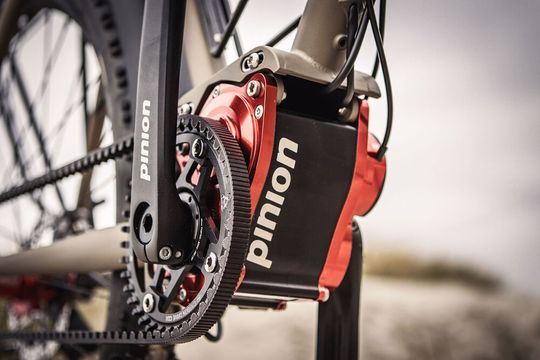
(Image: www.pinion.eu| pd-f)
The software ensures that the e-bike performs as it should. The individual drive components, such as sensors, motor, remote unit, and even the battery, communicate with each other through the software. Each component has its own software; all together they are bundled in firmware. This simplifies handling. By adjusting the software, the characteristics of the drive system are defined. The software can control, for example, the system's maximum power, how the riding modes are configured, and how much motor power is provided. The firmware is regularly updated, improved, and provided as an update.
No one in the e-bike market has reached the zenith. We can all still work on interaction.
Pascal Ketterer, Software-Entwickler, Fazua
Harmonize E-Bike Software With Humans And Machines
A key challenge in developing software for e-bikes or pedelecs is the coordination between human and machine, the interaction. Unlike other electronic devices, the human factor is crucial for the system's functioning. The software must process the information produced by a human (such as the force the cyclist applies to the pedals and what this implies for the overall system). The systems respond very sensitively to the rider's input. "The great art of the industry is recognizing and covering a wide range of different factors, purposes, and user groups," says Dirk Menze, Head of Marketing and Design at drive manufacturer Pinion. Improvements based on error analyses are therefore an essential part of software development. "No one in the e-bike market has reached their peak. We can all still work on interaction," says Pascal Ketterer, software developer at drive manufacturer Fazua.
Why are Regular Updates Useful?
Part of the development work involves making the systems even more personalized. For example, someone who rides sportily pedals at a higher frequency and therefore needs a more harmonious motor that feels similar to riding a bike.
(Image: www.fazua.com | pd-f)
The goal is always to further develop the system and provide a better product. When a new e-bike drive comes to market, it is sufficiently tested and verified, but practical applications can still reveal issues that cannot be simulated on a test bench. Software updates can address these identified problems without requiring repairs on the bike or extended time in the workshop. Manufacturers are also constantly working on optimizations and understanding what users truly need, continually rolling out new features. "We learn from the mistakes we make," says Pascal Ketterer.
The analysis is based on reading anonymous data by the manufacturers. It examines in which performance ranges a motor is used, which support modes are driven, or what average cadence is pedaled. Based on these values, possible errors are analyzed and corrected. Personal data such as address and place of residence are not read.
Noticeable in the data analysis: Most e-bikers ride in a battery-saving mode. Part of the work also involves making the systems even more individualized. Those who ride more sportily pedal at a higher cadence and therefore need a more harmonious motor that feels more like a bicycle. Those who are only occasionally on the road tend to have a lower cadence but stronger motor assistance. Such individual differences can also be managed through software settings.
How Do You Get A Software Update?
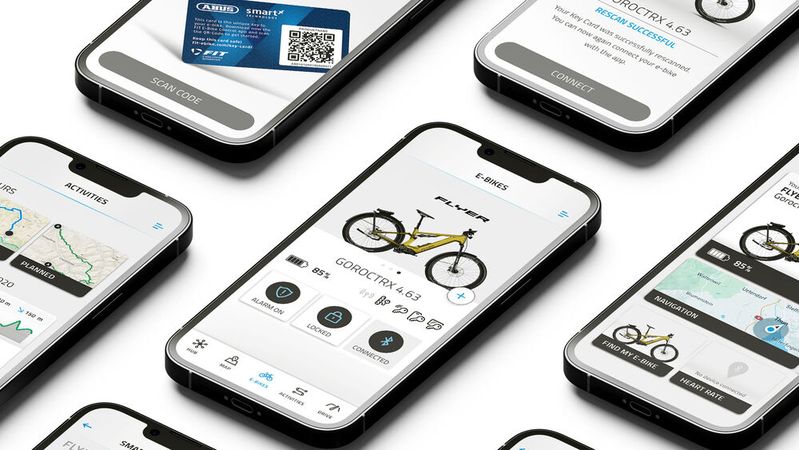
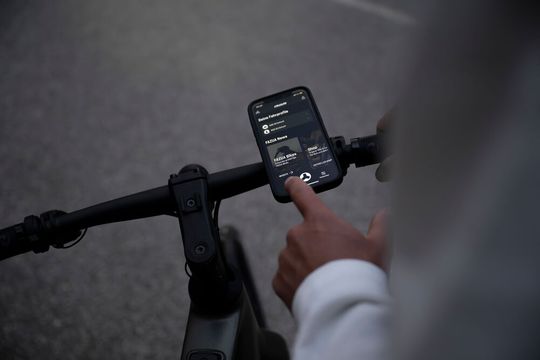
There are various solutions available. Manufacturers, for example, provide updates via a mobile app. Simply connect your phone to the e-bike and use the app to install the update. Other systems require a connection to a computer via a USB-C cable. "There's no need to worry about doing it yourself," says Pascal Ketterer. Some manufacturers also involve the specialist dealer in the update process, allowing the bike to be checked for defects at the same time. Whether there is a current update can usually be found out through the providers' newsletters or on their websites.
It depends on the manufacturer whether they regularly push small updates or prefer to bundle them. Major updates with significant changes occur approximately every six months.
An example of a major update can be found at Pinion. In the fall of 2024, the company released a software update that enabled an automatic shifting function on all previous systems. Instead of a hardware exchange, the function could simply be activated via software.
(Image: www.pinion.eu| pd-f)
However, there is no need to worry that the e-bike will stop working due to lack of updates. There is also no risk of losing warranty and guarantee claims. The updates are merely for improving the software or installing new features. Nonetheless, it is advisable to have the e-bike software read regularly, similar to a car, so that possible errors can be analyzed.
This depends on the scope of the update. Some updates directly affect riding behavior by, for instance, unlocking more motor power or integrating an additional riding mode, thus influencing riding behavior. Smaller technical updates, on the other hand, are hardly noticeable. An example of a major update can be seen with Pinion. In the fall of 2024, the company released a software update that enabled an automatic shift function on all previous systems. Instead of a hardware exchange, the function could simply be activated via software.
Self-learning is probably not the correct term yet. As an entire industry, we're not at the point where we can speak of that. However, certain assumptions and embedded logics already come quite close to AI and improve the system.
Dirk Menze, Head of Marketing und Design, Pinion
What Does Automatic Shifting Mean for E-Bikes?
Automatic shifting means that the gear system changes gears by itself. The cadence is crucial for this. Users can input their desired cadence, and the system bases its gear selection on this setting. Pinion goes even further: the cyclist can override the automatic system with a shift button when necessary and make individual adjustments. The system remembers the changed gear shifts and adapts them for the next automated operations. "Self-learning is probably still the wrong term. As an entire industry, we're not there yet to talk about that. But certain assumptions and embedded logics come very close to AI and improve the system," explains Dirk Menze.
Date: 08.12.2025
Naturally, we always handle your personal data responsibly. Any personal data we receive from you is processed in accordance with applicable data protection legislation. For detailed information please see our privacy policy.
Consent to the use of data for promotional purposes
I hereby consent to Vogel Communications Group GmbH & Co. KG, Max-Planck-Str. 7-9, 97082 Würzburg including any affiliated companies according to §§ 15 et seq. AktG (hereafter: Vogel Communications Group) using my e-mail address to send editorial newsletters. A list of all affiliated companies can be found here
Newsletter content may include all products and services of any companies mentioned above, including for example specialist journals and books, events and fairs as well as event-related products and services, print and digital media offers and services such as additional (editorial) newsletters, raffles, lead campaigns, market research both online and offline, specialist webportals and e-learning offers. In case my personal telephone number has also been collected, it may be used for offers of aforementioned products, for services of the companies mentioned above, and market research purposes.
Additionally, my consent also includes the processing of my email address and telephone number for data matching for marketing purposes with select advertising partners such as LinkedIn, Google, and Meta. For this, Vogel Communications Group may transmit said data in hashed form to the advertising partners who then use said data to determine whether I am also a member of the mentioned advertising partner portals. Vogel Communications Group uses this feature for the purposes of re-targeting (up-selling, cross-selling, and customer loyalty), generating so-called look-alike audiences for acquisition of new customers, and as basis for exclusion for on-going advertising campaigns. Further information can be found in section “data matching for marketing purposes”.
In case I access protected data on Internet portals of Vogel Communications Group including any affiliated companies according to §§ 15 et seq. AktG, I need to provide further data in order to register for the access to such content. In return for this free access to editorial content, my data may be used in accordance with this consent for the purposes stated here. This does not apply to data matching for marketing purposes.
Right of revocation
I understand that I can revoke my consent at will. My revocation does not change the lawfulness of data processing that was conducted based on my consent leading up to my revocation. One option to declare my revocation is to use the contact form found at https://contact.vogel.de. In case I no longer wish to receive certain newsletters, I have subscribed to, I can also click on the unsubscribe link included at the end of a newsletter. Further information regarding my right of revocation and the implementation of it as well as the consequences of my revocation can be found in the data protection declaration, section editorial newsletter.
Increase Performance With An Update—How Sensible is That?
Both torque and maximum power can be increased through updates. As long as the system ceases assistance at 15.5 mph and the nominal continuous power is limited to 250 watts, a software adjustment for more peak power is possible without the pedelec losing its status as a bicycle. However, the practicality of this should be questioned. The components are not designed for higher motor outputs and can wear out more quickly. Additionally, a motor in a high maximum power range overheats faster and is then throttled down to a lower power range. Higher power also means higher energy consumption, which in turn necessitates a larger battery, making the e-bike heavier.
How Long are Updates Available for A System?
E-bike drive systems are not products subject to annual model changes but remain current for several years, and older versions are also still available on the market—similar to smartphones. Additionally, these systems are designed for the lifecycle of an e-bike, which is defined as approximately ten years or even longer. Corresponding updates are provided for this duration. For example, Fazua introduced an update in 2024 for an old drive system that is no longer produced. When purchasing new, one should expect that the drive system will be supplied with updates for a long time. However, when buying used, it is important to check again to ensure that the system is still supported.
Future-Proof Authentication with Universal RFID Readers



:quality(80)/p7i.vogel.de/wcms/dd/08/dd086510d9ae7b50181f6070e4463b44/0129363730v1.jpeg "Typical application for ionizing devices: Wrapping films. (Picture: ©Adobe Stock/SMC)")
:quality(80)/p7i.vogel.de/wcms/35/57/3557c819943c53acec41a0ccba87da4f/0130049064v1.jpeg "Researchers at the Fraunhofer IWU in Chemnitz have long known that many typical sheet metal parts can be manufactured more cost-effectively using hollow embossing rollers. Now there is news to report ... (Image:Fraunhofer IWU)")
:quality(80)/p7i.vogel.de/wcms/59/02/590246e3b3f415c65edbee377c14ca77/26-06-pi-fraunhofer-iws-41450-direktplattieren-pic-01-7771x4369v1v1.jpeg "The Fraunhofer IWS has developed the new \"direct laser cladding\" process, which creates a functional layer directly on the base body by applying a strip-shaped metal to rotationally symmetrical components in a spiral and bonding it locally by laser. (Image:Christoph Wilsnack/Fraunhofer IWS)")
:quality(80)/p7i.vogel.de/wcms/73/60/73608418789b1d9c393f5e2fa974eda2/0130209906v1.jpeg "The robots of the X6 generation from b+m enable very high painting quality and are also particularly compact and easy to maintain. (Image:Beckhoff)")
:quality(80)/p7i.vogel.de/wcms/78/e9/78e9188c25a8a94e67c34c9bf8ffe495/visual-agile-20robots-20and-20google-20deepmind-20partner-20to-20bring-20intelligence-20to-20robotics-2500x1406v1v1.jpeg "Together, the partners are developing adaptable, intelligent robots for a wide range of applications (Image:Agile Robots SE)")
:quality(80)/p7i.vogel.de/wcms/e7/66/e7669ecf0260ae8fc54c214e34e4902a/0130316817v1.jpeg "Siemens and Palo Alto Networks offer tested cybersecurity solution for industrial 5G. (Image:Siemens)")
:quality(80)/p7i.vogel.de/wcms/9f/55/9f55324832c4f426958031375124d9de/siemens-20ubtech-20hmnd-1920x1079v1v1.png "Ready for the factory floor: While Ubtech is planning mass production, Siemens is already testing humanoids in real factory applications in Erlangen. (Image:Siemens)")
:quality(80)/p7i.vogel.de/wcms/11/36/113695ed260e29c8c2d9d39dc5f9d869/0130213768v1.jpeg "AI can work cheaply in China and deliver the results rapidly all over the world. (Image:Dall-E / AI-generated)")
:quality(80)/p7i.vogel.de/wcms/62/5f/625f41e87ebfef156a98c8e6393e32fd/0130211654v1.jpeg "Axial flux motors have some advantages over radial flux motor—but their production is currently still expensive. (Image:RWTH Aachen University)")
:quality(80)/p7i.vogel.de/wcms/77/9b/779b0685d010dfe45c9c2cb1cfecd467/0128886425v1.jpeg "The BlueEye is the first \"real\" hyperspectral camera for the UV range and covers the wavelength range from 220 to 380nm. (Image:Inno-spec GmbH)")
:quality(80)/p7i.vogel.de/wcms/e4/51/e451d52ce0182fb0aaa46a5774f832ef/26-04-pi-fraunhofer-iws-21160-bioslide-pic-01-4128x2321v1v1.jpeg "With the BioSlide research project, the Fraunhofer IWS is investigating how sliding systems can be designed to be more sustainable and energy-efficient. New materials can be tested in a particularly application-oriented manner on this plain bearing test stand. (Image:Fraunhofer IWS)")
![Thanks to advanced 3D printing technology, a more efficient use of resources should contribute to lower-emission aviation—this is the goal of ['skai]-lab. (Image:Oleksandr Pashchenko - stock.adobe.com / AI-generated)](https://cdn1.vogel.de/nghHNSbySccfOjG3n1qCA-FVOjQ=/288x162/smart/filters:format(jpg):quality(80)/p7i.vogel.de/wcms/62/64/626424c97a16e69f871bf216c9629c2a/adobestock-1927043193--c2-a9-20oleksandr-20pashchenko-20-e2-80-93-20stock-adobe-com-ki-generiertv1v1.jpeg "Thanks to advanced 3D printing technology, a more efficient use of resources should contribute to lower-emission aviation—this is the goal of ['skai]-lab. (Image:Oleksandr Pashchenko - stock.adobe.com / AI-generated)")
:quality(80)/p7i.vogel.de/wcms/c3/c4/c3c4ce270b083eeac55654148611f064/0130237945v1.jpeg "China is not giving up on hydrogen, but is intensifying its efforts. (Image:freely licensed from Pixabay)")
:quality(80)/p7i.vogel.de/wcms/4e/c0/4ec0bd19390b169edfa23677373dcdf1/0130260089v1.jpeg "Renewable fuels can supply European road traffic, according to a study. (Image:Aral)")
:quality(80)/p7i.vogel.de/wcms/6f/c9/6fc9050301d745cad25585c6780f8f51/0130197341v1.jpeg "Production facilities are a worthwhile target and are therefore at risk. (Image:ABB Robotics)")
:quality(80)/p7i.vogel.de/wcms/b6/62/b662adc2cec8227d8172509bbfb6ee42/25c0207-107-4961x2789v1v1.jpeg "The GLB is the second model based on Mercedes' new MMA platform. Apparently, Geely's platform is better and cheaper, which is why the two companies are negotiating a partnership. (Image:Mercedes-Benz)")
:quality(80)/p7i.vogel.de/wcms/4d/dd/4dddf438e91f394c04a095dbfd109d1c/0130236430v1.jpeg "Measurement modules: The 720301 module in combination with the SL2000 enables RMS and power calculations, among other things. (Image:Yokogawa)")
:quality(80)/p7i.vogel.de/wcms/61/fc/61fcf95f5cca15494ad18343901ae585/0130317237v1.jpeg "With the AGI CPU, Arm says it is taking a \"historic step\": With the processor aimed at AI in data centers, the company is presenting itself for the first time as a provider of its own chips, not just as a pure IP licensor. (Image:Arm)")
:quality(80)/p7i.vogel.de/wcms/82/90/8290dfe3595b6c6b33726ae8b76172c7/0130319587v1.jpeg "The concept image illustrates how the pattern of tiny protrusions and depressions created on the substrate (MgO, bottom) controls the arrangement of atoms in the superconducting material (YBCO, top). At the interface between the two layers, an electronic structure enables superconductivity to occur at higher temperatures than previously possible. (Image:Chalmers University of Technology / Riccardo Arpaia)")
:fill(fff,0)/images.vogel.de/vogelonline/companyimg/76800/76895/65.jpg "FAULHABER_120mm.jpg ()")
:fill(fff,0)/p7i.vogel.de/companies/67/eb/67eba621ef6ea/logo2.png "logo2 (Wuxi InfiMotion)")
:quality(80):fill(efefef,0)/p7i.vogel.de/wcms/67/ae/67ae0b9ac31f8/elatec-wp-universal-reader.png "Elatec WP Universal Reader")
:quality(80)/p7i.vogel.de/wcms/b2/fc/b2fcf47edaad635e4fa0b5ae51d6a423/0125068412v1.jpeg "With the M40 system, Mahle SmartBike Systems has launched its first mid-drive solution, which is particularly suitable for challenging environments. (Image:Mahle)")
:quality(80)/p7i.vogel.de/wcms/53/0b/530b6af45fe6dfabd83e4a2d4f243e9f/0128921888v1.jpeg "Artificial intelligence has begun to conquer China's 380 million electric two-wheelers. (Image:Segway)")