Artificial intelligence (AI) has arrived in the industry—not only in engineering or data analysis but directly on-site. It helps where operational processes take place, machines are operated, and products are manufactured: in production, assembly, and maintenance.
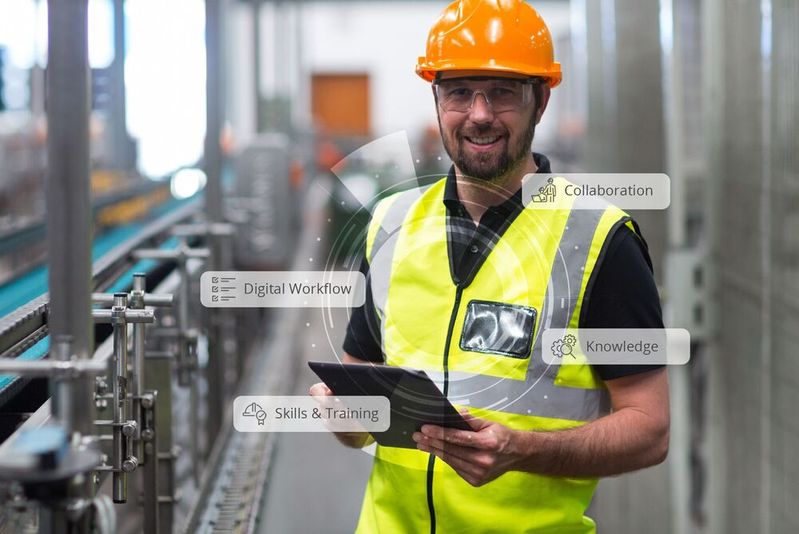
AI-based connected worker tools support production, assembly, and maintenance.
(Image: Augmentir)
In the electrical and high-tech industry, progress sets the pace—and it is accelerating. Accordingly, manufacturers of automation systems, semiconductors, medical technology, or household appliances are looking for ways to increase their productivity. AI-powered connected worker solutions offer enormous potential here. They make knowledge accessible, training more efficient, and processes easier to understand. The focus is not on new equipment or robots but on the people who work with them.
Learning in the Workflow
Demographic change is leading to fewer and fewer young professionals choosing trades and operational professions. At the same time, new employees in the electrical industry need to become operational more quickly. This is precisely where AI-based instructions come into play. During "onboarding on the job," they show exactly what needs to be done via mobile devices or augmented reality: visually, comprehensibly, interactively. Even newcomers can take on productive tasks right from the start. Quality is ensured through constant feedback, with expert support available in real-time. Connected worker applications provide extensive collaboration options—remotely if necessary.
Gallery
Support Tailored to Measure
The existing staff is also individually guided by AI. Whether it's Standard Operating Procedures (SOPs), other step-by-step instructions, or checklists: modern connected working apps rely on integrated skill management. Based on each employee's education, qualifications, and practical experience, AI tailors the input accordingly. Those already experienced receive only the most essential instructions or updates, meaning as little information as possible but as much as necessary. However, if the system detects that a professional is hesitating during a work step or repeatedly switching between instructions, it automatically provides more in-depth content.
Personalized training or learning units can also be offered in the same way. For example, an experienced machine operator only receives a brief update on how to retrofit a new model. In contrast, a colleague who has been absent for a longer period and works in quality control receives a more detailed re-training. Everyone receives exactly the knowledge they need—in the required level of detail, at the right time, and in the right format.
Automatically Generate Content
Some responsible parties might say, "First, we need to tackle the digitization of our materials." And rightly so: over decades, companies have accumulated a multitude of SOPs (Standard Operating Procedures), manuals, forms, and training content. The majority of this content still lies dormant as printed copies in folders, or at best, already exists digitally as Word files, JPGs, or PDFs on servers. But how can meaningful step-by-step guides be developed from this easily and quickly? Generative AI (GenAI) assistants are the saviors in this situation: they transform analog or file-based content into interactive step-by-step instructions for smartphones, tablets, or AR glasses.
Assistants now independently create training modules as well. They analyze SOPs or technical documentation and generate learning units with text, images, and quizzes. A practical example: the production manager of an electronics manufacturer wants to provide a training package for the autonomous maintenance of a system. The AI assistant processes the user manual and existing learning units to create suitable lessons, including a final test. The manager quickly receives a solid template that she can either approve directly or adapt to her requirements.
Break Down Language Barriers
International teams are standard in German companies—as are varying levels of language proficiency. To ensure safety, quality, and collaboration are not compromised, AI assistants now automatically translate digital work instructions, forms, and training materials into any imaginable language. The difference from simple translation software: the copilots pay attention to industry-specific terminology. Changes to templates are also automatically applied. This way, every version remains up-to-date for all locations with minimal effort.
Secure Knowledge Before it is Lost
What currently concerns companies in the industry is that more and more experienced employees are retiring. Whether machine operators, assembly workers at manual workstations, or maintenance technicians: their tips and tricks are rarely found in manuals. AI-powered systems now help capture this know-how from knowledge holders. When they respond in digital chats, film themselves at work, or provide assistance with questions, their explanations are saved, structured, and—upon approval—reused as knowledge modules.
Date: 08.12.2025
Naturally, we always handle your personal data responsibly. Any personal data we receive from you is processed in accordance with applicable data protection legislation. For detailed information please see our privacy policy.
Consent to the use of data for promotional purposes
I hereby consent to Vogel Communications Group GmbH & Co. KG, Max-Planck-Str. 7-9, 97082 Würzburg including any affiliated companies according to §§ 15 et seq. AktG (hereafter: Vogel Communications Group) using my e-mail address to send editorial newsletters. A list of all affiliated companies can be found here
Newsletter content may include all products and services of any companies mentioned above, including for example specialist journals and books, events and fairs as well as event-related products and services, print and digital media offers and services such as additional (editorial) newsletters, raffles, lead campaigns, market research both online and offline, specialist webportals and e-learning offers. In case my personal telephone number has also been collected, it may be used for offers of aforementioned products, for services of the companies mentioned above, and market research purposes.
Additionally, my consent also includes the processing of my email address and telephone number for data matching for marketing purposes with select advertising partners such as LinkedIn, Google, and Meta. For this, Vogel Communications Group may transmit said data in hashed form to the advertising partners who then use said data to determine whether I am also a member of the mentioned advertising partner portals. Vogel Communications Group uses this feature for the purposes of re-targeting (up-selling, cross-selling, and customer loyalty), generating so-called look-alike audiences for acquisition of new customers, and as basis for exclusion for on-going advertising campaigns. Further information can be found in section “data matching for marketing purposes”.
In case I access protected data on Internet portals of Vogel Communications Group including any affiliated companies according to §§ 15 et seq. AktG, I need to provide further data in order to register for the access to such content. In return for this free access to editorial content, my data may be used in accordance with this consent for the purposes stated here. This does not apply to data matching for marketing purposes.
Right of revocation
I understand that I can revoke my consent at will. My revocation does not change the lawfulness of data processing that was conducted based on my consent leading up to my revocation. One option to declare my revocation is to use the contact form found at https://contact.vogel.de. In case I no longer wish to receive certain newsletters, I have subscribed to, I can also click on the unsubscribe link included at the end of a newsletter. Further information regarding my right of revocation and the implementation of it as well as the consequences of my revocation can be found in the data protection declaration, section editorial newsletter.
Continuously Improve Processes
From technical cleanliness to standardization: many processes in the electrical industry are strictly regulated. AI systems automatically document completed work steps, log measurement results, and ensure seamless traceability. At the same time, this data forms the foundation for continuously improving processes. For example, an AI system analyzes connections between training measures, quality, and efficiency. This allows companies to strategically plan team training before bottlenecks in qualified or certified personnel arise.
Conclusion: AI Becomes An Everyday Aid
From translation to training, work instructions, and knowledge preservation: AI is accelerating connected work in the electrical industry. It enables employees to make the most of their knowledge and skills, improves operational processes, and makes the workplace safer and more efficient. For a sector that thrives on technological excellence, it is becoming an indispensable tool.
AI for autonomous and preventive maintenance
The combination of AI and connected work enables companies to increasingly transition to autonomous and predictive maintenance. Support ranges from personalized step-by-step instructions to expert support in real-time via video or augmented reality, and digital on-the-job training.
New is the lightning-fast support provided by industrial-grade AI copilots. If a worker notices a problem with a system, they can describe it to the AI assistant in their own words and in any language. Based on the available and approved content, the assistant analyzes manuals, documentation, or previous service cases—and provides instructions for troubleshooting. This allows operational workers to be deployed even for simple inspection and maintenance tasks.



:quality(80)/p7i.vogel.de/wcms/57/3e/573e5f8be45ba0d96122888a75ee68c0/0132000673v1.jpeg "EU Economic Affairs Commissioner Valdis Dombrovskis, speaking in the context of a reform of corporate tax rules, promises: “Our proposals for tax simplification include changes that will make life easier for businesses.” Read more here ... (Image:EU)")
:quality(80)/p7i.vogel.de/wcms/5b/99/5b99952e2dabf8632a55cfb60394c123/0131999764v1.jpeg "Billions are at stake! The preliminary proceedings for a project involving the construction of several cruise ships (stock photo) to be built by Meyer Werft and MSC are well underway ... (Image:Meyer Shipyard)")
:quality(80)/p7i.vogel.de/wcms/1f/8c/1f8cd24f2125a5bde27edde12d055d4b/0132000259v1.jpeg "No launch! Rheinmetall had hoped to land a contract for six F126-class frigates as a maritime construction project. But the federal government has now put a stop to the whole thing. Rheinmetall’s stock price dropped a bit further. Meanwhile, TKMS is now celebrating a government contract... (Image:dpa)")
:quality(80)/p7i.vogel.de/wcms/76/d4/76d453c828381481dcda836dfe11685e/0131992071v1.jpeg "The Profimill 3 from Waldrichsiegen has claimed the top spot as the largest machining system in the world. Read here what it can do and who the next three machining giants are... (Image: Waldrichsiegen)")
:quality(80)/p7i.vogel.de/wcms/12/c6/12c6bb1b6dbcdd48fd89da058cf5c80e/0131939666v1.jpeg "Libra is expected to process more than 256 corrected logical qubits and enable approximately one million reliable logical quantum operations. As part of an expanded collaboration with AWS, the system is expected to be available in the cloud via Amazon Braket starting in 2028. (Image:QuEra)")
:quality(80)/p7i.vogel.de/wcms/5f/a0/5fa0f04f647c40da140fceb082a72c86/0131975563v1.jpeg "After nine years, China has once again managed to dethrone the U.S. leader in supercomputing. The Lineshine supercomputer was the fastest of all in a standardized test ... (Image:Shuangong)")
:quality(80)/p7i.vogel.de/wcms/20/05/200513bd2a5145cc89ea9a1633b51abb/0131969098v1.jpeg "With the release of RealSource, RealMan Robotics aims to break down data silos and advance research in the field of AI-powered robot control. (Image:RealMan)")
:quality(80)/p7i.vogel.de/wcms/f1/e0/f1e0762012ba63607bd0ee537ef4db7a/bild1-phoenix-20contact-00167373-full-b5000v1.jpeg "The driverless transport systems (DTS) or automated guided vehicles (AGVs) used in intralogistics must meet one essential requirement: they should operate safely, quickly, and interoperably within the existing infrastructure. (Image: Phoenix Contact)")
:quality(80)/p7i.vogel.de/wcms/2d/da/2ddacc61c32608e3404dff7e9b102f7f/0131807833v1.jpeg "UCS housing with heat sink and heat spreader. (Image: Phoenix Contact)")
:quality(80)/p7i.vogel.de/wcms/9d/0c/9d0cde767c99aa00f527de1a7b0904f5/voss-evtech-2026v1.jpeg "Voss Automotive showcased, among other things, a liquid-cooled charging cable system and a thermal management system in a simulated passenger car application at the dual trade fair EVTech/The Battery Show. (Source: )")
:quality(80)/p7i.vogel.de/wcms/f1/dd/f1dd997329564af5537dc412cc205bd7/0131954184v1.jpeg "At Innovent Technology Development in Jena, it has been demonstrated that atmospheric pressure plasma can be used to clean copper (as shown here) and silver surfaces of oxides and sulfides— without harsh chemicals and with minimal energy consumption... (Image: Innovent)")
:quality(80)/p7i.vogel.de/wcms/0b/ff/0bffa42ea605978169d5e25eedb2c1ee/0131826953v2v1.jpeg "In the picture: from right to left, Pascale Herman, Christophe Delhovren, Antoine de Ryckel, Olivier de Laet. They intend to work together in the future. (Image:Valeo)")
:quality(80)/p7i.vogel.de/wcms/c5/97/c5970168e6bc3c0538715b5071836637/homelink-20console-2560x1439v1v1.jpeg "Gentex integrates Home Link into its rearview mirrors. Automakers can also integrate the supplier's product into their infotainment systems. (Image:Gentex)")
:quality(80)/p7i.vogel.de/wcms/7f/81/7f8112067de570333f3a730b9ed72a26/iaa-20mobility-202025-jf-1-01491-7953x4471v1v1.jpeg "\"AITO\" is the joint automotive brand of Seres and Huawei. With this new brand, Seres is seeking to become more independent from the electronics conglomerate. (Image:VDA/IAA Mobility)")
:quality(80)/p7i.vogel.de/wcms/a1/87/a187d1463ebbed0941233bc14bdde451/0131954862v1.jpeg "A new high-performance dispenser is now included with the Alpitronics HYC1000. (Image:Alpitronic)")
:quality(80)/p7i.vogel.de/wcms/f1/c3/f1c3428d7076590511abe1fb7c9f5bac/lucid-20uber-20nuro-20houston-201v1.webp "Lucid is currently testing its robotaxis in San Francisco and Houston with safety drivers on board. (Image: Lucid Motors)")
:quality(80)/p7i.vogel.de/wcms/3d/69/3d69a2ac15675566050d304cbb7c595a/0132006001v1.jpeg "The productivity paradox: AI speeds up code development, but according to GitLab’s AI Accountability Report, control, traceability, and governance are becoming the new bottleneck in the software delivery process. (Image:Dall-E / AI-generated)")
:quality(80)/p7i.vogel.de/wcms/98/c8/98c8d760f4a3a26c39d5ee61a3fc61d5/0131983597v1.jpeg "SanDisk goes beyond HBM: A U.S. patent reveals the direct connection of a processor to a NAND stack array, with HBM stacks on a shared interposer. (Image:U.S. Patent and Trademark Office / SanDisk)")
:quality(80)/p7i.vogel.de/wcms/44/7d/447da8981c8d2fa36153b34ac87929f5/0131993774v1.jpeg "When copper and aluminum reach their limits, composite material solutions come into play. At the Power of Electronics conference, Dr. Björn Reetz will speak about the potential of special alloys and metal composites. (Image:Materion)")
:quality(80)/p7i.vogel.de/wcms/41/26/4126391b01560b66d9409c831256e97e/0131986045v1.jpeg "Symbolic image: An autonomous mini-robot maps the environment. (Image:AI-generated)")
:fill(fff,0)/images.vogel.de/vogelonline/companyimg/76800/76895/65.jpg "FAULHABER_120mm.jpg ()")
:fill(fff,0)/p7i.vogel.de/companies/69/de/69de1b7403b0d/simtos-logo.jpeg "simtos-logo (SIMTOS)")
:quality(80)/p7i.vogel.de/wcms/a1/97/a197a0ed9403840939b296a0958a3003/0125373788v1.jpeg "AI agents not only analyze operational data. They also provide proactive support.(Image: Augmentir)")
:quality(80)/p7i.vogel.de/wcms/18/0a/180a52809dd0bd7de3415d3687191c55/0125373795v1.jpeg "AI assistants like Augie from Augmentir automatically create tests and quizzes for learning assessment from existing materials.(Image: Augmentir)")
:quality(80)/p7i.vogel.de/wcms/18/27/18276a9c33cbcb165827abcd66b22078/0125373781v1.jpeg "AI-based connected worker tools support production, assembly, and maintenance.(Image: Augmentir)")
:quality(80):fill(efefef,0)/p7i.vogel.de/wcms/67/ad/67adf92d254d2/elatec-wp-smart-factory.png "Elatec WP Smart Factory")
:quality(80)/p7i.vogel.de/wcms/9d/3c/9d3c307e605609786236ce32ea2b78f5/0127203741v1.jpeg "With Augmentir's AR and AI, even inexperienced workers can perform tasks safely. (Image: ©visoot – stock.adobe.com)")
:quality(80)/p7i.vogel.de/wcms/1f/59/1f597bb09292d18516f27a6836ee82ec/0123854342v1.jpeg "AI enables customized service offerings in mechanical engineering, enhances customer satisfaction, and promotes long-term customer loyalty. (Image:Kiattisak - stock.adobe.com)")