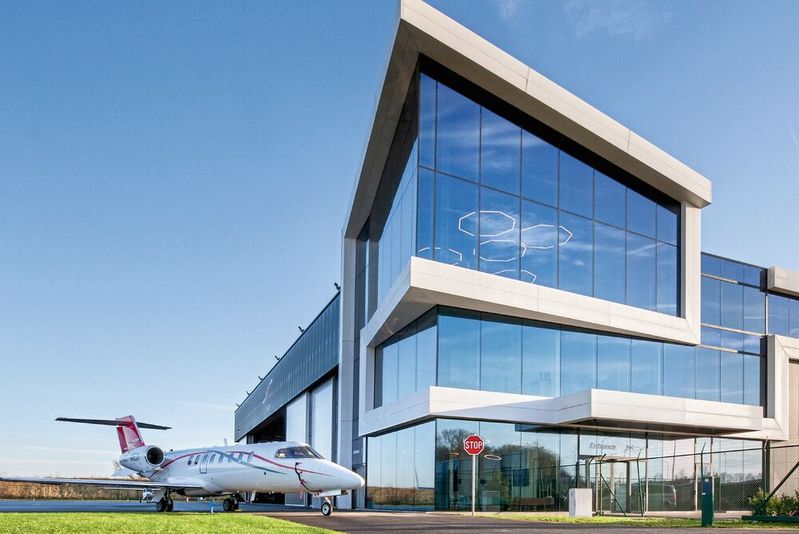
Is a fully autonomous building pure science fiction? No, it is already a reality, as the Belgian ASL Group in Liège proves with a state-of-the-art, round-the-clock terminal for the operation of private flights. The Beckhoff solution provider Boolean BV supported the implementation of this project with end-to-end building automation.
The ASL Group's new airport terminal autonomously powers up the building technology as soon as an employee enters the building.
Raf Weerts, Facility Manager at the ASL Group, explains: "We only have one permanent employee here. The rest of the staff are freelancers who only work when an aircraft arrives or departs. To ensure that they don't have to spend a lot of time starting up all the technology, the building starts everything up automatically when an employee enters. As soon as no movement is detected in the building, all systems—ventilation, lighting, heating, etc.—automatically switch back to sleep mode. This enables very energy-efficient operation. Especially in our energy-intensive industry, we try to prioritize sustainability wherever possible."
Seamless Integration for Autonomous Operation
The ultra-modern building is the result of a tender by Liège Airport itself. The airport was looking for a partner to build and operate a new general aviation terminal. "And we were looking for an operating base in this region, so it was a perfect match," recalls Raf Weerts. With 9,700 sq ft of office space and a 24,200 sq ftaircraft hangar, the building also offers state-of-the-art architecture. Inside, a large lounge can accommodate groups of up to 35 people, while a small intimate lounge can seat three to four people. "It definitely has a certain charisma," laughs Raf Weerts, "but the real power lies within. The autonomous operation we've achieved by seamlessly integrating all the technologies is amazing."
The ASL Group was not alone in this project. Raf Weerts already knew owner Chris Briers and CEO Thomas Nagels from Beckhoff solution provider Boolean through their previous professional collaboration and was aware of their extensive experience in implementing such a challenging project. "We were on the same wavelength right from the start. The backbone of this whole system had to be Beckhoff technology. Ultimately, open control technology is essential to bring together all the different signals and protocols." The KL4408 and KL6821 (DALI-2) Bus Terminals and the EL2809 Ethercat Terminals as well as the Twincat functions Modbus TCP, Modbus RTU and SMS/SMTP are used for this purpose.
The Twincat 3 control system coordinates the entire HVAC technology, from lighting, electricity and charging stations to the audio system. "Only access control remains in the hands of the airport. With any other automation platform, this would have required significantly more interfaces and integration effort. With PC-based control from Beckhoff, however, the necessary openness and connectivity is already integrated into the system," explains Chris Briers.
Monitoring for Quick Identification And Resolution of Problems
The biggest challenge for the Boolean team was to implement the high level of user-friendliness required by the ASL Group. "Raf Weerts had a very clear idea of what a technical installation should look like; a vision of how the building should function. Turning this into a flowchart gave us a guideline to work with and program the software accordingly," says Thomas Nagels. According to him, it was also crucial that sufficient flexibility was provided: "We also wanted to incorporate feedback from end users and be able to integrate new technologies or try out new things in the future - a living laboratory, so to speak." For Raf Weerts, the powerful monitoring visualized with Twincat 3 HMI is also important: "If something doesn't go quite according to plan, I can easily log in, identify the problem and solve it myself from my keyboard or explain to the people on site what needs to be done."
Proprietary Platform With IPC And Twincat Core
Boolytics, Boolean's proprietary platform, was of particular importance in this project, as Thomas Nagels explains: "We can capture and log real-time data on this platform. Using a web dashboard visualizes the process very well with Twincat 3 HMI and simply provides the information on all data points. This tool also offers enough flexibility to find the right balance between a high level of user-friendliness for the customer and the ability to go deep enough into the analysis." Raf Weerts clarifies his specifications as follows: "Everything is monitored in such a way that I have usually already called before the employees on site even recognize a problem. For example, if the heating is not working properly, I can take immediate action before the building has cooled down."
The heart of the entire control system is the C6030 ultra-compact industrial PC from Beckhoff. It receives most of the data via bus systems or IP communication, collects it in the Twincat software and transfers it to the Boolytics. "The transparency on both sides is what makes Beckhoff the right technology partner," summarizes Chris Briers. And not just in Liège - as the responsible facility manager, Raf Weerts is pushing for all buildings to be equipped with Beckhoff technology: "Not every building has the same technology, but you can still standardize operations and always use the same structure. This is much more convenient for the end user and means that more options are available for sharing energy, for example. By having the PLCs for the different locations communicate with each other, it's easy to see when it's best to switch on the major energy consumers."
Date: 08.12.2025
Naturally, we always handle your personal data responsibly. Any personal data we receive from you is processed in accordance with applicable data protection legislation. For detailed information please see our privacy policy.
Consent to the use of data for promotional purposes
I hereby consent to Vogel Communications Group GmbH & Co. KG, Max-Planck-Str. 7-9, 97082 Würzburg including any affiliated companies according to §§ 15 et seq. AktG (hereafter: Vogel Communications Group) using my e-mail address to send editorial newsletters. A list of all affiliated companies can be found here
Newsletter content may include all products and services of any companies mentioned above, including for example specialist journals and books, events and fairs as well as event-related products and services, print and digital media offers and services such as additional (editorial) newsletters, raffles, lead campaigns, market research both online and offline, specialist webportals and e-learning offers. In case my personal telephone number has also been collected, it may be used for offers of aforementioned products, for services of the companies mentioned above, and market research purposes.
Additionally, my consent also includes the processing of my email address and telephone number for data matching for marketing purposes with select advertising partners such as LinkedIn, Google, and Meta. For this, Vogel Communications Group may transmit said data in hashed form to the advertising partners who then use said data to determine whether I am also a member of the mentioned advertising partner portals. Vogel Communications Group uses this feature for the purposes of re-targeting (up-selling, cross-selling, and customer loyalty), generating so-called look-alike audiences for acquisition of new customers, and as basis for exclusion for on-going advertising campaigns. Further information can be found in section “data matching for marketing purposes”.
In case I access protected data on Internet portals of Vogel Communications Group including any affiliated companies according to §§ 15 et seq. AktG, I need to provide further data in order to register for the access to such content. In return for this free access to editorial content, my data may be used in accordance with this consent for the purposes stated here. This does not apply to data matching for marketing purposes.
Right of revocation
I understand that I can revoke my consent at will. My revocation does not change the lawfulness of data processing that was conducted based on my consent leading up to my revocation. One option to declare my revocation is to use the contact form found at https://contact.vogel.de. In case I no longer wish to receive certain newsletters, I have subscribed to, I can also click on the unsubscribe link included at the end of a newsletter. Further information regarding my right of revocation and the implementation of it as well as the consequences of my revocation can be found in the data protection declaration, section editorial newsletter.
Building Standards for 2030 Already Implemented Today
In terms of overall energy performance, the building is ahead of its time. Raf Weerts comments: "In terms of insulation, glazing, etc., we have followed the 2030 standards. After all, you can only insulate once. So you have to do it right. A VRF (direct expansion) heat pump with an output of 32 kW can now keep the entire office building at the right temperature. What's more, we don't need a room temperature of 73 °F. The guests who come here only have to spend five to ten minutes in the building and can therefore keep their coats on, for example. Nevertheless, it ensures that employees are also comfortable - if necessary, the room temperature can be quickly increased using a boost button."
Boolean's programming work has paid off, particularly in terms of energy efficiency, as Chris Briers explains: "We really delved deep into this subject. The manufacturers' conventional arrangements have all been revised. Everything was set and parameterized internally." Thomas Nagels adds: "With this building we have clear proof that our operation is more economical, because we monitor very extensively—incidentally also via Control Panels from Beckhoff. We even keep an eye on the intermediate steps in the arrangements. This allows us to see exactly where the process can be further optimized." Experiments have already been carried out with the heating curve settings to see what effects the adjustment of parameters has, how the end result will develop and whether the change effort is worthwhile at all.
Technology With High Stability
As a Beckhoff solution provider, Boolean required very little support. Nevertheless, Chris Briers makes special mention of the automation specialist's support. "The experts from Beckhoff Belgium are very accessible and always easy to reach if necessary. The longer you work with PC-based control, the less support you need. But if necessary, the support is there and also introduces new technologies and products. From our point of view, it is particularly important that Beckhoff technology offers a high level of stability despite all the innovations. Spare parts are still available for solutions that were installed more than a decade ago. This is robust, industrial technology—I could control a complex production process with the same IPC that controls the building management here. So there is no shortage of computing power and therefore no limit to what we can achieve with this building in the long term.



:quality(80)/p7i.vogel.de/wcms/2c/d6/2cd65bff6624dbdc007f2315307612fe/0130800023v1.jpeg "An international consortium led by Tata Steel Nederland has made significant progress in the development of new zinc-coated ultra-strong steels. (Image:Tata Steel)")
:quality(80)/p7i.vogel.de/wcms/f0/e0/f0e05856a96a9afa991a8dd9f4aceb04/0131242862v1.jpeg "Humanoid robots are the focus of the \"TUM RoboGym (powered by Neura)\". (Image:Neura Robotics)")
:quality(80)/p7i.vogel.de/wcms/c3/be/c3be858b644b6f52c83ea025a6f596ad/0130477152v1.jpeg "With the \"DUO\" version of the \"POWER-Skate XL\", loads can be moved in all directions. (Image:HTS)")
:quality(80)/p7i.vogel.de/wcms/92/87/9287ce9327245bdcd01af627044b34c8/0131221372v1.jpeg "Here, Binder provides information on a standardized portfolio and, above all, on improvements for the assembly of M12 connectors, which are now easier to handle and even safer ... (Image:Binder)")
:quality(80)/p7i.vogel.de/wcms/fc/5c/fc5c314369136a0f2b4819ca4011ce80/0131048280v1.jpeg "It all depends on the overall IO-Link package. If the interaction between sensors, powerful masters and a manufacturer-independent configuration tool is right, a significant increase in machine performance is possible. (Image:Baumer)")
:quality(80)/p7i.vogel.de/wcms/69/a2/69a26de87302feccb0ad51bc5eefae4d/0131155056v1.jpeg "Quantum Mate with integrated cobot takes over manual, repetitive tasks in an automated, reliable and efficient process. (Image:Galdabini)")
:quality(80)/p7i.vogel.de/wcms/72/54/7254c0031573057a049e5879cba0de85/0130912407v1.jpeg "The serial interface still has its legitimacy in the age of Industry 4.0: it is still used, for example, to connect peripheral devices such as scanners. (Picture: ©Guy - stock.adobe.com)")
:quality(80)/p7i.vogel.de/wcms/c1/70/c170fd5c52c08ceb4bc2b58eb94ea95f/newsimage421365-2048x1151v1v1.jpeg "Diving robot from TU Bergakademie Freiberg before its first dive at the Malter dam (Image:Andreas Hiekel/TUBAF)")
:quality(80)/p7i.vogel.de/wcms/30/76/3076278d4a7b51a5c566581a20135afc/54963580015-cdcb4657c5-k-2047x1151v1v1.jpeg "The Nancy Grace Roman space telescope was completed in the largest clean room at NASA's Goddard Space Flight Center. It is due to be launched into space in September 2026. (Image:NASA/Jolearra Tshiteya / CC BY 4.0)")
:quality(80)/p7i.vogel.de/wcms/3a/08/3a08d5a0623b4d32294e8108d639f237/nivalon-20medical-20-1626x914v1v1.png "EvoFlex implant from Nivalon Medical consists of a bone-like ZTA ceramic that is precisely adapted to the anatomy of each patient. (Image:Nivalon)")
:quality(80)/p7i.vogel.de/wcms/55/93/55936485100842cd9e83fa3ec053e9c1/2-995x560v1v1.png "The research team at the Technical University of Munich measures and controls the tendon forces on the robot. The aim of the research project is to develop new control concepts. (Image:TU Munich)")
:quality(80)/p7i.vogel.de/wcms/c2/df/c2df275b52afda5130ec90662fc767af/adobestock-1858604981--c2-a9-20vladyslav-20andrukhiv-20-e2-80-93-20stock-adobe-com-ki-generiertv1.jpeg "Artificial sun on earth: Start-ups in China are working to accelerate the development of the virtually inexhaustible energy source of nuclear fusion with AI. (Source: © Vladyslav Andrukhiv - stock.adobe.com/AI-generated)")
:quality(80)/p7i.vogel.de/wcms/2c/1f/2c1fb590b96de7ca3ca029564b063865/0131218954v1.jpeg "Xpeng brings the X9 to Germany. (Picture:Xpeng)")
:quality(80)/p7i.vogel.de/wcms/94/6b/946b136b4478d8b80e3d9e62041e7274/0131259520v1.jpeg "The Craft test bench in Berlin is used to develop future propulsion systems for sustainable aviation. The aim is to minimize noise while maintaining the efficiency of aircraft engines. (Image:DLR)")
:quality(80)/p7i.vogel.de/wcms/5a/14/5a14b26a5d4495d3a192e90e5c216251/ai-catl-sodium-batteries-vs-lithium-revolution-1800x1012v1v1.jpeg "The supplier CATL is bringing its first sodium-ion batteries into series production. Although not in the automotive industry, this step is set to follow soon. (Image:CATL)")
:quality(80)/p7i.vogel.de/wcms/68/43/68433001d98374eb72f51b4a7db590fe/0131229290v1.jpeg "Charging infrastructure provider Evoltra will operate as Citywatt Development in the future. (Image:Citywatt)")
:quality(80)/p7i.vogel.de/wcms/98/11/981107e7d149b2ff970c574cdd73f158/0131183152v1.jpeg "An optical phased array (OPA) counteracts strong optical crosstalk. For this purpose, the antenna geometry is arranged asymmetrically. (Image:Amy Pan / MIT)")
:quality(80)/p7i.vogel.de/wcms/a3/2e/a32e8b8bb38bd5c1cfd27b043baf72b7/0131203375v1.jpeg "Alliance for the AI age: Sony and TSMC join forces to produce next-generation smart image sensors (Image:Brunox983/Pixabay)")
:quality(80)/p7i.vogel.de/wcms/f9/5d/f95d24afa8d7ffb2c27916d0f329c670/0131192604v1.jpeg "Symbolic image: Kontron has a positive outlook for 2026, but must restructure. (Image:AI-generated)")
:quality(80)/p7i.vogel.de/wcms/c7/6b/c76b7659a76e1dd6e9b007340a12c70b/0131171547v1.jpeg "Circular economy in practice: in future, automated systems will save intact battery cells for reuse. (Image:Rainer Betz/Fraunhofer IPA)")
:fill(fff,0)/images.vogel.de/vogelonline/companyimg/76800/76895/65.jpg "FAULHABER_120mm.jpg ()")
:fill(fff,0)/p7i.vogel.de/companies/69/de/69de1b7403b0d/simtos-logo.jpeg "simtos-logo (SIMTOS)")
:quality(80)/p7i.vogel.de/wcms/d6/d1/d6d129f74ac367e1807d52d26d91ab2a/0125039562v1.jpeg "The experts on site (from left to right): Philip Neyens (Support Engineer from Beckhoff Belgium), Thomas Nagels (Board Member of Boolean), Bert Cuypers (Account Manager from Beckhoff Belgium), Chris Briers (Owner of Boolean) and Raf Weerts (Facility Manager of the ASL Group)(Image: © Philippe van Gelooven)")
:quality(80)/p7i.vogel.de/wcms/e5/4d/e54d705c6a458e6b702667a71d27adb9/0125039571v1.jpeg "The large lounge offers an unobstructed view of the airfield.(Image: © Philippe van Gelooven)")
:quality(80)/p7i.vogel.de/wcms/9f/07/9f076215aa46b78e4dd6e4d3f11dd76f/0125039353v1.jpeg "The C6030 ultra-compact industrial PC forms the core of building automation.(Image: © Philippe van Gelooven)")
:quality(80)/p7i.vogel.de/wcms/a8/b9/a8b9d673a5d288460b4776f601531b69/0125039574v1.jpeg "A small, more intimate lounge offers space for up to four people.(Image: Philippe van Gelooven)")
:quality(80):fill(efefef,0)/p7i.vogel.de/wcms/67/ad/67adf4a647532/elatec-wp-machine-authentication.png "Elatec WP Machine Authentication")
:quality(80)/p7i.vogel.de/wcms/d2/64/d2644ae7dcefb1982b9eabd822ce5472/0128551169v1.jpeg "The linear burner system Fire Snake can create a 11 feet wide fire wall with flames individually adjustable in shape and height; a truss structure with winches allows angle adjustment of the units for dynamic stage designs. (Image:Steve Jennings)")
:quality(80)/p7i.vogel.de/wcms/37/00/3700767e37c57d70a69f9faa3fa1c09e/0126213739v1.jpeg "The machine for fully automatic pressing of window and door frames is the result of teamwork by Calvet, CNC Solutions, and Beckhoff (from left to right): Stefan Nees, Managing Director of Calvet, Maarten Knevels and Cédric Sabbe, both from Beckhoff Belgium, as well as Edward Baekelandt, Eddy Marissens, and Lander Debruyne from CNC Solutions. (Image:© Philippe van Gelooven)")