While Smart Cities often only implement isolated technical solutions, the concept of the Cognitive City takes a crucial step further: as a learning city and autonomous system, it creates real value for municipalities, businesses, infrastructure operators, and people through artificial intelligence and connected systems.
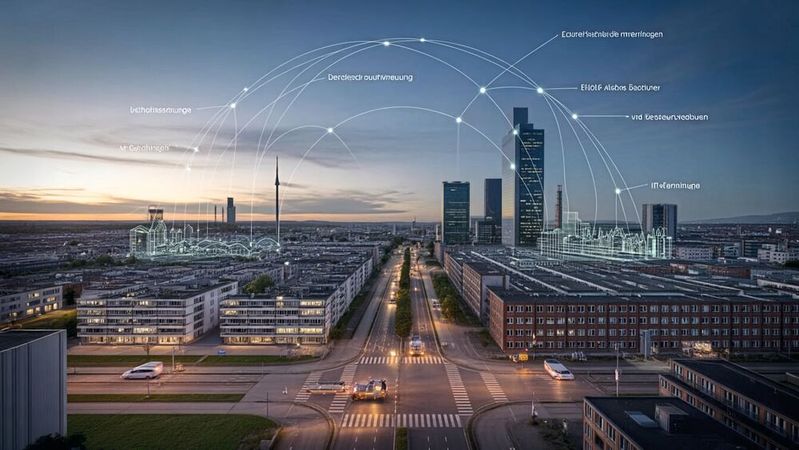
Cognitive Cities: Connected transportation, energy, and industrial infrastructures respond to data streams in real-time, creating the foundation for a learning, adaptive city.
(Image: AI-generated)
Cognitive Cities fundamentally differ from traditional Smart Cities. They process information differently and make decisions autonomously. According to the latest Smart City Index 2024 by the Digital Association Bitkom, 78 percent of major cities already use intelligent connected traffic lights, and every second city (50 percent) employs digital traffic signs. However, while Smart Cities act algorithmically, Cognitive Cities continuously learn and optimize their processes independently. Various data streams converge in this approach: from traffic volume and energy consumption to industrial production processes. This multitude of sources enables dynamic, context-based decision-making—in real time and on a local level.
An important component of this development is edge devices. These intelligent endpoints analyze data directly on-site without detouring through central data centers. Whether for traffic control at critical junctions or real-time monitoring of sensitive industrial facilities, edge computing brings computational power to where it is needed. Robust industrial PCs with ARM or x86 architecture are used, designed for decentralized real-time data processing.
Protocols such as MQTT (Message Queuing Telemetry Transport) and OPC UA (Open Platform Communications Unified Architecture) ensure seamless communication. While MQTT is particularly suitable for lightweight IoT devices, OPC UA excels in its ability to establish complex industrial data models.
The holistic networking enables pattern recognition and precise forecasting. A central Command & Control Center monitors and controls the city's connected systems in real-time. The digital twin—a virtual copy of the city—allows simulations and what-if scenarios to test the effects of potential measures beforehand.
Initial applications already showcase the potential of cognitive cities:
Intelligent traffic management: AI systems analyze the traffic situation live, prioritize emergency operations, and dynamically adjust traffic light phases. Thanks to V2X communication (Vehicle-to-Everything), a responsive, adaptive traffic network is created.
Industrial infrastructure: Sensors in industrial parks detect irregularities in energy consumption, temperature, or vibrations and initiate maintenance measures early—long before failures occur.
Building technology & facility management: Edge-based control systems adaptively regulate heating, lighting, and ventilation—depending on usage and time of day. This saves energy and operating costs.
Security: Drones equipped with thermal imaging cameras detect fires early. In combination with the digital twin, deployment plans can be simulated and precisely controlled.
These applications directly contribute to business objectives: reduced downtime, lower operating costs, and more efficient resource utilization.
The Technological Foundations of Cognitive Cities
At the heart of the Cognitive City is a powerful data platform—the digital "brain" of the city. It forms not only the technical infrastructure but also the strategic framework for data processing, utilization, and security. Its success largely depends on a clearly defined data strategy that combines modern technologies with binding governance principles. Four fundamental principles shape this technological foundation:
Sovereign cloud usage instead of dependency: Cloud technologies offer flexibility and scalability – but the Cognitive City must not become dependent on individual providers. A hybrid architecture provides the necessary flexibility: sensitive information remains in municipal data centers, while less critical applications can be outsourced to the cloud. The data strategy clearly defines where and how data is processed and stored—always considering data protection, IT governance, and economic efficiency.
Adaptation to the security concept: Multi-layer authentication and zero-trust architectures protect sensitive data. A Security Operations Center (SOC) monitors all systems in real-time for anomalies and potential threats. The concept is complemented by regular audits and clear emergency plans.
High user-friendliness: An intuitive user interface enables efficient integration into existing processes—from city administration to development teams to external industrial partners. At the same time, powerful interfaces and analysis tools are available to efficiently evaluate data and unlock new use cases.
Continuous scalability: The system architecture processes various formats—from IoT sensor data to video streams. A container-based microservices architecture allows the platform to be gradually expanded – for instance, to include new application areas from mobility, Industry 4.0, or intelligent building technology. This enables the city to grow digitally—modular, flexible, and future-proof.
The Path to Implementation
The successful implementation of a Cognitive City is far more than a technical project. It also requires organizational adjustments and a cultural shift—in administration, urban planning, and industry. Those who want to actively shape the digital transformation should focus on five key success factors:
Developing a strategy: It starts with a clear vision of how the city of the future should look. This vision must not be limited to technical innovations—it must focus on social benefits, economic impact, and added value for people. Data protection plays a key role: privacy by design and user-centered transparency are integral to the strategic architecture from the very beginning.
Start pragmatically: The path to a cognitive city is best achieved through specific, tangible projects with direct added value—such as automated traffic management or intelligent energy optimization in commercial districts. Such projects quickly gain acceptance and provide important learning effects. They serve as a springboard for larger transformations.
Actively involve all stakeholders: Cognitive Cities are not created in an ivory tower. Therefore, municipal utilities, mobility providers, industrial companies, and citizens must be part of the process from the start. Open participation formats and co-creation approaches help translate technologies into real-life contexts—and build acceptance.
Build competencies: New technologies are often complex and present entry barriers. It is all the more important to foster competencies internally. Training, pilot projects, and partnerships with experienced technology providers help to build the necessary know-how and firmly establish it within the system.
Establish new working methods: Cognitive Cities require flexible decision-making and development processes, especially at the interfaces between administration, IT, and industry. Agile methods and cross-functional teams are key here.
Shaping the City of the Future
Cognitive Cities offer enormous potential to improve quality of life, use resources more intelligently, and drive sustainable development. The key to success lies in the intelligent networking of systems, the targeted use of AI, and a focus on specific use cases with measurable added value.
Change doesn’t have to happen overnight; what matters is setting the course now. The technological possibilities are already in place. With a clear strategy, scalable platform solutions, and industry-specific pilot projects, cities can make the leap from "smart" to "cognitive." Those who act today actively shape the foundation for a digital, resilient, and livable city of tomorrow. (mc)
About the Author Dr. Hendrik Grosser is an expert in Industrial IoT, digital twins, Smart Cities, and Cognitive Cities. He advises clients on large international projects in the conception, planning, and implementation of digital twins from a holistic product lifecycle management perspective. As technical director, he also drives the development of IoT showcases at the Detecon Digital Engineering Center in Berlin. His expertise from studying information technology in mechanical engineering at TU Berlin (Germany), as well as his ten years of experience at the Fraunhofer Institute for Production Systems and Design Technology in the field of virtual product development, support him in this work.
Naturally, we always handle your personal data responsibly. Any personal data we receive from you is processed in accordance with applicable data protection legislation. For detailed information please see our privacy policy.
Consent to the use of data for promotional purposes
I hereby consent to Vogel Communications Group GmbH & Co. KG, Max-Planck-Str. 7-9, 97082 Würzburg including any affiliated companies according to §§ 15 et seq. AktG (hereafter: Vogel Communications Group) using my e-mail address to send editorial newsletters. A list of all affiliated companies can be found here
Newsletter content may include all products and services of any companies mentioned above, including for example specialist journals and books, events and fairs as well as event-related products and services, print and digital media offers and services such as additional (editorial) newsletters, raffles, lead campaigns, market research both online and offline, specialist webportals and e-learning offers. In case my personal telephone number has also been collected, it may be used for offers of aforementioned products, for services of the companies mentioned above, and market research purposes.
Additionally, my consent also includes the processing of my email address and telephone number for data matching for marketing purposes with select advertising partners such as LinkedIn, Google, and Meta. For this, Vogel Communications Group may transmit said data in hashed form to the advertising partners who then use said data to determine whether I am also a member of the mentioned advertising partner portals. Vogel Communications Group uses this feature for the purposes of re-targeting (up-selling, cross-selling, and customer loyalty), generating so-called look-alike audiences for acquisition of new customers, and as basis for exclusion for on-going advertising campaigns. Further information can be found in section “data matching for marketing purposes”.
In case I access protected data on Internet portals of Vogel Communications Group including any affiliated companies according to §§ 15 et seq. AktG, I need to provide further data in order to register for the access to such content. In return for this free access to editorial content, my data may be used in accordance with this consent for the purposes stated here. This does not apply to data matching for marketing purposes.
Right of revocation
I understand that I can revoke my consent at will. My revocation does not change the lawfulness of data processing that was conducted based on my consent leading up to my revocation. One option to declare my revocation is to use the contact form found at https://contact.vogel.de. In case I no longer wish to receive certain newsletters, I have subscribed to, I can also click on the unsubscribe link included at the end of a newsletter. Further information regarding my right of revocation and the implementation of it as well as the consequences of my revocation can be found in the data protection declaration, section editorial newsletter.



:quality(80)/p7i.vogel.de/wcms/31/84/3184f9ac736d8df7c2e934593684bc74/0130024314v1.jpeg "Here, the Bavarian car manufacturer BMW looks ahead to 2025: business was sluggish due to US tariffs and weakening sales in China ... (Image:BMW)")
:quality(80)/p7i.vogel.de/wcms/49/09/49095c6192a6c46d47b567e1def31ea6/0130024626v1.jpeg "The new TUM \"RoboGym\" (powered by Neura) is Europe's largest training center for next-generation humanoid robots. It focuses on the implementation of artificial intelligence in robotic systems. At the same time, it is a forge for AI experts ... (Image:Neura Robotics)")
:quality(80)/p7i.vogel.de/wcms/fe/8a/fe8af1b829b085210fef4c1fa8abddb5/0129784389v1.jpeg "As an integral part of Koch Pac-Systeme's Predictive Pack digital service product, the gearboxes with Cynapse and Wittenstein's Smart Services make it possible to detect damage risks in the packaging specialist's machines at an early stage. (Image:Koch Pac systems)")
:quality(80)/p7i.vogel.de/wcms/9f/7b/9f7be35880605811e045acd3af8b571b/0129558586v1.jpeg "An example of the V210 processing machine, which, according to Voortman, supplements the laser cutting of the V353 with drilling, thread cutting and milling. (Image:Voortman)")
:quality(80)/p7i.vogel.de/wcms/db/68/db689490e348201603dd30447711ea2b/0129578734v1.jpeg "With three-axis vibration measurement (X, Y and Z axes) and temperature detection, the CMSVT38 condition monitoring sensor provides detailed status information that helps to detect machine damage at an early stage. (Image:Kübler)")
:quality(80)/p7i.vogel.de/wcms/92/5e/925ee98ea36ad9bd574fa1cea11d0e53/0129964352v1.jpeg "The production of hardware components for humanoid robots offers great market potential. (Image:Fraunhofer IPA)")
:quality(80)/p7i.vogel.de/wcms/08/72/0872dd2dd119a54824c41e0e580e45a8/0129576591v1.jpeg "The Rose enclosure systems can be customized on request. (Image:Rose Systemtechnik GmbH)")
:quality(80)/p7i.vogel.de/wcms/73/17/7317794432521bf911711b91287cfc28/0129961259v1.jpeg "ABB Robotics and Nvidia are enabling the widespread use of physical AI in the world of robotics. This means that systems can be created virtually and with high precision and optimized much more cost-effectively. In the large image the virtual system, next to it the real robot cell ... (Image:ABB)")
:quality(80)/p7i.vogel.de/wcms/cb/fe/cbfe2741917274bbbf93d5b93e47a4f5/contact-software-launcht-fourier-20aiv1v1.png "Fourier AI combines AI models with AI applications developed for demanding engineering tasks. (Image:Contact Software)")
:quality(80)/p7i.vogel.de/wcms/bc/f7/bcf7a56980850be13ed37d220cd514bc/elchinator-security-5042249-1280-1280x720v1v1.jpeg "The HP Wolf Security Report shows: Attackers use AI for speed, modularity and automation, while the quality of campaigns is low. (Image:Picture: Pixabay)")
:quality(80)/p7i.vogel.de/wcms/68/89/688937087188b77da95b2079399ca862/0130009534v1.jpeg "Here you can see the Dualis layout configurator in use at Montratec. (Picture: ©Gorodenkoff - stock.adobe.com)")
:quality(80)/p7i.vogel.de/wcms/9e/98/9e984afbf9c6f2bcc8963bd13465b180/26-02-pi-fraunhofer-iws-41300-ultragrain-project-closing-pic-02-1562x878v1v1.png "The process of laser wire build-up welding (DED-LB) with pulse laser-induced plasma, which contributed to the success of the Ultra Grain project, is shown at high speed. (Image:Fraunhofer IWS)")
:quality(80)/p7i.vogel.de/wcms/69/f5/69f516f07a0ba999c5ba8763891853f1/0130030553v1.jpeg "Can be reloaded in 210 seconds for a return trip on the Greenford branch line: the GWR's 230001. (Image:Jack Boskett Media | GWR)")
:quality(80)/p7i.vogel.de/wcms/f0/5e/f05e720c52f757660ddbf7c410074f64/adobestock-222131875-5616x3157v1.jpeg "(Source: © jeson - stock.adobe.com)")
:quality(80)/p7i.vogel.de/wcms/b2/64/b2641254fef5afa15645cefc37089c88/0130021093v1.jpeg "Daimler Truck and Quantum Systems are jointly developing unmanned military vehicles. (Image:Quantum Systems)")
:quality(80)/p7i.vogel.de/wcms/30/7e/307e71ec64f7c52c29458544ca29adf1/org-blobs-user-response-file-output-799034cb-2ad7-4031-859a-15013f5b78e3-plugin-output-toolu-01vwfuenhw3cadvud7pddgyq-1536x864v1v1.png "China's government is debating the contents of the 15th five-year plan. The focus will change for the automotive industry. (Image:AI-generated)")
:quality(80)/p7i.vogel.de/wcms/61/8f/618f16f8fa95ec6cc838ca9bfb5dbaf1/0130027046v1.jpeg "The Belgian Research Institute has set up a European university consortium on the subject of CMOS 2.0. It brings together 26 university groups to research chip technologies that go beyond conventional transistor scaling. (Image:Imec)")
:quality(80)/p7i.vogel.de/wcms/db/a2/dba29322d0934dea1bbc4b31df80e392/0129953760v1.jpeg "SEM image: High-density electrode array with 128 nm dots. (Image:imec)")
:quality(80)/p7i.vogel.de/wcms/c2/a8/c2a8a93f306c1475489dff074ad59731/0129967672v1.jpeg "Figure 1: Imec's logic technology roadmap showing the extension of the nanosheet era from 2nm to the A10 node with the outer-wall forksheet, before the transition to CFET for A7 and beyond. (Image:imec)")
:quality(80)/p7i.vogel.de/wcms/07/79/0779a3ba2b38d583fc9b515900be2add/0129957428v1.jpeg "If the Chinese government has its way, domestic data centers full of Nvidia hardware will be a thing of the past. (Image:Nvidia)")
:fill(fff,0)/images.vogel.de/vogelonline/companyimg/76800/76895/65.jpg "FAULHABER_120mm.jpg ()")
:fill(fff,0)/p7i.vogel.de/companies/67/eb/67eba621ef6ea/logo2.png "logo2 (Wuxi InfiMotion)")
:quality(80):fill(efefef,0)/p7i.vogel.de/wcms/67/ad/67adf92d254d2/elatec-wp-smart-factory.png "Elatec WP Smart Factory")
:quality(80)/p7i.vogel.de/wcms/b1/75/b17550e74d87e7e95b4f8dbd8da4a7fd/0125640803v1.jpeg "A look inside: The digital twin of the Autodesk Technology Center enables intelligent and efficient building operations. (Image:Autodesk)")
:quality(80)/p7i.vogel.de/wcms/13/4d/134dee0c2b8af6b4f28937ca5b586e0d/0129499541v1.jpeg "The industry now needs to build a flexible, powerful and sovereign infrastructure that can exploit the full potential of artificial intelligence while guaranteeing control over data and processes. (Picture: ©Gorodenkoff - stock.adobe.com)")