Artificial intelligence is fundamentally reshaping industrial software applications. Instead of isolated automation, we are now seeing the emergence of increasingly networked, context-sensitive agent systems.
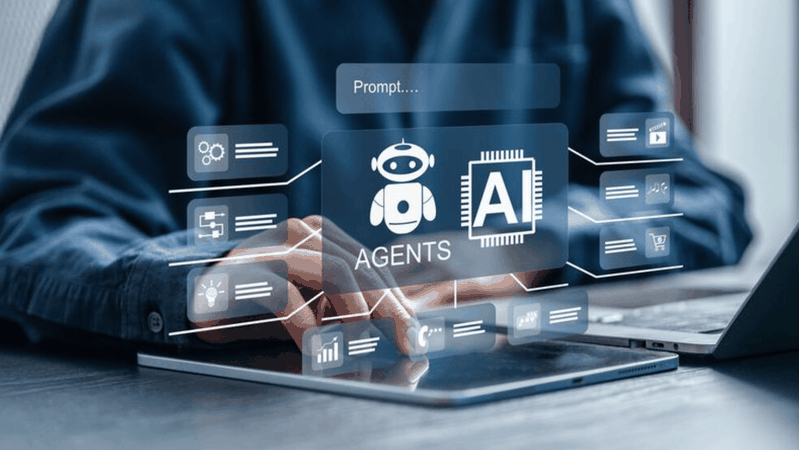
Agentic AI describes the capability of AI systems to not only execute tasks based on rules but also to interpret them independently, contextualize them, and actively derive actions.
According to Gartner, by 2028 around one-third of all enterprise applications will feature agent-based AI capabilities. Today, that figure is less than one percent. Analysts also predict that, in the medium term, approximately 15 percent of routine business decisions will be prepared, or even made autonomously, by AI agents, particularly in data-intensive, structured work environments.
In technical development areas where information must be managed, connected, and assessed over long product lifecycles, the key question becomes: What role can AI agents play in the context of existing PLM systems? And what structural prerequisites are required to integrate their capabilities effectively?
Bridging Data Management and Decision Support
Product Lifecycle Management (PLM) is well-established across many industries. It forms the technological backbone for managing engineering product data: from CAD models and bills of materials to change documentation, requirements, and approvals. The role of PLM systems is clearly defined: they ensure traceability, consistency, and process integrity across the entire product lifecycle.
However, as system complexity increases, development cycles shorten, and customization pressures mount, established PLM structures can be enhanced intelligently. This is particularly relevant in industries with highly modular or software-defined products, such as machinery, medical devices, or automotive manufacturing. Here, demands for speed, variant flexibility, and data consistency are growing. This is precisely where the Agentic AI approach comes into play.
How Agentic AI Differs from Traditional Automation
Agentic AI refers to the ability of AI systems not only to execute rule-based tasks but also to interpret them independently, put them into context, and proactively derive actions. The concept combines three defining capabilities:
Context sensitivity: AI agents analyze data while considering dependencies, system boundaries, and priorities.
Learning capability: With each task performed, the system becomes more accurate through feedback loops and structured knowledge management.
Interoperability: AI agents operate across system boundaries, linking data and processes between different applications.
In PLM-supported development processes, this could mean that an AI agent analyzes a change request, identifies the affected objects, assesses variant dependencies, and considers technical as well as regulatory implications, before a human makes the final decision. The result: measurable workload reduction in operational development.
Data Access, Semantics, and Integration: The Key Requirements
To make AI agents work effectively within a PLM system, certain technological prerequisites must be in place. Three factors are essential:
Vector-based data models: These enable the inclusion of unstructured content, such as free-text fields, requirements documents, or test reports, into systematic analyses. AI agents access machine-readable representations to link and interpret information.
Semantic interfaces: Translating natural-language user queries into structured database queries is a crucial step. For example, “Which open change requests affect component X?” would automatically be translated into a combination of object reference, filter logic, and process status.
Open APIs: These interfaces allow AI agents not only to read information but also to trigger processes, such as automatically generating approval proposals, updating linked objects, or forwarding data to downstream systems.
Together, these elements create an environment where technical decisions can be prepared based on consistent data, aligned across systems, and anchored in a coherent Digital Thread, also known as Intelligent Product Lifecycle.
Practical Use Cases
The benefits of AI agents are most evident in areas with high variant diversity, frequent changes, and extensive documentation requirements. Three examples:
Digital traceability: The AI agent automatically detects changes to requirements, engineering data, or system models. It analyzes the impact, identifies relevant objects, and suggests possible follow-up actions.
Product Line Engineering (PLE): Based on natural language, AI agents create initial system models, standardize components, and identify redundancies. In the event of changes, they dynamically adapt configurations - always within the defined variant space.
Variant analysis: In technical system architectures with high design flexibility, AI agents simulate the technical feasibility of certain configurations, calculate resulting unit costs, and assess potential compliance risks. The results are prepared for decision-making.
Organizational Implementation
Integrating Agentic AI into existing development environments is not purely a technical project, it also changes roles, workflows, and decision-making patterns. Step-by-step introduction is therefore essential, ideally starting with clearly defined pilot projects supported by training measures and interdisciplinary guidance.
Transparency is key: stakeholders are more likely to embrace AI agents as a support tool if they understand how recommendations are generated, rather than perceiving them as a black box. Coordination with existing roles in engineering, variant management, and system architecture should take place early to establish clear interfaces and ensure smooth collaboration.
Agentic AI is not a replacement for existing systems, it is a functional enhancement. It augments PLM environments where decision processes are structured but resource-intensive. The technology for gradual implementation is already available. Combined with a consistent Digital Thread and a willingness to embrace change, a new form of development support can emerge
*Michele Del Mondo is currently Global Advisor Automotive at PTC.
Date: 08.12.2025
Naturally, we always handle your personal data responsibly. Any personal data we receive from you is processed in accordance with applicable data protection legislation. For detailed information please see our privacy policy.
Consent to the use of data for promotional purposes
I hereby consent to Vogel Communications Group GmbH & Co. KG, Max-Planck-Str. 7-9, 97082 Würzburg including any affiliated companies according to §§ 15 et seq. AktG (hereafter: Vogel Communications Group) using my e-mail address to send editorial newsletters. A list of all affiliated companies can be found here
Newsletter content may include all products and services of any companies mentioned above, including for example specialist journals and books, events and fairs as well as event-related products and services, print and digital media offers and services such as additional (editorial) newsletters, raffles, lead campaigns, market research both online and offline, specialist webportals and e-learning offers. In case my personal telephone number has also been collected, it may be used for offers of aforementioned products, for services of the companies mentioned above, and market research purposes.
Additionally, my consent also includes the processing of my email address and telephone number for data matching for marketing purposes with select advertising partners such as LinkedIn, Google, and Meta. For this, Vogel Communications Group may transmit said data in hashed form to the advertising partners who then use said data to determine whether I am also a member of the mentioned advertising partner portals. Vogel Communications Group uses this feature for the purposes of re-targeting (up-selling, cross-selling, and customer loyalty), generating so-called look-alike audiences for acquisition of new customers, and as basis for exclusion for on-going advertising campaigns. Further information can be found in section “data matching for marketing purposes”.
In case I access protected data on Internet portals of Vogel Communications Group including any affiliated companies according to §§ 15 et seq. AktG, I need to provide further data in order to register for the access to such content. In return for this free access to editorial content, my data may be used in accordance with this consent for the purposes stated here. This does not apply to data matching for marketing purposes.
Right of revocation
I understand that I can revoke my consent at will. My revocation does not change the lawfulness of data processing that was conducted based on my consent leading up to my revocation. One option to declare my revocation is to use the contact form found at https://contact.vogel.de. In case I no longer wish to receive certain newsletters, I have subscribed to, I can also click on the unsubscribe link included at the end of a newsletter. Further information regarding my right of revocation and the implementation of it as well as the consequences of my revocation can be found in the data protection declaration, section editorial newsletter.



:quality(80)/p7i.vogel.de/wcms/7d/1b/7d1b6a432c52f68600583b25f7d5c80d/0113143253v1.jpeg "In our China Market Insider, we regularly provide you with relevant information directly from China. (Image:© Eisenhans - stock.adobe.com)")
:quality(80)/p7i.vogel.de/wcms/09/42/09426afd0e023190089bd8c1c36c432f/0132473007v1.jpeg "Particularly in the area of solid carbide cutters, Pferd Tools has thousands of variants in its portfolio. (Image:Pferd Tools)")
:quality(80)/p7i.vogel.de/wcms/81/ec/81ecbf040c7d1d426e0fa023f6139824/0132714825v1.jpeg "Growing trade surplus! As dpa has now learned, trade between China and Germany is increasingly heading in a direction where China's exports are rising while imports from Germany gradually dry up ... (Image:AI-generated)")
:quality(80)/p7i.vogel.de/wcms/2c/b5/2cb58b0c53a4a7d9c3032427e9a31861/0132623548v1.jpeg "Quality inspection in detail: Roundness measurement of a workpiece using Accretech Rondcom. (Image:Accretech)")
:quality(80)/p7i.vogel.de/wcms/6a/ab/6aab1e6c486540a1587dd92605efa931/0132684773v1.jpeg "Autonomous execution of workflows in the assembly of car doors at Audi. (Image:Mimic Robotics / Audi)")
:quality(80)/p7i.vogel.de/wcms/56/fe/56fe431946e1f4ac95fe71a53becc299/omdia-2025v1.png "Market shares of industrial Ethernet protocols according to an Omdia study. (Source: Omdia, Industrial Communication Report 2025)")
:quality(80)/p7i.vogel.de/wcms/00/4c/004c97f265026bc126720f24d0b0d68c/0132664223v1.jpeg "Physical AI can intervene directly in manufacturing, delivering significant added value. (Image:Shutterstock)")
:quality(80)/p7i.vogel.de/wcms/da/dc/dadcf29e66cec822e5fbac3144df7dce/0132579697v1.jpeg "The \"childhood\" of robots: Structured training environments provide the crucial practical data that AI models need for reliable autonomy. (Image:Gemini / AI-generated)")
:quality(80)/p7i.vogel.de/wcms/47/a6/47a65bc9763ddfc99d52e7d9e48e8220/najwa-abdel-latif-shingle-matrix-fraunhofer-isev1.png "The project manager at Fraunhofer ISE, Najwa Abdel Latif, inspects the interconnected solar cells on the shingle matrix stringer at Fraunhofer ISE. (Source: Fraunhofer ISE / Sophia Bächle)")
:quality(80)/p7i.vogel.de/wcms/e7/b4/e7b418e68ddd81c64f2326aa299fa6dc/jlae-form-jungv1.jpeg "Modern solutions from Jung Hebe- und Transporttechnik GmbH enable the safe movement and positioning of tons of heavy loads, even in confined spaces. (Source: Jung Hebe- und Transporttechnik GmbH)")
:quality(80)/p7i.vogel.de/wcms/05/32/05327c761501e081b73374edb98b5929/gruppenbild-quelle-dornier-1920x1080v1.png "Outstanding materials research for the aerospace industry: Award winners Dr Benedikt Neitzel (third from left) and Johanna Buschmann (fourth from right) at the 2026 Peter Dornier Foundation Prize ceremony, together with Foundation Chair Maja Dornier (fifth from left), members of the Foundation’s advisory board, DORNIER Supervisory Board Chairman Peter D. Dornier (second from right) and Prof Wolf Mutschler (right) (Image: DORNIER)")
:quality(80)/p7i.vogel.de/wcms/14/b7/14b722e669a9aa9810c1a77b4fa5e8af/0132649760v1.jpeg "The new version of the sensor system is based on reusable patches and integrates a portable computer that enables AI-supported analysis of the collected data. (Image:Basel Adams / AI-generated)")
:quality(80)/p7i.vogel.de/wcms/82/96/82961738cb293632baedba8990f899cd/0132689974v1.jpeg "Autonomous logistics is booming in China. Manufacturers of robovans like Neolix, Zelos, or Minieye are increasingly forming partnerships, including with delivery services. (Image:Neolix)")
:quality(80)/p7i.vogel.de/wcms/b0/47/b047bcfa5cdb3b51c89fed73a3324f40/0132687776v1.jpeg "Uber and its partner Wayve report that they now have the license to operate robotaxis in London. Electric Mustang models from Ford are being converted for this purpose. But the two are not alone in autonomous operations in London... (Image: Ford)")
:quality(80)/p7i.vogel.de/wcms/f6/1f/f61f2b1d4075be02671cfe37d8d9cfd2/0132714838v1.jpeg "The sun is rising again at Daimler Truck! Business is reportedly picking up again. The commercial vehicle specialists are seizing the opportunity to establish a new plant in the USA... (Image: Daimler Truck)")
:quality(80)/p7i.vogel.de/wcms/e5/2b/e52b30828b2c61228b8795d807520d68/0132607603v1.jpeg "In Project LEIA, various companies like Airbus are working on a hybrid-electric onboard network architecture for short- and medium-haul aircraft. (Image: Airbus)")
:quality(80)/p7i.vogel.de/wcms/da/39/da39a38e5c07b0461d44b1a4660aa24f/0132715760v1.jpeg "Product innovation: Innodisk announces GMSL2 camera modules and adapter board series. (Image: Innodisk)")
:quality(80)/p7i.vogel.de/wcms/83/a9/83a9493ad202f37e188f3323c56aa2c6/0132672260v1.jpeg "After Moore's Law: Packaging is becoming the most important driver for semiconductor technology. (Image: ©Svitlana - stock.adobe.com)")
:quality(80)/p7i.vogel.de/wcms/1c/ba/1cba2c23c75d7e5d18f726598dc00708/0132680361v1.jpeg "Symbolic image: Data centers, chips, and circuit boards represent the real AI infrastructure—the fragile bubble represents the high expectations for its continued growth. (Image:Dall-E / AI-generated)")
:quality(80)/p7i.vogel.de/wcms/df/b6/dfb6fc4bd19a03eaff97541bd402c942/newsimage425602v1.png "In their work, researchers at Fraunhofer SIT first create deepfakes themselves to train the system. (Source: Fraunhofer SIT)")
:fill(fff,0)/p7i.vogel.de/companies/69/88/69882c428938e/tmts2026-ticec-banner-en-2000px.png "tmts2026-ticec-banner-en-2000px (https://www.tmts.tw/en)")
:fill(fff,0)/p7i.vogel.de/companies/69/de/69de1b7403b0d/simtos-logo.jpeg "simtos-logo (SIMTOS)")
:quality(80)/p7i.vogel.de/wcms/49/db/49dbdb906050c2ee2f12aca95a309599/0131907985v1.jpeg "System-wide context integration: AI agents consolidate isolated data from ALM, PLM, and ERP systems into well-founded decision templates. (Image: PTC)")
:quality(80)/p7i.vogel.de/wcms/91/ed/91edb6fa32fc6547c9202a5a39650357/0129528943v1.jpeg "The path to software-defined mobility does not begin in the vehicle, but in the systems with which it is developed. Those who rely on old structures will not only lose time, but also the future. (Image:PTC)")