In order to be able to react better to fluctuating order volumes, the specialist HMT had Minitec automate a cleaning system for industrial parts to a greater extent. The success was clear.
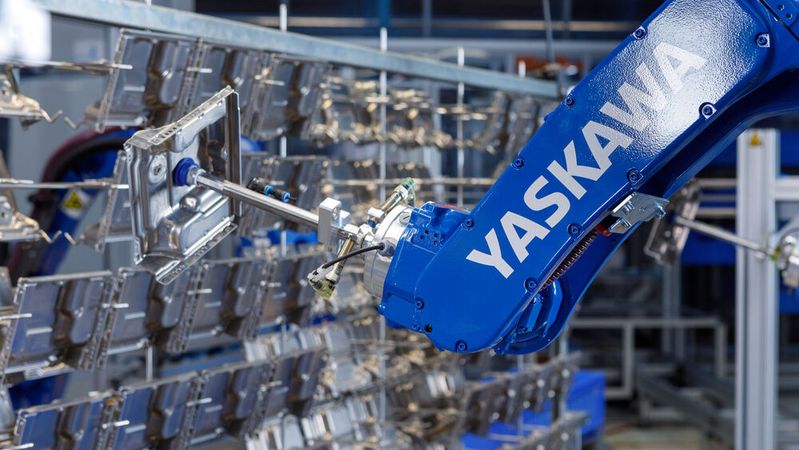
A camera inspection during removal ensures that the components are placed correctly in the KLTs.
(Image: Yaskawa Europe)
"Not just clean, but pure" was once the promise of a well-known detergent advertisement. HMT— Häseler Metalltechnik GmbH from St. Georgen has a similar claim when it comes to cleaning technical components. Founded in 1983, the company specializes in stamping and forming technology as well as component cleaning with very high technical cleanliness requirements. Its customers are mainly in the automotive sector. The workpieces are mostly stamped components that come into contact with electrical components and circuit boards.
Two cleaning systems are in use at HMT. They work in two shifts at normal capacity, which enables around 40 million components to be passed through each year. In the past, many activities in the cleaning process were carried out by employees. However, the general shortage of labor became increasingly noticeable. Cooperation with personnel service providers did not provide a satisfactory solution. The reason for this was the volatile weekly changes in the order backlog, according to Joachim Hölzl, Technical Managing Director of the company: "This made it difficult to plan resources properly - and also to react to new circumstances at short notice. One week the requirements go up and by the time you have integrated the capacities via the personnel, the week is almost over."
For the future, Hölzl wanted to be able to plan and control this much more reliably and react more flexibly to fluctuations in capacity. This goal was to be achieved through greater automation—the focus here was on loading the transport racks with the components for the cleaning process and subsequent removal.
Automation for More Flexibility
The first step was to sit down with in-house specialists—under the leadership of Tobias Seemann, team leader of the automation department at HMT. They drew up an ABC analysis of the components and discussed possible solutions. Hölzl explains: "We built our own internal laboratory and started the first tests with a training robot. The results were very impressive. We then contacted Yaskawa, who provided us with one of their robots for the next steps. When we were finally sure of the feasibility, we got in touch with Minitec as the system integrator. We presented our vision to automation expert Peter Müller and discussed with him what the system could look like based on our requirements and specifications. He then developed a concept for implementing the solution and we got down to work."
The result was a highly complex system in which the removal of the cleaned components and their storage and retrieval are fully automated. The design with two identical removal stations ensures sufficient capacity. A total of eight Motoman GP12 robots are used to remove the parts carriers. The robots in the GP series are characterized by high speeds, acceleration and repeat accuracy. The whole system is coupled with a fully automatic storage system. With a size of 66 ft × 33 ft, the system has considerable dimensions.
Procedure Today
The customer components to be cleaned arrive at HMT in various types of packaging (mesh boxes, wooden boxes, cardboard boxes, etc.). At the pick-up point, they are removed from the containers—still manually today—and fixed onto cleaning racks.
The system then collects the racks from the buffer store. They pass through the cleaning process via an overhead conveyor in various zones over a length of 197 feet. From there they go to the drying room, then to the cooling room and finally to the clean room. Depending on the technical specification of the components, the cleaning rack then either remains there for removal or continues into the clean room, where the removal stations with the robots are located.
Because the components can still move during the cleaning process, there may be a difference from one handle to another when the robot removes them. This is why a camera check is carried out here, which determines the coordinates so that the components can be placed correctly in the KLTs. This ensures that the order of these components is not lost when they are passed on to other departments.
Sophisticated Control System
During loading, the cleaning racks receive information on a barcode about which parts are involved and to which removal station they must travel. At the removal station, the item-specific information is transferred via an interface between the cleaning system and the robot cells. Joachim Hölzl explains: "This means that the robot knows exactly which part is coming and in what quantity. And it also knows that it has to remove this quantity. And if a component is lost, it calculates the target quantity minus 1. So we always have the correct quantity removed."
Date: 08.12.2025
Naturally, we always handle your personal data responsibly. Any personal data we receive from you is processed in accordance with applicable data protection legislation. For detailed information please see our privacy policy.
Consent to the use of data for promotional purposes
I hereby consent to Vogel Communications Group GmbH & Co. KG, Max-Planck-Str. 7-9, 97082 Würzburg including any affiliated companies according to §§ 15 et seq. AktG (hereafter: Vogel Communications Group) using my e-mail address to send editorial newsletters. A list of all affiliated companies can be found here
Newsletter content may include all products and services of any companies mentioned above, including for example specialist journals and books, events and fairs as well as event-related products and services, print and digital media offers and services such as additional (editorial) newsletters, raffles, lead campaigns, market research both online and offline, specialist webportals and e-learning offers. In case my personal telephone number has also been collected, it may be used for offers of aforementioned products, for services of the companies mentioned above, and market research purposes.
Additionally, my consent also includes the processing of my email address and telephone number for data matching for marketing purposes with select advertising partners such as LinkedIn, Google, and Meta. For this, Vogel Communications Group may transmit said data in hashed form to the advertising partners who then use said data to determine whether I am also a member of the mentioned advertising partner portals. Vogel Communications Group uses this feature for the purposes of re-targeting (up-selling, cross-selling, and customer loyalty), generating so-called look-alike audiences for acquisition of new customers, and as basis for exclusion for on-going advertising campaigns. Further information can be found in section “data matching for marketing purposes”.
In case I access protected data on Internet portals of Vogel Communications Group including any affiliated companies according to §§ 15 et seq. AktG, I need to provide further data in order to register for the access to such content. In return for this free access to editorial content, my data may be used in accordance with this consent for the purposes stated here. This does not apply to data matching for marketing purposes.
Right of revocation
I understand that I can revoke my consent at will. My revocation does not change the lawfulness of data processing that was conducted based on my consent leading up to my revocation. One option to declare my revocation is to use the contact form found at https://contact.vogel.de. In case I no longer wish to receive certain newsletters, I have subscribed to, I can also click on the unsubscribe link included at the end of a newsletter. Further information regarding my right of revocation and the implementation of it as well as the consequences of my revocation can be found in the data protection declaration, section editorial newsletter.
Each robot has a KLT in front of it. It removes the components from the cleaning rack and places them correctly in the box. When it has reached the specified quantity, the KLT automatically moves out and the robot is provided with another empty box.
The filled KLT now travels automatically along a conveyor line to a storage rack. The conveyor technology is an FMS system from Minitec. This is a transfer system where the boxes are then transported onwards via curves or turntables. A special feature of the HMT version is that the usual workpiece carriers (pallets) are not used here, instead the KLTs are driven directly by the roller chains.
Storage And Retrieval By Shuttle
A storage and retrieval unit (shuttle), also developed by Minitec, is located on the storage rack. This takes care of the automatic storage of the KLTs and moves back and forth. It also transports components for visual inspection. This area has a control station where the employees can see which components are in the storage system. They can then request the parts to be inspected via a control panel. The shuttle then starts the retrieval process and makes the KLTs available for visual inspection via a conveyor system. There, the parts are inspected according to the customer's defect catalogs. If they are OK, they are packed in the customer-specific packaging.
The great benefit is flexibility. Today, we have the decisive advantage of being able to increase capacity at any time, even at short notice.
Joachim Hölzl, Technical Director HMT
Joachim Hölzl already felt the benefits of the system after the first start-up time: "The big benefit is the flexibility. Today, we have the decisive advantage of being able to increase capacity at any time, even at short notice." Hölzl is also satisfied with the course of the project: "The collaboration in this three-man team of Minitec, Yaskawa and HMT worked very well and ultimately led to an excellent result."
Further Expansion of Automation As A Goal
In general, the HMT boss is very open to the topic of automation. He is already thinking about switching from manual to robotic assembly of the cleaning racks. Another topic is the removal of components in the cleanroom. "We have many approaches here, not just in production. There are also numerous automation options in administration, some of which we have already implemented. In future, we want to look at all areas to see which processes can be automated in order to minimize human error as much as possible." Accordingly, the automation department has now grown to four people. And Yaskawa and Minitec will also be on board again in the future due to their positive experiences.
*Stefan Wache is Head of Marketing and Communication at Minitec GmbH



:quality(80)/p7i.vogel.de/wcms/f9/7d/f97deef8fde21c8630d76411b18a20a7/0129803665v1.jpeg "Skoda has invested well over 220 million US dollars in the high-tech battery plant that has now opened in Mlada Boleslav. It has now started its work, which is highly automated ... (Image:Skoda)")
:quality(80)/p7i.vogel.de/wcms/f5/61/f561ad7c72ed41fd7a67ad9c481cb15d/0129799343v1.jpeg "Engine-generator units (MGU) from Steyr Motors are at work in the Leopard 2 main battle tank and the Leguan bridge vehicle (pictured). An extended contract is now to secure at least 500 more systems of this type for the Bundeswehr ... (Image:German Armed Forces)")
:quality(80)/p7i.vogel.de/wcms/6c/b5/6cb5ce2155433f6e73b16399adc4c561/0113143253v1.jpeg "In our China Market Insider we regularly provide you with relevant information directly from China. (Image:© Eisenhans - stock.adobe.com)")
:quality(80)/p7i.vogel.de/wcms/7f/fd/7ffd32863352c40f562f4245e4766e61/0129745849v1.jpeg "After US President Donald Trump once again resorted to his favorite weapon, tariffs, concerns rose in the EU that the so-called tariff deal could become invalid. But it looks as if the sea remains relatively calm ... (Image:F. Schneidler)")
:quality(80)/p7i.vogel.de/wcms/9c/ac/9cac6246660e746c5a3989399ac4d250/0128561645v1.jpeg "Artificial intelligence can drive efficiency in smart factories through centralized data management and predictive maintenance. (Picture: ©Fardived - stock.adobe.com)")
:quality(80)/p7i.vogel.de/wcms/6b/e2/6be235b5ad8a442ccd9d164b0b300d8b/0129763992v1.jpeg "As early as 2020, the Zimmer Group announced that it would convert its production to be sustainably CO2-neutral. (Image:Zimmer Group)")
:quality(80)/p7i.vogel.de/wcms/d4/ba/d4bab9481e66f8570f40eb8ef2a90198/0129795613v1.jpeg "A camera inspection during removal ensures that the components are placed correctly in the KLTs. (Image:Yaskawa Europe)")
:quality(80)/p7i.vogel.de/wcms/cb/56/cb56e42b01638b618e8d1b9b38f32faa/0129810132v1.jpeg "From summer 2026, \"AEON\" will support people at the BMW plant in Leipzig. (Image:diephotodesigner.de/BMW)")
:quality(80)/p7i.vogel.de/wcms/b5/5e/b55ed9355e0395ec0caf111d6af6b494/adobestock-495980372--c2-a9-20natali-mis-20-e2-80-93-20stock-adobe-com-6720x3778v1v1.jpeg "Which engineering skills will be in vogue in 2026? (Image:natali_mis - stock.adobe.com)")
:quality(80)/p7i.vogel.de/wcms/bf/a5/bfa5d882e93f159ce93e933742272b00/nord-vibn-cmyk-2196x1235v1v1.jpeg "With digital twins for virtual commissioning, Nord supports customers in ensuring that systems are available more quickly, even with complex drive systems. (Image:Nord Drivesystems)")
:quality(80)/p7i.vogel.de/wcms/f5/7e/f57ef535ee35e7b3b7ff15a8a63cef10/eds-keyvisual-8000x4496v1.jpeg "(Source: European Defence Supply)")
:quality(80)/p7i.vogel.de/wcms/af/a3/afa312176d956068af20491957eef642/newsimage418262-3100x1745v1v1.jpeg "The autonomous shuttle of the Aula AI project during a demonstration of sensor data with artificial fog. (Image:University of Magdeburg)")
:quality(80)/p7i.vogel.de/wcms/c4/40/c44043c61f9dd99b80ccca398c284018/0129795093v1.jpeg "Subaru manufactures the E-Outback at its Yajima plant, marking the first time it has produced an electric vehicle in-house. (Image:Subaru)")
:quality(80)/p7i.vogel.de/wcms/fe/18/fe1824e572677900655c854f6c92c391/0129811281v1.jpeg "BMW and CATL deepen their partnership and work together on the battery pass. (Image:BMW)")
:quality(80)/p7i.vogel.de/wcms/15/54/15546b27b3a679871325ef6d92509a95/0129750872v1.jpeg "Webasto plans to open its third plant for sunroofs in India. (Image:Webasto)")
:quality(80)/p7i.vogel.de/wcms/70/14/70142aa050f8d3f7784c5ddbb2aba5f1/0129778339v1.jpeg "The software investments in production have saved time in Lacon production. (Image:Lacon)")
:quality(80)/p7i.vogel.de/wcms/5c/0f/5c0fee074c4b6c8e8c0993f3217c2f5a/0129773718v1.jpeg "The General Fusion demonstration reactor. (Image:General Fusion)")
:quality(80)/p7i.vogel.de/wcms/7f/c1/7fc1c83b8509df676d27518b82aaef02/0129764984v1.jpeg "China Resources Microelectronics (CR Micro) has announced its intention to increase the prices of its own products. (Image:China Resources Microelectronics)")
:quality(80)/p7i.vogel.de/wcms/eb/4e/eb4e449562174ec95a5b3d30fb0137a2/0129648135v1.jpeg "The III-V germanium PV module with an efficiency of 34.2% is currently the most efficient solar module in the world. (Image:Jacob Forster)")
:fill(fff,0)/images.vogel.de/vogelonline/companyimg/76800/76895/65.jpg "FAULHABER_120mm.jpg ()")
:fill(fff,0)/p7i.vogel.de/companies/67/eb/67eba621ef6ea/logo2.png "logo2 (Wuxi InfiMotion)")
:quality(80)/p7i.vogel.de/wcms/5c/ce/5cce6fe125c6ebf520563d3b9da1264a/0129793087v1.jpeg "Trust is good, control is better: residual dirt analysis in our own laboratory.(Image: Yaskawa Europe)")
:quality(80)/p7i.vogel.de/wcms/bd/54/bd544791f97004c2ee326003dbb8fbfe/0129793080v1.jpeg "The components to be cleaned mainly come from the automotive sector.(Image: Yaskawa Europe)")
:quality(80)/p7i.vogel.de/wcms/b0/99/b099e002a1d9c88e4a348cb797e0caed/0129793077v1.jpeg "After cleaning, the racks automatically move to the correct removal point.(Image: Yaskawa Europe)")
:quality(80)/p7i.vogel.de/wcms/a1/d5/a1d5c0d00c45e6b0ee7d26e105a16880/0129793070v1.jpeg "The fully automatic storage system from Minitec.(Image: Yaskawa Europe)")
:quality(80)/p7i.vogel.de/wcms/37/de/37de9af70ae0e4aa39f87f581650dd51/0129072359v1.jpeg "For Eddie Seymour, the breakthrough of humanoid robots is within reach. (Image:Nvidia)")
:quality(80)/p7i.vogel.de/wcms/8f/b7/8fb7a6d69ebf4b80fa5c85d518ef93df/0127723470v1.jpeg "The overall system includes the palletizing system, the robot, and the transfer station. (Image:EGS Automation)")
:quality(80)/p7i.vogel.de/wcms/97/6b/976bc82f5cb651c1c499fb3c9af811c5/0124567790v1.jpeg "Leantechnik specifically designed the palletizer for blister handling. It is used in numerous applications, including in the pharmaceutical industry. (Image:Leantechnik)")