Researchers at MIT have developed a scalable and cost-effective approach to seamlessly integrate high-speed gallium nitride transistors into a standard silicon chip.
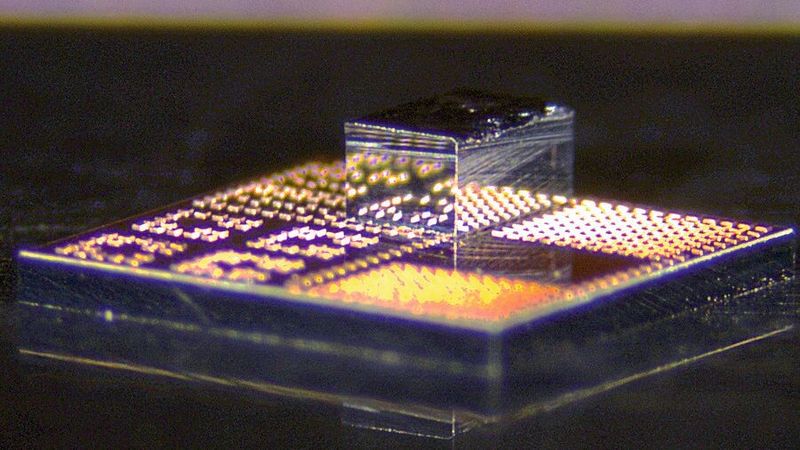
A GaN block on a chip (symbolic image): Researchers have developed a new manufacturing process that enables powerful gallium nitride transistors to be integrated into standard silicon CMOS chips cost-effectively and on a scalable basis.
(Image: MIT News)
The ongoing AI boom has led to a rapidly increasing demand for chips that require high performance as well as high energy efficiency. The semiconductor material gallium nitride is considered one of the possible keys for the next generation of high-speed communication systems and the power electronics needed for modern data centers. Unfortunately, the high costs of gallium nitride (GaN) and the specialization required to incorporate this semiconductor material into conventional electronics have limited its use in commercial applications.
Researchers from MIT and other partner institutes have now presented a manufacturing process that promises to integrate high-performance GaN transistors cost-effectively and scalably into standard silicon CMOS chips. The technology is also compatible with existing semiconductor foundries, thereby avoiding the need for costly new manufacturing facilities with new machinery.
Subsequent bonding of GaN transistors onto the silicon chip
The method involves constructing many tiny transistors on the surface of a GaN chip and cutting out each individual transistor. Then, only the required number of transistors are integrated onto a silicon chip. This is done in a low-temperature process that preserves the functionality of both materials.
According to the researchers, the resulting costs remain minimal, as only a tiny amount of GaN material is added to the chip. Nevertheless, the resulting product receives a significant performance boost through the compact high-speed transistors integrated in this way. By splitting the GaN circuit into discrete transistors that can be distributed over the silicon chip, the technology is also able to lower the temperature of the overall system.
The researchers demonstrated the process by producing a power amplifier that achieves higher signal strength and greater efficiency than devices with silicon transistors. In a smartphone, this could improve call quality, increase wireless bandwidth, enhance connectivity, and extend battery life. The result was presented in the study "3D-Millimeterwave Integrated Circuit (3D-mmWIC): A Gold-Free 3D-Integration Platform for Scaled RF GaN-on-Si Dielets with Intel 16 Si CMOS" at the IEEE Radio Frequency Integrated Circuits Symposium (June 15-17) in San Francisco.
Since their method fits into standard procedures, it could improve both current and future technologies. The researchers believe that the new integration scheme could even enable quantum applications, as GaN performs better than silicon at the cryogenic temperatures required for many types of quantum computers.
"If we manage to reduce costs, improve scalability, and simultaneously increase the performance of the electronic device, then it is a no-brainer to use this technology. We have combined the best of silicon with the best possible gallium nitride electronics. These hybrid chips can revolutionize many commercial markets," says Pradyot Yadav, an MIT graduate student and the lead author of the research paper on the method presented.
Replacement of transistors
After silicon, gallium nitride is the second most widely used semiconductor in the world. Due to its unique properties, GaN chips are currently primarily used in applications such as lighting, radar systems, and power electronics. To fully exploit the performance of semiconductors based on this material, it is important that GaN chips are connected to digital chips made of silicon, also known as CMOS chips. To enable this, some integration methods involve soldering GaN transistors onto a CMOS chip, which, however, limits the size of the GaN transistors. The smaller the transistors are, the higher the frequency at which they can operate.
Conventional methods typically involve integrating an entire gallium nitride wafer onto a silicon wafer. This is labor-intensive and expensive because silicon as a raw material is significantly cheaper. Additionally, the required gallium nitride material is usually needed only in a few tiny transistors. As a result, the rest of the material on the GaN wafer is generally wasted.
"We wanted to combine the functionality of GaN with the performance of digital silicon chips without compromising on cost or bandwidth. We achieved this by placing super tiny discrete gallium nitride transistors directly on the silicon chip," explains Yadav.
Date: 08.12.2025
Naturally, we always handle your personal data responsibly. Any personal data we receive from you is processed in accordance with applicable data protection legislation. For detailed information please see our privacy policy.
Consent to the use of data for promotional purposes
I hereby consent to Vogel Communications Group GmbH & Co. KG, Max-Planck-Str. 7-9, 97082 Würzburg including any affiliated companies according to §§ 15 et seq. AktG (hereafter: Vogel Communications Group) using my e-mail address to send editorial newsletters. A list of all affiliated companies can be found here
Newsletter content may include all products and services of any companies mentioned above, including for example specialist journals and books, events and fairs as well as event-related products and services, print and digital media offers and services such as additional (editorial) newsletters, raffles, lead campaigns, market research both online and offline, specialist webportals and e-learning offers. In case my personal telephone number has also been collected, it may be used for offers of aforementioned products, for services of the companies mentioned above, and market research purposes.
Additionally, my consent also includes the processing of my email address and telephone number for data matching for marketing purposes with select advertising partners such as LinkedIn, Google, and Meta. For this, Vogel Communications Group may transmit said data in hashed form to the advertising partners who then use said data to determine whether I am also a member of the mentioned advertising partner portals. Vogel Communications Group uses this feature for the purposes of re-targeting (up-selling, cross-selling, and customer loyalty), generating so-called look-alike audiences for acquisition of new customers, and as basis for exclusion for on-going advertising campaigns. Further information can be found in section “data matching for marketing purposes”.
In case I access protected data on Internet portals of Vogel Communications Group including any affiliated companies according to §§ 15 et seq. AktG, I need to provide further data in order to register for the access to such content. In return for this free access to editorial content, my data may be used in accordance with this consent for the purposes stated here. This does not apply to data matching for marketing purposes.
Right of revocation
I understand that I can revoke my consent at will. My revocation does not change the lawfulness of data processing that was conducted based on my consent leading up to my revocation. One option to declare my revocation is to use the contact form found at https://contact.vogel.de. In case I no longer wish to receive certain newsletters, I have subscribed to, I can also click on the unsubscribe link included at the end of a newsletter. Further information regarding my right of revocation and the implementation of it as well as the consequences of my revocation can be found in the data protection declaration, section editorial newsletter.
The new chips are the result of a multi-step process. First, a densely packed array of tiny transistors is fabricated across the entire surface of a GaN wafer. Using very fine laser technology, each one is cut to the transistor size of 240 by 410 microns, creating what is known as a dielet.
Each transistor is equipped with tiny copper pillars, which are directly connected to the copper pillars on the surface of a standard silicon CMOS chip. The copper-to-copper connection can be made at temperatures below 400 degrees Celsius, which is low enough not to damage either material.
Current GaN integration techniques require connections with gold, an expensive material that needs much higher temperatures and stronger bonding forces than copper. Since gold can contaminate the tools used in most semiconductor foundries, special facilities are generally required. "We wanted a process that is cost-effective, requires low temperatures and low forces, and copper is better than gold in all these aspects. At the same time, it has better conductivity," says Yadav.
New tools are used
To enable the integration process, a new specialized tool was developed, which can carefully integrate the extremely tiny GaN transistor into the silicon chips. The tool uses a vacuum to hold the dielet while moving onto a silicon chip and adjusts the copper connection interface with nanometer precision.
Using advanced microscopy, the interface is monitored, and when the dielet is in the correct position, the GaN transistor is bonded to the chip using heat and pressure. "For each process step, I had to find a new person who mastered the technique I needed, learn from them, and then integrate it into my platform. It was two years of constant learning," says Yadav.
After perfecting the manufacturing process, the researchers demonstrated it by developing power amplifiers, i.e., high-frequency circuits that amplify wireless signals. According to the study, the resulting semiconductor products achieved higher bandwidth and better amplification than comparable chips made with conventional silicon transistors. Each compact semiconductor has an area of less than half a square millimeter.
Since the silicon chip used for the demonstration is based on state-of-the-art Intel 16 22nm FinFET metallization and passivation options, they were also able to include components commonly used in silicon circuits, such as neutralization capacitors. This significantly improved the amplifier's gain, bringing it one step closer to the next generation of wireless technologies.
"To counteract the slowing down of Moore's Law in transistor scaling, heterogeneous integration has proven to be a promising solution for further system scaling, reducing the form factor, improving performance efficiency, and optimizing costs. Particularly in wireless technology, the close integration of compound semiconductors with silicon-based wafers is crucial for the realization of unified systems from integrated front-end circuits, baseband processors, accelerators, and memory for next-generation antenna-to-AI platforms. This work represents a significant advancement by demonstrating the 3D integration of multiple GaN chips with silicon CMOS and pushing the boundaries of current technological capabilities," says Atom Watanabe, a researcher at IBM who was not involved in this work. (sg)



:quality(80)/p7i.vogel.de/wcms/dd/08/dd086510d9ae7b50181f6070e4463b44/0129363730v1.jpeg "Typical application for ionizing devices: Wrapping films. (Picture: ©Adobe Stock/SMC)")
:quality(80)/p7i.vogel.de/wcms/35/57/3557c819943c53acec41a0ccba87da4f/0130049064v1.jpeg "Researchers at the Fraunhofer IWU in Chemnitz have long known that many typical sheet metal parts can be manufactured more cost-effectively using hollow embossing rollers. Now there is news to report ... (Image:Fraunhofer IWU)")
:quality(80)/p7i.vogel.de/wcms/59/02/590246e3b3f415c65edbee377c14ca77/26-06-pi-fraunhofer-iws-41450-direktplattieren-pic-01-7771x4369v1v1.jpeg "The Fraunhofer IWS has developed the new \"direct laser cladding\" process, which creates a functional layer directly on the base body by applying a strip-shaped metal to rotationally symmetrical components in a spiral and bonding it locally by laser. (Image:Christoph Wilsnack/Fraunhofer IWS)")
:quality(80)/p7i.vogel.de/wcms/73/60/73608418789b1d9c393f5e2fa974eda2/0130209906v1.jpeg "The robots of the X6 generation from b+m enable very high painting quality and are also particularly compact and easy to maintain. (Image:Beckhoff)")
:quality(80)/p7i.vogel.de/wcms/78/e9/78e9188c25a8a94e67c34c9bf8ffe495/visual-agile-20robots-20and-20google-20deepmind-20partner-20to-20bring-20intelligence-20to-20robotics-2500x1406v1v1.jpeg "Together, the partners are developing adaptable, intelligent robots for a wide range of applications (Image:Agile Robots SE)")
:quality(80)/p7i.vogel.de/wcms/e7/66/e7669ecf0260ae8fc54c214e34e4902a/0130316817v1.jpeg "Siemens and Palo Alto Networks offer tested cybersecurity solution for industrial 5G. (Image:Siemens)")
:quality(80)/p7i.vogel.de/wcms/9f/55/9f55324832c4f426958031375124d9de/siemens-20ubtech-20hmnd-1920x1079v1v1.png "Ready for the factory floor: While Ubtech is planning mass production, Siemens is already testing humanoids in real factory applications in Erlangen. (Image:Siemens)")
:quality(80)/p7i.vogel.de/wcms/11/36/113695ed260e29c8c2d9d39dc5f9d869/0130213768v1.jpeg "AI can work cheaply in China and deliver the results rapidly all over the world. (Image:Dall-E / AI-generated)")
:quality(80)/p7i.vogel.de/wcms/62/5f/625f41e87ebfef156a98c8e6393e32fd/0130211654v1.jpeg "Axial flux motors have some advantages over radial flux motor—but their production is currently still expensive. (Image:RWTH Aachen University)")
:quality(80)/p7i.vogel.de/wcms/77/9b/779b0685d010dfe45c9c2cb1cfecd467/0128886425v1.jpeg "The BlueEye is the first \"real\" hyperspectral camera for the UV range and covers the wavelength range from 220 to 380nm. (Image:Inno-spec GmbH)")
:quality(80)/p7i.vogel.de/wcms/e4/51/e451d52ce0182fb0aaa46a5774f832ef/26-04-pi-fraunhofer-iws-21160-bioslide-pic-01-4128x2321v1v1.jpeg "With the BioSlide research project, the Fraunhofer IWS is investigating how sliding systems can be designed to be more sustainable and energy-efficient. New materials can be tested in a particularly application-oriented manner on this plain bearing test stand. (Image:Fraunhofer IWS)")
![Thanks to advanced 3D printing technology, a more efficient use of resources should contribute to lower-emission aviation—this is the goal of ['skai]-lab. (Image:Oleksandr Pashchenko - stock.adobe.com / AI-generated)](https://cdn1.vogel.de/nghHNSbySccfOjG3n1qCA-FVOjQ=/288x162/smart/filters:format(jpg):quality(80)/p7i.vogel.de/wcms/62/64/626424c97a16e69f871bf216c9629c2a/adobestock-1927043193--c2-a9-20oleksandr-20pashchenko-20-e2-80-93-20stock-adobe-com-ki-generiertv1v1.jpeg "Thanks to advanced 3D printing technology, a more efficient use of resources should contribute to lower-emission aviation—this is the goal of ['skai]-lab. (Image:Oleksandr Pashchenko - stock.adobe.com / AI-generated)")
:quality(80)/p7i.vogel.de/wcms/c3/c4/c3c4ce270b083eeac55654148611f064/0130237945v1.jpeg "China is not giving up on hydrogen, but is intensifying its efforts. (Image:freely licensed from Pixabay)")
:quality(80)/p7i.vogel.de/wcms/4e/c0/4ec0bd19390b169edfa23677373dcdf1/0130260089v1.jpeg "Renewable fuels can supply European road traffic, according to a study. (Image:Aral)")
:quality(80)/p7i.vogel.de/wcms/6f/c9/6fc9050301d745cad25585c6780f8f51/0130197341v1.jpeg "Production facilities are a worthwhile target and are therefore at risk. (Image:ABB Robotics)")
:quality(80)/p7i.vogel.de/wcms/b6/62/b662adc2cec8227d8172509bbfb6ee42/25c0207-107-4961x2789v1v1.jpeg "The GLB is the second model based on Mercedes' new MMA platform. Apparently, Geely's platform is better and cheaper, which is why the two companies are negotiating a partnership. (Image:Mercedes-Benz)")
:quality(80)/p7i.vogel.de/wcms/4d/dd/4dddf438e91f394c04a095dbfd109d1c/0130236430v1.jpeg "Measurement modules: The 720301 module in combination with the SL2000 enables RMS and power calculations, among other things. (Image:Yokogawa)")
:quality(80)/p7i.vogel.de/wcms/61/fc/61fcf95f5cca15494ad18343901ae585/0130317237v1.jpeg "With the AGI CPU, Arm says it is taking a \"historic step\": With the processor aimed at AI in data centers, the company is presenting itself for the first time as a provider of its own chips, not just as a pure IP licensor. (Image:Arm)")
:quality(80)/p7i.vogel.de/wcms/82/90/8290dfe3595b6c6b33726ae8b76172c7/0130319587v1.jpeg "The concept image illustrates how the pattern of tiny protrusions and depressions created on the substrate (MgO, bottom) controls the arrangement of atoms in the superconducting material (YBCO, top). At the interface between the two layers, an electronic structure enables superconductivity to occur at higher temperatures than previously possible. (Image:Chalmers University of Technology / Riccardo Arpaia)")
:fill(fff,0)/images.vogel.de/vogelonline/companyimg/76800/76895/65.jpg "FAULHABER_120mm.jpg ()")
:fill(fff,0)/p7i.vogel.de/companies/67/eb/67eba621ef6ea/logo2.png "logo2 (Wuxi InfiMotion)")
:quality(80)/p7i.vogel.de/wcms/0f/b2/0fb28656d39754b67a76b90b42243cda/0129655768v1.jpeg "Driven by GaN wafer production at 300 millimeters, Infineon's GaN products deliver outstanding performance with clear application benefits. (Image:Infineon Technologies AG)")
:quality(80)/p7i.vogel.de/wcms/b5/32/b532d819a7aec29f1cd85ad30f4cf516/0128508030v1.jpeg "A new manufacturing technique, in which multiple active components are stacked on the back of a computer chip, could significantly increase the energy efficiency of microelectronics. (Image:Dall-E / AI-generated)")