As part of the reorganization of the entire production, Krones Nittenau has been heavily investing in its small parts manufacturing since 2021. Clamping systems from Gressel are used in the implementation of a highly automated manufacturing concept.
For the off-machine setup of the workpieces on pallets, Gressel has deployed a whole range of clamping devices: "C2" centric clamps, pyramids, "Gredoc" zero-point modules and plates, "SC5X" 5-axis clamps, "S2" fixed-jaw clamps, clamping towers, and "D2" double clamp towers.
(Image: Gressel)
Krones, headquartered in Neutraubling (Germany), is considered the world market leader in the planning, development, and manufacturing of process, filling, and packaging technology as well as intralogistics. Worldwide, tens of millions of bottles, cans, and molded containers are processed daily with Krones systems, primarily in breweries, the soft drink industry, wine, sparkling wine, and spirits producers, but also in the chemical, pharmaceutical, and cosmetic industries.
Three-stage plan for large parts manufacturing
In Germany, Krones produces with about 9,000 employees at five locations. One of them is Nittenau in the Upper Palatinate, where large and small parts of machines and systems for the main plant are manufactured. To ensure long-term competitiveness, Nittenau invested in a modern large-scale machining center for turning and milling in 2021. This investment was part of a reorganization of the entire manufacturing area started in 2018, comprising three stages as an investment program. Krones Nittenau completed the first step of the program at the end of 2020 with the commissioning of a new laser welding system, which included optimizing upstream and downstream processes and restructuring the material flow. In the coming years, phase three will see the commissioning of additional turning and milling systems.
Parallel to the program for large parts, Krones Nittenau also heavily invested in small parts manufacturing starting in 2021, where components between 5 and 1,250 millimeters (approx. between 0,2 and 0,05 in) in size are produced. These investments are associated with extensive automation and digitization measures aimed at ensuring the timely supply of high-quality parts in the future. As with the production of large parts, this occurs in small parts manufacturing in several steps. "We have devised a plan until 2028, which consists of several steps," outlines department head Vitali Schmidt of the scenario.
The implementation began with a highly automated manufacturing concept, whose essential components include milling machines, clamping tools, and driverless transport systems. The decision to choose clamping systems from Gressel is partly justified by the next step. Here we will move towards turning machining using the same clamping systems. In this respect, they are an investment with foresight.
Vitali Schmidt, Head of department, Krones Nittenau
Before modernization, the milling area at Krones Nittenau was operated in a traditional manner: "We pre-assembled on pallets, brought them to the machine, and lifted them in by crane," Schmidt explains. In the meantime, performance hours had been recorded and the number of hours increased with a separate setup station and optimized processes, but now the concept was maxed out. They were looking for a process with less setup at the machine and where employees were not tied up by the setup. This was only possible through automation. With this approach, a concept was developed with ten 5-axis machining centers G550 from Grob, a fleet of driverless transport systems (FTS) "Agilox" for handling workpieces and tools, as well as a whole series of clamping systems from Gressel.
As a result, we no longer have the classic operator at the machine today. There have also been drastic changes in work preparation. Today everything has to be 100 percent prepared. The programs must be 100 percent accurate, every screw, every vise has to be drawn in advance. This is a major challenge for the programmers.
Vitali Schmidt, Head of department, Krones Nittenau
Apart from the setup, Krones Nittenau primarily wanted to achieve two objectives with the transition. First of all, the machine runtime is to be significantly increased. "In the first step, an increase from 3,500 to 5,500 hours is planned," specifies the department head. "In the second step, we want to reach 6,000 hours, resulting in almost 40 percent more output and a substantial cost reduction to remain competitive internationally." The second point arises from employee turnover and a shortage of skilled workers. As in the old manufacturing world, Krones will also operate in three shifts in the new setup. "We might already run night shifts without personnel next year," Schmidt announces. "Initially, there will still be an employee on-site to re-clamp the parts, but a system operator will no longer be necessary. This way, we aim to reduce costs per hour—in addition to increasing the machine's output."
Orders are now started from a delivery point for sawn parts. A control system then checks whether all the required tools are in the machine. If this is not the case, the set is assembled. For example, from another machine that is not currently using the tool. An Agilox then transfers this tool to the first machine, as well as other tools from the central presetting. The remaining requirement had been automatically dispatched here beforehand. Once an FTS has picked up the preset tools and brought them to machine 1, the tool loading is complete.
The production itself operates under tool life monitoring, where the system also considers the remaining life of tools already in use. Depending on the processing time of an operation, the system automatically orders a duplicate tool to ensure the remaining work is completed. Again, it checks whether a tool can be transferred from another machine or if a new one is required from the tool presetting.
Vitali Schmidt, Head of department, Krones Nittenau
In a second loop, another Agilox fleet handles the workpieces. After being clamped at the setup station, an FTS brings the pallet to machine 1. "Here, it is placed in a buffer storage with nine slots and simultaneously integrated into the internal system," Schmidt explains. "The system then enables parts to be completed from the buffer based on different priorities according to delivery deadlines." After processing, the part goes into inspection. If everything is in order there, the system restarts and brings the pallet with the next part. How many parts are inspected in which cycle can be flexibly set. All parts feasible in terms of travel paths and clamping possibilities are manufactured in this way, whether they are made of aluminum, brass, or stainless steel. Batch sizes on the machines range from 1 to 50, often between 1 and 30. "We don't want to handle more than that, due to the throughput time," emphasizes the department head. "Since the number of different parts being processed is very high, easy and quick re-clamping is essential."
Date: 08.12.2025
Naturally, we always handle your personal data responsibly. Any personal data we receive from you is processed in accordance with applicable data protection legislation. For detailed information please see our privacy policy.
Consent to the use of data for promotional purposes
I hereby consent to Vogel Communications Group GmbH & Co. KG, Max-Planck-Str. 7-9, 97082 Würzburg including any affiliated companies according to §§ 15 et seq. AktG (hereafter: Vogel Communications Group) using my e-mail address to send editorial newsletters. A list of all affiliated companies can be found here
Newsletter content may include all products and services of any companies mentioned above, including for example specialist journals and books, events and fairs as well as event-related products and services, print and digital media offers and services such as additional (editorial) newsletters, raffles, lead campaigns, market research both online and offline, specialist webportals and e-learning offers. In case my personal telephone number has also been collected, it may be used for offers of aforementioned products, for services of the companies mentioned above, and market research purposes.
Additionally, my consent also includes the processing of my email address and telephone number for data matching for marketing purposes with select advertising partners such as LinkedIn, Google, and Meta. For this, Vogel Communications Group may transmit said data in hashed form to the advertising partners who then use said data to determine whether I am also a member of the mentioned advertising partner portals. Vogel Communications Group uses this feature for the purposes of re-targeting (up-selling, cross-selling, and customer loyalty), generating so-called look-alike audiences for acquisition of new customers, and as basis for exclusion for on-going advertising campaigns. Further information can be found in section “data matching for marketing purposes”.
In case I access protected data on Internet portals of Vogel Communications Group including any affiliated companies according to §§ 15 et seq. AktG, I need to provide further data in order to register for the access to such content. In return for this free access to editorial content, my data may be used in accordance with this consent for the purposes stated here. This does not apply to data matching for marketing purposes.
Right of revocation
I understand that I can revoke my consent at will. My revocation does not change the lawfulness of data processing that was conducted based on my consent leading up to my revocation. One option to declare my revocation is to use the contact form found at https://contact.vogel.de. In case I no longer wish to receive certain newsletters, I have subscribed to, I can also click on the unsubscribe link included at the end of a newsletter. Further information regarding my right of revocation and the implementation of it as well as the consequences of my revocation can be found in the data protection declaration, section editorial newsletter.
"The clamping tools we have deployed reflect this great variability," emphasizes Sokha Hem, sales technician at Gressel. "In addition to pyramids, C2 centric clamps, and Gredoc zero-point modules and plates, these include 5-axis clamps SC5X, S2 fixed jaw clamps, clamping towers, and D2 double clamp towers." The collaboration, especially the development of the clamping tasks, was extremely constructive and cooperative. The first effect Krones Nittenau achieves with the systems is the intended setup efficiency, which comes with features like quick jaw and spindle changes or rapid clamping range adjustment. "Added to this is the high stability of the clamping tools, which, together with the machine's stability, is indispensable for precision," says Hem. Schmidt explains the necessity:
A machine is only as good as its clamping system. But we manufacture many parts in the hundredth range. For this, the high stability and repeatability of the Gressel systems are just as necessary as the high retention forces that ensure secure fixation.
Vitali Schmidt, Head of departement, Krones Nittenau
A decisive factor for Krones is also the standardization that comes with the clamping tools. Nittenau has now defined the Gressel systems as the standard for milling. Turning is set to follow soon, which means that the zero-point clamping system will be used on all machines. In addition, the clamping tools are intended to be used for production in the main plant in Neutraubling in the future. "We want to be able to process parts manufactured there at the push of a button with us. However, that only works if the clamping tools are the same." Standardization is also crucial for international operations, such as in America, where it influences the spare parts business. By rolling out identical manufacturing tools internationally, parts can be easily produced abroad. Schmidt thus returns to the basic premise: "The entire concept is geared towards automation. This means the focus is on the seamless interaction of the individual, digitized components. Gressel's systems are a firm foundation for this."



:quality(80)/p7i.vogel.de/wcms/a0/47/a04725ef9bd09fb6c9341a1bea1b5d93/0130443083v1.jpeg "Here, a type of plastic pallet is produced by thermoforming (vacuum forming or deep drawing) at the corresponding division of New England Plastics in the USA. This division, which specializes in so-called liners, is now part of Ringmetall ... (Image:New England Plastics)")
:quality(80)/p7i.vogel.de/wcms/23/99/23992bf2dcdc432c9b7209c34a4a7c48/0129733089v1.jpeg "Stork relies on the modular Neoswiss turning system from Iscar to shorten the set-up times for its sliding headstock lathes and work more productively. (Image:Iscar)")
:quality(80)/p7i.vogel.de/wcms/7d/e2/7de2923434b2f1a78ba5482d8d335269/0113143253v1.jpeg "In our China Market Insider we regularly provide you with relevant information directly from China. (Image:© Eisenhans - stock.adobe.com)")
:quality(80)/p7i.vogel.de/wcms/9d/2b/9d2b802f800e5caf17b2831e74228cd3/screenshot-202026-03-03-20103822-609x343v1v1.png "Visual comparison: on the left, a clean, burr-free cut edge; on the right, typical burr formation with oxidation discoloration. This illustrates how strongly parameter control and gas management influence the quality of the result. (CO₂ laser, oxygen cutting gas, sheet thickness approx. 15 mm). (Image:Picture: Rime)")
:quality(80)/p7i.vogel.de/wcms/b7/36/b736dfebc16c42d6901d0d0e1f390493/3d-druck-20factory-20--20ki-20generiert-1920x1079v1.png "(Source: AI-generated)")
:quality(80)/p7i.vogel.de/wcms/79/b2/79b21aad663f4a7bd4472afc1c1afc62/0130433994v1.jpeg "Mission Joyride: The free-flying robot (shown here in the rendering) will relieve the ISS crew of logistics tasks from 2027 with its two mechanical arms. (Image:Icarus Robotics)")
:quality(80)/p7i.vogel.de/wcms/6b/45/6b4546fa6ebf305c3660326909363f32/0130437089v1.jpeg "Industrial AI in action: Rockwell Automation presents practical solutions for self-controlling production systems at the Hannover Messe. (Image:Rainer Jensen, Deutsche Messe)")
:quality(80)/p7i.vogel.de/wcms/78/e9/78e9188c25a8a94e67c34c9bf8ffe495/visual-agile-20robots-20and-20google-20deepmind-20partner-20to-20bring-20intelligence-20to-20robotics-2500x1406v1v1.jpeg "Together, the partners are developing adaptable, intelligent robots for a wide range of applications (Image:Agile Robots SE)")
:quality(80)/p7i.vogel.de/wcms/59/a2/59a2b11f0aa1b700eff02addd5de8703/adobestock-1788280853--c2-a9-20satria-20-e2-80-93-20stock-adobe-com-5081x2860v1v1.jpeg "Quantum computers require extreme cooling to temperatures close to absolute zero in order to keep qubits stable. (Image:satria - stock.adobe.com)")
:quality(80)/p7i.vogel.de/wcms/49/38/493876a248943456b7e4a6db6edfc454/0130230765v1.jpeg "Safe and reliable in aircraft construction: light-curing adhesive bond combined with universal fastening elements. (Source: Delo)")
:quality(80)/p7i.vogel.de/wcms/b5/c7/b5c749d16c8a2e789c1469c2c8c1c387/0130452780v1.jpeg "Volvo Trucks completes road tests with its new hydrogen-powered trucks. (Image:Volvo Trucks)")
:quality(80)/p7i.vogel.de/wcms/ba/69/ba6975f417a85147084f38dc2cd209e2/0130451386v1.jpeg "Together with Nvidia, Hyundai wants to develop an architecture that will be used for level 4 robotaxis (image) as well as for level 2 customer vehicles. (Image:Hyundai)")
:quality(80)/p7i.vogel.de/wcms/93/4d/934de334b47abaa526c78cba1417d7af/0130343495v1.jpeg "The new SU7 is available in three price categories, \"Standard\", \"Pro\" and \"Max\" (Image:Xiaomi)")
:quality(80)/p7i.vogel.de/wcms/df/a0/dfa048434bb94f1b7d030e346b25b3ae/0130373541v1.jpeg "From August, BMW will be producing the i3 at its main plant in Munich - which the car manufacturer has extensively rebuilt for this purpose. (Image:Rainer Haeckl)")
:quality(80)/p7i.vogel.de/wcms/ee/09/ee09acbd6dc896df25affaa9e871e6e5/0130440053v1.jpeg "IMS chip module for simple system integration into an ion mobility spectrometer. (Image:Fraunhofer IPMS)")
:quality(80)/p7i.vogel.de/wcms/10/6c/106cd22de5f68a0f74639d654827228c/0130345302v1.jpeg "Made in India: According to the India Electronics and Semiconductor Association (IESA), the country should be able to produce between 75 and 80 million chips by the beginning of 2027, once the plants currently under construction become operational. (Image:Pixabay (Montage: Sebastian Gerstl))")
:quality(80)/p7i.vogel.de/wcms/a5/ed/a5ed6fda029d362732a293d6b19d74c4/0130444216v1.jpeg "Thirteen executives from the Chinese chip industry have drawn up a plan to achieve an 80% self-sufficiency rate for semiconductors by 2030. (Image:Maxim_Kazmin - stock.adobe.com)")
:quality(80)/p7i.vogel.de/wcms/31/a6/31a646018b34d8e0a44bfc8bf17837f6/0130361632v1.jpeg "For many companies, PFAS are considered indispensable in electronics production. (Image:freely licensed)")
:fill(fff,0)/images.vogel.de/vogelonline/companyimg/76800/76895/65.jpg "FAULHABER_120mm.jpg ()")
:fill(fff,0)/p7i.vogel.de/companies/69/88/69882c428938e/tmts2026-ticec-banner-en-2000px.png "tmts2026-ticec-banner-en-2000px (https://www.tmts.tw/en)")
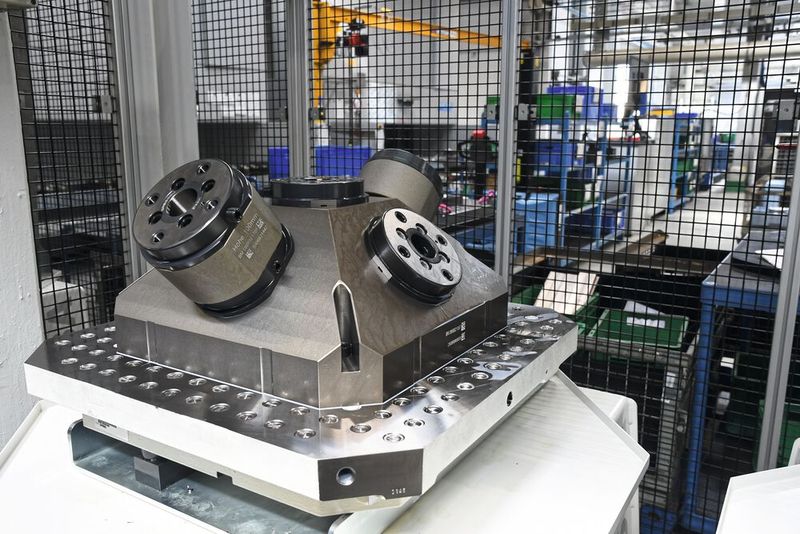
:quality(80)/p7i.vogel.de/wcms/96/24/9624baf6d70462e4d5f4b376525f9f35/0122361666v1.jpeg "For the off-machine setup of the workpieces on pallets, Gressel has deployed a whole range of clamping devices: C2 centric clamps, pyramids, Gredoc zero-point modules and plates, SC5X 5-axis clamps, S2 fixed-jaw clamps, clamping towers, and D2 double clamp towers.(Image: Gressel)")
:quality(80)/p7i.vogel.de/wcms/d3/4b/d34bdefeceeecfc41928bdd74b0b148d/0122361602v1.jpeg "For the off-machine setup of the workpieces on pallets, Gressel has deployed a whole range of clamping devices: C2 centric clamps, pyramids, Gredoc zero-point modules and plates, SC5X 5-axis clamps, S2 fixed-jaw clamps, clamping towers, and D2 double clamp towers.(Image: Gressel)")
:quality(80)/p7i.vogel.de/wcms/cf/d5/cfd527867d8d40a956598e4e7c9d6d23/0122361866v1.jpeg "Representing the entire project team: Sokha Hem, sales technician AT & DE South at Gressel, Stefan Rothmeier, field sales representative at Schunk, Markus Ziegler, tool design, Vitali Schmidt, department manager, Martin Bollwein, machine operator, and Alexander Bien, machine operator (from left).(Image: Gressel)")
:quality(80)/p7i.vogel.de/wcms/49/c7/49c73456d04979b1aff6c72d6951986b/0122361314v1.jpeg "Charging station of the driverless transport systems by Agilox Services. Right behind it is the central tool presetting.(Image: Gressel)")
:quality(80)/p7i.vogel.de/wcms/95/97/95976dbaac68b249eb65e74c5aad5300/0129651893v1.jpeg "The C2.0 centric clamps, the S2 fixed jaw clamps and the \"gredoc\" zero-point clamping systems are used for machining the raw parts. Fastening is carried out with width across flats 27. (Image:Gressel)")
:quality(80)/p7i.vogel.de/wcms/0c/58/0c587c8221ae96052b5dcc0f40eb3dcd/0128880879v1.jpeg "A chip surfer with a solid carbide head is used for finishing in the third operation. (Image:Ingersoll)")