With increasing digitalization in the industry, the implementation of AI in manufacturing is just a small step away—but one that offers great potential. In combination with the digital twin, Siemens sees this as both a tool for quality improvement and more efficient work preparation.
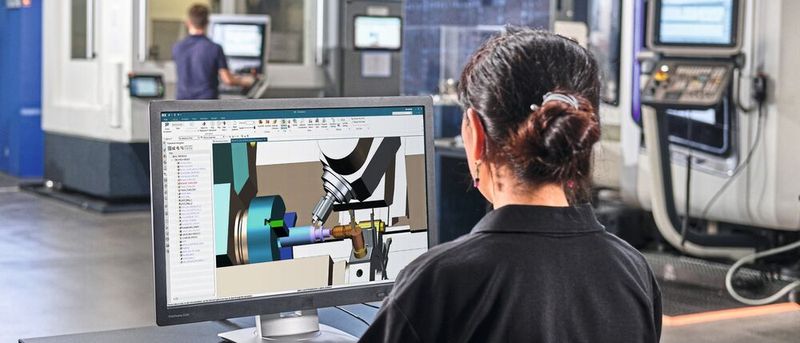
AI will not make CNC experts obsolete in the foreseeable future but can facilitate and accelerate their work in the form of a CAM co-pilot.
(Image: Siemens)
As digitization continues to gain momentum across all industries, data is becoming the lifeline of modern manufacturing. Today, on the verge of the AI revolution, this is even more true. Enormous amounts of data are generated in many parts of the manufacturing process, already being utilized in various ways. However, the sheer volume of such data also means that many optimization opportunities and important insights remain unused.
It is often feared that artificial intelligence (AI) could make workers obsolete, but its use in part manufacturing does not mean that humans and processes are "automated away." On the contrary, AI acts more as an "amplifier" that complements existing systems, thereby improving efficiency and productivity. One example of this is the co-pilot in a computer-aided manufacturing (CAM) system. It can automatically suggest tool paths by analyzing the 3D model of a component, using the capabilities of advanced software. The combination of traditional manufacturing processes with intelligent data collection, AI, and the comprehensive digital twin is a crucial step toward the next generation of data-driven manufacturing.
Gallery
The Need for Industrial-Grade AI
The use of AI in parts manufacturing offers many advantages but should be approached with caution. In consumer applications, an occasional error or hallucination by artificial intelligence may be acceptable—but in industry, where vast sums of money and even human lives may be at stake, a production error can have catastrophic consequences.
If the industry wants to benefit from the advantages of AI, it must deploy industrial-grade AI. The answers provided by a model must therefore be robust, reliable, and repeatable; users should not have to question every result. Building industrial-grade AI encompasses many individual aspects, such as
a testing framework for continuously verifying whether the models are still delivering plausible results,
automatic testing routines to ensure correctness, as well as
software that involves humans in critical tasks within the process.
When a solid foundation for implementation is established, industrial-grade AI can be used in three ways to improve parts manufacturing: AI to optimize manufacturing processes, AI to analyze manufacturing data and workflows, and AI to increase production profitability.
AI Optimizes Manufacturing
Even today, AI can accelerate many processes in the machine shop or any manufacturing environment, save labor time and materials, and increase efficiency in production. It is now used in many areas, including:
Natural language processing (NLP) for handling maintenance manuals, manufacturing data, and other tools such as the Industrial Copilot;
Optimization of energy consumption by using existing data to examine savings potential across all production processes;
AI-driven processing of CAM workflows for faster order completion.
These are just a few examples of how AI is already helping to make production more efficient. With further investments from companies in digitalization, the benefits of AI will also continue to increase.
Data Analysis for Greater Benefit
The combination of AI with data from manufacturing, design, and production enables optimizations through powerful analyses in all areas—from workflows to ergonomics. When all this information converges in solutions like the Siemens Insights Hub, AI can be applied to virtually anything: quality control reports, production plans in manufacturing, and more. A more thorough analysis thereby unlocks entirely new possibilities for streamlining processes.
AI makes a significant contribution to increasing production efficiency through predictive quality assurance. By analyzing defect data and correlating it with the manufacturing and performance data provided by intelligent machines, an AI model can be developed that detects signs of manufacturing errors at an early stage. Detecting such issues early enough saves time and materials, as the risk of defects in finished parts is reduced.
Increase Quality And Assess Risks
For example, so-called chatter during machining leads to substandard surfaces and reduces tool life. The result is chatter marks on the machined surface, often appearing as wave-like patterns or regular traces. Prolonged chatter can also lead to uneven wear or even tool breakage. AI algorithms can detect the occurrence of chatter by analyzing data from various sensors (vibrations, sound emissions, force, current) in real time. The machining parameters can then be adjusted immediately before the chatter becomes strong enough to affect the quality of the parts.
AI can not only process vast amounts of data but also significantly speed up the time-consuming analysis of data for specific use cases, such as improving ergonomics for human workers. Frequently performed movements can pose a physical strain, especially bending or gripping motions in awkward positions. While every person has a certain sense of the physical strain caused by repetitive movements, the long-term effects may be more difficult to assess. With an AI model trained on data about ergonomics and the human musculoskeletal system, the ergonomics of a specific motion can be evaluated based on a single image. AI-driven simulations of the human body allow effective analysis of high-risk scenarios. This information can be utilized in the comprehensive digital twin to more easily design a workplace that promotes health and enables efficient work by optimally arranging parts and tools.
Date: 08.12.2025
Naturally, we always handle your personal data responsibly. Any personal data we receive from you is processed in accordance with applicable data protection legislation. For detailed information please see our privacy policy.
Consent to the use of data for promotional purposes
I hereby consent to Vogel Communications Group GmbH & Co. KG, Max-Planck-Str. 7-9, 97082 Würzburg including any affiliated companies according to §§ 15 et seq. AktG (hereafter: Vogel Communications Group) using my e-mail address to send editorial newsletters. A list of all affiliated companies can be found here
Newsletter content may include all products and services of any companies mentioned above, including for example specialist journals and books, events and fairs as well as event-related products and services, print and digital media offers and services such as additional (editorial) newsletters, raffles, lead campaigns, market research both online and offline, specialist webportals and e-learning offers. In case my personal telephone number has also been collected, it may be used for offers of aforementioned products, for services of the companies mentioned above, and market research purposes.
Additionally, my consent also includes the processing of my email address and telephone number for data matching for marketing purposes with select advertising partners such as LinkedIn, Google, and Meta. For this, Vogel Communications Group may transmit said data in hashed form to the advertising partners who then use said data to determine whether I am also a member of the mentioned advertising partner portals. Vogel Communications Group uses this feature for the purposes of re-targeting (up-selling, cross-selling, and customer loyalty), generating so-called look-alike audiences for acquisition of new customers, and as basis for exclusion for on-going advertising campaigns. Further information can be found in section “data matching for marketing purposes”.
In case I access protected data on Internet portals of Vogel Communications Group including any affiliated companies according to §§ 15 et seq. AktG, I need to provide further data in order to register for the access to such content. In return for this free access to editorial content, my data may be used in accordance with this consent for the purposes stated here. This does not apply to data matching for marketing purposes.
Right of revocation
I understand that I can revoke my consent at will. My revocation does not change the lawfulness of data processing that was conducted based on my consent leading up to my revocation. One option to declare my revocation is to use the contact form found at https://contact.vogel.de. In case I no longer wish to receive certain newsletters, I have subscribed to, I can also click on the unsubscribe link included at the end of a newsletter. Further information regarding my right of revocation and the implementation of it as well as the consequences of my revocation can be found in the data protection declaration, section editorial newsletter.
Achieve Progress in Production
One of the newest and most well-known forms of artificial intelligence is generative AI, with its ability to communicate almost like a human. In the industry, it acts as a bridge between humans and technology, simplifying the use of complex tools. In the future, generative AI will be a central component of no- and low-code platforms, capable of programming complex machines using NLP.
An AI-powered co-pilot can also significantly accelerate the creation of CNC programs, the calculation of speeds and feeds, as well as the validation of tool paths. Currently, with CAM software, generating usable G-code from a 3D model is a complex and time-consuming process that requires extensive expertise in both CNC machining and the respective software.
It does not appear that the demand for CNC experts will decrease anytime soon. However, AI can speed up the work in the form of a CAM co-pilot by making tools more accessible and automating many labor-intensive manual steps. The CAM co-pilot can help automate the definition of machining processes for CNC machines, reducing programming time from hours to just minutes.
Once a feature in the 3D model is selected, the CAM co-pilot offers several combinations of work steps, tools, feed rates, etc., as suggestions. After the user approves one, it automatically transfers all the values of the chosen proposal into the software. At the same time, a co-pilot can learn to understand the characteristics of a manufacturing machine and immediately check whether a machine is suitable for a specific design and tool path and can produce the product safely.
Such generative AI tools can also serve as a kind of knowledge base that builds on the experience of qualified users and the data from previous workflows, providing best practices for the manufacturing environment. Through robust AI suitable for industrial use, a company also protects its own valuable expertise. This knowledge is just as easily accessible to new employees as it is to experienced staff and cannot be lost if someone changes jobs or retires.
Analyze, Optimize, And Generate With AI for Industrial Use
With the ongoing digitalization of manufacturing, it is becoming increasingly important for companies, regardless of their size, to use their data to achieve quality, sustainability, and efficiency goals. One thing is already clear today and will be even more so in the future: AI is becoming an increasingly essential tool for analyses, optimizations, and advancements in manufacturing. It offers everything—from simple analyses to fully integrated assistance functions—and will play a central role in building data-driven manufacturing. AI transforms dormant data, consisting of zeros and ones, into a goldmine for increasing efficiency across the entire company.
Rahul Garg is Vice President of Industrial Machinery at Siemens Digital Industries Software
Future-Proof Authentication with Universal RFID Readers



:quality(80)/p7i.vogel.de/wcms/31/84/3184f9ac736d8df7c2e934593684bc74/0130024314v1.jpeg "Here, the Bavarian car manufacturer BMW looks ahead to 2025: business was sluggish due to US tariffs and weakening sales in China ... (Image:BMW)")
:quality(80)/p7i.vogel.de/wcms/49/09/49095c6192a6c46d47b567e1def31ea6/0130024626v1.jpeg "The new TUM \"RoboGym\" (powered by Neura) is Europe's largest training center for next-generation humanoid robots. It focuses on the implementation of artificial intelligence in robotic systems. At the same time, it is a forge for AI experts ... (Image:Neura Robotics)")
:quality(80)/p7i.vogel.de/wcms/fe/8a/fe8af1b829b085210fef4c1fa8abddb5/0129784389v1.jpeg "As an integral part of Koch Pac-Systeme's Predictive Pack digital service product, the gearboxes with Cynapse and Wittenstein's Smart Services make it possible to detect damage risks in the packaging specialist's machines at an early stage. (Image:Koch Pac systems)")
:quality(80)/p7i.vogel.de/wcms/9f/7b/9f7be35880605811e045acd3af8b571b/0129558586v1.jpeg "An example of the V210 processing machine, which, according to Voortman, supplements the laser cutting of the V353 with drilling, thread cutting and milling. (Image:Voortman)")
:quality(80)/p7i.vogel.de/wcms/db/68/db689490e348201603dd30447711ea2b/0129578734v1.jpeg "With three-axis vibration measurement (X, Y and Z axes) and temperature detection, the CMSVT38 condition monitoring sensor provides detailed status information that helps to detect machine damage at an early stage. (Image:Kübler)")
:quality(80)/p7i.vogel.de/wcms/92/5e/925ee98ea36ad9bd574fa1cea11d0e53/0129964352v1.jpeg "The production of hardware components for humanoid robots offers great market potential. (Image:Fraunhofer IPA)")
:quality(80)/p7i.vogel.de/wcms/08/72/0872dd2dd119a54824c41e0e580e45a8/0129576591v1.jpeg "The Rose enclosure systems can be customized on request. (Image:Rose Systemtechnik GmbH)")
:quality(80)/p7i.vogel.de/wcms/73/17/7317794432521bf911711b91287cfc28/0129961259v1.jpeg "ABB Robotics and Nvidia are enabling the widespread use of physical AI in the world of robotics. This means that systems can be created virtually and with high precision and optimized much more cost-effectively. In the large image the virtual system, next to it the real robot cell ... (Image:ABB)")
:quality(80)/p7i.vogel.de/wcms/cb/fe/cbfe2741917274bbbf93d5b93e47a4f5/contact-software-launcht-fourier-20aiv1v1.png "Fourier AI combines AI models with AI applications developed for demanding engineering tasks. (Image:Contact Software)")
:quality(80)/p7i.vogel.de/wcms/bc/f7/bcf7a56980850be13ed37d220cd514bc/elchinator-security-5042249-1280-1280x720v1v1.jpeg "The HP Wolf Security Report shows: Attackers use AI for speed, modularity and automation, while the quality of campaigns is low. (Image:Picture: Pixabay)")
:quality(80)/p7i.vogel.de/wcms/68/89/688937087188b77da95b2079399ca862/0130009534v1.jpeg "Here you can see the Dualis layout configurator in use at Montratec. (Picture: ©Gorodenkoff - stock.adobe.com)")
:quality(80)/p7i.vogel.de/wcms/9e/98/9e984afbf9c6f2bcc8963bd13465b180/26-02-pi-fraunhofer-iws-41300-ultragrain-project-closing-pic-02-1562x878v1v1.png "The process of laser wire build-up welding (DED-LB) with pulse laser-induced plasma, which contributed to the success of the Ultra Grain project, is shown at high speed. (Image:Fraunhofer IWS)")
:quality(80)/p7i.vogel.de/wcms/69/f5/69f516f07a0ba999c5ba8763891853f1/0130030553v1.jpeg "Can be reloaded in 210 seconds for a return trip on the Greenford branch line: the GWR's 230001. (Image:Jack Boskett Media | GWR)")
:quality(80)/p7i.vogel.de/wcms/f0/5e/f05e720c52f757660ddbf7c410074f64/adobestock-222131875-5616x3157v1.jpeg "(Source: © jeson - stock.adobe.com)")
:quality(80)/p7i.vogel.de/wcms/b2/64/b2641254fef5afa15645cefc37089c88/0130021093v1.jpeg "Daimler Truck and Quantum Systems are jointly developing unmanned military vehicles. (Image:Quantum Systems)")
:quality(80)/p7i.vogel.de/wcms/30/7e/307e71ec64f7c52c29458544ca29adf1/org-blobs-user-response-file-output-799034cb-2ad7-4031-859a-15013f5b78e3-plugin-output-toolu-01vwfuenhw3cadvud7pddgyq-1536x864v1v1.png "China's government is debating the contents of the 15th five-year plan. The focus will change for the automotive industry. (Image:AI-generated)")
:quality(80)/p7i.vogel.de/wcms/61/8f/618f16f8fa95ec6cc838ca9bfb5dbaf1/0130027046v1.jpeg "The Belgian Research Institute has set up a European university consortium on the subject of CMOS 2.0. It brings together 26 university groups to research chip technologies that go beyond conventional transistor scaling. (Image:Imec)")
:quality(80)/p7i.vogel.de/wcms/db/a2/dba29322d0934dea1bbc4b31df80e392/0129953760v1.jpeg "SEM image: High-density electrode array with 128 nm dots. (Image:imec)")
:quality(80)/p7i.vogel.de/wcms/c2/a8/c2a8a93f306c1475489dff074ad59731/0129967672v1.jpeg "Figure 1: Imec's logic technology roadmap showing the extension of the nanosheet era from 2nm to the A10 node with the outer-wall forksheet, before the transition to CFET for A7 and beyond. (Image:imec)")
:quality(80)/p7i.vogel.de/wcms/07/79/0779a3ba2b38d583fc9b515900be2add/0129957428v1.jpeg "If the Chinese government has its way, domestic data centers full of Nvidia hardware will be a thing of the past. (Image:Nvidia)")
:fill(fff,0)/images.vogel.de/vogelonline/companyimg/76800/76895/65.jpg "FAULHABER_120mm.jpg ()")
:fill(fff,0)/p7i.vogel.de/companies/69/88/69882c428938e/tmts2026-ticec-banner-en-2000px.png "tmts2026-ticec-banner-en-2000px (https://www.tmts.tw/en)")
:fill(fff,0)/p7i.vogel.de/companies/67/eb/67eba621ef6ea/logo2.png "logo2 (Wuxi InfiMotion)")
:quality(80)/p7i.vogel.de/wcms/06/56/06568a51913a43fcfa5d2701fc73b807/0127894157v1.jpeg "The Production Copilot in the Siemens Insights Hub provides guidance: it recommends actions to the operator based on data and experience, eliminating the guesswork of what to do next.(Image: Siemens)")
:quality(80)/p7i.vogel.de/wcms/dd/d3/ddd337f6820ce7212e8bafdb781e5e31/0127894164v1.jpeg "Author Rahul Garg is Vice President in the Industrial Machinery segment at Siemens Digital Industries Software. He is responsible for defining and implementing key strategic initiatives and solutions as well as global business development.(Image: Siemens)")
:quality(80)/p7i.vogel.de/wcms/e1/71/e17181d99b1a2da8753a40a9f3f7449b/0127894159v1.jpeg "The co-pilot in NX CAM automates the NC programming process, saving up to 80 percent of development time.(Image: Siemens)")
:quality(80)/p7i.vogel.de/wcms/bb/8b/bb8b95994e45fada1f9350142fce5349/0127894166v1.jpeg "AI will not make CNC experts obsolete in the foreseeable future but can facilitate and accelerate their work in the form of a CAM co-pilot.(Image: Siemens)")
:quality(80):fill(efefef,0)/p7i.vogel.de/wcms/67/ae/67ae0b9ac31f8/elatec-wp-universal-reader.png "Elatec WP Universal Reader")
:quality(80)/p7i.vogel.de/wcms/a0/68/a068f5c560237c9fa634490b9aa1804c/pexels-daniel-smyth-83914874-10406128-4349x2446v1.jpeg "pexels-daniel-smyth-83914874-10406128-4349x2446v1 (Image: Daniel Smyth)")
:quality(80)/p7i.vogel.de/wcms/2b/9f/2b9f7d56c779b33bae32c382d4cd4f4f/0128285032v1.jpeg "Hanomag Aluminium Solutions processes aluminum parts with varying levels of intensity. Especially as a contract manufacturer, it was important to reduce setup and run-in times. (Image:d.u.h. Group)")