The industrial metaverse offers innovative approaches to improving product development through immersive visualizations and accelerated iterations. This digital transformation combines key technologies such as digital twins and AI to promote agile and adaptable development processes.
The metaverse as a consumer product is known—it is conceived as a virtual place where users can play, network, trade, and even own virtual property. However, the industrial metaverse only resembles these offerings in name.
(Image: Siemens)
Dale Tutt, Vice President of Industry Strategy, Siemens Digital Industries Software
In all industries, companies are facing increasing pressure, uncertainties, and opportunities. The proliferation of smart and connected products has continued to increase in many sectors as companies strive to enhance functionality and user experience through software and electronics. Interest in sustainable solutions has also risen. The challenges related to supply chain management, workforce dynamics, and sustainable innovation create uncertainty on the one hand but also opportunities for companies to gain a competitive advantage through creative solutions. This pressure, these challenges, and the resulting opportunities are forcing companies to rethink both their way of working and their market offerings.
Driving the digital journey forward
To continue to succeed, it is crucial for companies to become more resilient, agile, and adaptable to dynamic conditions. The foundation for this is a digital transformation strategy that leverages key technologies, each representing a facet of this digital transformation. These include
a comprehensive digital twin,
software and systems engineering,
the convergence of information and operational technology (IT/OT),
Mastering and combining these technologies will enable companies to progress on their digital journey, achieve a higher maturity level of digital transformation, and utilize powerful capabilities such as AI-powered generative design and closed-loop optimization.
Design concepts are easier to understand in the metaverse
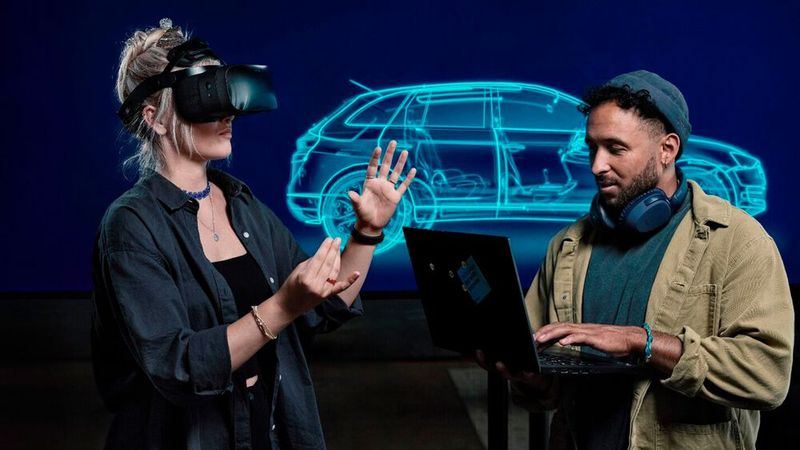
In this article, we will take a closer look at the industrial metaverse and explore how it could prove to be the most transformative method for managing businesses. The industrial metaverse also offers the potential to reshape the way products are designed, manufactured, and maintained. It combines the physical foundation of the comprehensive digital twin with the impressive visualizations of the metaverse to create a shared and immersive environment. In this environment, learning becomes faster and more intuitive, and design concepts are easier to understand. New ideas can be quickly and thoroughly explored to drive innovations for the future.
Why the industrial metaverse is more than CAD in VR
Industrial customers believe in the potential of industrial metaverses for realistic real-time visualization of systems in immersive environments. Immersive industrial metaverses are a crucial factor in the advancement of product development methods. They also change the manufacturing and maintenance of these products and hopefully make the work of people in companies easier.
The metaverse as a consumer product is certainly known—it is conceived as a virtual place where users can play, network, trade, and even own virtual property. The industrial metaverse only resembles these offerings in name.
The industrial metaverse is a physics-based virtual environment.
In this environment, the evaluation, analysis, and prediction of behavior based on deterministic models of the product, process, production facility, and more are possible.
This environment is accessible via various devices, including augmented and virtual reality.
It also aggregates and normalizes data from multiple sources to enable a holistic assessment of a system or product in a single environment.
Save time, resources and money
The result is a virtual environment based on physical reality that enables rapid and intuitive conceptualization, design, and detailed construction of complex products and systems. Instead of assessing system performance solely through diagrams, tables, or raw data, designs can be visualized and modified in three dimensions, allowing users to interact with the digital twin. This can help reveal issues that in the past were often only discovered when prototypes were built and tested in the real world—leading to scheduling delays, higher costs, and increased material consumption. All problems identified in the industrial metaverse can be solved through quick design iteration in the virtual world, saving time, resources, and money.
All issues identified in the industrial metaverse can be resolved through rapid design iteration in the virtual world, saving time, resources, and money.
Metaverse aggregates data from various sources
Moreover, the industrial metaverse is not a standalone environment separate from a company's day-to-day operations. The industrial metaverse is capable of integrating data from various sources, both real and digital, into a single user experience. In this way, all information is consolidated into a single view, providing greater transparency and a deeper understanding of the dynamics of a system design, production process, supply chain, or a variety of other topics. Thus, the industrial metaverse is more than just a space for design. It also enables companies to actively monitor, analyze, and manage real assets in a closed loop, allowing them to make more informed technical and business decisions.
Date: 08.12.2025
Naturally, we always handle your personal data responsibly. Any personal data we receive from you is processed in accordance with applicable data protection legislation. For detailed information please see our privacy policy.
Consent to the use of data for promotional purposes
I hereby consent to Vogel Communications Group GmbH & Co. KG, Max-Planck-Str. 7-9, 97082 Würzburg including any affiliated companies according to §§ 15 et seq. AktG (hereafter: Vogel Communications Group) using my e-mail address to send editorial newsletters. A list of all affiliated companies can be found here
Newsletter content may include all products and services of any companies mentioned above, including for example specialist journals and books, events and fairs as well as event-related products and services, print and digital media offers and services such as additional (editorial) newsletters, raffles, lead campaigns, market research both online and offline, specialist webportals and e-learning offers. In case my personal telephone number has also been collected, it may be used for offers of aforementioned products, for services of the companies mentioned above, and market research purposes.
Additionally, my consent also includes the processing of my email address and telephone number for data matching for marketing purposes with select advertising partners such as LinkedIn, Google, and Meta. For this, Vogel Communications Group may transmit said data in hashed form to the advertising partners who then use said data to determine whether I am also a member of the mentioned advertising partner portals. Vogel Communications Group uses this feature for the purposes of re-targeting (up-selling, cross-selling, and customer loyalty), generating so-called look-alike audiences for acquisition of new customers, and as basis for exclusion for on-going advertising campaigns. Further information can be found in section “data matching for marketing purposes”.
In case I access protected data on Internet portals of Vogel Communications Group including any affiliated companies according to §§ 15 et seq. AktG, I need to provide further data in order to register for the access to such content. In return for this free access to editorial content, my data may be used in accordance with this consent for the purposes stated here. This does not apply to data matching for marketing purposes.
Right of revocation
I understand that I can revoke my consent at will. My revocation does not change the lawfulness of data processing that was conducted based on my consent leading up to my revocation. One option to declare my revocation is to use the contact form found at https://contact.vogel.de. In case I no longer wish to receive certain newsletters, I have subscribed to, I can also click on the unsubscribe link included at the end of a newsletter. Further information regarding my right of revocation and the implementation of it as well as the consequences of my revocation can be found in the data protection declaration, section editorial newsletter.
The metaverse—more than the digital twin
To realize its full potential, the industrial metaverse must be more than a visualized version of the digital twin. In manufacturing, every movement and action must be captured precisely, which requires realistic physical behavior. Better access to cloud computing supports the industrial metaverse with the necessary computing power to underpin immersive visualizations with physical simulations, significantly increasing its value in the development and design process.
By applying real-world physics and robust operational data to the industrial metaverse, we have the potential to create more than just a gamification experience.
Evaluate new ideas quickly and thoroughly
By applying real physics and robust operational data to the industrial metaverse, we have the potential to create more than just a gamification experience. The result can be a shared and immersive environment where learning is faster and more intuitive, design concepts are more easily understood, and new ideas can be quickly and thoroughly explored to drive innovations for the future.
Such a powerful environment is the result of current technology trends taking shape across industries today. Companies embarking on the path of digital transformation will be able to overcome these challenges. They gain an edge by leveraging the possibilities of the comprehensive digital twin, software and systems engineering, integrated IT and OT systems, artificial intelligence, and ultimately industrial metaverses.



:quality(80)/p7i.vogel.de/wcms/8e/63/8e631ccb75fda465c197fc52848289fa/0130260202v1.jpeg "According to the Laser-Zentrum Hannover, what is sizzling away underwater marks the first steps towards a way of repairing steel structures more cheaply and without complications using robots, laser 3D printing and AI ... (Image:LZH)")
:quality(80)/p7i.vogel.de/wcms/67/30/6730b015b3dd6f925877edd795eda319/0130247463v1.jpeg "The comparison between the SLA printable plastics Accura Xtreme Grey (above) and the robust newcomer Accura Xtreme Black now used at Speedpart, which represents an inexpensive and deep black alternative to mechanically processed plastic prototypes ... (Image:Speedpart)")
:quality(80)/p7i.vogel.de/wcms/06/9d/069d939b77a4feab0a8d2ece62c28dc1/0129655701v1.jpeg "This turned part is slotted twice. The deburring that would otherwise be necessary is no longer required for high-pressure machining. (Image:Knoll)")
:quality(80)/p7i.vogel.de/wcms/3f/72/3f72e30d61f3522bff192171b60776a4/0130245214v1.jpeg "No idea what else your humanoid robot can do, or where it fails? Then it might be worth taking a look at the Humanoid Capabilities Navigator, which now helps you to find the right robot for a job, or to improve humanoids in a targeted manner ... (Image:Fraunhofer IPA)")
:quality(80)/p7i.vogel.de/wcms/ba/28/ba28ec056a82abd76758c8c87296c0d5/0130213997v1.jpeg "The Nexy automatic material call-off system (AMS) controls the replenishment of non-stocked materials or components. (Image:Steute Technologies GmbH & Co. KG, Löhne)")
:quality(80)/p7i.vogel.de/wcms/21/3b/213b5e5454b0c4344ba0eaa700857607/0129635774v1.jpeg "The QRV flow control valves from Lee are available in sizes from 5.5 to 18 mm and cover a flow rate of 0.2 to 20 l/min. Depending on the version, the pressure range is either between 0.1 and 2.75 bar (1.5 - 40 psi) or between 0.17 and 2 bar (2.5 - 30 psi). (Image:Lee)")
:quality(80)/p7i.vogel.de/wcms/63/e9/63e9db3259a656cca88c5f7158af3fcb/0129385769v1.jpeg "The Agibot A2 at a Fortune China event in December 2025. (Image:Agibot)")
:quality(80)/p7i.vogel.de/wcms/df/a1/dfa1786a3b05f5ff2e51d0f633695c57/0130137877v1.jpeg "Openclaw inspires AI communities. (Image:Openclaw.ai)")
:quality(80)/p7i.vogel.de/wcms/e4/51/e451d52ce0182fb0aaa46a5774f832ef/26-04-pi-fraunhofer-iws-21160-bioslide-pic-01-4128x2321v1v1.jpeg "With the BioSlide research project, the Fraunhofer IWS is investigating how sliding systems can be designed to be more sustainable and energy-efficient. New materials can be tested in a particularly application-oriented manner on this plain bearing test stand. (Image:Fraunhofer IWS)")
![Thanks to advanced 3D printing technology, a more efficient use of resources should contribute to lower-emission aviation—this is the goal of ['skai]-lab. (Image:Oleksandr Pashchenko - stock.adobe.com / AI-generated)](https://cdn1.vogel.de/nghHNSbySccfOjG3n1qCA-FVOjQ=/288x162/smart/filters:format(jpg):quality(80)/p7i.vogel.de/wcms/62/64/626424c97a16e69f871bf216c9629c2a/adobestock-1927043193--c2-a9-20oleksandr-20pashchenko-20-e2-80-93-20stock-adobe-com-ki-generiertv1v1.jpeg "Thanks to advanced 3D printing technology, a more efficient use of resources should contribute to lower-emission aviation—this is the goal of ['skai]-lab. (Image:Oleksandr Pashchenko - stock.adobe.com / AI-generated)")
:quality(80)/p7i.vogel.de/wcms/78/28/7828775af76773458b4d1409ceb1cf0c/368945-20dam-20imagery-digital-transformation-pc-1920x1079v1v1.jpeg "Complex development projects with high regulatory requirements, such as in the aerospace industry, benefit in particular from the Intelligent Product Lifecycle. (Image:PTC)")
:quality(80)/p7i.vogel.de/wcms/e7/82/e7822e208621ba2ae892d609e60481e8/texas-20uni-850x478v1v1.jpeg "Superfoam is a composite that is capable of absorbing 10 times more energy than a conventional foam. (Image:Abbey Toronjo/Texas A&M University Division of Marketing & Communications)")
:quality(80)/p7i.vogel.de/wcms/e6/53/e6539c6b5df2d2af2970ca981131fb42/0130215307v1.jpeg "Volkswagen is in first place in the first two months of 2026—no one has sold as many cars in China as the car manufacturer. (Image:Volkswagen)")
:quality(80)/p7i.vogel.de/wcms/b0/6d/b06d9ad54bfc39053e1db5494df5cb9a/0130237932v1.jpeg "Pleased about their partnership in the field of bidirectional charging: Christian Haferkamp and Aurélie Alemany from enercity as well as Stefan Mecha and Lars Krause, both Volkswagen Commercial Vehicles (from left to right). (Image:PSONNACK)")
:quality(80)/p7i.vogel.de/wcms/2b/0b/2b0b5ff55299be32174cb0ed76718253/0130177406v1.jpeg "Rolls-Royce has received funding of 70 million US dollars from the EU public-private partnership \"Joint Undertakings for Clean Aviation\". (Image:Rolls-Royce)")
:quality(80)/p7i.vogel.de/wcms/95/7e/957ed49b185794b3e76b9e610a8a389f/0130217926v1.jpeg "Bosch wants to offer components for e-vehicles in India together with Tata. (Image:Bosch)")
:quality(80)/p7i.vogel.de/wcms/22/08/22085b4997a696887dd5a712a30b262b/0130211045v1.jpeg "Imec has announced that the world's most advanced high numerical aperture (High NA) EUV lithography system, the ASML EXE:5200, has arrived at its 300mm cleanroom in Leuven. (Image:Imec)")
:quality(80)/p7i.vogel.de/wcms/48/f2/48f250e2385d3f43743dc44133cc4731/0130161592v1.jpeg "The world's first fully functional quantum battery as a proof-of-concept, developed by CSIRO and its cooperation partners, the University of Melbourne and RMIT. (Image:CSIRO and collaborators, The University of Melbourne and RMIT)")
:quality(80)/p7i.vogel.de/wcms/16/9c/169c092e854d8740928a080cead3b88e/0130241261v1.jpeg "NVIDIA's GB300 AI chip with HBM3E and HBM4 from SK Hynix. (Image:SK Hynix)")
:quality(80)/p7i.vogel.de/wcms/3a/50/3a50d3f269f38f14d7a25a93c6f2b2f8/0130147601v1.jpeg "The compact modulator enables fast and energy-efficient data transmission and can be manufactured cost-effectively. (Image:Hugo Larocque, EPFL)")
:fill(fff,0)/images.vogel.de/vogelonline/companyimg/76800/76895/65.jpg "FAULHABER_120mm.jpg ()")
:fill(fff,0)/p7i.vogel.de/companies/69/88/69882c428938e/tmts2026-ticec-banner-en-2000px.png "tmts2026-ticec-banner-en-2000px (https://www.tmts.tw/en)")
:fill(fff,0)/p7i.vogel.de/companies/67/eb/67eba621ef6ea/logo2.png "logo2 (Wuxi InfiMotion)")
:quality(80)/p7i.vogel.de/wcms/ad/da/adda2b0237d0167d79524dc8845649b8/0128720455v1.jpeg "Pepsico is digitizing selected production facilities and warehouses in the USA using Digital Twin Composer. (Image:Pepsico)")
:quality(80)/p7i.vogel.de/wcms/88/67/88675aa529774fbdeeb601887b6356b3/0126305407v1.jpeg "XR headsets equipped with RGB passthrough color cameras enable companies to integrate 3D models into real environments, allowing 1:1 testing of layouts and workflows on-site without physical reconstruction. (Image:HTC Vive)")