The agricultural machinery manufacturer and mechanical engineer Göweil has built a Smart Factory at its latest location, which paves the way to the future for the company thanks to the latest technologies and systems. Cronetwork MES plays a central role in this.
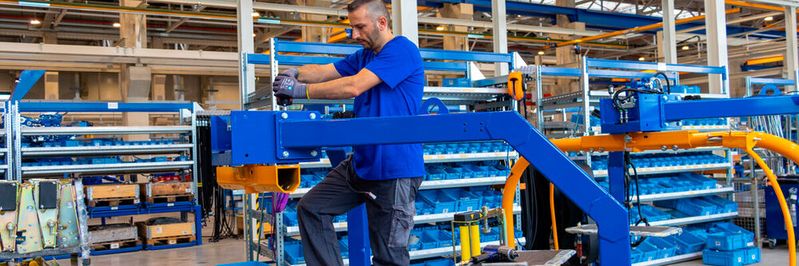
In addition to the paint shop, Cronetwork's fine planning also optimizes assembly.
(Image: Göweil.)
Markus Maier is Team Leader Corporate Marketing at Industrie Informatik.
For more than 35 years, the Göweil name has stood for a high-quality product range in the field of bale wrapping and pressing technology in the agricultural machinery market. Thanks to a very high export quota, the Austrian machines are well-known and successfully in use not only in Europe, but all over the world. In addition, the robust and powerful machines are now also finding application in the industrial environment. However, this steep company development also poses new challenges for the family-run company.
Göweil products have always been produced at the headquarters in Kirchschlag in Upper Austria. In order to meet the new market requirements and the high demand in the future, the machine builder invested in the construction of a completely new production site. On more than 15,000 m² area, agricultural products are now also painted, assembled and shipped in Rainbach.
Closely linked to the ambitious project was the desire for comprehensive digitization at the site. Markus Jungwirth, the technician responsible for optimizing the workflows at Göweil, recalls the challenges at the beginning of the project: "We use a chain system in painting and assembly. This means that the planned processes take place in a predetermined order, which can hardly be interfered with or not interfered with at all. The challenge is to equip the transport elements for the parts to be painted – the so-called carriers – with components in such a way that the formulas and painting processes established for them match and the right assembly areas can then be supplied with them. Due to this basic setting alone, some providers dropped out in the MES pre-selection." According to Jungwirth, the goal was to "touch" the painted parts as little as possible and always provide them at the right places and workplaces without much detour.
Integrative systems as the key
Even before the construction of the new site began, Göweil was already using an ERP and a warehouse management system (WMS). The MES intended for production was supposed to seamlessly tie into the existing structures and form a unit with them. With Cronetwork MES, a system was finally found that ideally maps and supports the existing and future processes. Markus Jungwirth explains: "Today, the WMS is triggered by the detailed production planning, initiating the necessary picking steps. The parts to be painted set off, are planned on carriers and finally go through the painting system."
In detail, this means that on the basis of the planning data in the detailed planning, the WMS is informed where and at what time the necessary components must be provided in production. A availability check is carried out via WMS, which returns the updated data to Cronetwork MES. If all components are available, the planner gives the order release. The next steps are scheduling and commissioning of the transports by the WMS, the start of the painting process and finally the delivery to the assembly workstations. Cronetwork is always informed about order statuses or storage locations through continuous automatic reconciliations and thus assumes the leading role in the digital shop floor process.
Optimization potentials thanks to intensive use
In addition to the paint shop, Cronetwork's detailed planning also optimizes assembly. Göweil products, which consist of numerous assemblies, flow just-in-time from various workstations into the final assembly line. This requires precise planning of the parallel stations to ensure optimal supply of the final assembly line with the necessary assemblies. With Cronetwork MES, the company masters this complex challenge very efficiently.
The data gained in the process, such as quantities and times, is recorded using Cronetwork BDE. This puts the focus on the shop floor workers. "Our employees are informed via the terminals at their workplace when which assembly sections need to be started or completed and when the required parts are available. In addition, they can retrieve further product-relevant information such as drawings," says Jungwirth, who continues: "Colleagues also like to use the Cronetwork terminals for a look into the near future. This way, they are better prepared for upcoming orders. An underestimated effect is the many optimization ideas that come from our employees based on this new information and constantly improve our processes." According to Jungwirth, an important factor is the close cooperation and the say that colleagues have in designing the terminals.
Date: 08.12.2025
Naturally, we always handle your personal data responsibly. Any personal data we receive from you is processed in accordance with applicable data protection legislation. For detailed information please see our privacy policy.
Consent to the use of data for promotional purposes
I hereby consent to Vogel Communications Group GmbH & Co. KG, Max-Planck-Str. 7-9, 97082 Würzburg including any affiliated companies according to §§ 15 et seq. AktG (hereafter: Vogel Communications Group) using my e-mail address to send editorial newsletters. A list of all affiliated companies can be found here
Newsletter content may include all products and services of any companies mentioned above, including for example specialist journals and books, events and fairs as well as event-related products and services, print and digital media offers and services such as additional (editorial) newsletters, raffles, lead campaigns, market research both online and offline, specialist webportals and e-learning offers. In case my personal telephone number has also been collected, it may be used for offers of aforementioned products, for services of the companies mentioned above, and market research purposes.
Additionally, my consent also includes the processing of my email address and telephone number for data matching for marketing purposes with select advertising partners such as LinkedIn, Google, and Meta. For this, Vogel Communications Group may transmit said data in hashed form to the advertising partners who then use said data to determine whether I am also a member of the mentioned advertising partner portals. Vogel Communications Group uses this feature for the purposes of re-targeting (up-selling, cross-selling, and customer loyalty), generating so-called look-alike audiences for acquisition of new customers, and as basis for exclusion for on-going advertising campaigns. Further information can be found in section “data matching for marketing purposes”.
In case I access protected data on Internet portals of Vogel Communications Group including any affiliated companies according to §§ 15 et seq. AktG, I need to provide further data in order to register for the access to such content. In return for this free access to editorial content, my data may be used in accordance with this consent for the purposes stated here. This does not apply to data matching for marketing purposes.
Right of revocation
I understand that I can revoke my consent at will. My revocation does not change the lawfulness of data processing that was conducted based on my consent leading up to my revocation. One option to declare my revocation is to use the contact form found at https://contact.vogel.de. In case I no longer wish to receive certain newsletters, I have subscribed to, I can also click on the unsubscribe link included at the end of a newsletter. Further information regarding my right of revocation and the implementation of it as well as the consequences of my revocation can be found in the data protection declaration, section editorial newsletter.
MES is now the central system in manufacturing
The plant manager for the Rainbach location, Mathias Kapfer, sums up the current status of digitization measures on the shop floor: "Cronetwork MES is the central system in our production. All orders from our ERP are automatically transferred to the MES, cast into a time schedule using fine planning, and after final release automatically sent to the linked systems such as LVS, the paint shop and the assembly workstations. You could say that Cronetwork fine planning is the working tool for our AV to be able to reflect production as a digital timeline. As a result, we are working more structured, planned and have been able to free up resources." Kapfer also praises the professional collaboration with Industrie Informatik: "To put it simply, Cronetwork MES covered our requirements best of all providers. Since the start of the project, we have also been in close exchange with the employees of Industrie Informatik. The partner is always striving to implement our additional requirements in the standard, which is possible to a very high percentage. But individual adjustments are generally not a problem and are quickly realized."
The digital shop floor has become a reality at Göweil's new location. The MES as the central pivot point for this delivers what the machine builder expected - and even more. Above all, the digital mapping of the pearl chain system in Cronetwork is an important step towards resource efficiency. A large part of storage and logistics activities are eliminated as a result, chaotic warehouses are a thing of the past. The close link and high degree of integration with adjacent systems such as ERP and WMS enable paperless, automated, structured and documented workflows. In addition, the powerful fine manufacturing planning takes over the scheduling coordination on the shop floor, which relieves a lot of work for the employees around the foreman and frees up capacities and concentration for other important tasks in the factory. Last but not least, many more optimization potentials at the production line were uncovered thanks to the transparent processes - keyword terminals.
"Currently, we are still working on further optimizing the use of Cronetwork MES in our plant. The possibilities in the combination of MDE, BDE and detailed planning are huge and we are only at the beginning of our journey," says Mathias Kapfer in conclusion.



:quality(80)/p7i.vogel.de/wcms/46/af/46afee96b1fdae5653adcbd82b187e06/0130522052v1.jpeg "What you see here is the successful combination of the Lars UPS system from Kraken Robotics and the RD-22 from Sefine. Added to this is the Katfish towed sonar system from Kraken. All in all, this robotic mix is intended to strengthen mine defense. Initial demonstrations have been successful. (Image:Octopus Robotics)")
:quality(80)/p7i.vogel.de/wcms/61/44/61443e99b250115b515e7d9dc7163818/0130460078v1.jpeg "Full halls at TMTS 2026. (Image:VCG/Sonnenberg)")
:quality(80)/p7i.vogel.de/wcms/fb/89/fb890ec01dc3b288d85c3e560dbc6e53/0130440360v1.jpeg "All-in-one machines for the production of long screws: this is what Amba is known for. The company now wants to make even more of this expertise. (Image:Aachen mechanical engineering)")
:quality(80)/p7i.vogel.de/wcms/a0/47/a04725ef9bd09fb6c9341a1bea1b5d93/0130443083v1.jpeg "Here, a type of plastic pallet is produced by thermoforming (vacuum forming or deep drawing) at the corresponding division of New England Plastics in the USA. This division, which specializes in so-called liners, is now part of Ringmetall ... (Image:New England Plastics)")
:quality(80)/p7i.vogel.de/wcms/44/47/44472248cfbd4dc1301fa8fdff3616a5/0130443860v1.jpeg "Siemens has entered into a partnership with the European Space Agency (ESA). It has joined the 'Partnership Initiative for Commercialization' (EPIC) programme, which opens up new opportunities for start-ups from ESA's Business Incubation Centres (ESA BICs). (Image:ESA/NASA/Cities at Night)")
:quality(80)/p7i.vogel.de/wcms/fa/8f/fa8f69dfc822db4f3cf051d12d36b020/0130499198v1.jpeg "(Image:Sensirion)")
:quality(80)/p7i.vogel.de/wcms/1c/03/1c03f177c3f718060fca6b0b8a462813/0130301009v1.jpeg "Dr. Matthias Wick, CTO of Cisco Systems (Switzerland) during his presentation at the asut Lunch Forum on AgenticOps. (Image:Anne Richter, VCG)")
:quality(80)/p7i.vogel.de/wcms/8b/2a/8b2aa1706944495814db6ec30efd5cb2/0129190693v1.jpeg "With sensors for thickness, position, temperature and 3D geometry, Micro-Epsilon enables precise automation. (Picture:Micro-Epsilon)")
:quality(80)/p7i.vogel.de/wcms/14/27/142774c1c27785d56d8ab10131fb648d/adobestock-844361487--c2-a9-20jk-kyoto-20-e2-80-93-20stock-adobe-com-ki-generiertv1.jpeg "Large-scale or rapidly growing IoT scenarios in factory automation can often only be implemented using conventional cabling with considerable infrastructure costs. Wireless technologies can offer great added value when used in a complementary and sensible way. (Source: © JK_kyoto - stock.adobe.com / AI-generated)")
:quality(80)/p7i.vogel.de/wcms/3d/bf/3dbfb672adb0446d40669e6403baf3b6/adobestock-1421003638--c2-a9-20tenpixels-20--20stock-adobe-comv1.jpeg "Many processes in design and development are undergoing change. PLM solutions ensure greater efficiency thanks to transparency and data consistency. (Source: © TenPixels - stock.adobe.com)")
:quality(80)/p7i.vogel.de/wcms/b7/36/b736dfebc16c42d6901d0d0e1f390493/3d-druck-20factory-20--20ki-20generiert-1920x1079v1.png "(Source: AI-generated)")
:quality(80)/p7i.vogel.de/wcms/79/b2/79b21aad663f4a7bd4472afc1c1afc62/0130433994v1.jpeg "Mission Joyride: The free-flying robot (shown here in the rendering) will relieve the ISS crew of logistics tasks from 2027 with its two mechanical arms. (Image:Icarus Robotics)")
:quality(80)/p7i.vogel.de/wcms/42/19/4219735a4602950073b3f8492fd20a4c/0130476518v1.jpeg "An e-paper screen is invisibly integrated into the interior door trim. Marquardt, Covestro and E Ink worked together on the concept. (Image:Covestro)")
:quality(80)/p7i.vogel.de/wcms/13/23/1323ce113841ece5e51dd055f9e1f088/0130524198v1.jpeg "Thanks to invisible sensors installed behind the display, it is possible to detect whether the driver is tired or distracted while driving, for example. (Image:Aumovio)")
:quality(80)/p7i.vogel.de/wcms/9c/fc/9cfcfad5d96b849179e39c2999f2ff2f/0130534276v1.jpeg "More recycling for sustainable cell-to-pack battery systems is the aim of the Difference research project. (Image:Fraunhofer IPA)")
:quality(80)/p7i.vogel.de/wcms/9f/1d/9f1d995e45e9e661df981aad09789842/0130489199v1.jpeg "The BMW plant in Irlbach-Straßkirchen is considered a showcase project for \"Bavarian Speed\": short distances, close cooperation with regional partners and a digital toolbox that accelerates planning and implementation. (Image:BMW Group)")
:quality(80)/p7i.vogel.de/wcms/c0/37/c0372a27e362d2108e114ea045fdb2e8/0130532716v1.jpeg "Robot density: South Korea leads by a wide margin. Germany in third place. (Image:IFR)")
:quality(80)/p7i.vogel.de/wcms/aa/0d/aa0df5652cc37cfd8b6c3601c92c1f4c/0130519149v1.jpeg "The GQA2W024A050V-007-R converter is available in multiple housing configurations to give developers maximum flexibility for their overall housing design and converter cooling. (Image:TDK Lambda)")
:quality(80)/p7i.vogel.de/wcms/34/b4/34b4fe3e34f655aa3b0e3e6bfb83fde4/0130526171v1.jpeg "Private networks: Siemens expands its private 5G infrastructure to the USA and seven other countries (Image:Siemens AG)")
:quality(80)/p7i.vogel.de/wcms/8d/fe/8dfe4efea68edaaa40058dfea8f3da2f/0130519880v1.jpeg "Chip giant Intel has made gains on the US stock market, according to reports today. This is actually unusual for the current state of affairs. There is also news that Intel wants to get involved in Elon Musk's Terafab project ... (Image:Chipcheck)")
:fill(fff,0)/images.vogel.de/vogelonline/companyimg/76800/76895/65.jpg "FAULHABER_120mm.jpg ()")
:quality(80)/p7i.vogel.de/wcms/19/cc/19ccc9ae20892dfe2d775f6066749321/0117640762.jpeg "In addition to the paint shop, Cronetwork's fine planning also optimizes assembly.(Image: Göweil.)")
:quality(80)/p7i.vogel.de/wcms/0d/df/0ddff1ae0d399985cafd1f8894344a37/0117640761.jpeg "Göweil products, which are composed of numerous assemblies, flow into the final assembly line just-in-time from various workstations.(Image: Göweil.)")
:quality(80)/p7i.vogel.de/wcms/a8/89/a88940a34d7c30602ca775b05fcfed32/0117640766.jpeg "For more than 35 years, the Göweil name has stood in the agricultural machinery market for a high-quality product range in the field of bale-wrapping and pressing technology.(Image: Göweil.)")
:quality(80)/p7i.vogel.de/wcms/c8/7e/c87e284f0748dbe5ea5d09ff91e8cda0/0117640767.jpeg "The agricultural machinery manufacturer and mechanical engineer Göweil has built a Smart Factory at its latest location, which paves the way to the future for the company thanks to the most modern technologies and systems.(Image: Göweil.)")
:quality(80)/p7i.vogel.de/wcms/ba/28/ba28ec056a82abd76758c8c87296c0d5/0130213997v1.jpeg "The Nexy automatic material call-off system (AMS) controls the replenishment of non-stocked materials or components. (Image:Steute Technologies GmbH & Co. KG, Löhne)")
:quality(80)/p7i.vogel.de/wcms/9b/0b/9b0b36b44295aec66449dc602f0db193/0127926769v1.jpeg "During ongoing operations, the digital twin becomes the central \"hub\" for process understanding. (Image:Hexagon)")