Infineon has undergone a remarkable development since its spin-off from Siemens, marked by crises, records, and strategic realignments. We take a look at key milestones of Germany's largest semiconductor manufacturer.
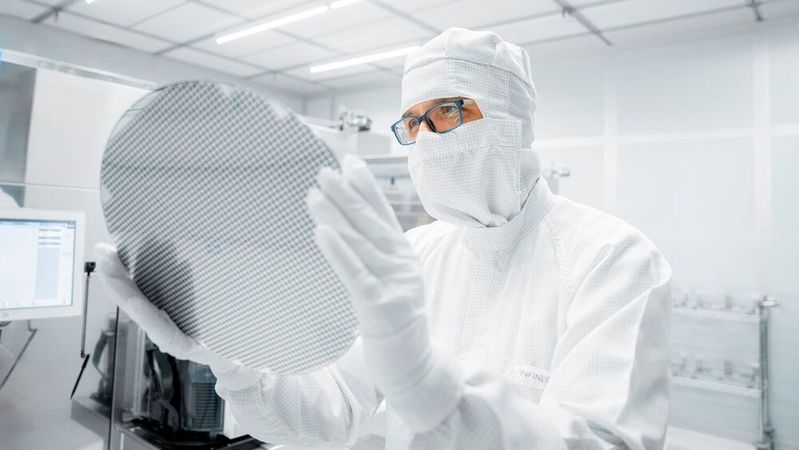
Inspection of a 300-mm wafer in Dresden.
(Image: Infineon Technologies)
The most well-known semiconductor manufacturer in Germany is Infineon. Some may still remember Infineon's highly publicized IPO in 2000 with then-CEO Ulrich Schumacher. The occasion for this was the spin-off of the semiconductor division from parent company Siemens in 1999, which also involved naming the newly created company.
We will look at some facts and historical points about Infineon, without proceeding strictly chronologically. There are simply too many individual topics, which we will address separately. Since the end of 2005, Infineon's headquarters has been located in Neubiberg in the so-called Campeon Park. This borders directly on Munich and Unterhaching and houses, among other things, offices of Intel Mobile Communication, which emerged from a former Infineon department.
The current Infineon CEO, Jochen Hanebeck, has been with the company since its founding and previously worked for Siemens in DRAM development starting in 1994. In 2024, Infineon, with over 58,000 employees worldwide and numerous production sites, achieved a turnover of nearly 15 billion euros (~$17.5 Billion).
The Birth of Infineon and the Course of Stock Prices
When it comes to semiconductor chips, the large corporation Siemens was an important player well into the 1990s. In 1999, Siemens decided to spin off its entire semiconductor division. The reason for this was the costly financing of the semiconductor business, which is considered cyclical. An independent, publicly listed company with stock market financing was deemed more advantageous. The name Infineon is composed of the English and Greek terms infinity and aeon; infinity and era.
In March 2000, Infineon finally went public. By 2001, the share of stock still owned by Siemens had dropped below 50 percent. By 2006, Siemens had sold all its shares. The issue price was 35 euros, and the initial stock market price was around 70 euros (~$39 to $77) due to high demand, briefly climbing above 76 euros (~$88), but then rapidly falling by the end of the year to approximately 35 (~$39) euros by early 2001. By spring 2009, the stock price, also influenced by the financial crisis, continued to drop steadily, with only a few brief peaks, reaching as low as 0.44 euros (~$0.5) at times. Over the past twelve months, the stock has consistently traded above 30 euros (~$35), except during April and May.
Dresden and Warstein as Plant Examples
We continue with two Infineon locations that already existed and belonged to Siemens before Infineon was founded. The largest production facility of Infineon to date is in Dresden (Germany) and has another special feature besides its size. It was established in 1994, relatively shortly before Infineon's founding. Today, there are more than 4,000 employees in Dresden, spread across two locations in the city.
The core area of production in Dresden includes products based on 200-mm and 300-mm wafers. The facilities for 300-mm-based memory products were built starting in 2001 and were technologically world-leading at the time. In the summer of 2026, the so-called Power Fab, currently under construction in Dresden, will open, producing products in the field of power supply for AI systems, with Infineon investing around four billion euros (~$4.6 Billion). An additional one billion euros is being provided through government funding. The Dresden site is particularly important due to its size, its history, and the current investments. It can be considered a kind of foundation for Infineon, dating back to Infineon's start in 1999.
Of course, since Infineon emerged from Siemens, there are additional locations that existed prior to Infineon's IPO. As an example, we will mention a second, particularly old location. It was established directly after World War II in 1945 and is located in Warstein (Germany), which is also known for the beer of the same name. Thus, the Siemens employees were well supplied after work. But jokes aside: Currently, over 2,000 Infineon employees work in Warstein in the field of electrical engineering products related to renewable energies. According to Infineon, power modules from Warstein are found in numerous solar and wind energy systems worldwide; technology from Warstein is also used in electric vehicles and heat pumps.
Memory Chips: Unsuccessful Spin-Off
We take a look at the year 2006 and the business with memory chips, as there was a lot of movement in the early years – the memory division remained with Infineon for only a few years. Some of our readers, who may have searched for new RAM for their PC or laptop after Infineon's founding, would have already encountered Infineon as a RAM manufacturer at that time. In May 2006, parallel to the move into Campeon Munich, Infineon spun off its memory chip division, creating a new, separate company with 12,000 employees.
Date: 08.12.2025
Naturally, we always handle your personal data responsibly. Any personal data we receive from you is processed in accordance with applicable data protection legislation. For detailed information please see our privacy policy.
Consent to the use of data for promotional purposes
I hereby consent to Vogel Communications Group GmbH & Co. KG, Max-Planck-Str. 7-9, 97082 Würzburg including any affiliated companies according to §§ 15 et seq. AktG (hereafter: Vogel Communications Group) using my e-mail address to send editorial newsletters. A list of all affiliated companies can be found here
Newsletter content may include all products and services of any companies mentioned above, including for example specialist journals and books, events and fairs as well as event-related products and services, print and digital media offers and services such as additional (editorial) newsletters, raffles, lead campaigns, market research both online and offline, specialist webportals and e-learning offers. In case my personal telephone number has also been collected, it may be used for offers of aforementioned products, for services of the companies mentioned above, and market research purposes.
Additionally, my consent also includes the processing of my email address and telephone number for data matching for marketing purposes with select advertising partners such as LinkedIn, Google, and Meta. For this, Vogel Communications Group may transmit said data in hashed form to the advertising partners who then use said data to determine whether I am also a member of the mentioned advertising partner portals. Vogel Communications Group uses this feature for the purposes of re-targeting (up-selling, cross-selling, and customer loyalty), generating so-called look-alike audiences for acquisition of new customers, and as basis for exclusion for on-going advertising campaigns. Further information can be found in section “data matching for marketing purposes”.
In case I access protected data on Internet portals of Vogel Communications Group including any affiliated companies according to §§ 15 et seq. AktG, I need to provide further data in order to register for the access to such content. In return for this free access to editorial content, my data may be used in accordance with this consent for the purposes stated here. This does not apply to data matching for marketing purposes.
Right of revocation
I understand that I can revoke my consent at will. My revocation does not change the lawfulness of data processing that was conducted based on my consent leading up to my revocation. One option to declare my revocation is to use the contact form found at https://contact.vogel.de. In case I no longer wish to receive certain newsletters, I have subscribed to, I can also click on the unsubscribe link included at the end of a newsletter. Further information regarding my right of revocation and the implementation of it as well as the consequences of my revocation can be found in the data protection declaration, section editorial newsletter.
The name of the new company was Qimonda. However, stock sales and the new memory business never really gained traction. In 2008, Infineon still held nearly 78 percent of Qimonda shares. On January 23, 2009, Qimonda had to file for bankruptcy at the Munich District Court.
Shortly thereafter, another restructuring began, through which Infineon sold the Wireless Communications division to Intel in a process that lasted until 2011. This resulted in the aforementioned Intel Mobile Communications, which still resides in the Campeon Park today. The sale was necessary, not least because of the failed Qimonda project, as well as further revenue losses and mounting costs, which led Infineon to accumulate losses of over 2.5 billion euros (~$2.9 Billion) in 2008 and 2009. Bankruptcy was only avoided through bond issuance.
Several Acquisitions and Major Investments
After the financial difficulties and the sale of the Wireless Communication division in 2011, Infineon achieved a successful restart, evidenced by several major acquisitions from 2015 to the present day. In 2015, Infineon acquired International Rectifier, a California-based specialist in semiconductors and integrated circuits, for around three billion dollars. In 2016, Infineon purchased the semiconductor company Innoluce BV. The planned acquisition of the US semiconductor manufacturer Wolfspeed failed in 2017 due to a veto by the then newly elected US President Donald Trump.
The largest acquisition to date and at the same time the biggest single investment in Infineon's history took place in 2020, when Infineon purchased the California-based company Cypress Semiconductor Corporation. Based on information from 2019, the investment is estimated at nine billion euros, which exceeded Infineon's annual revenue at the time.
Further corporate acquisitions took place in 2022 with Industrial Analytics, a Berlin-based start-up, as well as in 2023 with the purchase of Imagimob, a Swedish specialist in machine learning, and GaN Systems, a Canadian chip manufacturer. Regarding investments in the company itself, we already mentioned the four billion euros (~$4.6 Billion) for the Power Fab in Dresden. A second major single investment occurred in Villach, Austria, where Infineon spent approximately 1.6 billion euros (~$2 Billion) starting in May 2018 for a new semiconductor plant and research center – construction continued until September 2021. Additionally, in 2024, Infineon opened a facility in Malaysia, which according to the company is the most advanced production plant based on 200-mm silicon carbide wafers.
Negative Headlines
There were also phases when Infineon was surrounded by dark clouds, not due to normal management or market reasons. In 2004, Infineon admitted to price-fixing regarding DRAM memory chips, which took place during the company's early years in 1999 and 2000, resulting in prison sentences for four managers in the USA. In 2005, then COO Andreas von Zitzewitz resigned after the Munich Public Prosecutor's Office leveled accusations against several Infineon managers, including allegations of bribery.
In 2010, the EU Commission imposed a fine of approximately 56.7 million euros (~$65 Million), also due to price-fixing on DRAM chips. Infineon also made negative headlines most recently in August 2023 in connection with the Ukraine war. Chips produced by Infineon were discovered in the debris of Russian cruise missiles, whose sale to Russia would violate sanctions. However, evidence of wrongdoing by Infineon has not yet been substantiated.
Infineon: Four Pillars and Milestones
Infineon has been the global market leader in discrete power semiconductors and modules for many years. In the meantime, Infineon differentiates between four business segments, with key figures reported separately in the annual report. The most revenue-generating sector is the Automotive division, with chips and sensors for automotive manufacturing, where Infineon was the global market leader in 2024.
The Green Industrial Power sector, which develops and offers semiconductors for products related to renewable energies, likely holds significant future potential. Economically essential for Infineon is the third sector, called Power & Sensor Systems, which is responsible for chips designed for power efficiency and high-frequency applications in modern consumer electronics and computers. The fourth sector – Connected Secure Systems – specializes in controllers for SIM cards and chips for identification cards. Infineon is a major supplier of the chips integrated into German ID cards, which have also been provided by Infineon since 2005. In the field of security circuits (ICs), Infineon is the global market leader with almost 25 percent market share.
Between 2021 and 2024, Infineon's annual revenues ranged from 11 billion euros (~ $12.7 billion) to 16.4 billion euros (~ $18.7 billion), with pre-tax profits of 1.3 billion euros (~$1.5 billion) to 3.9 billion euros (~ $4.5 billion). Infineon technology has also been featured in remarkable large-scale projects. For example, chips from Infineon were installed in the French TGV when it set a speed world record of 574.8 kilometers per hour (~ 358 miles per hour) in 2007, the Mars rover Curiosity (2012), and the James Webb Space Telescope (2021). (sb)



:quality(80)/p7i.vogel.de/wcms/c2/57/c257474faf6095a24bacfd98524bc7f8/0130090188v1.jpeg "With the Coromill MR20 milling system, the cutting tool specialist Sandvik Coromant is bringing a product that should make a name for itself in tool and mold making, as well as in aerospace components, to what the manufacturer claims it can do ... (Image:Sandvik Coromant)")
:quality(80)/p7i.vogel.de/wcms/87/f8/87f88a6b4e47ea77b22b1eb88db533a8/0130110840v1.jpeg "Zenadrone, a subsidiary of Zenatec, is in the process of developing an operational low-cost drone as a disposable concept (symbolic image). The first prototype already exists. The aim is to counter the increasing number of enemy drone attacks in the future without spending a lot of money ... (Image:Cenadrone)")
:quality(80)/p7i.vogel.de/wcms/c4/8f/c48fdd4e437b1bca2b0a2d3e77ec74ad/0130015902v1.jpeg "AI will gain importance in manufacturing in 2026. (Picture: ©miss irine - stock.adobe.com / AI-generated)")
:quality(80)/p7i.vogel.de/wcms/eb/9f/eb9f3da11ab6e979c15c195ff516b2ec/0130128194v1.jpeg "Clamping force 110,000 kilonewtons! This is the largest injection molding machine in the world currently under construction. It is being built at Engel in Austria and bears the name Duo 1200 US. Eight tie bars ensure stability. Find out more about this giant of plastics processing ... (Image:Angels)")
:quality(80)/p7i.vogel.de/wcms/f0/35/f035afad8613734aaefe4d6778d21309/0129554823v1.jpeg "The Aquis Touch S multi-channel measuring, control and recording device ensures that the quality parameters of the cooling media are correct. (Image:Jumo)")
:quality(80)/p7i.vogel.de/wcms/ab/23/ab2371c186380215b8311d1aeb4e47df/0130095643v1.jpeg "Geointelligent supply chain management provides valuable information, for example, about which control unit a microchip is installed in. (Picture: ©Aleksandr Matveev - stock.adobe.com)")
:quality(80)/p7i.vogel.de/wcms/b4/01/b401c197e3591f2bec3fb84ae810ac80/0130096280v1.jpeg "Only prophecies of doom! Jensen Huang, the head of chip giant Nvidia, dismisses any concerns that the huge sums currently being invested in AI data centers will not turn a profit one day ... (Image:Nvidia)")
:quality(80)/p7i.vogel.de/wcms/53/4f/534fe0f168f6ee070ded4a48faca4cef/business-wire-main-image-1103x620v1.jpeg "The new UR AI Trainer, developed by Universal Robots and Scale AI, is the first direct lab-to-factory solution for AI model training.
(Source: Universal Robots)")
:quality(80)/p7i.vogel.de/wcms/63/21/6321beb732bf7d92640df46d7aa77573/0130125122v1.jpeg "As part of the Carbon Lab Factory Lausitz, a pilot plant for the production of sustainable, cost-effective and competitive carbon fibers will be built at the Guben site. (Image:Fraunhofer IAP / Kristin Stein)")
:quality(80)/p7i.vogel.de/wcms/08/70/087062e2e1a9b9add5777410dd746ee9/adobestock-1923991605-5607x3156v1v1.jpeg "A new type of tactile sensor, inspired by human skin, even recognizes grains of sand. (Image:Curioso.Photography - stock.adobe.com)")
:quality(80)/p7i.vogel.de/wcms/7f/08/7f087d7013424d123ab7275cd2e3fe55/adobestock-809456218--c2-a9-20degimages-20-e2-80-93-20stock-adobe-com-ki-generiert-4179x2351v1v1.jpeg "The digital upgrading of existing machines conserves resources, saves energy and reduces the need for new production. (Image:Degimages - stock.adobe.com/AI-generated)")
:quality(80)/p7i.vogel.de/wcms/24/1b/241b271e20d9171e063a4f284a748ee9/0130115596v1.jpeg "(Image:Chery)")
:quality(80)/p7i.vogel.de/wcms/5e/11/5e11044efcf1b31e6dd361b293587cbc/0130110355v1.jpeg "Lotus boss Qingfeng Feng wants to continue to offer exclusive models. (Image:Lotus)")
:quality(80)/p7i.vogel.de/wcms/95/48/954885de5a930b6770191d7f35b477c4/0130110863v1.jpeg "Honda will not be launching the two electric cars 0 Saloon and 0 SUV presented in 2025 after all (Image:Honda)")
:quality(80)/p7i.vogel.de/wcms/34/e2/34e2a9e46e59eb28f09f9a5fdf41ff9a/0130091813v1.jpeg "Electrical drive trains require a multidimensional concept of performance characterization. Rohde & Schwarz has developed the MXO 3 oscilloscope series for this purpose. (Image:Rohde & Schwarz)")
:quality(80)/p7i.vogel.de/wcms/f2/48/f24888ee4cf187dcaf569ede74cdec14/0130104146v1.jpeg "Compact AI power: The SIM8668 and SIM8666 smart modules from Simcom combine a quad-core CPU with an integrated NPU for resource-saving industrial and robotics applications in the smallest of spaces. (Image:Chip: Simcom/Background: AI-generated)")
:quality(80)/p7i.vogel.de/wcms/33/4a/334a40bdce62798bd6eb90957e222d6a/0130085649v1.jpeg "From hardware manufacturer to software provider: Neocortec is increasingly licensing its NeoMesh protocol stack directly to OEMs and third-party manufacturers instead of relying exclusively on selling its own radio modules. (Image:mc/VCG)")
:quality(80)/p7i.vogel.de/wcms/5f/4a/5f4aae3a1c19fb2b1a2df58925afeca1/0130111244v1.jpeg "Power saver for the IoT: The Npzero module takes over sensor monitoring and sends the main processor into deep sleep. (Image:Manuel Christa)")
:quality(80)/p7i.vogel.de/wcms/0c/ac/0cacda94ed641488ba0ac4b9daa2bce5/0130073615v1.jpeg "Part of the experimental set-up for a quantum physics experiment in the laboratory of the Institute of Physics at Humboldt-Universität zu Berlin, Adlershof (Germany) campus. (Image:HU Berlin/S. Klenke)")
:fill(fff,0)/p7i.vogel.de/companies/67/eb/67eba621ef6ea/logo2.png "logo2 (Wuxi InfiMotion)")
:quality(80)/p7i.vogel.de/wcms/c8/5e/c85ea6e984b10fc668e2a03a840c228a/0128196941v1.jpeg "Cleanroom in the Dresden plant for 200-mm wafers.(Image: Infineon Technologies)")
:quality(80)/p7i.vogel.de/wcms/31/90/3190fb9599c98123928e1e2ef74cb1e3/0128196925v1.jpeg "Infineon headquarters in Campeon Park.(Image: Infineon Technologies)")
:quality(80)/p7i.vogel.de/wcms/a6/5d/a65db1ddc3e2933011ec5ddc257d350a/0128196928v1.jpeg "Infineon in Warstein.(Image: Infineon Technologies)")
:quality(80)/p7i.vogel.de/wcms/2b/f5/2bf5be8cea58e116b121d92f61f5af42/0128196931v1.jpeg "Infineon CEO Jochen Hanebeck.(Image: Infineon Technologies)")
:quality(80)/p7i.vogel.de/wcms/73/0a/730a4c9cfa4c8684fbed25c960c2b029/0127413701v1.jpeg "ABB Robotics is the world's third-largest manufacturer of industrial robots by revenue. (Image:ABB Robotics)")
:quality(80)/p7i.vogel.de/wcms/7f/c1/7fc1c83b8509df676d27518b82aaef02/0129764984v1.jpeg "China Resources Microelectronics (CR Micro) has announced its intention to increase the prices of its own products. (Image:China Resources Microelectronics)")