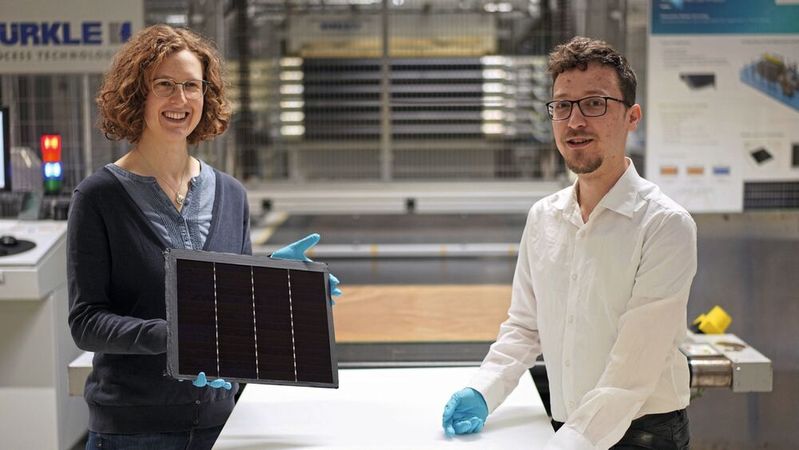
Researchers at Fraunhofer ISE have set two efficiency records for tandem PV modules under laboratory conditions. The III-V germanium module achieved a world record of 34.2%, while a III-V silicon PV module set a new class record with an efficiency of 31.3%.
The III-V germanium PV module with an efficiency of 34.2% is currently the most efficient solar module in the world.
(Image: Jacob Forster)
The Fraunhofer Institute for Solar Energy Systems ISE has set two world records for tandem photovoltaic modules: a III-V germanium module achieved an efficiency of 34.2%, and a III-V silicon module reached 31.3%. Both values significantly exceed the theoretical limit of conventional silicon solar cells. These laboratory results mark an important milestone on the path to highly efficient next-generation solar technologies.
The III-V germanium module, with an area of 129 in² is based on triple-junction III-V cells from AZUR SPACE Solar Power, specifically adapted to the terrestrial solar spectrum. Additionally, antireflective nanostructures from Temicon are used to minimize reflection losses, further increasing efficiency. The second record-breaking module combines III-V materials with silicon over an area of 34 in², achieving an efficiency of 31.3%.
Semiconductor Materials With Different Bandgaps
The physics behind this breakthrough lies in the combination of different semiconductor materials with varying bandgaps. While conventional silicon solar cells are limited to a maximum of 33.2% efficiency by the Shockley-Queisser limit, tandem cells overcome this barrier through their multi-junction design. The III-V materials absorb the visible spectral range with higher energies, while germanium or silicon utilize the infrared range with lower energies. This layer architecture allows for much more efficient use of the entire solar spectrum compared to single-junction solar cells.
Professor Andreas Bett, director of the Fraunhofer ISE, views tandem technologies as an important bridge between cost-effective standard photovoltaic modules and expensive space solar cells. The III-V silicon variant offers a better cost-benefit ratio for terrestrial applications, while III-V germanium modules excel in applications with extreme space constraints. However, both record-breaking modules are still laboratory demonstrators developed in research projects and are not commercially available.
Higher Efficiency And Limited Area
The currently best commercially available solar modules achieve efficiencies of up to 24.8%, meaning the new laboratory values are 1.4 times higher. The tandem modules were developed in the projects Vorfahrt and Mod30plus, which involved the Fraunhofer ISE as well as industry partners such as Azur Space, Temicon, Gochermann Solar, and Audi. The participation of the automobile manufacturer already points to an important target direction: highly efficient solar cells for integration into electric vehicles, where every square centimeter of space must be utilized optimally.
For electronics developers, these advancements open up new design possibilities in the medium term, particularly for space-critical applications. With limited installation space, the higher efficiencies enable more compact system designs, which is especially relevant for electromobility, mobile electronics with solar integration, industrial IoT sensors with energy harvesting, as well as aerospace and satellite applications. Although module costs are higher than standard technologies, system costs can be improved through fewer modules needed per kilowatt, reduced balance-of-system components, and lower installation costs.
Market Readiness Will Take A Few More Years
The path to market maturity will, however, take several more years. III-V semiconductors are extremely expensive and require highly precise manufacturing processes, similar to those in space solar cell technology. In the short term, these modules will therefore first be used in niche markets such as automotive integration or specialized industrial applications before potentially becoming affordable for broader applications with appropriate scaling. As a more cost-effective alternative, other research groups are developing perovskite tandem cells, which are already achieving commercial efficiencies of around 25%.
With the surpassing of the 30 percent mark in module efficiency in the laboratory, tandem photovoltaics is emerging as a forward-looking key technology for the next generation of solar energy systems and demonstrates the enormous potential that lies beyond the physical limits of conventional silicon solar cells. (heh)
Date: 08.12.2025
Naturally, we always handle your personal data responsibly. Any personal data we receive from you is processed in accordance with applicable data protection legislation. For detailed information please see our privacy policy.
Consent to the use of data for promotional purposes
I hereby consent to Vogel Communications Group GmbH & Co. KG, Max-Planck-Str. 7-9, 97082 Würzburg including any affiliated companies according to §§ 15 et seq. AktG (hereafter: Vogel Communications Group) using my e-mail address to send editorial newsletters. A list of all affiliated companies can be found here
Newsletter content may include all products and services of any companies mentioned above, including for example specialist journals and books, events and fairs as well as event-related products and services, print and digital media offers and services such as additional (editorial) newsletters, raffles, lead campaigns, market research both online and offline, specialist webportals and e-learning offers. In case my personal telephone number has also been collected, it may be used for offers of aforementioned products, for services of the companies mentioned above, and market research purposes.
Additionally, my consent also includes the processing of my email address and telephone number for data matching for marketing purposes with select advertising partners such as LinkedIn, Google, and Meta. For this, Vogel Communications Group may transmit said data in hashed form to the advertising partners who then use said data to determine whether I am also a member of the mentioned advertising partner portals. Vogel Communications Group uses this feature for the purposes of re-targeting (up-selling, cross-selling, and customer loyalty), generating so-called look-alike audiences for acquisition of new customers, and as basis for exclusion for on-going advertising campaigns. Further information can be found in section “data matching for marketing purposes”.
In case I access protected data on Internet portals of Vogel Communications Group including any affiliated companies according to §§ 15 et seq. AktG, I need to provide further data in order to register for the access to such content. In return for this free access to editorial content, my data may be used in accordance with this consent for the purposes stated here. This does not apply to data matching for marketing purposes.
Right of revocation
I understand that I can revoke my consent at will. My revocation does not change the lawfulness of data processing that was conducted based on my consent leading up to my revocation. One option to declare my revocation is to use the contact form found at https://contact.vogel.de. In case I no longer wish to receive certain newsletters, I have subscribed to, I can also click on the unsubscribe link included at the end of a newsletter. Further information regarding my right of revocation and the implementation of it as well as the consequences of my revocation can be found in the data protection declaration, section editorial newsletter.



:quality(80)/p7i.vogel.de/wcms/72/a0/72a0ffc94f0929c8b193b4bc40638d72/0129755066v1.jpeg "Tens of billions less! After Ford and General Motors, Stellantis is now also feeling the painful consequences of Donald Trump's decision to change its electric car strategy ... (Image:Stellantis)")
:quality(80)/p7i.vogel.de/wcms/7f/fd/7ffd32863352c40f562f4245e4766e61/0129745849v1.jpeg "After US President Donald Trump once again resorted to his favorite weapon, tariffs, concerns rose in the EU that the so-called tariff deal could become invalid. But it looks as if the sea remains relatively calm ... (Image:F. Schneidler)")
:quality(80)/p7i.vogel.de/wcms/53/69/5369bed136061188d873441dfefd6d6e/0129245111v1.jpeg "The company revised the factory layout even though construction work had already begun. (Image:Efeso Management Consultants)")
:quality(80)/p7i.vogel.de/wcms/d2/d7/d2d79e3fb84663cb7e918c88f123989b/0129733908v1.jpeg "Mineral decision! This is how lithium is mined. There is a lot of it in Chile, Australia, Bolivia and also in Zimbabwe. However, the latter country has now announced that the export of all minerals, including lithium concentrate, will be stopped. Read more about the reasons here ... (Image:Largbatt)")
:quality(80)/p7i.vogel.de/wcms/d9/bd/d9bd1bfa7d02f586e092f06c61ee3d9a/0129464423v1.jpeg "This is what the Black Soldier Fly (BSF) looks like. The first impression is of a common two-winged insect. But appearances are deceptive, because its larvae are true protein reactors, whose industriousness is now to be exploited for food ... (Image:Fly Friends)")
:quality(80)/p7i.vogel.de/wcms/13/4d/134dee0c2b8af6b4f28937ca5b586e0d/0129499541v1.jpeg "The industry now needs to build a flexible, powerful and sovereign infrastructure that can exploit the full potential of artificial intelligence while guaranteeing control over data and processes. (Picture: ©Gorodenkoff - stock.adobe.com)")
:quality(80)/p7i.vogel.de/wcms/c6/71/c671ce338f12be49d39d1b04b40a54f7/0129697443v1.jpeg "Claas is working on making its combine harvesters fit for refurbishment. (Image:Claas)")
:quality(80)/p7i.vogel.de/wcms/f2/4b/f24b8f1c3070e7f13e4f0ffd7854e75a/0129653538v1.jpeg "The production of the BMW iX3 is to be taken as far as possible in terms of sustainability. This is also ensured by the climate-friendly Blueprint recycled steel from Thyssenkrupp Steel ... (Image:BMW)")
:quality(80)/p7i.vogel.de/wcms/f5/7e/f57ef535ee35e7b3b7ff15a8a63cef10/eds-keyvisual-8000x4496v1.jpeg "(Source: European Defence Supply)")
:quality(80)/p7i.vogel.de/wcms/af/a3/afa312176d956068af20491957eef642/newsimage418262-3100x1745v1v1.jpeg "The autonomous shuttle of the Aula AI project during a demonstration of sensor data with artificial fog. (Image:University of Magdeburg)")
:quality(80)/p7i.vogel.de/wcms/84/2d/842d51915fa4fe69c72da5cc4ba52ed1/newsimage418103-3408x1917v1v1.jpeg "3 Printing can also be sustainable—if recyclable ink is used. (Image:Hereon/Steffen Niemann)")
:quality(80)/p7i.vogel.de/wcms/b0/78/b078e07634ffd4d5ee6b73af42cc7c55/newsimage418259-1000x563v1v1.jpeg "Magnesium during forming. (Image:TU Bergakademie Freiberg)")
:quality(80)/p7i.vogel.de/wcms/c7/5e/c75e5942cd1d7e6bce973391af6dafe8/0129757614v1.jpeg "Pony.ai is cooperating with Moore Threads to bring Level 4 autonomous driving to the roads in China more quickly. (Image:Pony.ai)")
:quality(80)/p7i.vogel.de/wcms/a8/9f/a89ff7a3e28a19c03a22fd16cf3404b4/0129761837v1.jpeg "KD and Hitachi High-Tech have concluded a distribution agreement. (Image:KD)")
:quality(80)/p7i.vogel.de/wcms/29/b5/29b536a22d9b5ac80387b02620cce554/20260212-sue-60-6000x3372v1v1.jpeg "The People Mover at its world premiere. The large polycarbonate windshield is clearly visible. One of several materials contributed by Covestro. (Image:UE | STUDIOS)")
:quality(80)/p7i.vogel.de/wcms/a0/3e/a03e71cec3a956df095607a0b176a7b0/0129584071v1.jpeg "Andreas Mindt will be Head of Design at the Volkswagen Group from March. (Image:Volkswagen AG)")
:quality(80)/p7i.vogel.de/wcms/eb/4e/eb4e449562174ec95a5b3d30fb0137a2/0129648135v1.jpeg "The III-V germanium PV module with an efficiency of 34.2% is currently the most efficient solar module in the world. (Image:Jacob Forster)")
:quality(80)/p7i.vogel.de/wcms/92/c2/92c23fd5d95286c8c8c634314f6b22f8/0129722027v1.jpeg "The Meta Group has signed a five-year contract for GPU and CPU deliveries to expand its AI capacities. The agreement covers the delivery of up to 6 gigawatts of GPU computing power with a total value of around USD 60 billion. (Image:freely licensed)")
:quality(80)/p7i.vogel.de/wcms/01/77/017742db7d5eb5964c297bb8917df701/0129696639v1.jpeg "Mini-STX K3921-N: The motherboard masters Intel's Core i3 and N-Series processors and can connect multiple monitors with Full HD. (Image:Kontron)")
:quality(80)/p7i.vogel.de/wcms/17/21/1721b98b7580a86c7790f607395878a1/0129697493v1.jpeg "Universal: Motors are used everywhere. (Image:Microchip Technology)")
:fill(fff,0)/images.vogel.de/vogelonline/companyimg/76800/76895/65.jpg "FAULHABER_120mm.jpg ()")
:fill(fff,0)/p7i.vogel.de/companies/67/eb/67eba621ef6ea/logo2.png "logo2 (Wuxi InfiMotion)")
:quality(80):fill(efefef,0)/p7i.vogel.de/wcms/67/09/67094781dd403/dossier-additive-manufacturing.png "Dossier Additive Manufacturing")
:quality(80)/p7i.vogel.de/wcms/9a/4d/9a4deb8816e5b1c837d3fa541e611aae/0129026074v1.jpeg "Organic PV modules with an improved p/n junction: researchers at Osaka Metropolitan University have developed a special molecule that organizes itself and forms controllable structures. (Image:Fraunhofer ISE)")
:quality(80)/p7i.vogel.de/wcms/2e/62/2e62e5977481169dd2a0301ab847dc2b/0129163687v1.jpeg "Increasing the voltage reduces the cable cross-sections and therefore the copper requirement considerably. (Image:Fraunhofer ISE)")