Tatra Trucks is bringing its engine production up to the latest standards. A production cell with three Heckert HEC 800 machining centers, automated by a pallet system, increases efficiency.
Tatra chose a Fastems FPC3000 system as the automation solution, which initially contains twelve pallet spaces, and in a later stage 18 pallet spaces and a linear conveyor.
(Image: Starrag/Ralf Baumgarten)
Tatra, a car manufacturer from Kopřivnice, Czech Republic, started producing carriages back in 1850 and has been manufacturing automobiles since the end of the 19th century. Today, it is above all the heavy Tatra trucks that impress with their off-road capability, high reliability and outstanding utility properties—even in extreme weather conditions such as frost and desert temperatures.
One of the special features of the vehicles is the Tatra concept: a chassis with a central support tube and individually suspended semi-axles, which makes it possible to mount any number of axles, from 4x4 to 12x12 and more. The direct air-cooled V8 and V12 diesel engines of the Tatra T3 series with supercharging and intake air cooler are also among the USPs.
Production takes place at the headquarters in Kopřivnice in the Czech Republic. The complete chassis for the T158 Phoenix vehicles, which are available with various superstructures such as containers, concrete mixers, tanks and special superstructures, are produced there. Vehicles from the T815-7 Force series are also produced, which are available in both civilian versions (e.g. as fire engines etc.) and military versions. Technology and Process Manager Martin Kappler explains:
We manufacture almost all components for our Force series vehicles ourselves: the complete chassis, cab, engine and transmission.
Martin Kappler, Technology and Process Manager, Tatra
Tatra's production portfolio also includes the Tactic series of medium-sized vehicles, which are designed exclusively for military purposes.
Automated Production Cell Replaces Transfer Line
As far as engine equipment is concerned, Tatra Trucks lets its customers choose from several options. Liquid-cooled engines from proven manufacturers and Tatra's own V8 and V12 engines in various power variants are available. The latter have been manufactured on a transfer line in Kopřivnice since 1980.
Despite its age, the technical condition of this system is still good, but the energy costs are extremely high, as is the consumption of cooling lubricants. We therefore decided to switch engine housing production to a cell with automated machining centers.
Martin Kappler, Technology and Process Manager, Tatra
He also argues that the changeover from V8 to V12 on the transfer line takes a long time, usually several production shifts: "In view of the flexibility required today, the new production cell also scores points in this respect. With our universal device, we are quick to change over and can manufacture each engine housing individually. This makes us much more efficient with the machining centers, even if the pure machining time of a motor housing on the transfer line is shorter."
As a result, the production managers at Tatra Trucks decided in 2024 to order a Heckert HEC 800 from Starrag as the basis for the planned production cell—supplemented by an automation solution in the form of a Fastems FPC3000 system.
A Decision With a History
Tatra replaced an ageing machining center back in 2017. Its original tasks were the milling of base surfaces and the machining of index holes, which are required for clamping and positioning the cast parts in the transfer line. Purchaser Libor Kalíšek recalls: "After comparing several suppliers at the time, we opted for a Heckert HEC 800 as it seemed the most suitable and offered an extended machining spectrum."
Since then, Tatra has been using the Heckert HEC 800 to pre-machine 8 and 12-cylinder engine housings. The lower part of the housing is completely machined in a single operation, including the index holes and all holes for attaching the oil pan.
We also rough the motor housing surfaces on the Heckert HEC 800 and drill holes that cannot be machined on the line. Before we send the pre-machined housing to the transfer line, the motor housing is completely reworked, including the various covers, the pump seat, etc.
Dušan Kelnar, Technologist, Tratra
Dušan Kelnar points out that he and his colleagues have been familiar with the machine manufacturer Starrag and the Heckert centers for a long time: "We bought the first Heckert CWK 630 machine for machining gearbox housings 25 years ago." In the years that followed, Tatra regularly invested in further Heckert machines: two CWK 630s for machining axle housings, three CWK 500s for swing arms and wheel reduction housings and two CWK 500s for components from the Tatra Tactic series. By 2017, three HEC 630 and two HEC 500 machining centers had also replaced other old machines. "We therefore have extensive experience with Heckert machines," emphasizes Kelnar. "These machines have proven themselves thanks to their design, reliability and long-term accuracy."
Production Cell is Expanded Step By Step
The new Heckert HEC 800, which was delivered at the beginning of 2025, is the basis of the production cell that has since been put into operation. The machine has special equipment, including, for example, a travel path extended to 81 inches in the Z axis, an NC axis in the spindle for controlling special tools and a magazine for long tools up to 49 inches.
The cell takes over the complete machining of our 8 and 12-cylinder engine housings and is increasingly replacing the transfer line.
Martin Kappler, Technology and Process Manager, Tatra
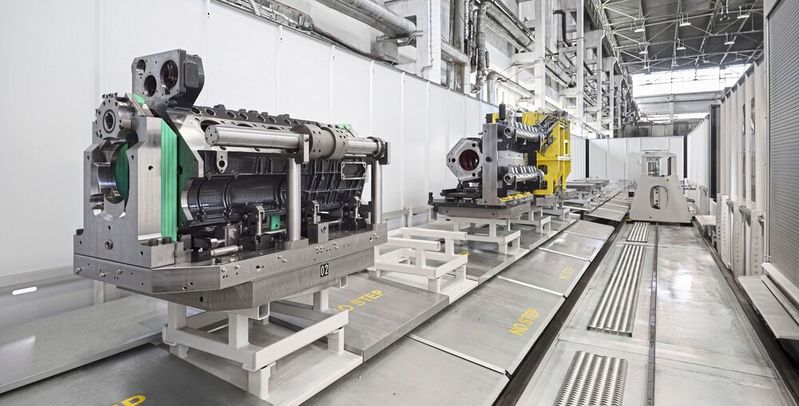
The blanks are cast parts made of Cu-alloyed GG20 cast iron with dimensions of around 47 × 24 × 28 inches and a weight of around 882 pounds. Complete machining is carried out in four clamping operations using special hydraulic clamping devices developed and manufactured by Starrag.
Date: 08.12.2025
Naturally, we always handle your personal data responsibly. Any personal data we receive from you is processed in accordance with applicable data protection legislation. For detailed information please see our privacy policy.
Consent to the use of data for promotional purposes
I hereby consent to Vogel Communications Group GmbH & Co. KG, Max-Planck-Str. 7-9, 97082 Würzburg including any affiliated companies according to §§ 15 et seq. AktG (hereafter: Vogel Communications Group) using my e-mail address to send editorial newsletters. A list of all affiliated companies can be found here
Newsletter content may include all products and services of any companies mentioned above, including for example specialist journals and books, events and fairs as well as event-related products and services, print and digital media offers and services such as additional (editorial) newsletters, raffles, lead campaigns, market research both online and offline, specialist webportals and e-learning offers. In case my personal telephone number has also been collected, it may be used for offers of aforementioned products, for services of the companies mentioned above, and market research purposes.
Additionally, my consent also includes the processing of my email address and telephone number for data matching for marketing purposes with select advertising partners such as LinkedIn, Google, and Meta. For this, Vogel Communications Group may transmit said data in hashed form to the advertising partners who then use said data to determine whether I am also a member of the mentioned advertising partner portals. Vogel Communications Group uses this feature for the purposes of re-targeting (up-selling, cross-selling, and customer loyalty), generating so-called look-alike audiences for acquisition of new customers, and as basis for exclusion for on-going advertising campaigns. Further information can be found in section “data matching for marketing purposes”.
In case I access protected data on Internet portals of Vogel Communications Group including any affiliated companies according to §§ 15 et seq. AktG, I need to provide further data in order to register for the access to such content. In return for this free access to editorial content, my data may be used in accordance with this consent for the purposes stated here. This does not apply to data matching for marketing purposes.
Right of revocation
I understand that I can revoke my consent at will. My revocation does not change the lawfulness of data processing that was conducted based on my consent leading up to my revocation. One option to declare my revocation is to use the contact form found at https://contact.vogel.de. In case I no longer wish to receive certain newsletters, I have subscribed to, I can also click on the unsubscribe link included at the end of a newsletter. Further information regarding my right of revocation and the implementation of it as well as the consequences of my revocation can be found in the data protection declaration, section editorial newsletter.
In a second step, the production cell will soon be expanded to include an identical Heckert HEC 800 machine. And in a third expansion stage, Starrag will integrate the Heckert HEC 800 already installed, which is currently still responsible for the external pre-machining of the cast blanks.
A flexible pallet storage system, consisting of a rack with twelve pallet spaces and a linear conveyor, automates the production cell. The latter transports the pallets between the machines or the machine set-up stations. The pallet storage system will also be expanded as the number of machines grows.
Enormous Increase in Productivity Per Unit Area
Martin Kappler compares the two production systems: "Our transfer line recently had a capacity of around 1,600 units per year, which we are currently only using to half capacity. Our production cell will also reach this number of units in the final expansion stage in two-shift operation, which is important for us. Because we expect demand to grow strongly. If necessary, we can cover a further increase in demand with a third shift."
His enthusiasm for the new production solution is primarily due to its high efficiency. There are several reasons for this, as Kappler emphasizes:
Thanks to automation, our new production cell can be operated by a single employee. Compared to the previous transfer line, the operating costs are many times lower and the production cell takes up just over a quarter of the space at 6,130 square feet.
Martin Kappler, Technology and Process Manager, Tatra
Purchaser Libor Kalíšek, who initiated the purchase of the Heckert HEC 800, has since retired. His successor Tomáš Holčák also praises the cooperation with Starrag: "All offers and negotiations were at a high technical and commercial level. We greatly appreciate the fact that Starrag supplies us with turnkey machines as a fully functional unit comprising machine, tools, fixtures, technologies, testing and handover. The technical support, service and maintenance are also excellent." Based on the positive experience, further projects to modernize and rationalize production are already being planned.



:quality(80)/p7i.vogel.de/wcms/59/62/5962dcf9841ed62b2d7ecf2c129bef61/0130538481v1.jpeg "For the machining of fiber-reinforced plastics (FRP), such as carbon fiber-reinforced (CFRP) and glass fiber-reinforced (GFRP) types, you can't just use any milling cutter. That's why there is the Coromill Plura Composite 2P350 from Sandvik Coromant. (Image:Sandvik Coromant)")
:quality(80)/p7i.vogel.de/wcms/46/af/46afee96b1fdae5653adcbd82b187e06/0130522052v1.jpeg "What you see here is the successful combination of the Lars UPS system from Kraken Robotics and the RD-22 from Sefine. Added to this is the Katfish towed sonar system from Kraken. All in all, this robotic mix is intended to strengthen mine defense. Initial demonstrations have been successful. (Image:Octopus Robotics)")
:quality(80)/p7i.vogel.de/wcms/61/44/61443e99b250115b515e7d9dc7163818/0130460078v1.jpeg "Full halls at TMTS 2026. (Image:VCG/Sonnenberg)")
:quality(80)/p7i.vogel.de/wcms/fb/89/fb890ec01dc3b288d85c3e560dbc6e53/0130440360v1.jpeg "All-in-one machines for the production of long screws: this is what Amba is known for. The company now wants to make even more of this expertise. (Image:Aachen mechanical engineering)")
:quality(80)/p7i.vogel.de/wcms/44/47/44472248cfbd4dc1301fa8fdff3616a5/0130443860v1.jpeg "Siemens has entered into a partnership with the European Space Agency (ESA). It has joined the 'Partnership Initiative for Commercialization' (EPIC) programme, which opens up new opportunities for start-ups from ESA's Business Incubation Centres (ESA BICs). (Image:ESA/NASA/Cities at Night)")
:quality(80)/p7i.vogel.de/wcms/fa/8f/fa8f69dfc822db4f3cf051d12d36b020/0130499198v1.jpeg "(Image:Sensirion)")
:quality(80)/p7i.vogel.de/wcms/1c/03/1c03f177c3f718060fca6b0b8a462813/0130301009v1.jpeg "Dr. Matthias Wick, CTO of Cisco Systems (Switzerland) during his presentation at the asut Lunch Forum on AgenticOps. (Image:Anne Richter, VCG)")
:quality(80)/p7i.vogel.de/wcms/8b/2a/8b2aa1706944495814db6ec30efd5cb2/0129190693v1.jpeg "With sensors for thickness, position, temperature and 3D geometry, Micro-Epsilon enables precise automation. (Picture:Micro-Epsilon)")
:quality(80)/p7i.vogel.de/wcms/14/27/142774c1c27785d56d8ab10131fb648d/adobestock-844361487--c2-a9-20jk-kyoto-20-e2-80-93-20stock-adobe-com-ki-generiertv1.jpeg "Large-scale or rapidly growing IoT scenarios in factory automation can often only be implemented using conventional cabling with considerable infrastructure costs. Wireless technologies can offer great added value when used in a complementary and sensible way. (Source: © JK_kyoto - stock.adobe.com / AI-generated)")
:quality(80)/p7i.vogel.de/wcms/3d/bf/3dbfb672adb0446d40669e6403baf3b6/adobestock-1421003638--c2-a9-20tenpixels-20--20stock-adobe-comv1.jpeg "Many processes in design and development are undergoing change. PLM solutions ensure greater efficiency thanks to transparency and data consistency. (Source: © TenPixels - stock.adobe.com)")
:quality(80)/p7i.vogel.de/wcms/b7/36/b736dfebc16c42d6901d0d0e1f390493/3d-druck-20factory-20--20ki-20generiert-1920x1079v1.png "(Source: AI-generated)")
:quality(80)/p7i.vogel.de/wcms/79/b2/79b21aad663f4a7bd4472afc1c1afc62/0130433994v1.jpeg "Mission Joyride: The free-flying robot (shown here in the rendering) will relieve the ISS crew of logistics tasks from 2027 with its two mechanical arms. (Image:Icarus Robotics)")
:quality(80)/p7i.vogel.de/wcms/f4/5e/f45e28d870cfed508b8d5dd520fb27f2/0130504498v1.jpeg "Mercedes has given the GLS a facelift (Image:Mercedes)")
:quality(80)/p7i.vogel.de/wcms/42/19/4219735a4602950073b3f8492fd20a4c/0130476518v1.jpeg "An e-paper screen is invisibly integrated into the interior door trim. Marquardt, Covestro and E Ink worked together on the concept. (Image:Covestro)")
:quality(80)/p7i.vogel.de/wcms/13/23/1323ce113841ece5e51dd055f9e1f088/0130524198v1.jpeg "Thanks to invisible sensors installed behind the display, it is possible to detect whether the driver is tired or distracted while driving, for example. (Image:Aumovio)")
:quality(80)/p7i.vogel.de/wcms/9c/fc/9cfcfad5d96b849179e39c2999f2ff2f/0130534276v1.jpeg "More recycling for sustainable cell-to-pack battery systems is the aim of the Difference research project. (Image:Fraunhofer IPA)")
:quality(80)/p7i.vogel.de/wcms/c0/37/c0372a27e362d2108e114ea045fdb2e8/0130532716v1.jpeg "Robot density: South Korea leads by a wide margin. Germany in third place. (Image:IFR)")
:quality(80)/p7i.vogel.de/wcms/aa/0d/aa0df5652cc37cfd8b6c3601c92c1f4c/0130519149v1.jpeg "The GQA2W024A050V-007-R converter is available in multiple housing configurations to give developers maximum flexibility for their overall housing design and converter cooling. (Image:TDK Lambda)")
:quality(80)/p7i.vogel.de/wcms/34/b4/34b4fe3e34f655aa3b0e3e6bfb83fde4/0130526171v1.jpeg "Private networks: Siemens expands its private 5G infrastructure to the USA and seven other countries (Image:Siemens AG)")
:quality(80)/p7i.vogel.de/wcms/8d/fe/8dfe4efea68edaaa40058dfea8f3da2f/0130519880v1.jpeg "Chip giant Intel has made gains on the US stock market, according to reports today. This is actually unusual for the current state of affairs. There is also news that Intel wants to get involved in Elon Musk's Terafab project ... (Image:Chipcheck)")
:fill(fff,0)/images.vogel.de/vogelonline/companyimg/76800/76895/65.jpg "FAULHABER_120mm.jpg ()")
:quality(80)/p7i.vogel.de/wcms/a0/4c/a04cf4843e90651091c80014bf18ddab/0128312646v1.jpeg "Tatra trucks impress with their off-road capability, high reliability and outstanding utility properties.(Image: Starrag/Ralf Baumgarten)")
:quality(80)/p7i.vogel.de/wcms/2c/65/2c659e5115e26325dd5d2fa2effafc03/0128312643v1.jpeg "In addition to the 180 tools in the two magazine towers, the spindle can also access tools with a length of up to 1,250 millimetres.(Image: Starrag/Ralf Baumgarten)")
:quality(80)/p7i.vogel.de/wcms/e2/f1/e2f18f7da3cad9b0662e2b5f45e04bc8/0128311633v1.jpeg "Tatra's own V8 and V12 engines are built in Kopřivnice in various power variants.(Image: Starrag/Ralf Baumgarten)")
:quality(80)/p7i.vogel.de/wcms/4a/fc/4afc2e06e9a87f6046329a2096f622e7/0128312084v1.jpeg "Two operating stations are used for exchanging parts between the individual operations and for loading castings and removing finished parts.(Image: Starrag/Ralf Baumgarten)")
:quality(80):fill(efefef,0)/p7i.vogel.de/wcms/65/a6/65a67ff3b25de/etmm-smart-factory.png "ETMM Smart Factory")
:quality(80)/p7i.vogel.de/wcms/8b/c7/8bc7380a7e8dc5dcb9d7337383e93e46/0127912129v1.jpeg "For the second machining step, the thin-walled component is moved into the gap between the inner and outer tool. (Image:Mapal)")
:quality(80)/p7i.vogel.de/wcms/19/32/193281d281e697f7e7ed1e59beebbc8a/0127912129v1.jpeg "For the second processing step, the thin-walled component is moved into the gap between the inner and outer tool. (Image:Mapal)")