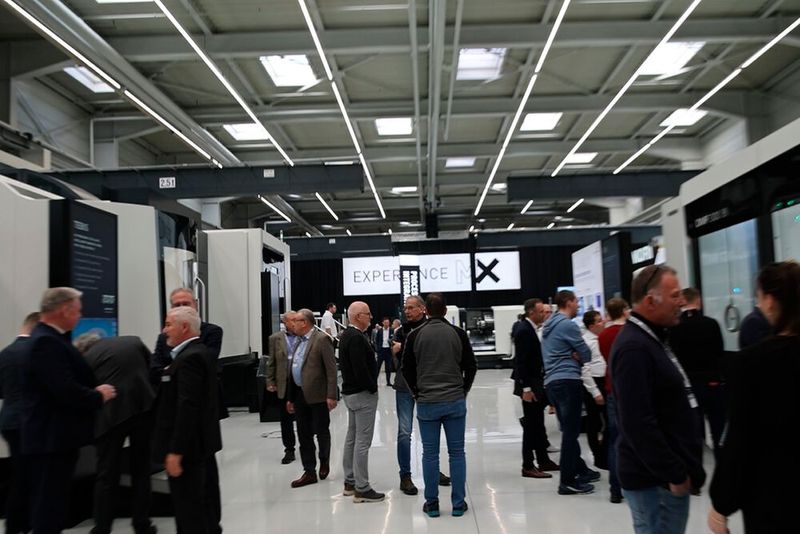
For many machining professionals, the in-house exhibition of DMG Mori in Pfronten (Germany) is the first event of the year. On its 30th anniversary, the event is themed "Machining Transformation Strategy."
Around 6,000 trade visitors are expected by those responsible at DMG Mori for the 30th anniversary of their in-house exhibition.
(Image: Maschinenmarkt)
The plant in Pfronten (Germany), which is now part of DMG Mori, opened its doors for the first time 30 years ago for an in-house exhibition. Today, this event has a permanent place in the schedules of many machining companies. A lot of practical knowledge and numerous technical innovations attract many trade visitors to the Ostallgäu region (County in Bavaria, Germany) every year.
Wide range of exhibits
Under the term "Machining Transformation Strategy," the company showcases its vision for the future of metalworking. Additionally, the world's largest machine tool manufacturer presents five exclusive world premieres—ranging from the highly rigid CTX 750|1250 universal turning machine for 6-sided complete machining, an ultrasonic-assisted 5-axis machine for high precision, and two robust entry-level 5-axis vertical machining centers to the new generation of a proven 5-axis universal machine. This is the range of innovations presented at the in-house exhibition.
All these innovations support DMG Mori's Machining Transformation approach as a window into fascinating possibilities. At its core, it is about an optimal connection of people, machines, technologies, automation, and digitization. With this, the machine manufacturer aims to provide a comprehensive approach to optimizing process chains, increasing productivity, and promoting sustainability.
High-rigidity universal lathe
One of the world premieres presented is the highly rigid CTX 750|1250 universal turning machine—the novelty that represents the sixth generation of the CTX universal turning machine series, promising users top performance and precision thanks to 6-sided complete machining. The machine combines high performance with excellent precision and energy efficiency. It is built very compactly, offering users a workspace on just 11.7 m² (approx. 14 sq yd) that can accommodate workpieces with a diameter of up to 700 mm (approx. 27,5 inches) and a length of up to 1290 mm (approx. 50,7 inches).
Machining Transformation is based on four essential pillars: process integration, automation, digitalization, and green transformation.
Cornelius Nöß, Managing Director in Pfronten (Germany) at DMG Mori
The machine is equipped with powerful spindles on both the right and left sides. It can be optionally fitted with a Y-axis offering a +/- 85 mm travel range (approx. +/- 3,3 inch travel range) and provides driven tools with up to 6000 rpm. Thanks to the integrated processes, it enables productive and highly precise 6-sided complete machining of complex geometries. With its highly rigid machine concept, linear guides up to 55 mm wide (approx. 2,2 inches wide), comprehensive cooling measures, and direct measuring systems from Magnescale, the CTX 750|1250 can achieve positioning accuracies of 6 µm and 12", according to the manufacturer.
Ultrasonic-assisted machining center
Another world premiere is the ultrasonic-assisted machining center Ultrasonic 20 linear in its 3rd generation—according to the tool manufacturer's officials, the most precise 5-axis machine from DMG Mori. The new machine for ultrasonic-assisted grinding has been completely redesigned. The developers benefited from the experience of 600 installed predecessors. The high positioning accuracies of 3 µm in the linear axes and 3" in the swivel axis reportedly surpass even the µPrecision technology, according to the manufacturer.
Strategy
Machining Transformation (MX) embodies the integration of new technologies, thoughtful automation, and digital tools to revolutionize the manufacturing industry. With Machining Transformation (MX), users are expected to optimize their manufacturing processes, enhance their efficiency, make optimal use of their machines, and unlock new possibilities in the world of manufacturing.
Supported by Ultrasonic technology, DMG Mori's most precise 5-axis simultaneous machining center is designed to enable ultrasonic-assisted milling and optionally grinding of advanced materials such as glass, ceramics, and challenging composites for the semiconductor industry. The ultrasonic overlay of the tool rotation with amplitudes of up to 15 µm promises a 50 percent reduction in process forces. This allows for higher feed rates, improved surface quality, and longer tool life, depending on requirements.
Universal machining centers for a wide range of components
Two other world premieres presented for the first time at the in-house exhibition are the universal machining centers DMX 60 U and DMX 80 U. The machines are based on the proven and robust design of the three-axis DMV vertical milling machines. The developers at DMG Mori have adapted the concept for the DMX 60 U and DMX 80 U for five-sided machining of complex workpieces weighing up to 300 and 350 kg, respectively. The DMX 60 U offers travel paths of 600 x 600 x 510 mm (approx. 24 x 24 x 20 inches), while the DMX 80 U provides 800 x 600 x 510 mm (approx. 31 x 24 x 20 inches). With this, the two new universal machining centers are intended to be suitable for a wide range of components in general mechanical engineering, tool and mold making, as well as other demanding industries.
Date: 08.12.2025
Naturally, we always handle your personal data responsibly. Any personal data we receive from you is processed in accordance with applicable data protection legislation. For detailed information please see our privacy policy.
Consent to the use of data for promotional purposes
I hereby consent to Vogel Communications Group GmbH & Co. KG, Max-Planck-Str. 7-9, 97082 Würzburg including any affiliated companies according to §§ 15 et seq. AktG (hereafter: Vogel Communications Group) using my e-mail address to send editorial newsletters. A list of all affiliated companies can be found here
Newsletter content may include all products and services of any companies mentioned above, including for example specialist journals and books, events and fairs as well as event-related products and services, print and digital media offers and services such as additional (editorial) newsletters, raffles, lead campaigns, market research both online and offline, specialist webportals and e-learning offers. In case my personal telephone number has also been collected, it may be used for offers of aforementioned products, for services of the companies mentioned above, and market research purposes.
Additionally, my consent also includes the processing of my email address and telephone number for data matching for marketing purposes with select advertising partners such as LinkedIn, Google, and Meta. For this, Vogel Communications Group may transmit said data in hashed form to the advertising partners who then use said data to determine whether I am also a member of the mentioned advertising partner portals. Vogel Communications Group uses this feature for the purposes of re-targeting (up-selling, cross-selling, and customer loyalty), generating so-called look-alike audiences for acquisition of new customers, and as basis for exclusion for on-going advertising campaigns. Further information can be found in section “data matching for marketing purposes”.
In case I access protected data on Internet portals of Vogel Communications Group including any affiliated companies according to §§ 15 et seq. AktG, I need to provide further data in order to register for the access to such content. In return for this free access to editorial content, my data may be used in accordance with this consent for the purposes stated here. This does not apply to data matching for marketing purposes.
Right of revocation
I understand that I can revoke my consent at will. My revocation does not change the lawfulness of data processing that was conducted based on my consent leading up to my revocation. One option to declare my revocation is to use the contact form found at https://contact.vogel.de. In case I no longer wish to receive certain newsletters, I have subscribed to, I can also click on the unsubscribe link included at the end of a newsletter. Further information regarding my right of revocation and the implementation of it as well as the consequences of my revocation can be found in the data protection declaration, section editorial newsletter.
The foundation for high precision requirements is laid by the monolithic machine bed made from solid cast components and the wide roller guides. These ensure that the DMX-U machines have 45 percent higher rigidity compared to the previous series. This allows for dynamic machining with rapid traverses of up to 42 m/min (approx. 138 ft/min). With sophisticated temperature compensation measures, the developers achieve high thermal stability in the machines. Additionally, direct measuring systems and direct drives in the X and Y axes enable high positioning accuracy. DMG Mori specifies the roundness accuracy at 6 µm.
Our users need to continue evolving to remain sustainably competitive.
Cornelius Nöß, Managing Director in Pfronten (Germany) at DMG Mori
With its fifth new introduction, the machine tool manufacturer aims to set new standards in 5-axis universal machining. The DMU 60 eVo of the 2nd generation is intended to excel, particularly in precision and productivity. The engineers at DMG Mori expanded the concept with its special table kinematics to include the ability to integrate machining processes such as mill-turning, gear milling, and grinding processes. This process integration extends the machine into a multifunctional machining solution, allowing users to respond flexibly to a wide variety of workpieces, materials, and increasing demands. With automation tailored to the users' needs, spindle run times can be optimized, making the machine's hourly rates more economical.
Machining Transformation Strategy
Although each of these world premieres is already a good step towards optimized process chains, higher productivity, and more sustainability on its own, the innovations only reveal their full potential when integrated into a "Machining Transformation Strategy." What lies behind this?
We aim to provide maximum support to users with our technological expertise and our specialists.
Cornelius Nöß, Managing Director in Pfronten (Germany) at DMG Mori
"Our Machining Transformation Strategy is based on four key pillars: process integration, automation, digitization, and green transformation," explains Cornelius Nöß, Managing Director at DMG Mori in Pfronten (Germany). "We believe our users will need to transform. They must continue to develop to remain sustainably competitive. And we want to provide maximum support with our guiding principle of 'Machining Transformation'."
Process integration is based on 5-axis technology
One of the pillars of the Machining Transformation Strategy is process integration. "It is generally based on 5-axis technology—essentially, it is about trying to integrate as many manufacturing processes as possible into one machine or system. For example, as turn-mill centers or mill-turn centers. Additional technologies can be integrated, such as gear machining, in-process measurement, grinding on the machines, and much more." It is the attempt to pack as much as possible into one machine to complete parts as extensively as possible on a single machine in just a few setups.
Falling quantities are one of the challenges we must face.
Cornelius Nöß, Managing Director in Pfronten (Germany) at DMG Mori
Another pillar is automation—especially challenging in times of decreasing batch sizes down to lot size one. "We have to address this," emphasizes Nöß. "For example, by trying to make automation as flexible as possible for our users, so that they can manufacture automated down to actual lot size one. For instance, with modular concepts that we offer our users, where it's not about the last tenth of a second, but rather about process stability, about spindle run time. It's about keeping the machines running 24/7 around the clock."
Sustainability creates competitiveness
The third pillar, "Green Transformation," revolves around sustainability. "This is important for all of us. In our society in general, but it is also an important topic for our users," explains Nöß. "It's not about a company attaching a green label to itself. It's rather about saving energy, reducing costs in manufacturing, and producing sustainably overall." According to Nöß, this also goes hand in hand with making users competitive. For instance, if they can save up to 30 percent energy and thereby reduce operating costs on the machines: "The goal is, of course, to achieve savings with at least the same performance and, accordingly, manufacture more productively at lower costs."
The goal, of course, is to achieve savings with at least the same performance and accordingly produce more productively at lower costs.
Cornelius Nöß, Managing Director in Pfronten (Germany) at DMG Mori
The last point is "Digital Transformation"—it makes operating the machines more attractive and easier for users and increases process security. "Additionally, it's about making machining itself and the manufacturing industry more attractive for young employees. With Celos X, we have created a platform that allows our controls to be operated app-based. It also simplifies operation for our users, addressing the skills shortage. But it's also about making the machines generally attractive."
Integrate existing solutions
Typically, companies have grown organically, and it's not just new DMG machines present in operations. "Here, we offer appropriate retrofit solutions for existing machines and also integrate third-party machines," adds Nöß. "For instance, through DMG Mori Messenger solutions, which allow users to query the status of machines. We try to raise awareness among users to retrofit where it makes sense and is possible."
In machine transformation, the most important thing is to start and get going—regardless of which topic.
Cornelius Nöß, Managing Director in Pfronten (Germany) at DMG Mori
Furthermore, DMG Mori now prepares its machines for automation as a standard from the factory. In many cases, automation interfaces are already present in the standard to simplify retrofitting when users take the next steps. "In Machine Transformation, the most important thing is to start and get going—no matter which topic," emphasizes Nöß. "But it's crucial to get moving and shape the future. Our specialists can provide effective support. We have the corresponding expertise to advise each user accordingly and offer them the right solution. One that is tailored to fit them perfectly. We want to provide maximum support to users with our technology expertise and our specialists."
Latest trends and developments in metal cutting
In addition to the exhibits from DMG Mori and numerous co-exhibitors, visitors will find plenty of opportunities to learn about the latest trends and developments in metal cutting. The exchange among professionals is also well catered for. Furthermore, the machine manufacturer invites school classes to its in-house exhibition—the youth of today are the future of the industry. The exhibition presents itself as a modern, innovative, and interesting employer for the creative minds of tomorrow.



:quality(80)/p7i.vogel.de/wcms/a0/47/a04725ef9bd09fb6c9341a1bea1b5d93/0130443083v1.jpeg "Here, a type of plastic pallet is produced by thermoforming (vacuum forming or deep drawing) at the corresponding division of New England Plastics in the USA. This division, which specializes in so-called liners, is now part of Ringmetall ... (Image:New England Plastics)")
:quality(80)/p7i.vogel.de/wcms/23/99/23992bf2dcdc432c9b7209c34a4a7c48/0129733089v1.jpeg "Stork relies on the modular Neoswiss turning system from Iscar to shorten the set-up times for its sliding headstock lathes and work more productively. (Image:Iscar)")
:quality(80)/p7i.vogel.de/wcms/7d/e2/7de2923434b2f1a78ba5482d8d335269/0113143253v1.jpeg "In our China Market Insider we regularly provide you with relevant information directly from China. (Image:© Eisenhans - stock.adobe.com)")
:quality(80)/p7i.vogel.de/wcms/9d/2b/9d2b802f800e5caf17b2831e74228cd3/screenshot-202026-03-03-20103822-609x343v1v1.png "Visual comparison: on the left, a clean, burr-free cut edge; on the right, typical burr formation with oxidation discoloration. This illustrates how strongly parameter control and gas management influence the quality of the result. (CO₂ laser, oxygen cutting gas, sheet thickness approx. 15 mm). (Image:Picture: Rime)")
:quality(80)/p7i.vogel.de/wcms/b7/36/b736dfebc16c42d6901d0d0e1f390493/3d-druck-20factory-20--20ki-20generiert-1920x1079v1.png "(Source: AI-generated)")
:quality(80)/p7i.vogel.de/wcms/79/b2/79b21aad663f4a7bd4472afc1c1afc62/0130433994v1.jpeg "Mission Joyride: The free-flying robot (shown here in the rendering) will relieve the ISS crew of logistics tasks from 2027 with its two mechanical arms. (Image:Icarus Robotics)")
:quality(80)/p7i.vogel.de/wcms/6b/45/6b4546fa6ebf305c3660326909363f32/0130437089v1.jpeg "Industrial AI in action: Rockwell Automation presents practical solutions for self-controlling production systems at the Hannover Messe. (Image:Rainer Jensen, Deutsche Messe)")
:quality(80)/p7i.vogel.de/wcms/78/e9/78e9188c25a8a94e67c34c9bf8ffe495/visual-agile-20robots-20and-20google-20deepmind-20partner-20to-20bring-20intelligence-20to-20robotics-2500x1406v1v1.jpeg "Together, the partners are developing adaptable, intelligent robots for a wide range of applications (Image:Agile Robots SE)")
:quality(80)/p7i.vogel.de/wcms/59/a2/59a2b11f0aa1b700eff02addd5de8703/adobestock-1788280853--c2-a9-20satria-20-e2-80-93-20stock-adobe-com-5081x2860v1v1.jpeg "Quantum computers require extreme cooling to temperatures close to absolute zero in order to keep qubits stable. (Image:satria - stock.adobe.com)")
:quality(80)/p7i.vogel.de/wcms/49/38/493876a248943456b7e4a6db6edfc454/0130230765v1.jpeg "Safe and reliable in aircraft construction: light-curing adhesive bond combined with universal fastening elements. (Source: Delo)")
:quality(80)/p7i.vogel.de/wcms/b5/c7/b5c749d16c8a2e789c1469c2c8c1c387/0130452780v1.jpeg "Volvo Trucks completes road tests with its new hydrogen-powered trucks. (Image:Volvo Trucks)")
:quality(80)/p7i.vogel.de/wcms/ba/69/ba6975f417a85147084f38dc2cd209e2/0130451386v1.jpeg "Together with Nvidia, Hyundai wants to develop an architecture that will be used for level 4 robotaxis (image) as well as for level 2 customer vehicles. (Image:Hyundai)")
:quality(80)/p7i.vogel.de/wcms/93/4d/934de334b47abaa526c78cba1417d7af/0130343495v1.jpeg "The new SU7 is available in three price categories, \"Standard\", \"Pro\" and \"Max\" (Image:Xiaomi)")
:quality(80)/p7i.vogel.de/wcms/df/a0/dfa048434bb94f1b7d030e346b25b3ae/0130373541v1.jpeg "From August, BMW will be producing the i3 at its main plant in Munich - which the car manufacturer has extensively rebuilt for this purpose. (Image:Rainer Haeckl)")
:quality(80)/p7i.vogel.de/wcms/ee/09/ee09acbd6dc896df25affaa9e871e6e5/0130440053v1.jpeg "IMS chip module for simple system integration into an ion mobility spectrometer. (Image:Fraunhofer IPMS)")
:quality(80)/p7i.vogel.de/wcms/10/6c/106cd22de5f68a0f74639d654827228c/0130345302v1.jpeg "Made in India: According to the India Electronics and Semiconductor Association (IESA), the country should be able to produce between 75 and 80 million chips by the beginning of 2027, once the plants currently under construction become operational. (Image:Pixabay (Montage: Sebastian Gerstl))")
:quality(80)/p7i.vogel.de/wcms/a5/ed/a5ed6fda029d362732a293d6b19d74c4/0130444216v1.jpeg "Thirteen executives from the Chinese chip industry have drawn up a plan to achieve an 80% self-sufficiency rate for semiconductors by 2030. (Image:Maxim_Kazmin - stock.adobe.com)")
:quality(80)/p7i.vogel.de/wcms/31/a6/31a646018b34d8e0a44bfc8bf17837f6/0130361632v1.jpeg "For many companies, PFAS are considered indispensable in electronics production. (Image:freely licensed)")
:fill(fff,0)/images.vogel.de/vogelonline/companyimg/76800/76895/65.jpg "FAULHABER_120mm.jpg ()")
:quality(80)/p7i.vogel.de/wcms/1e/b0/1eb00bd4c30fd21002d5c371a1abbcc8/0123111059v1.jpeg "Unmanned production: Workpieces are automatically transported between machines. This is intended to ensure optimal utilization of resources.(Image: Maschinenmarkt)")
:quality(80)/p7i.vogel.de/wcms/9d/a4/9da4b6c58a924e24f4bafa0454ab8d0b/0123111056v1.jpeg "In the Ultrasonic 20 linear 3rd generation, the spindle features an ultrasonic actuator, which enables not only milling and drilling but also ultrasonic-assisted grinding.(Image: DMG Mori)")
:quality(80)/p7i.vogel.de/wcms/dd/a1/dda16afe35db51621a4f1eca221811ff/0123111003v1.jpeg "Another world premiere: The new Ultrasonic 20 linear 3rd generation, as a variant for ultrasonic-assisted grinding, is a sign that DMG Mori is also further developing proven technologies with a high level of innovative power.(Image: Maschinenmarkt)")
:quality(80)/p7i.vogel.de/wcms/18/8a/188a1069f3c9e50291963ee453d6d683/0123110934v1.jpeg "Cornelius Nöß, Managing Director at DMG Mori in Pfronten: \"Our Machining Transformation Strategy is based on four key pillars: process integration, automation, digitization, and green transformation. Our users will need to transform. They need to continue developing to remain sustainably competitive. And we want to provide maximum support with our guiding principle of Machining Transformation.\"(Image: Maschinenmarkt)")
:quality(80):fill(efefef,0)/p7i.vogel.de/wcms/67/ad/67adf4a647532/elatec-wp-machine-authentication.png "Elatec WP Machine Authentication")
:quality(80)/p7i.vogel.de/wcms/8b/6a/8b6aad613a795da69f6c0420e880dff0/0124318861v1.jpeg "Manufacturing of a single blade on a Grob machine tool of the G series, with a counter bearing in the upper area. (Image:www.christianschneider.photography)")
:quality(80)/p7i.vogel.de/wcms/22/b6/22b66d616d209a9770d6f3aed6a80cde/0125849429v1.jpeg "On display at EMO 2025: The Heller 5-axis machining center HF 3500. It is characterized by table kinematics with standard counter bearings as well as high dynamics and short auxiliary times. (Image:Heller)")