During an air show, two eVTOL air taxis collide – one passenger is injured. Yet China remains unwavering in the 190-billion-euro market.
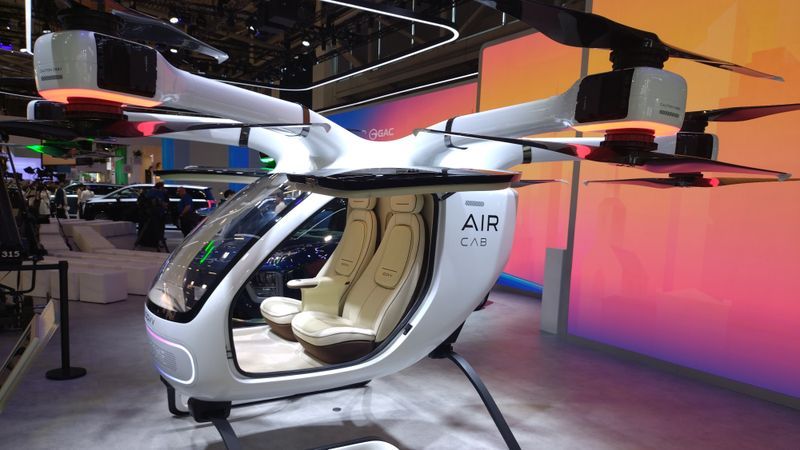
An air taxi (“eVTOL”) by the car manufacturer GAC at the IAA Mobility 2025 in Munich.
(Image: Sven Prawitz/VCG)
It was the first collision of two air taxis. On September 16, 2025, during an air show, two eVTOLs (electric vertical take-off and landing) of the AeroHT brand by Xpeng collided in mid-air. One of them crashed and burst into flames. A passenger had to be hospitalized with injuries but was not in life-threatening condition, according to Chinese media reports.
Although this accident occurred during the "Changchun Airshow," and not during regular operations, it has reignited the debate about the safety of the "low-altitude economy" in China. Commentators are calling it a "wake-up call."
A video of the crash went viral on China's social media. It was followed by much ridicule. "Sort things out on the ground first before you go to the sky, that's better for everyone," one user remarked. "New technology always comes at a price," read a comment on the portal Hangzhou Wang. For the industry, the call now is to guide the young sector's ascent "from frenzy to reason."
eVTOL industry as a state key project
However, no one expects the accident to significantly slow down the rapid rise of the Advanced Air Mobility sector in the People's Republic. This is due to, on the one hand, strong state support for the development of this new economic sector, and on the other hand, the many investments in the industry.
The central government had officially declared the development of eVTOLs for passenger operations and parcel delivery a "key project" just last year. In the 2024 government report, the low-altitude economy was explicitly mentioned for the first time, after it had already been addressed at the 20th Congress of the Communist Party leadership.
Six pilot cities
Accordingly, there are numerous local projects across the country. Six cities, including Hefei, Hangzhou, and Shenzhen, are officially supported as pilot cities for air taxis and flight drones by the Civil Aviation Commission in Beijing.
Corridors for deliveries
Each of these locations is now testing its own scenarios. Hefei has launched pilot projects for eVTOL passenger routes, Hangzhou is establishing delivery corridors for drones, and Shenzhen is enabling its taxi company Meituan to conduct citywide delivery flights by drone. More than 30 provinces and cities have since incorporated the topic into their development programs.
Legislation is also advancing rapidly. At the end of 2024, the Ministry of Transport and CAAC jointly proposed a draft amendment to civil aviation legislation to provide nationwide legal backing for the new low-altitude economy.
Local laws regulate the industry
At the local level, regions are enacting supporting regulations. For example, on March 1, 2025, a new ordinance came into effect in Guangzhou, preparing cities for vertiports, infrastructure, and the promotion of the new aviation economy.
Hangzhou is developing its own rules for licensing, launch sites, and emergency management in low airspace as the first city. Shenzhen has passed a special law to promote intra-city and inter-city routes for eVTOL passenger and cargo transport.
Industry receives ten billion in new capital
All these political decisions are beginning to show results. 2024 was celebrated in China's trade media as the "first year of the low-altitude era."
The strong support from government circles is encouraging more and more investors to invest in the production of eVTOLs. In the first half of 2025, China recorded nearly 100 new funding rounds in the low-altitude sector with a total of over 75 billion yuan in fresh capital (approx. 9.5 billion euros).
Funding creates supplier ecosystem
More and more start-ups and tech investors intend to join in. The CAAC estimates the total volume of the Low-Altitude Economy for 2025 at around 1.5 trillion yuan, approximately 190 billion euros. This would already be a tripling compared to 2023, when the total value amounted to about 64 billion euros.
This sector in China includes eVTOLs as air taxis, drones in logistics, helicopters and small aircraft for regional transport, the construction of "vertiports" and other infrastructure, as well as the entire supply industry for components such as batteries, electric motors, or flight control systems.
Industry with million-dollar revenues
By 2035, this entire new market is expected to grow to approximately 3.5 trillion yuan. However, the eVTOL aircraft segment is clearly developing particularly rapidly.
In 2023, eVTOLs in China already generated nearly one billion yuan in revenue (approximately 120 million euros), an increase of 77 percent compared to the previous year. Experts predict that the eVTOL sector could grow to nearly ten billion yuan by 2026.
Date: 08.12.2025
Naturally, we always handle your personal data responsibly. Any personal data we receive from you is processed in accordance with applicable data protection legislation. For detailed information please see our privacy policy.
Consent to the use of data for promotional purposes
I hereby consent to Vogel Communications Group GmbH & Co. KG, Max-Planck-Str. 7-9, 97082 Würzburg including any affiliated companies according to §§ 15 et seq. AktG (hereafter: Vogel Communications Group) using my e-mail address to send editorial newsletters. A list of all affiliated companies can be found here
Newsletter content may include all products and services of any companies mentioned above, including for example specialist journals and books, events and fairs as well as event-related products and services, print and digital media offers and services such as additional (editorial) newsletters, raffles, lead campaigns, market research both online and offline, specialist webportals and e-learning offers. In case my personal telephone number has also been collected, it may be used for offers of aforementioned products, for services of the companies mentioned above, and market research purposes.
Additionally, my consent also includes the processing of my email address and telephone number for data matching for marketing purposes with select advertising partners such as LinkedIn, Google, and Meta. For this, Vogel Communications Group may transmit said data in hashed form to the advertising partners who then use said data to determine whether I am also a member of the mentioned advertising partner portals. Vogel Communications Group uses this feature for the purposes of re-targeting (up-selling, cross-selling, and customer loyalty), generating so-called look-alike audiences for acquisition of new customers, and as basis for exclusion for on-going advertising campaigns. Further information can be found in section “data matching for marketing purposes”.
In case I access protected data on Internet portals of Vogel Communications Group including any affiliated companies according to §§ 15 et seq. AktG, I need to provide further data in order to register for the access to such content. In return for this free access to editorial content, my data may be used in accordance with this consent for the purposes stated here. This does not apply to data matching for marketing purposes.
Right of revocation
I understand that I can revoke my consent at will. My revocation does not change the lawfulness of data processing that was conducted based on my consent leading up to my revocation. One option to declare my revocation is to use the contact form found at https://contact.vogel.de. In case I no longer wish to receive certain newsletters, I have subscribed to, I can also click on the unsubscribe link included at the end of a newsletter. Further information regarding my right of revocation and the implementation of it as well as the consequences of my revocation can be found in the data protection declaration, section editorial newsletter.
Yang Jincai, chairman of a drone association, called 2025 the "founding year" for eVTOL and anticipates a "very active development phase" over the next five years.
Xpeng AeroHT as a pioneer
Xpeng AeroHT, a subsidiary of the electric car manufacturer Xpeng, is particularly active. In November, the company presented its first model, a "Land Aircraft Carrier," at an air show. It was precisely this model that recently crashed at the air show in Changchun.
In the middle of this year, just shortly before the accident, the start-up secured funding rounds totaling over 750 million dollars. It is currently building a factory in the Greater Guangzhou area with a capacity for 10,000 eVTOLs per year.
EHang with approval success
Another pioneer in the industry is EHang from Guangzhou. The company, founded in 2014, has built a two-seater, autonomously flying passenger drone model (EH216). It is successfully working to secure approvals from authorities.
At the end of 2023, EHang became the first company to be awarded a type certificate for an autonomous eVTOL. Later, the company also received a production license for its EH216. The eVTOL is already being produced in small series, for example, for providers of tourist flights that have placed large orders.
This brief overview of the current status shows that the low-altitude economy will very likely remain an important future project for China's authorities and companies despite the unfortunate accident. However, insiders expect there will be more regulations on flight safety, which is generally welcomed.



:quality(80)/p7i.vogel.de/wcms/35/57/3557c819943c53acec41a0ccba87da4f/0130049064v1.jpeg "Researchers at the Fraunhofer IWU in Chemnitz have long known that many typical sheet metal parts can be manufactured more cost-effectively using hollow embossing rollers. Now there is news to report ... (Image:Fraunhofer IWU)")
:quality(80)/p7i.vogel.de/wcms/77/9b/779b0685d010dfe45c9c2cb1cfecd467/0128886425v1.jpeg "The BlueEye is the first \"real\" hyperspectral camera for the UV range and covers the wavelength range from 220 to 380nm. (Image:Inno-spec GmbH)")
:quality(80)/p7i.vogel.de/wcms/73/60/73608418789b1d9c393f5e2fa974eda2/0130209906v1.jpeg "The robots of the X6 generation from b+m enable very high painting quality and are also particularly compact and easy to maintain. (Image:Beckhoff)")
:quality(80)/p7i.vogel.de/wcms/82/90/8290dfe3595b6c6b33726ae8b76172c7/0130319587v1.jpeg "The concept image illustrates how the pattern of tiny protrusions and depressions created on the substrate (MgO, bottom) controls the arrangement of atoms in the superconducting material (YBCO, top). At the interface between the two layers, an electronic structure enables superconductivity to occur at higher temperatures than previously possible. (Image:Chalmers University of Technology / Riccardo Arpaia)")
:quality(80)/p7i.vogel.de/wcms/dd/08/dd086510d9ae7b50181f6070e4463b44/0129363730v1.jpeg "Typical application for ionizing devices: Wrapping films. (Picture: ©Adobe Stock/SMC)")
:quality(80)/p7i.vogel.de/wcms/78/e9/78e9188c25a8a94e67c34c9bf8ffe495/visual-agile-20robots-20and-20google-20deepmind-20partner-20to-20bring-20intelligence-20to-20robotics-2500x1406v1v1.jpeg "Together, the partners are developing adaptable, intelligent robots for a wide range of applications (Image:Agile Robots SE)")
:quality(80)/p7i.vogel.de/wcms/e7/66/e7669ecf0260ae8fc54c214e34e4902a/0130316817v1.jpeg "Siemens and Palo Alto Networks offer tested cybersecurity solution for industrial 5G. (Image:Siemens)")
:quality(80)/p7i.vogel.de/wcms/9f/55/9f55324832c4f426958031375124d9de/siemens-20ubtech-20hmnd-1920x1079v1v1.png "Ready for the factory floor: While Ubtech is planning mass production, Siemens is already testing humanoids in real factory applications in Erlangen. (Image:Siemens)")
:quality(80)/p7i.vogel.de/wcms/59/02/590246e3b3f415c65edbee377c14ca77/26-06-pi-fraunhofer-iws-41450-direktplattieren-pic-01-7771x4369v1v1.jpeg "The Fraunhofer IWS has developed the new \"direct laser cladding\" process, which creates a functional layer directly on the base body by applying a strip-shaped metal to rotationally symmetrical components in a spiral and bonding it locally by laser. (Image:Christoph Wilsnack/Fraunhofer IWS)")
:quality(80)/p7i.vogel.de/wcms/e4/51/e451d52ce0182fb0aaa46a5774f832ef/26-04-pi-fraunhofer-iws-21160-bioslide-pic-01-4128x2321v1v1.jpeg "With the BioSlide research project, the Fraunhofer IWS is investigating how sliding systems can be designed to be more sustainable and energy-efficient. New materials can be tested in a particularly application-oriented manner on this plain bearing test stand. (Image:Fraunhofer IWS)")
![Thanks to advanced 3D printing technology, a more efficient use of resources should contribute to lower-emission aviation—this is the goal of ['skai]-lab. (Image:Oleksandr Pashchenko - stock.adobe.com / AI-generated)](https://cdn1.vogel.de/nghHNSbySccfOjG3n1qCA-FVOjQ=/288x162/smart/filters:format(jpg):quality(80)/p7i.vogel.de/wcms/62/64/626424c97a16e69f871bf216c9629c2a/adobestock-1927043193--c2-a9-20oleksandr-20pashchenko-20-e2-80-93-20stock-adobe-com-ki-generiertv1v1.jpeg "Thanks to advanced 3D printing technology, a more efficient use of resources should contribute to lower-emission aviation—this is the goal of ['skai]-lab. (Image:Oleksandr Pashchenko - stock.adobe.com / AI-generated)")
:quality(80)/p7i.vogel.de/wcms/78/28/7828775af76773458b4d1409ceb1cf0c/368945-20dam-20imagery-digital-transformation-pc-1920x1079v1v1.jpeg "Complex development projects with high regulatory requirements, such as in the aerospace industry, benefit in particular from the Intelligent Product Lifecycle. (Image:PTC)")
:quality(80)/p7i.vogel.de/wcms/c1/79/c179ce9acd000e7cf48318e03e3fe4da/0130333964v1.jpeg "Magna is expanding its hybrid portfolio with the DHD REX, a dedicated hybrid drive for REEVs. (Image:Magna)")
:quality(80)/p7i.vogel.de/wcms/62/5f/625f41e87ebfef156a98c8e6393e32fd/0130211654v1.jpeg "Axial flux motors have some advantages over radial flux motor—but their production is currently still expensive. (Image:RWTH Aachen University)")
:quality(80)/p7i.vogel.de/wcms/80/c2/80c2ea3fbe2df808a263d99adad93f66/0130160344v1.jpeg "Francois Provost has been CEO of Renault since summer 2025. (Image:Renault)")
:quality(80)/p7i.vogel.de/wcms/8d/f8/8df87aa10e28419e1869acb641b4c4dd/0130324805v1.jpeg "With the Affela 1 in the Signature Edition, the Sony Honda Mobility joint project was to be launched in a few months' time. (Image:SHM)")
:quality(80)/p7i.vogel.de/wcms/4d/dd/4dddf438e91f394c04a095dbfd109d1c/0130236430v1.jpeg "Measurement modules: The 720301 module in combination with the SL2000 enables RMS and power calculations, among other things. (Image:Yokogawa)")
:quality(80)/p7i.vogel.de/wcms/61/fc/61fcf95f5cca15494ad18343901ae585/0130317237v1.jpeg "With the AGI CPU, Arm says it is taking a \"historic step\": With the processor aimed at AI in data centers, the company is presenting itself for the first time as a provider of its own chips, not just as a pure IP licensor. (Image:Arm)")
:quality(80)/p7i.vogel.de/wcms/11/36/113695ed260e29c8c2d9d39dc5f9d869/0130213768v1.jpeg "AI can work cheaply in China and deliver the results rapidly all over the world. (Image:Dall-E / AI-generated)")
:quality(80)/p7i.vogel.de/wcms/22/08/22085b4997a696887dd5a712a30b262b/0130211045v1.jpeg "Imec has announced that the world's most advanced high numerical aperture (High NA) EUV lithography system, the ASML EXE:5200, has arrived at its 300mm cleanroom in Leuven. (Image:Imec)")
:fill(fff,0)/p7i.vogel.de/companies/69/88/69882c428938e/tmts2026-ticec-banner-en-2000px.png "tmts2026-ticec-banner-en-2000px (https://www.tmts.tw/en)")
:fill(fff,0)/p7i.vogel.de/companies/67/eb/67eba621ef6ea/logo2.png "logo2 (Wuxi InfiMotion)")
:quality(80)/p7i.vogel.de/wcms/89/5d/895dfb4fb9a90c33ddd287c7d09c9ffd/0129938355v1.jpeg "Ganfeng Lithium has developed semi-solid batteries for eVTOLs together with Geely subsidiary Aerofugia. (Image:Aerofugia)")
:quality(80)/p7i.vogel.de/wcms/c7/87/c787b3f37d56123822f44f74afdccc04/0125447172v1.jpeg "As early as this summer, the first commercial routes for eVTOLs are set to launch in China. (Image:EHang)")