TDK sets new standards in magnetic field sensing by eliminating the use of rare earths. An alternative is ferrite magnets. They are cost-efficient and also environmentally friendly. In use, they impress with performance and temperature stability.
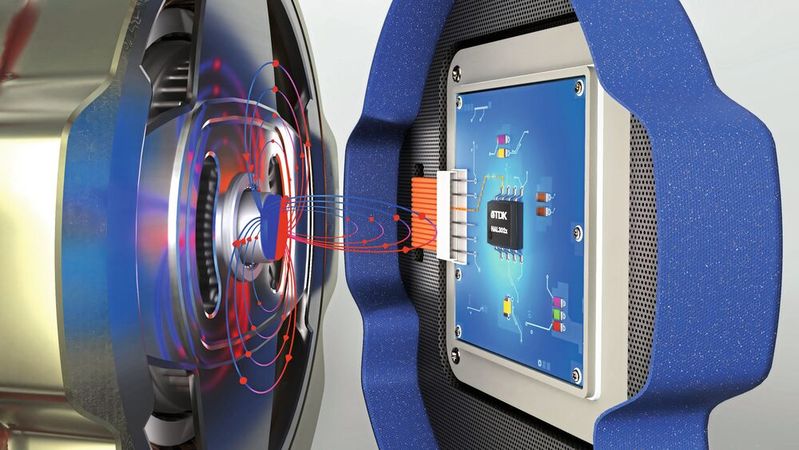
Image 1: A magnetic field sensor on a motor shaft for determining speed and control.
(Image: TDK-Micronas)
Karsten Köhler is Manager Business Development at TDK-Micronas.
In today's technological landscape, geopolitical tensions play an increasingly decisive role, jeopardizing the supply chain for rare earths as they are the centerpiece of many electronic products. Faced with the risk of production halts, companies in the electronics industry are desperately seeking solutions. TDK demonstrates a groundbreaking approach in magnetic field sensing that eliminates the use of rare earths.
In modern automation and control systems, magnetic field sensing is indispensable. Whether it involves the precise determination of position, speed, rotational speed, or torque, the performance and precision of these sensors are crucial for their reliable operation in devices.
A complete magnetic measurement system consists of two main components: the magnet, also called the target, and the sensor, such as a Hall sensor. This detects the magnetic field and converts it into a measurable voltage. The magnet is precisely positioned on the moving component, such as a motor shaft or a control pedal. The sensor is installed in the exact geometric relationship to it to measure the precise movement and condition of the component.
Pure Iron is Simply Unsuitable for Many Applications
Since the magnet represents a foreign object on the component, it makes sense for the magnet to be as small as possible. Nevertheless, it should generate a strong field so that the sensor receives a strong and low-noise signal. This is where rare earths come into play. Basically, magnetism arises when oppositely charged structural elements in a metal, also called dipoles, are evenly aligned, forming a north and a south pole. The most common magnetizable metal is iron. However, iron alone creates only weakly pronounced magnetic fields and loses its magnetic properties, especially under the influence of heat. This phenomenon is known as thermal demagnetization. Since many technical applications take place in heat-intensive environments, such as in motors, pure iron is simply unsuitable as a target material.
Here, rare earth metals come into play: a group of 17 metals from the 3rd subgroup of the periodic table, most of them led by lanthanum. Among these metals, neodymium is particularly well-known, while terbium as a heavy rare earth and samarium as well as dysprosium are intermediately positioned. These elements provide the necessary stability and strength even at elevated temperatures. This is a critical property for the next generation of high-performance magnets.
Geopolitics And the Problem With Rare Earths
What initially sounds like theoretical chemistry has practical implications for magnet production: The electron structure of rare earths stabilizes the bipolar structure in magnetizable metals. Two key advantages result from this:
Increasing coercivity: The field strength per unit volume can be increased so that smaller magnet sizes lead to the desired magnetic fields.
Improved temperature stability: Magnets can operate reliably even at higher temperatures without losing their magnetic properties.
These properties have made magnets with rare earths a technical standard that is recognized worldwide. However, the global deposits of these raw materials are geologically limited and concentrated in specific regions, which leads to supply shortages during times of geopolitical tensions. Unfortunately, the situation is currently significantly affecting industrial production.
Ferrite Magnets As Alternatives to Rare Earths
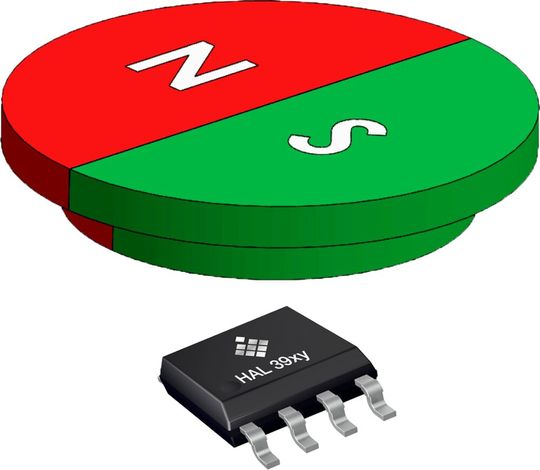
Image 2: The position sensor Micronas 3D HAL "HAL 39xy" in a typical end-of-shaft position opposite a ferrite target magnet.
(Image: TDK-Micronas)
Alternatives such as ferrite magnets and electromagnets offer potential possibilities. Ferrite magnets, produced through sintering processes, exhibit stable crystal structures with excellent field strength and thermal stability. Electromagnets, on the other hand, are unsuitable for moving components because their power supply would be too complex. Ferrites therefore present themselves as the preferred substitute for rare earth magnets.
Even in times when the supply situation was more favorable, ferrites were preferred due to their cost efficiency and lower environmental impact. In light of current developments, many companies, especially in the automotive industry, are working closely with sensor manufacturers to replace rare earth metals with ferrites. Existing sensory developments for ferrite magnets facilitate smooth implementation in this regard.
For example, the existing product families HAL 35xy and HAL 39xy from TDK-Micronas have already been optimized in their design phase for use with ferrite magnets. These products are high-performance position sensors that can detect movements in all three spatial directions. Image 2 schematically shows a typical setup in an end-of-shaft position, meaning for attachment at the end of a shaft.
Date: 08.12.2025
Naturally, we always handle your personal data responsibly. Any personal data we receive from you is processed in accordance with applicable data protection legislation. For detailed information please see our privacy policy.
Consent to the use of data for promotional purposes
I hereby consent to Vogel Communications Group GmbH & Co. KG, Max-Planck-Str. 7-9, 97082 Würzburg including any affiliated companies according to §§ 15 et seq. AktG (hereafter: Vogel Communications Group) using my e-mail address to send editorial newsletters. A list of all affiliated companies can be found here
Newsletter content may include all products and services of any companies mentioned above, including for example specialist journals and books, events and fairs as well as event-related products and services, print and digital media offers and services such as additional (editorial) newsletters, raffles, lead campaigns, market research both online and offline, specialist webportals and e-learning offers. In case my personal telephone number has also been collected, it may be used for offers of aforementioned products, for services of the companies mentioned above, and market research purposes.
Additionally, my consent also includes the processing of my email address and telephone number for data matching for marketing purposes with select advertising partners such as LinkedIn, Google, and Meta. For this, Vogel Communications Group may transmit said data in hashed form to the advertising partners who then use said data to determine whether I am also a member of the mentioned advertising partner portals. Vogel Communications Group uses this feature for the purposes of re-targeting (up-selling, cross-selling, and customer loyalty), generating so-called look-alike audiences for acquisition of new customers, and as basis for exclusion for on-going advertising campaigns. Further information can be found in section “data matching for marketing purposes”.
In case I access protected data on Internet portals of Vogel Communications Group including any affiliated companies according to §§ 15 et seq. AktG, I need to provide further data in order to register for the access to such content. In return for this free access to editorial content, my data may be used in accordance with this consent for the purposes stated here. This does not apply to data matching for marketing purposes.
Right of revocation
I understand that I can revoke my consent at will. My revocation does not change the lawfulness of data processing that was conducted based on my consent leading up to my revocation. One option to declare my revocation is to use the contact form found at https://contact.vogel.de. In case I no longer wish to receive certain newsletters, I have subscribed to, I can also click on the unsubscribe link included at the end of a newsletter. Further information regarding my right of revocation and the implementation of it as well as the consequences of my revocation can be found in the data protection declaration, section editorial newsletter.
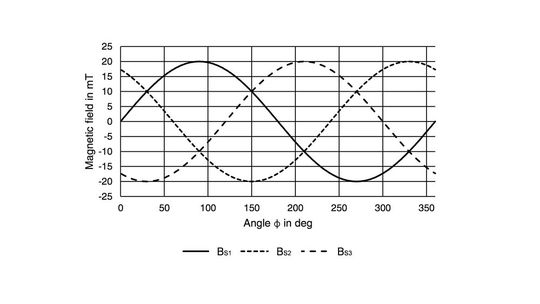
Image 3: Phase-shifted signal over a 360° rotation.
(Image: TDK-Micronas)
The key factor is the high sensitivity of the sensors, meaning the ratio between output voltage (signal) and the magnetic field strength to be measured, specified in mV/mT. The image illustrates the signal progression using three horizontal Hall elements, which in this case are used for angle measurement. It becomes clear that the HAL 39xy already provides a low-noise, easily evaluable signal progression for magnets with a field strength of 20 mT. This field strength can be well represented with ferrite magnets (Image 3).
The Performance of A Ferrite Magnet
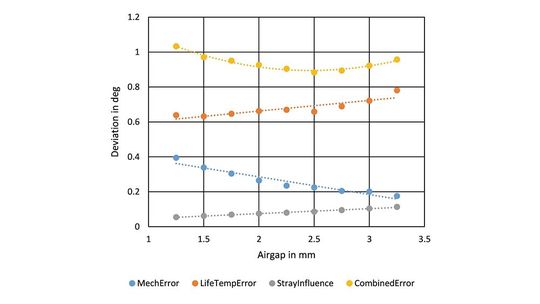
Image 4: Error components and total error in the output signal of the HAL 39xy for a ferrite 20 mT magnet over temperature and lifespan.
(Image: TDK-Micronas)
Ferrite magnets generate a weaker magnetic field and are more prone to thermal demagnetization, which affects measurement accuracy. Error magnitudes are therefore crucial for signal quality. The image shows the performance of the HAL 39xy based on errors in the output angle signal depending on the air gap, meaning the distance between the sensor and the magnet surface. It can be seen that the resulting error (top yellow line) as the sum of various error sources remains within the specified maximum value of only 1° deviation.
It is particularly noteworthy that the total error already takes into account the thermal stress during the lifespan (determined according to the Automotive AEC-Q100 Grade 0 temperature profile), which includes the critical thermal behavior of ferrite magnets. How does the HAL 39xy achieve this? Two main features are crucial for its performance with ferrite magnets:
6ZD silicon structure: The chip's silicon structure integrates six Hall cells in a specific geometry. This configuration captures the entire magnetic field generated by the ferritic magnet. Test series with automotive customers demonstrate that this arrangement delivers significantly better results than sensors with fewer Hall cells.
Internal temperature compensation: The chip contains temperature compensation that compensates for the magnetic system behavior and thus minimizes the impact on the overall error.
Benchmark tests show that the HAL 39xy, at 10 mT—only half the typical field strength mentioned above—exhibits the lowest interference field impact. This makes the sensor ideal for ferrite magnets. The sensor is available in standard packages such as SOIC-8, simplifying replacement during a switch to ferrite magnets. TDK supports customers in quickly transitioning to ferrite systems and avoiding production downtimes.
All sensor families from Micronas benefit from TDK's technology pool. The described advantages of the HAL 39xy and HAL 35xy can also be applied to other sensors, such as the HAL 302x for e-motor commutation applications and the HAL 15xy switches. In light of geopolitical changes in supply chains, TDK helps mitigate negative impacts through advanced technological solutions. (heh)
Future-Proof Authentication with Universal RFID Readers



:quality(80)/p7i.vogel.de/wcms/d0/4c/d04c032c8e1e150bf33ba84def4ed9a6/0130721540v1.jpeg "Müller Precision Tools supports its customers with customized, application-specific tools. (Image: Müller)")
:quality(80)/p7i.vogel.de/wcms/f0/7a/f07aa6f8243048d3bc7156fa4fc263bb/0113143253v1.jpeg "In our China Market Insider, we regularly provide you with relevant information directly from China. (Image:© Eisenhans - stock.adobe.com)")
:quality(80)/p7i.vogel.de/wcms/c0/92/c0922365a230627bafa6a3ed7fbe15d7/0131573143v1v1.jpeg "The EU members of the European Parliament have voted by a majority in favor of the planned tariff agreement coming into effect. Trump's threats have clearly worked ... (Image: F. Schneidler)")
:quality(80)/p7i.vogel.de/wcms/81/22/8122583abe81b65e0590e99aa189b001/0131847826v1.jpeg "Rymoplast has invested in a recycling plant in Markranstädt, Saxony, near Leipzig. There, high-quality granulate is produced from plastic films. However, the thermal management of the processing systems must be optimal for this. Technotrans had the right solution ... (Image: Rymoplast)")
:quality(80)/p7i.vogel.de/wcms/72/a4/72a42738f6a899a841d4fa5961aca547/0131865780v1.jpeg "Siemens Industrial Edge enables customers to deploy and manage edge devices and apps directly at the production site. The app ecosystem ensures seamless connectivity to industrial systems, IT systems, and the cloud. (Image:Siemens)")
:quality(80)/p7i.vogel.de/wcms/bb/38/bb38b290715449fdcb977cb4a0c720be/0131850167v1.jpeg "To make manufacturing faster, more robust, and more flexible, production must be designed in a more IT-oriented manner. This also requires virtual controls. (Image: Audi AG)")
:quality(80)/p7i.vogel.de/wcms/ab/e8/abe8dd2398744832931a48d525b18acf/screenshot-202026-04-02-20163710v1.png "The interplay of horizontal and vertical grinding discs effortlessly creates a 2-mm radius with maximum efficiency. (Source: Teqram)")
:quality(80)/p7i.vogel.de/wcms/de/49/de496edc0815d63154eccc7d1341d696/0131501872v1.jpeg "Cybersecurity: is increasingly evolving from an isolated IT discipline to an integral part of industrial value creation. (Image: Designed by Freepik)")
:quality(80)/p7i.vogel.de/wcms/7d/f0/7df0df2c3fc0cd9cb7fd614412361aac/henkel-20ami-20pm-20anodis-uminium-bild-201-v1.jpeg "Henkel research in action: The development of Bonderite M-AD 2000A demonstrates how targeted additives can make anodizing processes more energy-efficient, sustainable, and economical. (Source: Henkel)")
:quality(80)/p7i.vogel.de/wcms/e3/01/e3018c55021f2a0ce0745124354eb96e/6000x4000v1.jpeg "Holographic projection of a model of a human ear. (Source: Adrien Buttier/EPFL)")
:quality(80)/p7i.vogel.de/wcms/2c/65/2c65057b446b0c6fd5f59a51af9081c1/ruderer-pm-sonderfahrzeugbau-caravan-cmyk-02v1.jpeg "Modern adhesives and sealants enable stable, tight, and economical connections in special vehicle construction – from vehicle structure to interior fittings to repairs. (Source: Ruderer)")
:quality(80)/p7i.vogel.de/wcms/dc/1e/dc1e164ca1e524e7cb48de6fd6a16a1c/hytank-ifam-pi-bilder-1-ad-plasmav1.png "Non-contact atmospheric pressure plasma pretreatment of a CFRP surface. (Source: Fraunhofer IFAM)")
:quality(80)/p7i.vogel.de/wcms/52/8f/528f5c85caa342eaa46e101351bbb1ee/a201486-largev1.jpeg "Permanent magnets from electric motors contain valuable raw materials. (Source: Audi)")
:quality(80)/p7i.vogel.de/wcms/5a/b6/5ab6a38b387b4f9d9f18e889588d85da/0131905522v1.jpeg "The Chinese are clever! After the EU introduced countervailing duties on electric cars, they quickly realized that plug-in hybrids, like the Sealing 6 Touring from BYD, were not affected. However, the EU Commission now wants to block these loopholes... (Image: BYD)")
:quality(80)/p7i.vogel.de/wcms/5c/46/5c4696dbe0c30e52f9cccb6b0aba1af9/b2026cw00206v1.jpeg "Oliver Blume has reaffirmed the automaker's cost-cutting strategy. (Source: Volkswagen)")
:quality(80)/p7i.vogel.de/wcms/49/d2/49d254cee8bf109b21ebe0012ab7b896/0131877440v1.jpeg "Press conference for the opening of the Schaeffler Automotive Symposium 2026 (from left): Klaus Rosenfeld, CEO of Schaeffler AG, together with Matthias Zink, Board Member Powertrain & Chassis, and Thomas Stierle, Board Member E-Mobility. (Image:Schaeffler | Daniel Karmann)")
:quality(80)/p7i.vogel.de/wcms/49/db/49dbdb906050c2ee2f12aca95a309599/0131907985v1.jpeg "System-wide context integration: AI agents consolidate isolated data from ALM, PLM, and ERP systems into well-founded decision templates. (Image: PTC)")
:quality(80)/p7i.vogel.de/wcms/a8/f7/a8f769adac577406bb0c56f5b7535564/0131874725v1.jpeg "Huge success: In 1983, the Controller Area Network was born. A revolution, as it reduced wiring efforts, is fail-safe, and real-time capable. (Image: ©Elena - stock.adobe.com / AI-generated)")
:quality(80)/p7i.vogel.de/wcms/d3/37/d337fde36d300515a0d679aa55fb5432/0131894777v1.jpeg "Mixed-signal and power semiconductors: The services of the Cosmic Group support customers from the initial design phase to the end-of-line test. (Image: Cosmic Group)")
:quality(80)/p7i.vogel.de/wcms/40/77/4077a0064066bde13aa0a8e2817c8858/0131879275v1.jpeg "Bosch location in Shanghai: Due to unauthorized deliveries to Huawei, Bosch must pay a multi-million dollar fine in the USA. (Image: Bosch)")
:fill(fff,0)/images.vogel.de/vogelonline/companyimg/76800/76895/65.jpg "FAULHABER_120mm.jpg ()")
:quality(80):fill(efefef,0)/p7i.vogel.de/wcms/67/ae/67ae0b9ac31f8/elatec-wp-universal-reader.png "Elatec WP Universal Reader")
:quality(80)/p7i.vogel.de/wcms/50/42/5042d10a118ce24d1fb0e7be71e688cf/0128631153v1.jpeg "0128631153v1 (Image:Rutronik)")
:quality(80)/p7i.vogel.de/wcms/78/a8/78a8e5f1e97c4f2c4e94bc43c9378e85/0130066407v1.jpeg "Comparison: When is a shunt better than a current sensor and when is it not? (Image:WDI AG)")