In our "Fascination with Technology" section, we present engineers with impressive projects from research and development every week. Today: a living material that actively extracts carbon dioxide from the atmosphere.
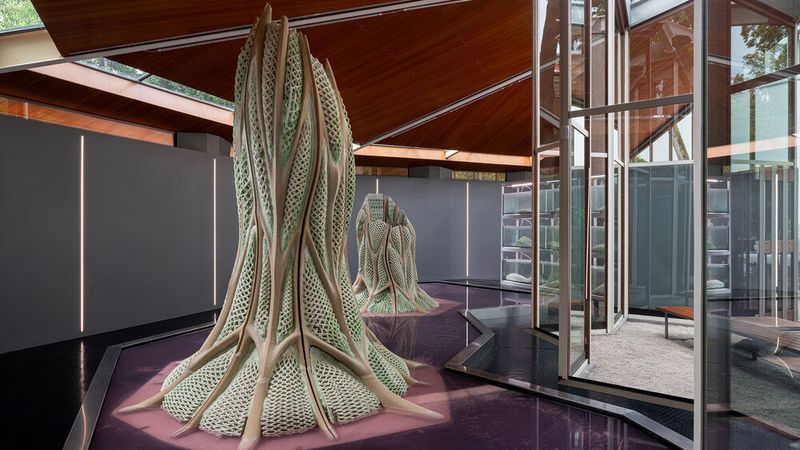
Picoplanktonics showcases large-scale objects made from photosynthetic structures.
(Image: Valentina Mori / Biennale di Venezia)
At ETH Zurich, researchers from various disciplines are working together to combine conventional materials with bacteria, algae, or fungi. The common goal is to create living materials that, thanks to the metabolism of microorganisms, acquire useful properties—"such as the ability to bind CO2 from the air through photosynthesis," says Mark Tibbitt, Professor of Macromolecular Engineering at ETH Zurich.
An interdisciplinary research team under Tibbitt's leadership has now turned this vision into reality: they have incorporated photosynthetic bacteria—known as cyanobacteria or blue-green algae—stably into a printable gel, creating a material that is living, grows internally, and actively removes carbon from the air. The researchers recently presented their "photosynthetic living material" in a study in the journal Nature Communications.
CO2, Sunlight, And Artificial Seawater for Growth
The living material can be shaped at will using 3D printing and requires only CO2, sunlight, and artificial seawater with readily available nutrients for its growth. "As a building material, it could help store CO2 directly in buildings in the future," says Tibbitt, who co-initiated the research on living materials at ETH Zurich. What is special about it: the living material absorbs much more CO2 than it binds through organic growth. "This is because the material can store carbon not only in biomass but also in the form of minerals—a special property of blue-green algae," reveals Tibbitt.
Yifan Cui, one of the two lead authors of the study, explains: "Cyanobacteria are among the oldest life forms in the world. They perform photosynthesis very efficiently and can utilize even the weakest light to produce biomass from CO2 and water." At the same time, as a result of photosynthesis, blue-green algae alter their chemical environment outside the cell, causing solid carbonates (such as lime) to precipitate. These minerals represent an additional carbon sink and store CO2 permanently, unlike biomass.
Cyanobacteria as Builders
"We specifically exploit this ability in our material," says Cui, who is pursuing his doctorate in Tibbitt's research group. A practical side effect: the minerals deposit within the material and reinforce it mechanically. In this way, the cyanobacteria slowly harden the initially soft structures. Laboratory tests showed that the material continuously binds CO₂ over a period of 400 days, mostly in mineral form—about 26 milligrams of CO2 per gram of material. This is significantly more than many biological approaches and comparable to the chemical mineralization of recycled concrete (around 7 mg CO2 per gram).
The carrier material hosting the blue-green algae is a hydrogel—a gel made from cross-linked polymers with a high water content. Tibbitt's team selected the polymer network such that it can transport light, CO2, water, and nutrients, allowing the cells to spread evenly within without leaving the material. To ensure the cyanobacteria live as long and as efficiently as possible, the researchers also optimized the geometry of the structures using 3D printing methods to increase surface area, enhance light penetration, and promote nutrient flow.
Co-author Dalia Dranseike: "In this way, we created structures that stand with only a small part in the nutrient liquid and distribute it passively throughout the entire body using capillary forces." Thanks to this design, the encapsulated cyanobacteria lived productively for more than a year, the materials scientist in Tibbitts' team is pleased to report.
In the future, we want to explore how the material can be used as a coating for building facades to bind CO2 throughout the entire life cycle of a structure.
Mark Tibbitt
Material as A Coating for Building Facades
The researchers view their living material as an energy-efficient and environmentally friendly approach that can bind CO2 from the atmosphere and complement existing chemical processes. "In the future, we want to explore how the material can be used as a coating for building facades to bind CO2 throughout the entire life cycle of a structure," Tibbitt looks ahead.
There is still a long way to go, but colleagues from architecture have already adopted the concept and experimentally implemented initial interpretations. Thanks to ETH doctoral student Andrea Shin Ling, the foundational research from ETH labs has made it onto the big stage of the Venice Architecture Biennale. "The most challenging aspect was scaling the manufacturing process from the laboratory format to spatial dimensions," says the architect and biodesigner, who was also involved in the present study.
Date: 08.12.2025
Naturally, we always handle your personal data responsibly. Any personal data we receive from you is processed in accordance with applicable data protection legislation. For detailed information please see our privacy policy.
Consent to the use of data for promotional purposes
I hereby consent to Vogel Communications Group GmbH & Co. KG, Max-Planck-Str. 7-9, 97082 Würzburg including any affiliated companies according to §§ 15 et seq. AktG (hereafter: Vogel Communications Group) using my e-mail address to send editorial newsletters. A list of all affiliated companies can be found here
Newsletter content may include all products and services of any companies mentioned above, including for example specialist journals and books, events and fairs as well as event-related products and services, print and digital media offers and services such as additional (editorial) newsletters, raffles, lead campaigns, market research both online and offline, specialist webportals and e-learning offers. In case my personal telephone number has also been collected, it may be used for offers of aforementioned products, for services of the companies mentioned above, and market research purposes.
Additionally, my consent also includes the processing of my email address and telephone number for data matching for marketing purposes with select advertising partners such as LinkedIn, Google, and Meta. For this, Vogel Communications Group may transmit said data in hashed form to the advertising partners who then use said data to determine whether I am also a member of the mentioned advertising partner portals. Vogel Communications Group uses this feature for the purposes of re-targeting (up-selling, cross-selling, and customer loyalty), generating so-called look-alike audiences for acquisition of new customers, and as basis for exclusion for on-going advertising campaigns. Further information can be found in section “data matching for marketing purposes”.
In case I access protected data on Internet portals of Vogel Communications Group including any affiliated companies according to §§ 15 et seq. AktG, I need to provide further data in order to register for the access to such content. In return for this free access to editorial content, my data may be used in accordance with this consent for the purposes stated here. This does not apply to data matching for marketing purposes.
Right of revocation
I understand that I can revoke my consent at will. My revocation does not change the lawfulness of data processing that was conducted based on my consent leading up to my revocation. One option to declare my revocation is to use the contact form found at https://contact.vogel.de. In case I no longer wish to receive certain newsletters, I have subscribed to, I can also click on the unsubscribe link included at the end of a newsletter. Further information regarding my right of revocation and the implementation of it as well as the consequences of my revocation can be found in the data protection declaration, section editorial newsletter.
Picoplanktonics Bind Up to 39.7 lbs of CO2 per year
Ling is pursuing her doctorate at the Chair of Digital Building Technologies under ETH Professor Benjamin Dillenburger. In her dissertation, she developed a platform for biofabrication that can print living structures with embedded cyanobacteria at an architectural scale. For the installation Picoplanktonics in the Canada Pavilion, the project team used the printed structures as living building blocks to erect two tree trunk-like objects, each about three meters high. Thanks to the cyanobacteria, these can bind up to 39.7 lbs of CO2 per year—about the same amount as a 20-year-old pine tree in the temperate zone.
"The installation is an experiment—we have adapted the Canada Pavilion to provide enough light, moisture, and warmth to allow the cyanobacteria to thrive. Now we are observing how they behave," says Ling. This requires commitment: The team monitors and maintains the installation on-site—daily. Until November 23.
At the 24th Triennale di Milano, Dafne's Skin explores the potential of living materials for future building envelopes. On 3D-printed wooden shingles, microorganisms form a deep green patina that changes the wood over time: a sign of decay becomes an active design element that binds CO2 and emphasizes the aesthetics of microbial processes.
Dafne's Skin is a collaboration between Studio MAEID and Dalia Dranseike. The installation is part of the exhibition "We the Bacteria: Notes Toward Biotic Architecture" and runs until November 9.
The photosynthetic living material was created thanks to an interdisciplinary collaboration within the framework of ALIVE (Advanced Engineering with Living Materials). The initiative by ETH Zurich promotes the collaboration of researchers from various disciplines to develop new living materials for a variety of applications.



:quality(80)/p7i.vogel.de/wcms/ef/1e/ef1e248f58a3697ec1384f6849762d5a/0129842086v1.jpeg "Bodo will soon be hitting it off smart! Signing the memorandum of understanding in Las Vegas: Steffen Haack, Member of the Board of Bosch Rexroth, and Yoshimoto Matsuda, Managing Director of Precision Machinery & Robot Company, Kawasaki Heavy Industries. Here's what it's all about ... (Image:Bosch Rexroth)")
:quality(80)/p7i.vogel.de/wcms/f9/7d/f97deef8fde21c8630d76411b18a20a7/0129803665v1.jpeg "Skoda has invested well over 220 million US dollars in the high-tech battery plant that has now opened in Mlada Boleslav. It has now started its work, which is highly automated ... (Image:Skoda)")
:quality(80)/p7i.vogel.de/wcms/f5/61/f561ad7c72ed41fd7a67ad9c481cb15d/0129799343v1.jpeg "Engine-generator units (MGU) from Steyr Motors are at work in the Leopard 2 main battle tank and the Leguan bridge vehicle (pictured). An extended contract is now to secure at least 500 more systems of this type for the Bundeswehr ... (Image:German Armed Forces)")
:quality(80)/p7i.vogel.de/wcms/6c/b5/6cb5ce2155433f6e73b16399adc4c561/0113143253v1.jpeg "In our China Market Insider we regularly provide you with relevant information directly from China. (Image:© Eisenhans - stock.adobe.com)")
:quality(80)/p7i.vogel.de/wcms/9c/ac/9cac6246660e746c5a3989399ac4d250/0128561645v1.jpeg "Artificial intelligence can drive efficiency in smart factories through centralized data management and predictive maintenance. (Picture: ©Fardived - stock.adobe.com)")
:quality(80)/p7i.vogel.de/wcms/6b/e2/6be235b5ad8a442ccd9d164b0b300d8b/0129763992v1.jpeg "As early as 2020, the Zimmer Group announced that it would convert its production to be sustainably CO2-neutral. (Image:Zimmer Group)")
:quality(80)/p7i.vogel.de/wcms/d4/ba/d4bab9481e66f8570f40eb8ef2a90198/0129795613v1.jpeg "A camera inspection during removal ensures that the components are placed correctly in the KLTs. (Image:Yaskawa Europe)")
:quality(80)/p7i.vogel.de/wcms/cb/56/cb56e42b01638b618e8d1b9b38f32faa/0129810132v1.jpeg "From summer 2026, \"AEON\" will support people at the BMW plant in Leipzig. (Image:diephotodesigner.de/BMW)")
:quality(80)/p7i.vogel.de/wcms/b5/5e/b55ed9355e0395ec0caf111d6af6b494/adobestock-495980372--c2-a9-20natali-mis-20-e2-80-93-20stock-adobe-com-6720x3778v1v1.jpeg "Which engineering skills will be in vogue in 2026? (Image:natali_mis - stock.adobe.com)")
:quality(80)/p7i.vogel.de/wcms/bf/a5/bfa5d882e93f159ce93e933742272b00/nord-vibn-cmyk-2196x1235v1v1.jpeg "With digital twins for virtual commissioning, Nord supports customers in ensuring that systems are available more quickly, even with complex drive systems. (Image:Nord Drivesystems)")
:quality(80)/p7i.vogel.de/wcms/f5/7e/f57ef535ee35e7b3b7ff15a8a63cef10/eds-keyvisual-8000x4496v1.jpeg "(Source: European Defence Supply)")
:quality(80)/p7i.vogel.de/wcms/af/a3/afa312176d956068af20491957eef642/newsimage418262-3100x1745v1v1.jpeg "The autonomous shuttle of the Aula AI project during a demonstration of sensor data with artificial fog. (Image:University of Magdeburg)")
:quality(80)/p7i.vogel.de/wcms/40/b3/40b38efc9eae25e69d644512a2dc4b7c/0129806862v1.jpeg "This is one of the new MDA power clamping nuts from Jakob Antriebstechnik from various angles. It is described as particularly durable and powerful. Here are a few specific data ... (Image:Jakob Drive Technology)")
:quality(80)/p7i.vogel.de/wcms/29/3a/293a6a8483f59bc2fa65a7e1a4d9a703/0129822140v1.jpeg "The Fraunhofer IDMT, Mercedes-Benz and Burmester have developed the 3D audio technology \"Audiofields\". (Image:Thomas Günnel - Automotive Industry)")
:quality(80)/p7i.vogel.de/wcms/cb/23/cb23acd8e9de969d52522692b62b1892/0129680605v1.jpeg "The Z22198 is an extremely compact, three-axis IEPE acceleration sensor for measuring oscillations (vibrations) and shocks in demanding applications. With an edge length of just 0.24 inches and a weight of 0.03 ounces, it is ideal for lightweight structures and confined spaces. (Image:Copyright 2020 ScROGERS,All Rights Reserved)")
:quality(80)/p7i.vogel.de/wcms/c4/40/c44043c61f9dd99b80ccca398c284018/0129795093v1.jpeg "Subaru manufactures the E-Outback at its Yajima plant, marking the first time it has produced an electric vehicle in-house. (Image:Subaru)")
:quality(80)/p7i.vogel.de/wcms/8f/48/8f48b0ed0d6c5c4f299b1310a7b577e9/0129830738v1.jpeg "Data centers in orbit are indeed dreams of the future, while data centers under water are already being tested. (Image:Dall-E / AI-generated)")
:quality(80)/p7i.vogel.de/wcms/36/ec/36ec46b311c3fb2cf9759ba4843047c5/0129831604v1.jpeg "Keysight and Ericsson enable validation of pre-6G interoperability with real network infrastructure and devices. (Image:Keysight)")
:quality(80)/p7i.vogel.de/wcms/c5/7a/c57ab05221defbbcaf6bddc346d21464/0129752421v1.jpeg "(Image:concept electronic GmbH)")
:quality(80)/p7i.vogel.de/wcms/12/e4/12e428b994a4f83779ce72d333964fcf/wth1pi1740-01-2048x1152v1v1.jpeg "Würth Elektronik has developed a customized transformer for the intelligent Motion Mate orthosis from Powered Orthotics, which was presented at DLD. (Image:Philipp Guelland for DLD Hubert Burda Media)")
:fill(fff,0)/images.vogel.de/vogelonline/companyimg/76800/76895/65.jpg "FAULHABER_120mm.jpg ()")
:fill(fff,0)/p7i.vogel.de/companies/69/88/69882c428938e/tmts2026-ticec-banner-en-2000px.png "tmts2026-ticec-banner-en-2000px (https://www.tmts.tw/en)")
:fill(fff,0)/p7i.vogel.de/companies/67/eb/67eba621ef6ea/logo2.png "logo2 (Wuxi InfiMotion)")
:quality(80)/p7i.vogel.de/wcms/cc/49/cc495daa02cd075d956e2c2ec3b8040d/0125273808v1.jpeg "Moisture, warmth, and light from grow lamps allow the cyanobacteria to thrive.(Image: Girts Apskalns)")
:quality(80)/p7i.vogel.de/wcms/54/99/5499484bca995c73a8dce19b23d28e6c/0125273807v1.jpeg "Living patina on wood (I): Bacterial growth.(Image: Lorem / Luca Pagan)")
:quality(80)/p7i.vogel.de/wcms/e9/05/e90579e4a85f26058c6ce7bf441eb787/0125273806v1.jpeg "Incubation chambers allow cyanobacteria to multiply in freshly printed structures.(Image: Clayton Lee)")
:quality(80)/p7i.vogel.de/wcms/c8/d7/c8d766ca13d30227ebadafed4ec956dd/0125273816v1.jpeg "3D-printed \"pineapple,\" within which cyanobacteria grow, after a development period of 60 days. The green color comes from the chlorophyll of the photosynthetic bacteria.(Image: Yifan Cui / ETH Zurich)")
:quality(80):fill(efefef,0)/p7i.vogel.de/wcms/67/ad/67adf4a647532/elatec-wp-machine-authentication.png "Elatec WP Machine Authentication")
:quality(80)/p7i.vogel.de/wcms/1a/d3/1ad3b385cbe9d8695351970614137c9a/0125117571v1.jpeg "Infrared light passes through the metalens and is converted into violet light due to the material and special surface structures (magnified in the lens), and is bundled at a focal point. (Image:Ü.Talts / ETH Zurich)")
:quality(80)/p7i.vogel.de/wcms/7c/d3/7cd36af4ee3314e07ba99a6c69d02338/0123920958v1.jpeg "Animation of an alga coated with the natural polymer chitosan and magnetic nanoparticles. (Image:MPI-IS / A. Posada)")