Reports of burning e-cars regularly appear in social and traditional media. However, this happens quite rarely. A clarification.
E-cars catching fire is rare.
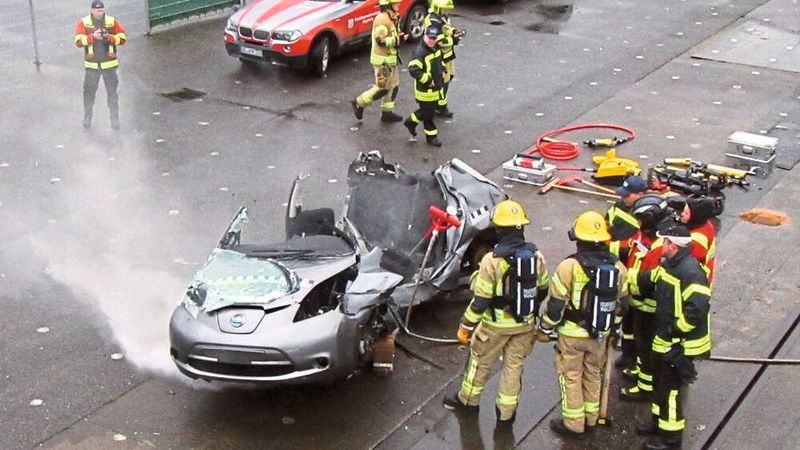
(Image: Dekra)
One of the more common reservations against e-cars is their alleged fire hazard. Compared to combustion engines, however, they tend to fare rather well. These are the most frequent questions and the corresponding answers regarding the fire hazard of e-vehicles.
Do e-cars catch fire more often than combustion engines?
Currently, all indications suggest that battery electric vehicles (BEVs) are less likely to catch fire than vehicles with internal combustion engines. Data from Norway shows that between 2016 and March 2022, BEVs accounted for only 2.3 percent of car fires, while their share of the total vehicle population was 8.9 percent. Other statistics point in a similar direction, such as data from the German Insurance Association (GDV), the Swedish government, and the Australian Department of Defence. However, e-cars are on average significantly younger than the combustion engine stock, which could slightly skew the data.
How are electric vehicles protected against fires?
Electric cars are equipped with several safety systems. The minimum required provisions are outlined in the ECE Regulation R 100, which details specific requirements for the battery and the entire electric drive system. Mandated are various vibration, shock, and thermal tests. Protection against short circuits, overcharging or discharging, and overheating is also specified. To fulfill all these requirements, numerous technical measures are implemented. For example, a Battery Management System (BMS) continuously monitors the current, voltage, and temperature of the battery cells. In collaboration with the thermal management system, it regulates the battery temperature using air or liquid cooling. If problems still arise, the BMS responds with automatic shutdown in case of over or under voltage, overcurrent, excessive temperature, or vehicle rollover. Additional protective measures include heat shields, ventilation openings, and mechanical impact protection for the battery.
What are the most common causes of fires in electric vehicles?
With combustion engines, there are a multitude of fire causes: ranging from leaks in the fuel system and electrical faults to parking with a hot catalytic converter on a dry summer meadow. In electric cars, almost exclusively battery issues are the cause. These arise from excessive thermal, electrical, or mechanical stress on the battery cells. Possible causes include mechanical damage from traffic accidents or errors in the battery management system. An external fire can also trigger the so-called thermal runaway of the energy storage system.
What does thermal runaway mean?
Whether due to an external or internal fault, if a cell in the battery becomes too hot, the so-called thermal runaway threatens. The cell ignites, the fire spreads to neighboring cells, and quickly the entire battery pack burns, sometimes even exploding under pressure. Another problem is that all the elements necessary for a fire are present in the casing: the electrolyte chemically related to gasoline, the graphite similar to charcoal at the anode, and the separator often made of organic material. In addition, oxygen-containing compounds come from the electrodes. The fire feeds itself and is difficult to reach from outside due to the comprehensive battery casing, which makes extinguishing it difficult. This "runaway" likely contributed significantly to the fear myths about e-car fires.
Do e-cars burn hotter or longer than combustion engines?
The majority of the thermal energy released during a car fire does not come from the energy storage system. Instead, tires, plastic cladding, and fabrics make up the bulk of the fire load. In this regard, e-cars and combustion vehicles of comparable size differ little. In terms of the total amount of heat released and the peak temperature, fires in battery electric vehicles and combustion vehicles are also similar, as indicated by documents from the state National Hydrogen and Fuel Cell Technology Organization (NOW).
Do more pollutants arise from an e-car fire than from a combustion engine fire?
The environmental impact differs at least in terms of the substances released. According to NOW, when extinguishing a burning battery, concentrations of nickel, cobalt, lithium, manganese, and hydrogen fluoride can be higher in the wastewater compared to vehicles with internal combustion engines. However, higher concentrations of lead, polycyclic aromatic hydrocarbons (PAHs), and volatile organic compounds (VOCs) can be detected in the extinguishing water of combustion engine vehicles. The concentration of per- and polyfluoroalkyl substances (PFAS)—non-biodegradable "forever chemicals"—in the wastewater is also four times higher.
Date: 08.12.2025
Naturally, we always handle your personal data responsibly. Any personal data we receive from you is processed in accordance with applicable data protection legislation. For detailed information please see our privacy policy.
Consent to the use of data for promotional purposes
I hereby consent to Vogel Communications Group GmbH & Co. KG, Max-Planck-Str. 7-9, 97082 Würzburg including any affiliated companies according to §§ 15 et seq. AktG (hereafter: Vogel Communications Group) using my e-mail address to send editorial newsletters. A list of all affiliated companies can be found here
Newsletter content may include all products and services of any companies mentioned above, including for example specialist journals and books, events and fairs as well as event-related products and services, print and digital media offers and services such as additional (editorial) newsletters, raffles, lead campaigns, market research both online and offline, specialist webportals and e-learning offers. In case my personal telephone number has also been collected, it may be used for offers of aforementioned products, for services of the companies mentioned above, and market research purposes.
Additionally, my consent also includes the processing of my email address and telephone number for data matching for marketing purposes with select advertising partners such as LinkedIn, Google, and Meta. For this, Vogel Communications Group may transmit said data in hashed form to the advertising partners who then use said data to determine whether I am also a member of the mentioned advertising partner portals. Vogel Communications Group uses this feature for the purposes of re-targeting (up-selling, cross-selling, and customer loyalty), generating so-called look-alike audiences for acquisition of new customers, and as basis for exclusion for on-going advertising campaigns. Further information can be found in section “data matching for marketing purposes”.
In case I access protected data on Internet portals of Vogel Communications Group including any affiliated companies according to §§ 15 et seq. AktG, I need to provide further data in order to register for the access to such content. In return for this free access to editorial content, my data may be used in accordance with this consent for the purposes stated here. This does not apply to data matching for marketing purposes.
Right of revocation
I understand that I can revoke my consent at will. My revocation does not change the lawfulness of data processing that was conducted based on my consent leading up to my revocation. One option to declare my revocation is to use the contact form found at https://contact.vogel.de. In case I no longer wish to receive certain newsletters, I have subscribed to, I can also click on the unsubscribe link included at the end of a newsletter. Further information regarding my right of revocation and the implementation of it as well as the consequences of my revocation can be found in the data protection declaration, section editorial newsletter.
Are there differences between cell types in terms of fire safety?
Fundamentally, all cell types used in cars are safe. Lithium iron phosphate (LFP) cells are considered particularly safe, as their cathode material has higher thermal stability than nickel-based cells (NMC, NCA). LFP cells are cheaper and less powerful than nickel cells, and are therefore increasingly used, especially in smaller passenger cars or commercial vehicles. Sodium-ion batteries could be even safer, although they are not currently used in Europe. Truly inflammable might be real solid-state batteries—the mere absence of the flammable liquid electrolyte could increase the safety level again. For all current cell types, the risk of thermal runaway is highest when fully charged and significantly lower at lower charges. For this reason, batteries are only charged to about a quarter of their capacity during sea transport.
How are burning electric cars extinguished?
As with combustion engine vehicles, the fire department uses water for extinguishing and cooling. Because it can burn inside the battery casing, the fire department needs to adjust its strategy for e-car fires. To deliver the extinguishing agent into the battery pack, special extinguishing lances or access points are used. After extinguishing, continuous temperature monitoring is necessary since the battery could reignite. Handover to towing companies only takes place after at least 30 minutes of observation. Subsequently, the electric cars must be placed in quarantine for safety reasons, in case the fire should flare up again.



:quality(80)/p7i.vogel.de/wcms/a0/47/a04725ef9bd09fb6c9341a1bea1b5d93/0130443083v1.jpeg "Here, a type of plastic pallet is produced by thermoforming (vacuum forming or deep drawing) at the corresponding division of New England Plastics in the USA. This division, which specializes in so-called liners, is now part of Ringmetall ... (Image:New England Plastics)")
:quality(80)/p7i.vogel.de/wcms/23/99/23992bf2dcdc432c9b7209c34a4a7c48/0129733089v1.jpeg "Stork relies on the modular Neoswiss turning system from Iscar to shorten the set-up times for its sliding headstock lathes and work more productively. (Image:Iscar)")
:quality(80)/p7i.vogel.de/wcms/7d/e2/7de2923434b2f1a78ba5482d8d335269/0113143253v1.jpeg "In our China Market Insider we regularly provide you with relevant information directly from China. (Image:© Eisenhans - stock.adobe.com)")
:quality(80)/p7i.vogel.de/wcms/9d/2b/9d2b802f800e5caf17b2831e74228cd3/screenshot-202026-03-03-20103822-609x343v1v1.png "Visual comparison: on the left, a clean, burr-free cut edge; on the right, typical burr formation with oxidation discoloration. This illustrates how strongly parameter control and gas management influence the quality of the result. (CO₂ laser, oxygen cutting gas, sheet thickness approx. 15 mm). (Image:Picture: Rime)")
:quality(80)/p7i.vogel.de/wcms/b7/36/b736dfebc16c42d6901d0d0e1f390493/3d-druck-20factory-20--20ki-20generiert-1920x1079v1.png "(Source: AI-generated)")
:quality(80)/p7i.vogel.de/wcms/79/b2/79b21aad663f4a7bd4472afc1c1afc62/0130433994v1.jpeg "Mission Joyride: The free-flying robot (shown here in the rendering) will relieve the ISS crew of logistics tasks from 2027 with its two mechanical arms. (Image:Icarus Robotics)")
:quality(80)/p7i.vogel.de/wcms/6b/45/6b4546fa6ebf305c3660326909363f32/0130437089v1.jpeg "Industrial AI in action: Rockwell Automation presents practical solutions for self-controlling production systems at the Hannover Messe. (Image:Rainer Jensen, Deutsche Messe)")
:quality(80)/p7i.vogel.de/wcms/78/e9/78e9188c25a8a94e67c34c9bf8ffe495/visual-agile-20robots-20and-20google-20deepmind-20partner-20to-20bring-20intelligence-20to-20robotics-2500x1406v1v1.jpeg "Together, the partners are developing adaptable, intelligent robots for a wide range of applications (Image:Agile Robots SE)")
:quality(80)/p7i.vogel.de/wcms/59/a2/59a2b11f0aa1b700eff02addd5de8703/adobestock-1788280853--c2-a9-20satria-20-e2-80-93-20stock-adobe-com-5081x2860v1v1.jpeg "Quantum computers require extreme cooling to temperatures close to absolute zero in order to keep qubits stable. (Image:satria - stock.adobe.com)")
:quality(80)/p7i.vogel.de/wcms/49/38/493876a248943456b7e4a6db6edfc454/0130230765v1.jpeg "Safe and reliable in aircraft construction: light-curing adhesive bond combined with universal fastening elements. (Source: Delo)")
:quality(80)/p7i.vogel.de/wcms/b5/c7/b5c749d16c8a2e789c1469c2c8c1c387/0130452780v1.jpeg "Volvo Trucks completes road tests with its new hydrogen-powered trucks. (Image:Volvo Trucks)")
:quality(80)/p7i.vogel.de/wcms/ba/69/ba6975f417a85147084f38dc2cd209e2/0130451386v1.jpeg "Together with Nvidia, Hyundai wants to develop an architecture that will be used for level 4 robotaxis (image) as well as for level 2 customer vehicles. (Image:Hyundai)")
:quality(80)/p7i.vogel.de/wcms/93/4d/934de334b47abaa526c78cba1417d7af/0130343495v1.jpeg "The new SU7 is available in three price categories, \"Standard\", \"Pro\" and \"Max\" (Image:Xiaomi)")
:quality(80)/p7i.vogel.de/wcms/df/a0/dfa048434bb94f1b7d030e346b25b3ae/0130373541v1.jpeg "From August, BMW will be producing the i3 at its main plant in Munich - which the car manufacturer has extensively rebuilt for this purpose. (Image:Rainer Haeckl)")
:quality(80)/p7i.vogel.de/wcms/ee/09/ee09acbd6dc896df25affaa9e871e6e5/0130440053v1.jpeg "IMS chip module for simple system integration into an ion mobility spectrometer. (Image:Fraunhofer IPMS)")
:quality(80)/p7i.vogel.de/wcms/10/6c/106cd22de5f68a0f74639d654827228c/0130345302v1.jpeg "Made in India: According to the India Electronics and Semiconductor Association (IESA), the country should be able to produce between 75 and 80 million chips by the beginning of 2027, once the plants currently under construction become operational. (Image:Pixabay (Montage: Sebastian Gerstl))")
:quality(80)/p7i.vogel.de/wcms/a5/ed/a5ed6fda029d362732a293d6b19d74c4/0130444216v1.jpeg "Thirteen executives from the Chinese chip industry have drawn up a plan to achieve an 80% self-sufficiency rate for semiconductors by 2030. (Image:Maxim_Kazmin - stock.adobe.com)")
:quality(80)/p7i.vogel.de/wcms/31/a6/31a646018b34d8e0a44bfc8bf17837f6/0130361632v1.jpeg "For many companies, PFAS are considered indispensable in electronics production. (Image:freely licensed)")
:fill(fff,0)/images.vogel.de/vogelonline/companyimg/76800/76895/65.jpg "FAULHABER_120mm.jpg ()")
:quality(80)/p7i.vogel.de/wcms/e9/d9/e9d98e79d33ddc21879e923947a1c566/0124239712v1.jpeg "Hyundai Mobis has registered three patents for its new battery system, with which thermal runaways should no longer be a problem. (Image:Hyundai Mobis)")
:quality(80)/p7i.vogel.de/wcms/a3/b1/a3b1fc7017077329db7f36638c443293/org-blobs-user-response-file-output-3464bb0e-cba5-499e-b2d1-f0550dad2b2c-plugin-output-call-98wgfin4vwuwdk4rk2mcggg2-1536x864v1v1.png "The safety of electric cars is currently the subject of much debate in China. (Image:Image: AI-generated)")