Universal Programming LanguageExtension of Embedded Software on FPGA Hardware
From
Denis Vasilik* | Translated by AI
10 min Reading Time
FPGA development using markup languages such as Verilog and VHDL is considered difficult to access. However, software programming languages such as C or C++ are often inadequate for this purpose. A universal language for FPGA/ASIC design with software tools and abstractions such as Livt could close this gap.
FPGAs solve performance bottlenecks, but are considered difficult to program. The universal programming language Livt is intended to lower the hurdle - correct, deterministic and HDL-compatible.
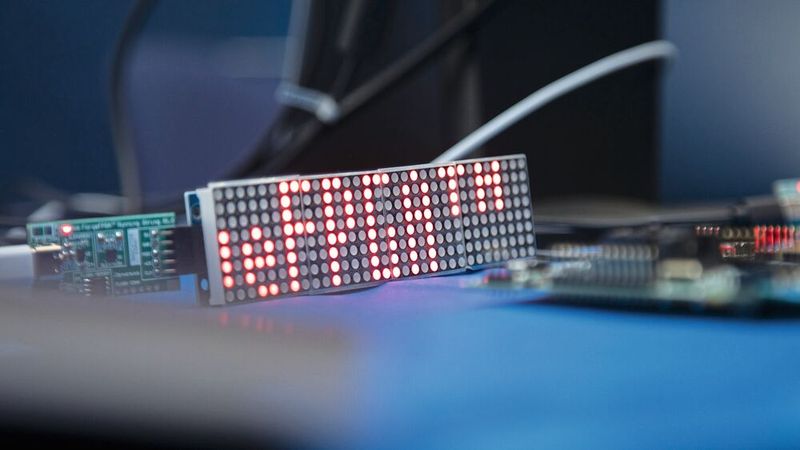
(Image: Toby Giessen / VCG)
For decades, FPGA and ASIC development has existed in a world of its own. Hardware description languages like VHDL and Verilog are powerful and precise, but they come with a long learning curve, verbose syntax, and workflows that feel disconnected from modern software engineering practices.
At the same time, embedded software developers often come up against the limits of MCUs and CPUs. Latency, determinism, energy efficiency and parallelism eventually become bottlenecks. Although FPGAs are often the right technical solution, the barrier to entry is so high that many teams avoid them altogether.
Livt was developed to fill this gap. Livt is a general-purpose programming language for FPGA and ASIC design that brings abstraction, tools and software-style workflows to the hardware domain without compromising correctness, determinism or interoperability with existing HDL code.
Why Another Language for FPGA Development?
Traditional HDL development forces developers to think in terms of low-level hardware from the first line of code. While this level of control is essential for correct and efficient hardware design, it also means that even simple behaviors often require extensive boilerplate code and a deep understanding of hardware-specific details.
In practice, traditional HDL development requires you to think in the following terms:
Signals instead of variables;
Processes instead of functions;
Explicit bars and resets throughout the design;
Handwritten test benches for verification; and
Manufacturer-specific tool flows and workflows.
These concepts are powerful, but they complicate FPGA development, slow down iteration and make maintenance difficult - especially for developers with a software background.
Livt takes a different approach. Instead of starting with low-level mechanisms, you describe what a design should do, and the compiler derives a correct and readable VHDL representation from this description. The generated HDL integrates seamlessly into existing toolchains and can coexist with hand-written VHDL or Verilog when deeper control or optimization is required.
Livt was developed to cover all the requirements of modern development:
First you describe the behavior.
The compiler derives correct VHDL from this.
If required, you retain full access to VHDL and Verilog.
You will work in a software-oriented ecosystem, including package management, unit testing, CI/CD integration and AI-powered tools.
The result is not "HDL replaced", but "HDL extended" - which is also reflected in the name "Livt". The intention is not to replace hardware description languages, but to increase the level of abstraction at which most of the system is expressed. Hardware engineers retain full control where it matters, while large parts of a design can be developed faster, safer and with significantly improved readability and maintainability.
Hardware-Software Integration via HxS
A key factor in Livt's approach is its close integration with the existing domain-specific language HxS. HxS focuses on the description of hardware-software interfaces, in particular register mappings and CPU-visible control points.
With Livt and HxS together, it becomes easy to link a processor-accessible register to a value within the FPGA or even to a function implemented in the hardware logic. Instead of writing fragile glue logic, you define clear and explicit interfaces between software and hardware.
This fundamentally changes the way in which communication between the processor and FPGA is organized. The hardware logic is no longer controlled passively via registers, but can actively disclose its behavior via clearly defined APIs.
Why MCU Developers Should be Interested in FPGAs
From the perspective of an MCU developer, FPGAs become relevant when software alone can no longer fulfill the system requirements. This is often the case when strict real-time behavior is required, when latency must be reduced to an absolute minimum or when tasks can benefit from massive parallelism.
Typical examples are high-speed sensor interfaces, motor control, protocol processing, signal pre-processing or energy-efficient data processing. In many of these cases, implementing part of the functionality in hardware is the technically correct solution.
What has been missing is an accessible way to do this without completely switching to an HDL-centric mindset. Livt fills this gap by providing a programming model that is familiar to embedded developers while producing efficient, synthesizable hardware.
A Software-Oriented Programming Model
Livt deliberately adopts concepts that are familiar from modern programming languages. The code is organized using namespaces and components. The status is expressed by fields. Behavior is encapsulated in functions and processes with clear visibility rules. Constructors describe how components are connected to each other instead of forcing the developer to manually manage low-level signal connections.
Date: 08.12.2025
Naturally, we always handle your personal data responsibly. Any personal data we receive from you is processed in accordance with applicable data protection legislation. For detailed information please see our privacy policy.
Consent to the use of data for promotional purposes
I hereby consent to Vogel Communications Group GmbH & Co. KG, Max-Planck-Str. 7-9, 97082 Würzburg including any affiliated companies according to §§ 15 et seq. AktG (hereafter: Vogel Communications Group) using my e-mail address to send editorial newsletters. A list of all affiliated companies can be found here
Newsletter content may include all products and services of any companies mentioned above, including for example specialist journals and books, events and fairs as well as event-related products and services, print and digital media offers and services such as additional (editorial) newsletters, raffles, lead campaigns, market research both online and offline, specialist webportals and e-learning offers. In case my personal telephone number has also been collected, it may be used for offers of aforementioned products, for services of the companies mentioned above, and market research purposes.
Additionally, my consent also includes the processing of my email address and telephone number for data matching for marketing purposes with select advertising partners such as LinkedIn, Google, and Meta. For this, Vogel Communications Group may transmit said data in hashed form to the advertising partners who then use said data to determine whether I am also a member of the mentioned advertising partner portals. Vogel Communications Group uses this feature for the purposes of re-targeting (up-selling, cross-selling, and customer loyalty), generating so-called look-alike audiences for acquisition of new customers, and as basis for exclusion for on-going advertising campaigns. Further information can be found in section “data matching for marketing purposes”.
In case I access protected data on Internet portals of Vogel Communications Group including any affiliated companies according to §§ 15 et seq. AktG, I need to provide further data in order to register for the access to such content. In return for this free access to editorial content, my data may be used in accordance with this consent for the purposes stated here. This does not apply to data matching for marketing purposes.
Right of revocation
I understand that I can revoke my consent at will. My revocation does not change the lawfulness of data processing that was conducted based on my consent leading up to my revocation. One option to declare my revocation is to use the contact form found at https://contact.vogel.de. In case I no longer wish to receive certain newsletters, I have subscribed to, I can also click on the unsubscribe link included at the end of a newsletter. Further information regarding my right of revocation and the implementation of it as well as the consequences of my revocation can be found in the data protection declaration, section editorial newsletter.
At the same time, the language remains clear in terms of what is combinatorial and what is sequential and how timing is defined. This ensures that the resulting hardware remains deterministic and predictable, which is crucial for FPGA and ASIC design.
This model allows mixed teams to work effectively. Embedded software developers can implement non-critical or application-specific logic, while FPGA engineers focus on architecture, timing closure and optimization, where their expertise has the greatest impact.
An Example: Triggering the FPGA Logic via a CPU Register
A simple but representative example is a processor that triggers a behavior within the FPGA by writing to a memory-mapped register. In Livt, this limit is expressed directly where the behavior is defined. The following component declares a bus interface and binds a register bit visible to the CPU with HxS annotations to a function call.
An AXI4-Lite bus is used in the following example. Avalon and Wishbone are supported in the same way by selecting a different bus type.
namespace Demo.App
using Livt.HxS
@Interface(BusType="AXI4Lite")
component LedController
{
    led: out logic
    // A write to bit 0 of this register triggers Toggle().
    // Because Toggle() has no parameters and no return value,
    // the compiler infers pure trigger semantics.
    @Register(Id="LedToggleTrigger", Address=0x4000_0000)
    public fn Toggle()
    {
        this.led = !this.led
    }
}
At this point, it is worth noting how compact the Livt code remains. The component expresses only the essential behavior required for the task, while the entire bus-related infrastructure - including register decoding, address mapping, access handshaking and protocol-compliant bus transactions - is automatically generated by the compiler and the underlying framework. This avoids a whole class of bus-related errors that often occur when implementing AXI4-Lite slave interfaces manually.
A write operation to the register at address 0x4000_0000 with bit 0 set causes the function to be executed. From the compiler's point of view, this is clearly a trigger and not a value register, as the function does not accept any parameters and does not return a value.
If the function signature changes in the future, the compiler can automatically adapt the register semantics. A written value can be passed to the function or a return value can be provided for reading back without changing the entire integration concept.
Use on the MCU Side (C, memory-mapped I/O)
From the MCU side, this looks like an ordinary memory-mapped register access.
#include <stdint.h>
#define LED_TOGGLE_TRIGGER_ADDR  (0x40000000u)
#define LED_TOGGLE_TRIGGER_BIT   (1u << 0)
static inline void Led_Toggle(void)
{
    *(volatile uint32_t*)LED_TOGGLE_TRIGGER_ADDR = LED_TOGGLE_TRIGGER_BIT;
}
int main(void)
{
    while (1)
    {
        Led_Toggle();
        // delay via timer, busy wait, or RTOS service
    }
}
The firmware remains trivial, while the behavior of the hardware is clearly defined and adheres closely to the interface description. This close coupling of behavior and register assignment significantly reduces integration errors and improves maintainability.
A Software Ecosystem for Hardware Design
Livt is not just a language, but a complete ecosystem. Projects follow a clear structure, support unit testing, integrate seamlessly into CI/CD pipelines and benefit from AI-powered tools. This allows hardware projects to adopt workflows that have been standard in software development for years, improving reliability, maintainability and development speed.
An important part of this ecosystem is the Livt base library. It provides basic language functions and reusable building blocks that would otherwise have to be implemented again and again. Instead of starting with raw primitives, developers can fall back on clearly defined, tested abstractions that behave consistently across projects.
The following excerpt provides a brief insight into the namespaces that are available when using Livt:
Livt.Protocol namespace o SPI, I2C, UART master/slaves o AXI, Wishbone, Avalon interfaces o Ethernet frame parser/generators o USB packet handler
Livt.Math Namespace o Basic operations (Abs, Min, Max, Clamp, Saturate) o Transcendental functions (Sin, Cos, Sqrt, Log, Exp, Pow) o Auxiliary functions for fixed-point arithmetic o Bit manipulation (CountLeadingZeros, PopCount, BitReverse, RotateLeft/Right) o Statistical functions (Average, Median, Variance, StdDev)
Livt. signal namespace o FIR/IIR filter implementations o FFT/IFFT o Window functions (Hamming, Hanning, Blackman) o Correlation and convolution o CRC/checksum calculator
This directly addresses a long-standing problem in traditional HDL-based development. VHDL suffers from fragmented and inconsistent custom package ecosystems where each team - and often each developer - creates their own helper functions. This leads to error-prone code duplication, incompatible data type definitions between projects, and significant long-term maintenance overhead. The lack of a comprehensive standard library beyond the basic types forces engineers to reinvent common functions over and over again.
Livt moves away from this model. Instead of promoting ad-hoc utility packages, it provides a coherent base library and a structured package system. In addition, Livt encourages development at the package and framework level, rather than distributing hardware as ready-made, opaque IP blocks with minimal configuration options. Packages and frameworks expose structure and intent, making them easier to understand, customize and extend.
The following example illustrates how these components work together in practice. The "UartController" component is assembled using functions from the "Livt.Protocol" namespace and made available to a processor via an HxS register interface. Instead of integrating a ready-made black box IP, the design is based on the reusable component "BufferedUart" at framework level and adds application-specific behavior with just a few lines of code.
namespace Demo.App
using Livt.HxS
using Livt.Protocol
@Interface(BusType="AXI4Lite")
component UartController
{
    uart: BufferedUart
    new (rx: in logic, tx: out logic)
    {
        this.uart = new BufferedUart(rx, tx)
    }
    @Register(Id="SayHelloWorldTrigger", Address=0x4000_0000)
    public fn SayHelloWorld()
    {
        let greeting = "Hello, World!".Encode()
        this.uart.Send(greeting)
    }
}
This approach significantly reduces the learning curve for new developers, improves reusability across teams and projects and enables hardware development to be scaled in the same way as in modern software ecosystems.
No Replacement for FPGA Engineers
Livt does not make FPGA engineers superfluous, and that is not its goal. Low-level optimization, timing closure, clock domain design, FSM tuning and manufacturer-specific primitives still require in-depth hardware know-how.
Livt ensures that this expertise is used where it really matters. Engineers spend less time on repetitive standard tasks and more time on architecture, performance and correctness.
Concluding Thoughts
Livt is changing the way FPGA and ASIC development is integrated into modern engineering teams. It lowers the barriers for software developers to make a meaningful contribution to hardware logic, while maintaining the precision and reliability required for real hardware.
At the same time, the adoption of modern software concepts is becoming increasingly important in order to take advantage of AI-supported programming and autonomous development agents. These tools are based on a clear structure, explicit intent and consistent abstractions - features that are largely missing in traditional HDL-based workflows. By adopting software-oriented design principles, Livt makes hardware designs more accessible not only to humans, but also to AI-based tools that are fully supported by the Livt ecosystem.
If you've ever reached a point where software alone was no longer enough, but hardware seemed unattainable, Livt is designed for just that moment. (sg)



:quality(80)/p7i.vogel.de/wcms/53/f7/53f7dadbe4d656a3fd4f4077445f29f6/0129828707v1.jpeg "Thanks to its compact design and drilling/unscrewing function, the Fire Birdie is suitable for applications with limited installation space and frequent tool changes. (Image:Marcel Kraibühler)")
:quality(80)/p7i.vogel.de/wcms/da/4d/da4da8d34671dc6bce80e496212de877/0129850788v1.jpeg "Mate-XT Go supports the arms and shoulders during overhead work and repetitive tasks and is designed to significantly reduce muscle strain in everyday working life. (Image:Comau)")
:quality(80)/p7i.vogel.de/wcms/95/97/95976dbaac68b249eb65e74c5aad5300/0129651893v1.jpeg "The C2.0 centric clamps, the S2 fixed jaw clamps and the \"gredoc\" zero-point clamping systems are used for machining the raw parts. Fastening is carried out with width across flats 27. (Image:Gressel)")
:quality(80)/p7i.vogel.de/wcms/57/1b/571b8895efb299d70846bbdbd7af2338/0130043886v1.jpeg "Servo hydraulics independent of the control system: The servo hydraulics software module is integrated directly into the b Maxx 5500 servo drive (pictured: Mehmet Sari, Export Sales Manager at Hürsan Pres (left), Özgür Deniz Demirbaş, Country Manager at Baumüller Turkey) (Image:Baumüller)")
:quality(80)/p7i.vogel.de/wcms/3b/27/3b27f6c5848be73acecb04054bf0a146/0130115209v1.jpeg "Spectroscopic glucose measurement with infrared spectroscopy enables more regular measurements without physical strain. (Image:Endrich)")
:quality(80)/p7i.vogel.de/wcms/3f/cc/3fccb748b0fe16f1f61249d94c72f126/0130149439v1.jpeg "Requirements for integrated power supply systems: Precise AC and DC power supply systems that not only provide energy, but also reliably combine measurement, analysis and system integration. (Image:Schulz Electronic)")
:quality(80)/p7i.vogel.de/wcms/fd/93/fd93e01c16f5a4709278499d981a459c/0130061090v1.jpeg "Revealed: These servo drives are assembled at Aerotech in Fürth. (Image:Aerotech)")
:quality(80)/p7i.vogel.de/wcms/cb/8a/cb8ae7f5205365efce3e7285154fc3cf/0130132198v1.jpeg "Markus Huber (left) and Nicolai Friis from TU Wien know how to make quantum computers multidimensional in order to perform computing operations even better. (Image:TU Vienna / A. Rommel)")
:quality(80)/p7i.vogel.de/wcms/63/21/6321beb732bf7d92640df46d7aa77573/0130125122v1.jpeg "As part of the Carbon Lab Factory Lausitz, a pilot plant for the production of sustainable, cost-effective and competitive carbon fibers will be built at the Guben site. (Image:Fraunhofer IAP / Kristin Stein)")
:quality(80)/p7i.vogel.de/wcms/53/4f/534fe0f168f6ee070ded4a48faca4cef/business-wire-main-image-1103x620v1.jpeg "The new UR AI Trainer, developed by Universal Robots and Scale AI, is the first direct lab-to-factory solution for AI model training.
(Source: Universal Robots)")
:quality(80)/p7i.vogel.de/wcms/08/70/087062e2e1a9b9add5777410dd746ee9/adobestock-1923991605-5607x3156v1v1.jpeg "A new type of tactile sensor, inspired by human skin, even recognizes grains of sand. (Image:Curioso.Photography - stock.adobe.com)")
:quality(80)/p7i.vogel.de/wcms/7f/08/7f087d7013424d123ab7275cd2e3fe55/adobestock-809456218--c2-a9-20degimages-20-e2-80-93-20stock-adobe-com-ki-generiert-4179x2351v1v1.jpeg "The digital upgrading of existing machines conserves resources, saves energy and reduces the need for new production. (Image:Degimages - stock.adobe.com/AI-generated)")
:quality(80)/p7i.vogel.de/wcms/90/db/90db3087d3af0560fcdb4dbc42443ce1/0130157448v1.jpeg "The switch to SDV is the most complex transformation the industry has ever had to master. The end consumer gets a vehicle that gains rather than loses value over its lifetime. (Image:Sonatus)")
:quality(80)/p7i.vogel.de/wcms/73/f0/73f00bb99a23197db05bb584fe78f20f/0130080581v1.jpeg "The \"China Speed\" analysis by Roland Berger shows that the speed of development has only a limited connection with labor costs. (Image:freely licensed at Pexels)")
:quality(80)/p7i.vogel.de/wcms/2f/5b/2f5ba6a150b52c2b8efada560c5cdafe/0130143442v1.jpeg "Automotive suppliers are facing a severe crisis, which is primarily due to a combination of structural change and economic problems. (Image:freely licensed at Pexels)")
:quality(80)/p7i.vogel.de/wcms/22/d0/22d03cd48e992435338b59464c428d41/0129739814v1.jpeg "More electric vehicles on the roads mean a higher demand for electricity - which should ideally be covered by renewable energies. (Image:BMW)")
:quality(80)/p7i.vogel.de/wcms/94/7a/947ac066b98cbcd3470e83ff9da3e25f/0130096114v1.jpeg "The use of amorphous steels in the stator enables a significant reduction in losses and increases the efficiency of modern electric motors in vehicle drives. (Image:Horse Powertrain)")
:quality(80)/p7i.vogel.de/wcms/e5/f1/e5f171d3d7ae021332cc0aeae4d6e299/0130127049v1.jpeg "In collaboration with Shanghai Jiao Tong University, Lenovo has presented a silicon anode battery under the name \"ED1000\" as a proof of concept for mobile workstations. (Image:Lenovo)")
:quality(80)/p7i.vogel.de/wcms/fa/69/fa696e59706b96fff02283dd74cc2398/0130129635v1.jpeg "Samsung Co-CEO Jun Young-hyun wants to respond to the AI-driven boom in demand in the memory market with contracts for up to five years. This should provide more planning security in the traditionally volatile storage business. At the same time, however, this is likely to increase the pressure on customers to secure precise long-term requirements, prices and supply chains. (Image:Samsung)")
:quality(80)/p7i.vogel.de/wcms/31/a8/31a883a47b86634c382923e78fd9a4c9/0130133225v1.jpeg "Figure 1: GMSL-capable point-to-point connection. (Image:ADI)")
:quality(80)/p7i.vogel.de/wcms/e1/51/e151e8da466432ed73337f72847f0c0f/0128241940v1.jpeg "0128241940v1 (Image:freely licensed)")
:quality(80)/p7i.vogel.de/wcms/88/c0/88c0efef674e9a92a9438c4ca87232b4/0127890201v1.jpeg "A large number of different programming languages are used in the development of software for the automotive sector. But which language is best suited to meet the stringent requirements of cybersecurity? (Image:freely licensed)")
:quality(80)/p7i.vogel.de/wcms/66/08/660805a7af69a79b12c4d76fccc5b56b/0129347606v1.jpeg "Can real-time applications for motion or robotics, for example, be operated with virtual controllers in the data center? (Image:AI-generated)")