Raw materials, electricity demand, politics: the EU's e-mobility strategy has structural weaknesses - which will be expensive. A guest commentary by Arndt Uhlendorff, Head of the Institute for Rare Earths and Metals.
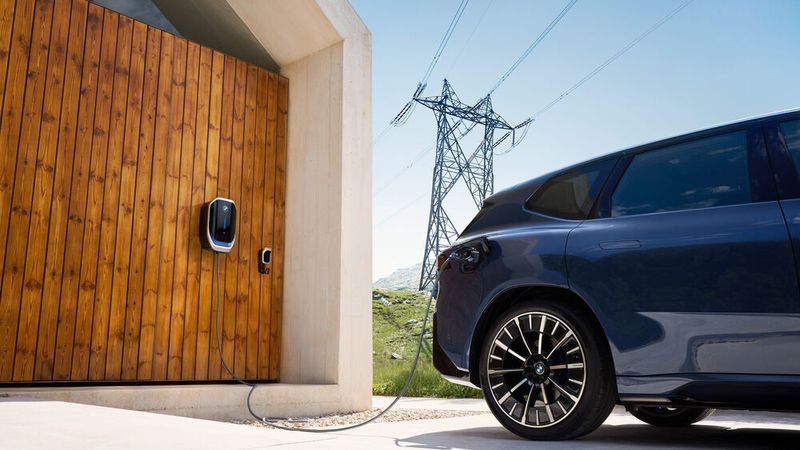
More electric vehicles on the roads mean a higher demand for electricity - which should ideally be covered by renewable energies.
(Image: BMW)
Europe's indecision on electromobility does not give the automotive industry a competitive advantage. Access to raw materials, on which the energy transition also depends, is crucial. Control over them is still a long way off: in China.
The global pioneer in electromobility is a country that lives from the oil and gas business: Norway. But that's not the only curiosity when it comes to car policy. In 2023, the EU de facto decided to phase out vehicles with combustion engines from 2035, only to do a somersault backwards after just 19 months. Under pressure from the car industry together with Germany, Italy and the Eastern European member states.
Arndt Uhlendorff is head of the Institute for Rare Earths and Metals based in Lucerne, Switzerland.
(Image: ISE)
This is curious because sticking to the combustion engine leads to higher costs for manufacturers if combustion and electric platforms have to be operated in parallel, which does not sound like a competitive advantage over Chinese competitors. The political U-turn is also the opposite of the clear policy that is so important for industry and investors, which ensures planning security. This is particularly true for the automotive industry, which plans in long cycles of up to 15 years.
But there is another fundamental question: is a complete switch to electromobility even possible? Theoretically yes, according to artificial intelligence. But in practice, the answer is currently rather negative, considering the supply of the necessary raw materials and clean electricity.
Toothless EU Raw Materials Policy
At the beginning of February, the European Court of Auditors published a report in which it scrutinized the EU's raw materials policy. In 2023, the EU adopted a law on critical raw materials, which sets out all kinds of measures with the aim of overcoming the excessive dependence on China and a few other countries for raw materials such as lithium, cobalt, nickel and rare earths. The Court of Auditors' damning verdict on Europe's raw materials strategy was toothless and haphazard.
The World Bank predicts that the green transition will increase demand for raw materials fivefold by 2050. Based on 2020, the EU Commission predicts that demand for lithium, for example, will increase 18-fold by 2030 and that for cobalt will increase five-fold. However, the EU countries will import three quarters of their raw material requirements.
High Losses Due to Shortage of Rare Earths
Nevertheless, governments have failed to back up their grandiose announcements on climate targets in material terms. If China wants to, it will simply strangle European industry. And it wants to, as the export restrictions on rare earths (permanent magnets), gallium and germanium (computer chips) over the past two years have shown.
Thomas Krümmer, rare earths expert and author of the "Rare Earths Observer", estimates the direct and indirect economic losses caused by China's restrictions on rare earths to be at least ten percent of global economic power. All of this has actually been known since 2010, when China first tightened the thumbscrews and triggered the first rare earth crisis - which incidentally led to the founding of the Institute for Rare Earths.
Up to 240 Terawatt Hours More Electricity Needed
And what about the supply of clean electricity? In 2024, there were 260 million cars on the roads in the EU. Of these, only three percent are purely electric, which equates to eight million. They consume around 16 terawatt hours, TWh, of electricity per year. The total electricity consumption of the EU-27 was 2,732 TWh. Around 1,000 TWh or 40 percent of this electricity came from renewable energy sources.
A study by Fraunhofer ISI and the auditing firm PwC predicts that the proportion of e-cars will increase to 30 percent by 2040, which would correspond to an additional electricity demand of around 240 TWh. In order to generate this additional electricity with clean energies, around 120 to 160 gigawatts (GW) of new wind and solar capacity will need to be installed.
However, it is not only transport that will be electrified, but also energy-intensive industries, heating systems for living spaces, such as heat pumps, and, last but not least, data centers will lead to a massive increase in electricity demand, which could therefore rise by 30 to 50 percent overall. That would already be 800 to 1,350 TWh more than today. In order to cover this additional electricity demand with renewables, 470 to 790 GW of renewable electricity capacity would have to be installed over the next 15 years.
Grid Expansion Bottleneck
According to initial estimates, 85 GW of new wind and solar capacity was added in the EU in 2025. If the expansion continues at this rate, the EU could realistically achieve its targets. But solar panels and wind turbines are not the only prerequisite for the green energy transition. The expansion of the grid infrastructure, storage capacities and the implementation of intelligent control systems are other important pillars to ensure that the green electricity generated arrives where it is needed - and to guarantee security of supply.
Date: 08.12.2025
Naturally, we always handle your personal data responsibly. Any personal data we receive from you is processed in accordance with applicable data protection legislation. For detailed information please see our privacy policy.
Consent to the use of data for promotional purposes
I hereby consent to Vogel Communications Group GmbH & Co. KG, Max-Planck-Str. 7-9, 97082 Würzburg including any affiliated companies according to §§ 15 et seq. AktG (hereafter: Vogel Communications Group) using my e-mail address to send editorial newsletters. A list of all affiliated companies can be found here
Newsletter content may include all products and services of any companies mentioned above, including for example specialist journals and books, events and fairs as well as event-related products and services, print and digital media offers and services such as additional (editorial) newsletters, raffles, lead campaigns, market research both online and offline, specialist webportals and e-learning offers. In case my personal telephone number has also been collected, it may be used for offers of aforementioned products, for services of the companies mentioned above, and market research purposes.
Additionally, my consent also includes the processing of my email address and telephone number for data matching for marketing purposes with select advertising partners such as LinkedIn, Google, and Meta. For this, Vogel Communications Group may transmit said data in hashed form to the advertising partners who then use said data to determine whether I am also a member of the mentioned advertising partner portals. Vogel Communications Group uses this feature for the purposes of re-targeting (up-selling, cross-selling, and customer loyalty), generating so-called look-alike audiences for acquisition of new customers, and as basis for exclusion for on-going advertising campaigns. Further information can be found in section “data matching for marketing purposes”.
In case I access protected data on Internet portals of Vogel Communications Group including any affiliated companies according to §§ 15 et seq. AktG, I need to provide further data in order to register for the access to such content. In return for this free access to editorial content, my data may be used in accordance with this consent for the purposes stated here. This does not apply to data matching for marketing purposes.
Right of revocation
I understand that I can revoke my consent at will. My revocation does not change the lawfulness of data processing that was conducted based on my consent leading up to my revocation. One option to declare my revocation is to use the contact form found at https://contact.vogel.de. In case I no longer wish to receive certain newsletters, I have subscribed to, I can also click on the unsubscribe link included at the end of a newsletter. Further information regarding my right of revocation and the implementation of it as well as the consequences of my revocation can be found in the data protection declaration, section editorial newsletter.
The expansion of cross-border capacities also plays an important role. However, the massive blackout in Spain, a pioneering country in renewable electricity generation, also illustrates the serious consequences that can result from the slow expansion of domestic and cross-border grid infrastructure.
More Raw Materials Required for Electricity Infrastructure
The investment required in the EU's electricity grids will amount to 1.1 trillion euros by 2040 (approx. USD 1.3 trillion), which equates to 74 billion euros per year (approx. USD 85 billion). This in turn translates into many tons of steel and thousands of kilometers of copper cables. Massive expansion with wind turbines and solar panels will require massive quantities of critical raw materials such as rare earths, silicon, indium and selenium, and lithium, graphite, cobalt and nickel for battery storage.
This brings us back full circle to the issue of the EU's dependence on raw materials and the Court of Auditors' damning verdict: "No sound strategy". So it remains to be seen how the EU intends to achieve the energy transition alongside the transport transition if it cannot secure the raw materials it needs. Perhaps behind the lurching course on the phase-out of combustion engines is a quiet suspicion on the part of politicians that the EU will probably not be able to close the gap in the race for critical minerals.
*Arndt Uhlendorff is head of the Institute for Rare Earths and Metals based in Lucerne, Switzerland



:quality(80)/p7i.vogel.de/wcms/95/97/95976dbaac68b249eb65e74c5aad5300/0129651893v1.jpeg "The C2.0 centric clamps, the S2 fixed jaw clamps and the \"gredoc\" zero-point clamping systems are used for machining the raw parts. Fastening is carried out with width across flats 27. (Image:Gressel)")
:quality(80)/p7i.vogel.de/wcms/57/1b/571b8895efb299d70846bbdbd7af2338/0130043886v1.jpeg "Servo hydraulics independent of the control system: The servo hydraulics software module is integrated directly into the b Maxx 5500 servo drive (pictured: Mehmet Sari, Export Sales Manager at Hürsan Pres (left), Özgür Deniz Demirbaş, Country Manager at Baumüller Turkey) (Image:Baumüller)")
:quality(80)/p7i.vogel.de/wcms/c2/57/c257474faf6095a24bacfd98524bc7f8/0130090188v1.jpeg "With the Coromill MR20 milling system, the cutting tool specialist Sandvik Coromant is bringing a product that should make a name for itself in tool and mold making, as well as in aerospace components, to what the manufacturer claims it can do ... (Image:Sandvik Coromant)")
:quality(80)/p7i.vogel.de/wcms/87/f8/87f88a6b4e47ea77b22b1eb88db533a8/0130110840v1.jpeg "Zenadrone, a subsidiary of Zenatec, is in the process of developing an operational low-cost drone as a disposable concept (symbolic image). The first prototype already exists. The aim is to counter the increasing number of enemy drone attacks in the future without spending a lot of money ... (Image:Cenadrone)")
:quality(80)/p7i.vogel.de/wcms/3b/27/3b27f6c5848be73acecb04054bf0a146/0130115209v1.jpeg "Spectroscopic glucose measurement with infrared spectroscopy enables more regular measurements without physical strain. (Image:Endrich)")
:quality(80)/p7i.vogel.de/wcms/3f/cc/3fccb748b0fe16f1f61249d94c72f126/0130149439v1.jpeg "Requirements for integrated power supply systems: Precise AC and DC power supply systems that not only provide energy, but also reliably combine measurement, analysis and system integration. (Image:Schulz Electronic)")
:quality(80)/p7i.vogel.de/wcms/fd/93/fd93e01c16f5a4709278499d981a459c/0130061090v1.jpeg "Revealed: These servo drives are assembled at Aerotech in Fürth. (Image:Aerotech)")
:quality(80)/p7i.vogel.de/wcms/cb/8a/cb8ae7f5205365efce3e7285154fc3cf/0130132198v1.jpeg "Markus Huber (left) and Nicolai Friis from TU Wien know how to make quantum computers multidimensional in order to perform computing operations even better. (Image:TU Vienna / A. Rommel)")
:quality(80)/p7i.vogel.de/wcms/63/21/6321beb732bf7d92640df46d7aa77573/0130125122v1.jpeg "As part of the Carbon Lab Factory Lausitz, a pilot plant for the production of sustainable, cost-effective and competitive carbon fibers will be built at the Guben site. (Image:Fraunhofer IAP / Kristin Stein)")
:quality(80)/p7i.vogel.de/wcms/53/4f/534fe0f168f6ee070ded4a48faca4cef/business-wire-main-image-1103x620v1.jpeg "The new UR AI Trainer, developed by Universal Robots and Scale AI, is the first direct lab-to-factory solution for AI model training.
(Source: Universal Robots)")
:quality(80)/p7i.vogel.de/wcms/08/70/087062e2e1a9b9add5777410dd746ee9/adobestock-1923991605-5607x3156v1v1.jpeg "A new type of tactile sensor, inspired by human skin, even recognizes grains of sand. (Image:Curioso.Photography - stock.adobe.com)")
:quality(80)/p7i.vogel.de/wcms/7f/08/7f087d7013424d123ab7275cd2e3fe55/adobestock-809456218--c2-a9-20degimages-20-e2-80-93-20stock-adobe-com-ki-generiert-4179x2351v1v1.jpeg "The digital upgrading of existing machines conserves resources, saves energy and reduces the need for new production. (Image:Degimages - stock.adobe.com/AI-generated)")
:quality(80)/p7i.vogel.de/wcms/90/db/90db3087d3af0560fcdb4dbc42443ce1/0130157448v1.jpeg "The switch to SDV is the most complex transformation the industry has ever had to master. The end consumer gets a vehicle that gains rather than loses value over its lifetime. (Image:Sonatus)")
:quality(80)/p7i.vogel.de/wcms/73/f0/73f00bb99a23197db05bb584fe78f20f/0130080581v1.jpeg "The \"China Speed\" analysis by Roland Berger shows that the speed of development has only a limited connection with labor costs. (Image:freely licensed at Pexels)")
:quality(80)/p7i.vogel.de/wcms/2f/5b/2f5ba6a150b52c2b8efada560c5cdafe/0130143442v1.jpeg "Automotive suppliers are facing a severe crisis, which is primarily due to a combination of structural change and economic problems. (Image:freely licensed at Pexels)")
:quality(80)/p7i.vogel.de/wcms/22/d0/22d03cd48e992435338b59464c428d41/0129739814v1.jpeg "More electric vehicles on the roads mean a higher demand for electricity - which should ideally be covered by renewable energies. (Image:BMW)")
:quality(80)/p7i.vogel.de/wcms/94/7a/947ac066b98cbcd3470e83ff9da3e25f/0130096114v1.jpeg "The use of amorphous steels in the stator enables a significant reduction in losses and increases the efficiency of modern electric motors in vehicle drives. (Image:Horse Powertrain)")
:quality(80)/p7i.vogel.de/wcms/e5/f1/e5f171d3d7ae021332cc0aeae4d6e299/0130127049v1.jpeg "In collaboration with Shanghai Jiao Tong University, Lenovo has presented a silicon anode battery under the name \"ED1000\" as a proof of concept for mobile workstations. (Image:Lenovo)")
:quality(80)/p7i.vogel.de/wcms/fa/69/fa696e59706b96fff02283dd74cc2398/0130129635v1.jpeg "Samsung Co-CEO Jun Young-hyun wants to respond to the AI-driven boom in demand in the memory market with contracts for up to five years. This should provide more planning security in the traditionally volatile storage business. At the same time, however, this is likely to increase the pressure on customers to secure precise long-term requirements, prices and supply chains. (Image:Samsung)")
:quality(80)/p7i.vogel.de/wcms/31/a8/31a883a47b86634c382923e78fd9a4c9/0130133225v1.jpeg "Figure 1: GMSL-capable point-to-point connection. (Image:ADI)")
:fill(fff,0)/images.vogel.de/vogelonline/companyimg/76800/76895/65.jpg "FAULHABER_120mm.jpg ()")
:fill(fff,0)/p7i.vogel.de/companies/69/88/69882c428938e/tmts2026-ticec-banner-en-2000px.png "tmts2026-ticec-banner-en-2000px (https://www.tmts.tw/en)")
:fill(fff,0)/p7i.vogel.de/companies/67/eb/67eba621ef6ea/logo2.png "logo2 (Wuxi InfiMotion)")

:quality(80)/p7i.vogel.de/wcms/eb/92/eb9267f5522dd1664e0ee125a11c4c4b/adobestock-308282197--c2-a9-20malp-20-e2-80-93-20stock-adobe-com-4700x2643v1v1.jpeg "A new liquid air storage system is expected to generate 180 million kilowatt hours of electricity per year, enough to supply 30,000 households with electricity for a whole year. (Image:malp - stock.adobe.com.jpeg)")
:quality(80)/p7i.vogel.de/wcms/4f/35/4f352211a68db5d0d86c4685d68d2dc2/0113143253v1.jpeg "In our China Market Insider, we regularly provide you with relevant information directly from China. (Image:© Eisenhans - stock.adobe.com)")