At the end of November 2026, Euro 7 will take effect. The regulation limits brake particle emissions. What does this mean for pads and discs?
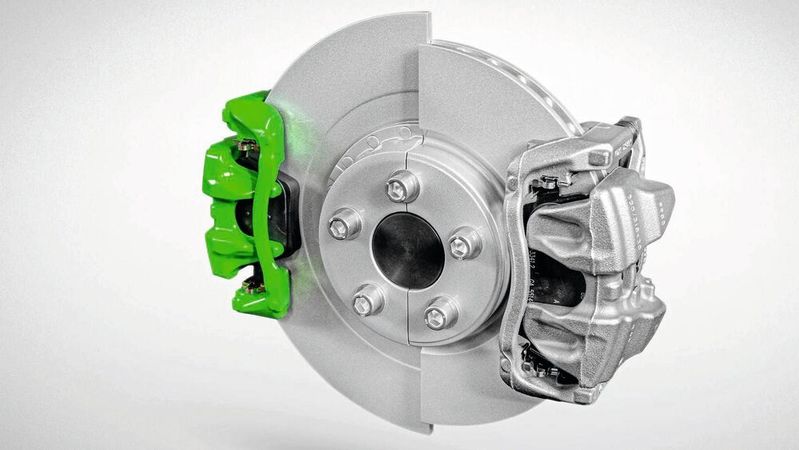
The new Euro 7 standard sets requirements for the wear of service brakes. These can be met with some technical methods.
(Image: Aumovio)
From November 29 of this year, newly homologated vehicle models may not release more than seven milligrams of brake wear per mile into the environment. For battery-electric vehicles, the limit is only three milligrams. From November 29, 2027, this requirement will apply to all new registrations.
This is the first time air pollutants are addressed that do not originate from the drivetrain or exhaust—which is why one should now refer to an emissions standard rather than an exhaust standard.
We asked several manufacturers and suppliers of brake components what the new standard means for the design and production of brake pads and discs. We thank the companies Aumovio, Brembo, Forvia Hella, TMD Friction, and Zimmermann for their responses.
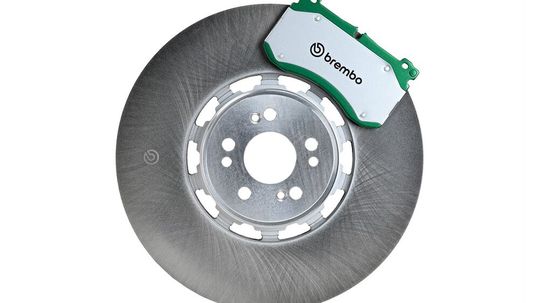
Coated or heat-treated brake discs, like these from Brembo, emit significantly less fine dust and do not rust—the ideal combination for Euro 7 and e-mobility. Unfortunately, they are expensive.
(Image: Brembo)
What is the Share of Emissions from the Brake Disc And Brake Pad?
The proportions of fine dust emissions attributable to the brake disc and the brake pad strongly depend on the friction pairing used. For a classic friction pairing, predominantly used in Europe, consisting of a cast iron brake disc with a "low-metallic" ECE brake pad, studies show a high iron content in fine dust emissions. The iron content can range from 70 to 90 percent. Accordingly, the main component of fine dust emissions is the wear of the brake disc.
Will New Technologies Be Necessary to Meet Euro 7? If So, Which Ones?
Different friction pairings are required for different vehicle platforms and drive concepts. For example, small, lightweight electric vehicles often only need an adjustment of the brake pad towards less abrasive material combinations to meet the Euro 7 standard.
Large vehicles can meet the new Euro 7 requirements by using a brake disc subjected to a ferritic nitrocarburizing heat treatment (NFC) and a corresponding adapted brake pad. For large, heavy vehicles with combustion engines, the use of hard-coated brake discs and matching brake pads is necessary. The coating is typically made of stainless steel mixed with titanium carbides. Other options include tungsten carbide or Verocrom. These coatings have a surface hardness up to ten times higher than cast iron.
An alternative development approach focuses on the brake pad, making it less aggressive to reduce wear on the brake disc. This often involves the use of NAO brake pads, "Non-Asbestos Organics," which operate on the adhesion friction principle. In contrast, traditional "low-metallic" ECE pads operate abrasively.
An example of Euro 7-compliant brake technology is the "Greentell" set by Brembo. The brake disc features a two-layer, nickel-free coating applied using laser metal deposition. Combined with the corresponding brake pads, it reduces surface wear by 80 percent compared to an uncoated cast iron brake disc. Additionally, some OEMs are testing closed systems such as drum brakes to structurally reduce fine dust emissions.
Are There Conflicts of Interest Between Corrosion Protection And Euro 7?
When using traditional friction pairings, a clear conflict of objectives currently arises. For electric vehicles, highly abrasive friction pairings are currently used to remove rust that forms on the brake disc even with lower friction performance. However, this increases the generation of fine dust. Alternatives include the aforementioned hard-coated or FNC-treated brake discs. Both solutions offer excellent corrosion protection.
What Are the Consequences of Euro 7 for Pure Aftermarket Parts?
The pairing of the brake disc with the respective friction pad gains importance under Euro 7, as they are tested in combination and the limits apply to the pairing. Replacing only one component may, therefore, no longer ensure compliance with the limits. This will present a particular challenge for the aftermarket and significantly restrict interchangeability, Hella notes.
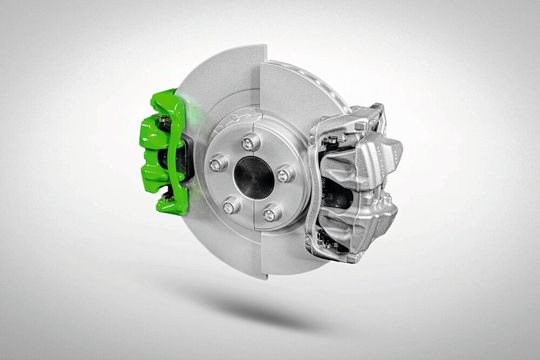
The transition to electromobility enables new brake designs: more compact and lighter brake calipers (such as the Green Electric Caliper from Aumovio), different disc materials (stainless steel), or drum brakes.
(Image: Aumovio)
The question of how aftermarket parts will be approved for the market in terms of their emission properties has not yet been conclusively clarified. According to Aumovio, the issue is currently being discussed in various committees so that independent aftermarket parts suppliers and wholesalers have clarity on how their products can comply with the new regulation.
Will Brakes for Electric Cars Differ from Other Brakes in the Future?
According to TMD Friction, the highly electrically assisted braking of electric vehicles presents new opportunities for materials that were not suitable for conventional vehicles due to insufficient performance. For example, stainless steel would be a suitable material for the brake disc to protect against corrosion. Other materials that are hardly susceptible to corrosion could also be considered, such as aluminum.
Date: 08.12.2025
Naturally, we always handle your personal data responsibly. Any personal data we receive from you is processed in accordance with applicable data protection legislation. For detailed information please see our privacy policy.
Consent to the use of data for promotional purposes
I hereby consent to Vogel Communications Group GmbH & Co. KG, Max-Planck-Str. 7-9, 97082 Würzburg including any affiliated companies according to §§ 15 et seq. AktG (hereafter: Vogel Communications Group) using my e-mail address to send editorial newsletters. A list of all affiliated companies can be found here
Newsletter content may include all products and services of any companies mentioned above, including for example specialist journals and books, events and fairs as well as event-related products and services, print and digital media offers and services such as additional (editorial) newsletters, raffles, lead campaigns, market research both online and offline, specialist webportals and e-learning offers. In case my personal telephone number has also been collected, it may be used for offers of aforementioned products, for services of the companies mentioned above, and market research purposes.
Additionally, my consent also includes the processing of my email address and telephone number for data matching for marketing purposes with select advertising partners such as LinkedIn, Google, and Meta. For this, Vogel Communications Group may transmit said data in hashed form to the advertising partners who then use said data to determine whether I am also a member of the mentioned advertising partner portals. Vogel Communications Group uses this feature for the purposes of re-targeting (up-selling, cross-selling, and customer loyalty), generating so-called look-alike audiences for acquisition of new customers, and as basis for exclusion for on-going advertising campaigns. Further information can be found in section “data matching for marketing purposes”.
In case I access protected data on Internet portals of Vogel Communications Group including any affiliated companies according to §§ 15 et seq. AktG, I need to provide further data in order to register for the access to such content. In return for this free access to editorial content, my data may be used in accordance with this consent for the purposes stated here. This does not apply to data matching for marketing purposes.
Right of revocation
I understand that I can revoke my consent at will. My revocation does not change the lawfulness of data processing that was conducted based on my consent leading up to my revocation. One option to declare my revocation is to use the contact form found at https://contact.vogel.de. In case I no longer wish to receive certain newsletters, I have subscribed to, I can also click on the unsubscribe link included at the end of a newsletter. Further information regarding my right of revocation and the implementation of it as well as the consequences of my revocation can be found in the data protection declaration, section editorial newsletter.
Aumovio is working on lighter brake components. The so-called "green" floating brake calipers for electric vehicles are more compact and lighter than those in conventional vehicles—while maintaining identical braking performance. With this new design, the brake caliper can be up to two kilograms lighter, and the brake disc even up to three kilograms.
Do Brake Pads for Electric Cars Have A Thinner Friction Layer?
Aumovio: When brake systems are developed for a purely electric vehicle platform, the advantages of recuperation can also be utilized in the design of the friction brake. If less total frictional performance needs to be realized in the pad, brake pads or the friction material used can be made thinner.
Forvia Hella: At present, we are not making targeted adjustments to the pad thickness specifically for electric cars. In principle, it would be conceivable to save material due to the reduced strain on brake pads from recuperation. However, the pad thickness in our development and during reverse engineering is always based on the specifications of the respective OEMs.
TMD Friction: In individual cases, this is practiced.
Will Electric Cars Have A "Lifetime Brake" in the Future?
Fundamentally, this is conceivable, says Aumovio. However, there are two technical challenges that stand in the way: corrosion and wear. As previously mentioned, the corrosion protection of the brake disc can be improved through coatings. The wear of these brake discs is low enough that they can be used for "lifetime brakes." However, such a brake disc is significantly more expensive than traditional designs.
The wear of brake pads is also significantly lower compared to uncoated brake discs, by a factor of 2 to 3, but is currently still not in the range of "lifetime brakes" with up to 186,000 miles.
In the future, the main reason for replacing brake discs will be less due to wear of the friction partners and more due to aging effects such as rust in the cooling fins or possible cracks in the coating that promote corrosion. According to TMD Friction, it is conceivable that vehicle manufacturers will specify replacement after a certain mileage or operating time—whichever comes first.



:quality(80)/p7i.vogel.de/wcms/93/33/93337b12f88eb2c776c80d4f9e49d323/0129247650v1.jpeg "Isolated IoT data becomes connected real-time personalization. (Image: ©PB Studio Photo - stock.adobe.com)")
:quality(80)/p7i.vogel.de/wcms/8e/fa/8efad6aa006fcf624d07c645b774d8ce/screenshot-202026-01-21-20113324-764x430v1v1.png "The system processes heavy sheets weighing up to 200 kg fully automatically, without programming or teaching. (Image:Teqram)")
:quality(80)/p7i.vogel.de/wcms/0c/58/0c587c8221ae96052b5dcc0f40eb3dcd/0128880879v1.jpeg "A chip surfer with a solid carbide head is used for finishing in the third operation. (Image:Ingersoll)")
:quality(80)/p7i.vogel.de/wcms/a2/9b/a29bb02b3f1e34962e28579dccfbbc49/0129266114v1.jpeg "Bevel gears on workpiece carriers in the rotary indexing conveyor of the VSC 400 DDS - the pick-up spindle removes the workpiece precisely and reproducibly for hard machining at EWS. (Image:Emag)")
:quality(80)/p7i.vogel.de/wcms/4d/74/4d745446555110ca9797db1eabb7c9d3/0129551585v1.jpeg "Jochen Gemeinhardt is responsible for NTT Data's AI business in the DACH region as Head of Production & Supply Chain and Head of Industry Line Global Business. (Image:NTT Data)")
:quality(80)/p7i.vogel.de/wcms/7a/c8/7ac81c41bab1cc98fbe7b20c95644c6c/0129575667v1.jpeg "For the live gala show celebrating the New Year festival, Unitree rehearsed an impressive performance with its robots. (Image:Unitree/YouTube)")
:quality(80)/p7i.vogel.de/wcms/a3/0c/a30c4c3a36910e92d6082fde37261730/0129555015v1.jpeg "From command recipient to decision-maker: thanks to Agentic AI, robots no longer just stubbornly execute pre-programmed scripts. Instead, they analyze visual data in real time and decide autonomously on the next process step (Image:Nano Banana / AI-generated)")
:quality(80)/p7i.vogel.de/wcms/60/00/6000deb595c3e6b2dd0bfe508aa71653/newsimage418166-5084x2861v1v1.jpeg "The robot-guided friction stir welding gun \"Steppwelder\" in use on a conventional 6-axis industrial robot. (Image:Image: Dominik Walz, MPA, University of Stuttgart)")
:quality(80)/p7i.vogel.de/wcms/48/38/4838074eab3f29ec319797fb63881b18/adobestock-693942839--c2-a9-20wirot-20-e2-80-93-20stock-adobe-com-3389x1907v1v1.jpeg "Leaves or bird droppings can cause hotspots on solar modules and reduce performance. (Image:Wirot stock.adobe.com.)")
:quality(80)/p7i.vogel.de/wcms/3f/7f/3f7f9f45ebccd4751d41106866314aea/newsimage418028-2772x1559v1v1.jpeg "Live in the ice channel—detailed recordings in real time make the smallest mistakes and thus time losses in the luge run visible. (Image:Mittweida University of Applied Sciences)")
:quality(80)/p7i.vogel.de/wcms/05/b7/05b7c58dcf5a7fc900348d1c30f7c116/0129540459v1.jpeg "Researchers from Stuttgart have investigated whether the \"technology\" behind hairy elephant trunks, which function as a sensitive gripping system, can also be used in robotics. (Image:Zoo Magic)")
:quality(80)/p7i.vogel.de/wcms/6b/6f/6b6fff754fedf05375e5255460743297/0129197850v1.jpeg "A new core-shell design for anodes aims to reduce storage losses during the first charge cycle of sodium-ion batteries. (Image:BAM)")
:quality(80)/p7i.vogel.de/wcms/37/23/372374e00db2f1803ae5cde2f00aff31/0129599814v1.jpeg "The new Euro 7 standard sets requirements for the wear of service brakes. These can be met with some technical methods. (Image:Aumovio)")
:quality(80)/p7i.vogel.de/wcms/0c/1d/0c1da1d70af62238b11e22b102bd256d/0129108406v1.jpeg "At the first ADAC glare symposium, experts illustrated and analyzed the topic of glare under real conditions. (Image:Dominsky – VCG)")
:quality(80)/p7i.vogel.de/wcms/95/00/95009ae2972690e3fdab0dc701e202c3/0129621847v1.jpeg "Last year, Airbus's revenue increased by six percent to 81 billion US dollars. (Image:Airbus SAS 2024)")
:quality(80)/p7i.vogel.de/wcms/ae/cf/aecf874a057676aa69b3b5e4c7b52411/0129609464v1.jpeg "Glass storage in action: Microsoft has stored map data from the Flight Simulator on this piece of glass. (Image:Microsoft Research)")
:quality(80)/p7i.vogel.de/wcms/2c/8d/2c8da4b72e35ded278178929afb94d55/0129561713v1.jpeg "Change in direction: The shift away from PFAS in semiconductor manufacturing and the move toward sustainable chip production is demonstrated by the trilateral collaboration between Fraunhofer ENAS, the Paul Scherrer Institute PSI, and Memsstar Limited, which rely on the environmentally friendly Gas-MacEtch technology. (Image:andreyarmyagov/Canva)")
:quality(80)/p7i.vogel.de/wcms/a3/df/a3df18dc04ecd4cffbf933b32018facb/0129644484v1.jpeg "Acquisition complete: Finnish Incap has finalized the takeover of EMS manufacturer Lacon. (Image:Gerd Altmann from Pixabay)")
:quality(80)/p7i.vogel.de/wcms/41/85/41855b7e5c57936c33039a7e785462c9/0129633555v1.jpeg "A chip processing method developed by MIT could help cryptographic processes keep data secure by allowing two chips within the same system to authenticate each other using a common fingerprint. (Image:freely licensed)")
:fill(fff,0)/images.vogel.de/vogelonline/companyimg/76800/76895/65.jpg "FAULHABER_120mm.jpg ()")
:fill(fff,0)/p7i.vogel.de/companies/67/eb/67eba621ef6ea/logo2.png "logo2 (Wuxi InfiMotion)")
:quality(80):fill(efefef,0)/p7i.vogel.de/wcms/63/7f/637f1d3982ca7/siemens-retargeting-wp1-cover-369123.png "Siemens_Retargeting_WP1 Cover_369123")
:quality(80)/p7i.vogel.de/wcms/78/44/7844b36de65e915679161b021927805d/0127497026v1.jpeg "HiPIMS enables coating thicknesses of up to 12 micrometers (0.00047 inches) and significantly enhances the quality and performance of the coatings. (Image:CemeCon AG)")
:quality(80)/p7i.vogel.de/wcms/e5/56/e556e72572c421a13071be62ddcb31ea/0124376715v1.jpeg "The CCGT 09T304 turning insert is well-suited for roughing Ecobrass. (Image:Iscar)")