The production of battery cells in gigafactories consumes a tremendous amount of energy and is inflexible. An alternative has been successfully tested at the wbk Institute of Production Science in Karlsruhe: process enclosure in mini-environments. Playing a leading role: robots from Kuka.
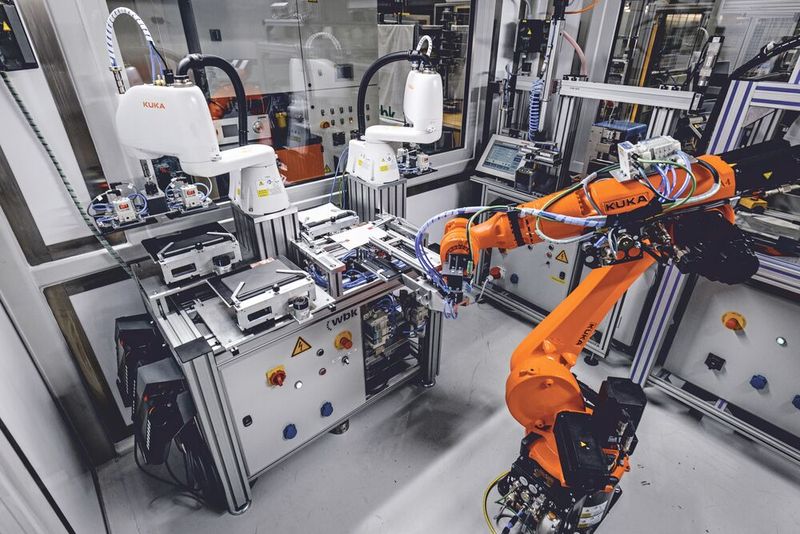
Two KR Scara and one KR Cybertech nano from Kuka in a successful practical test during cell stacking.
(Image: Kuka)
At the wbk Institute of Production Science at the Karlsruhe Institute of Technology (KIT), forward-looking battery production is already tangible. To make it more flexible and efficient, researchers have established an agile cell production as part of the AgiloBat project: using robot-based automation in mini-environments, they achieved a level of flexibility previously only possible in manufacturing. Through adaptable processes and program changes, various cell geometries can be produced without the need for elaborate retooling of the facility!
Dry rooms: challenging environment for robots
The use in dry rooms presents special challenges for the robots. The extremely low humidity can lead to increased wear and tear. This is especially true for materials containing plasticizers, such as seals or cable connections: in long-term applications in dry rooms, they can become porous more quickly, or in the worst case, even break. Lubricants can also lose functionality because they lose their water content.
The Future of Battery Cell Production: Energy-Optimized and Flexible
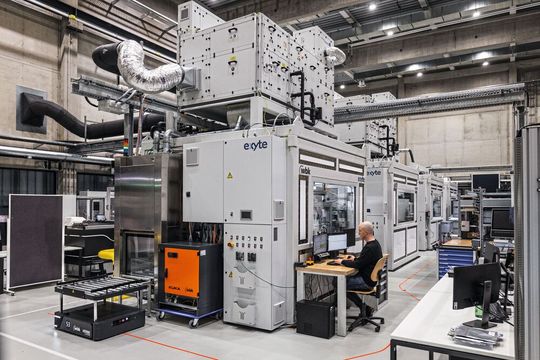
The robot cells developed by researchers at the wbk, a world first in terms of their nature and design, were built by Exentec.
(Image: Kuka)
For this purpose, the researchers developed special robot cells that are a world first in terms of their composition and execution. They were designed and built by Exentec Germany GmbH, a company of the Exyte Group. Exyte is an international company based in Stuttgart specializing in building technology and plant construction. It designs, plans, and provides sustainable and ultra-clean manufacturing facilities for high-tech industries, including semiconductor and battery factories, data centers, and facilities for the biopharma industry. One of Exentec's focuses is on clean and dry rooms. Or, in the words of Nicole Neub, Director of the Battery Technology Department at Exentec: "We are responsible for the necessary dry air in the battery manufacturing process."
Each Process Step in a Mini-Environment
As is well known, the ambient air in battery cell production must contain very little humidity. More precisely, to prevent oxidation or moisture inclusions during the processing of sensitive battery materials, the relative humidity is usually less than one percent. This is because higher relative humidity can later lead to quality problems or even critical failures of the batteries.
The required dryness is achieved in so-called mini-environments. "Individual production process steps and the associated machines are enclosed, and filtered air is supplied directly to the process," explains Nicole Neub. "This means only the machine is supplied with clean and dry air, not an unused large volume in the production hall." In industrial mass production of battery cells, entire production areas are usually operated as dry rooms, which is not necessary for individual processes and requires large amounts of energy.
In the AgiloBat project, this is achieved through container-like boxes with a dew point of up to -50 °C (-122°F). "This has nothing to do with the temperature of the production environment," explains Sebastian Henschel, the technical director of the AgiloBat project at the wbk Institute of Production Science at KIT. Rather, the dew point indicates the temperature to which air must be cooled for moisture to condense. In other words, the lower the dew point, the drier the air. "At a dew point of -50 °C (-122°F), there are fewer than 100 water molecules per million air molecules by volume," Henschel clarifies. "This corresponds to a relative humidity of well below one percent."
Humans are Separated From the Process—Thanks to Automation
A crucial factor in this is the employees: "We humans are composed of 80 percent water, which is anything but helpful in such a process," says Henschel. "And even when we are completely still, we exhale at least 120 grams of pure moisture every hour," adds Neub. "These amounts of moisture significantly negatively affect a stable dew point of, for example, -50°C (-122°F)." To get the production environment properly dry, people must be kept out of it as much as possible. This is precisely Exentec's approach: "In our mini-environment, we consistently separate people from the process through enclosure," Neub explains. "This is only possible if the process is fully automated." And this is where Kuka's robots come into play.
As part of AgiloBat, four KR Cybertech nano robots, a KR 4 Agilus, and two KR Scara for cell stacking are used—to the complete satisfaction of the project leaders. "Battery cell manufacturers have been using Kuka robots in large numbers in dry rooms for years to reduce environmental contamination by employees and to increase production quality," says Thomas Schmidberger, Business Development Manager at Kuka. Kuka has been in contact with battery producers for some time regarding their technological requirements for dry room environments.
Robots from Kuka Master the Special Challenges in the Dry Room
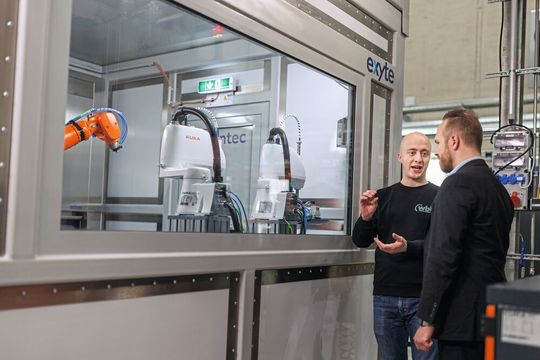
Sebastian Henschel (left) and Thomas Schmidberger examine the automated process in the mini-environment.
(Image: Kuka)
"The requirements for our products in dry rooms are well known to us from numerous successful customer projects and are continuously analyzed together with leading industry experts," emphasizes Schmidberger. As one of the leading robot manufacturers, Kuka is working on certifying its robots for use in dry rooms. Special challenges, therefore, are considered by Kuka: since 2020, the automation experts from Augsburg have already gained experience with over 10,000 robots in battery production, more than 1,000 of which are in dry room applications. The customer feedback is consistently positive.
However, production in mini-environments using automation is not only interesting for battery cell production, but also for many other industries: "In the semiconductor industry, this topic is essential, as well as in the pharmaceutical industry," reports Neub. Here, the advantages of Kuka's broad product range fully come into play: thanks to their versatility and flexibility, the robots can be used for completely different areas, products, and environments.
The project at KIT has also demonstrated this: "We wanted to build a maximally flexible system by mapping different process steps through various production modules and then connecting them," says Henschel. "Here, Kuka's robots have absolutely proven themselves. With their help, we achieved industrial repeatability and accuracy—combined with flexibility that we otherwise only know from manual craftsmanship."
Attractive Production Opportunity, also for Small and Medium-Sized Enterprises
These features are particularly attractive for SMEs—not coincidentally, the KIT team collaborated with medium-sized machinery and plant manufacturers on AgiloBat. Mini-environments and automation enable them to offer competitive plant technology along the critical process chain within dry-room-relevant production environments. The insights from AgiloBat allow them to flexibly produce battery cells and test new material systems through industry-related production with small material quantities.
"After all, we must not forget that these chemical process steps in battery production involve working with critical substances," says Schmidberger. "Robot-based automation in conjunction with the use of mini-environments thus also protects the health of employees."
Above all, the production processes applied in AgiloBat can save significant resources in two ways: firstly, considerably less energy is required than in conventional production. "In gigafactories, between 25 and 40 percent of the total energy demand is solely for maintaining dry room conditions. And we’re constantly drying against the continuous moisture entry of every person in the dry room," says Neub. "Through mini-environments and the consequent separation of humans and processes, this figure and thus ongoing costs, or OPEX, can be significantly reduced."
And secondly, the unusable scrap is significantly reduced: "With the large systems, even when they are in full operation, we sometimes have 15 to 20 percent scrap material that has to be thrown away or recycled," Henschel calculates. "We can also significantly reduce this rate through the flexibility of production." The robots from Kuka make it possible!
Additional Information on the Topic
The production of battery cells must take place in an extremely dry environment.
Mini-environments are robot cells where the desired conditions are created.
This saves energy compared to air-conditioning entire halls by removing humans from the filtered environment.
Naturally, we always handle your personal data responsibly. Any personal data we receive from you is processed in accordance with applicable data protection legislation. For detailed information please see our privacy policy.
Consent to the use of data for promotional purposes
I hereby consent to Vogel Communications Group GmbH & Co. KG, Max-Planck-Str. 7-9, 97082 Würzburg including any affiliated companies according to §§ 15 et seq. AktG (hereafter: Vogel Communications Group) using my e-mail address to send editorial newsletters. A list of all affiliated companies can be found here
Newsletter content may include all products and services of any companies mentioned above, including for example specialist journals and books, events and fairs as well as event-related products and services, print and digital media offers and services such as additional (editorial) newsletters, raffles, lead campaigns, market research both online and offline, specialist webportals and e-learning offers. In case my personal telephone number has also been collected, it may be used for offers of aforementioned products, for services of the companies mentioned above, and market research purposes.
Additionally, my consent also includes the processing of my email address and telephone number for data matching for marketing purposes with select advertising partners such as LinkedIn, Google, and Meta. For this, Vogel Communications Group may transmit said data in hashed form to the advertising partners who then use said data to determine whether I am also a member of the mentioned advertising partner portals. Vogel Communications Group uses this feature for the purposes of re-targeting (up-selling, cross-selling, and customer loyalty), generating so-called look-alike audiences for acquisition of new customers, and as basis for exclusion for on-going advertising campaigns. Further information can be found in section “data matching for marketing purposes”.
In case I access protected data on Internet portals of Vogel Communications Group including any affiliated companies according to §§ 15 et seq. AktG, I need to provide further data in order to register for the access to such content. In return for this free access to editorial content, my data may be used in accordance with this consent for the purposes stated here. This does not apply to data matching for marketing purposes.
Right of revocation
I understand that I can revoke my consent at will. My revocation does not change the lawfulness of data processing that was conducted based on my consent leading up to my revocation. One option to declare my revocation is to use the contact form found at https://contact.vogel.de. In case I no longer wish to receive certain newsletters, I have subscribed to, I can also click on the unsubscribe link included at the end of a newsletter. Further information regarding my right of revocation and the implementation of it as well as the consequences of my revocation can be found in the data protection declaration, section editorial newsletter.



:quality(80)/p7i.vogel.de/wcms/f9/7d/f97deef8fde21c8630d76411b18a20a7/0129803665v1.jpeg "Skoda has invested well over 220 million US dollars in the high-tech battery plant that has now opened in Mlada Boleslav. It has now started its work, which is highly automated ... (Image:Skoda)")
:quality(80)/p7i.vogel.de/wcms/f5/61/f561ad7c72ed41fd7a67ad9c481cb15d/0129799343v1.jpeg "Engine-generator units (MGU) from Steyr Motors are at work in the Leopard 2 main battle tank and the Leguan bridge vehicle (pictured). An extended contract is now to secure at least 500 more systems of this type for the Bundeswehr ... (Image:German Armed Forces)")
:quality(80)/p7i.vogel.de/wcms/6c/b5/6cb5ce2155433f6e73b16399adc4c561/0113143253v1.jpeg "In our China Market Insider we regularly provide you with relevant information directly from China. (Image:© Eisenhans - stock.adobe.com)")
:quality(80)/p7i.vogel.de/wcms/7f/fd/7ffd32863352c40f562f4245e4766e61/0129745849v1.jpeg "After US President Donald Trump once again resorted to his favorite weapon, tariffs, concerns rose in the EU that the so-called tariff deal could become invalid. But it looks as if the sea remains relatively calm ... (Image:F. Schneidler)")
:quality(80)/p7i.vogel.de/wcms/9c/ac/9cac6246660e746c5a3989399ac4d250/0128561645v1.jpeg "Artificial intelligence can drive efficiency in smart factories through centralized data management and predictive maintenance. (Picture: ©Fardived - stock.adobe.com)")
:quality(80)/p7i.vogel.de/wcms/6b/e2/6be235b5ad8a442ccd9d164b0b300d8b/0129763992v1.jpeg "As early as 2020, the Zimmer Group announced that it would convert its production to be sustainably CO2-neutral. (Image:Zimmer Group)")
:quality(80)/p7i.vogel.de/wcms/d4/ba/d4bab9481e66f8570f40eb8ef2a90198/0129795613v1.jpeg "A camera inspection during removal ensures that the components are placed correctly in the KLTs. (Image:Yaskawa Europe)")
:quality(80)/p7i.vogel.de/wcms/cb/56/cb56e42b01638b618e8d1b9b38f32faa/0129810132v1.jpeg "From summer 2026, \"AEON\" will support people at the BMW plant in Leipzig. (Image:diephotodesigner.de/BMW)")
:quality(80)/p7i.vogel.de/wcms/b5/5e/b55ed9355e0395ec0caf111d6af6b494/adobestock-495980372--c2-a9-20natali-mis-20-e2-80-93-20stock-adobe-com-6720x3778v1v1.jpeg "Which engineering skills will be in vogue in 2026? (Image:natali_mis - stock.adobe.com)")
:quality(80)/p7i.vogel.de/wcms/bf/a5/bfa5d882e93f159ce93e933742272b00/nord-vibn-cmyk-2196x1235v1v1.jpeg "With digital twins for virtual commissioning, Nord supports customers in ensuring that systems are available more quickly, even with complex drive systems. (Image:Nord Drivesystems)")
:quality(80)/p7i.vogel.de/wcms/f5/7e/f57ef535ee35e7b3b7ff15a8a63cef10/eds-keyvisual-8000x4496v1.jpeg "(Source: European Defence Supply)")
:quality(80)/p7i.vogel.de/wcms/af/a3/afa312176d956068af20491957eef642/newsimage418262-3100x1745v1v1.jpeg "The autonomous shuttle of the Aula AI project during a demonstration of sensor data with artificial fog. (Image:University of Magdeburg)")
:quality(80)/p7i.vogel.de/wcms/cb/23/cb23acd8e9de969d52522692b62b1892/0129680605v1.jpeg "The Z22198 is an extremely compact, three-axis IEPE acceleration sensor for measuring oscillations (vibrations) and shocks in demanding applications. With an edge length of just 0.24 inches and a weight of 0.03 ounces, it is ideal for lightweight structures and confined spaces. (Image:Copyright 2020 ScROGERS,All Rights Reserved)")
:quality(80)/p7i.vogel.de/wcms/c4/40/c44043c61f9dd99b80ccca398c284018/0129795093v1.jpeg "Subaru manufactures the E-Outback at its Yajima plant, marking the first time it has produced an electric vehicle in-house. (Image:Subaru)")
:quality(80)/p7i.vogel.de/wcms/fe/18/fe1824e572677900655c854f6c92c391/0129811281v1.jpeg "BMW and CATL deepen their partnership and work together on the battery pass. (Image:BMW)")
:quality(80)/p7i.vogel.de/wcms/15/54/15546b27b3a679871325ef6d92509a95/0129750872v1.jpeg "Webasto plans to open its third plant for sunroofs in India. (Image:Webasto)")
:quality(80)/p7i.vogel.de/wcms/70/14/70142aa050f8d3f7784c5ddbb2aba5f1/0129778339v1.jpeg "The software investments in production have saved time in Lacon production. (Image:Lacon)")
:quality(80)/p7i.vogel.de/wcms/5c/0f/5c0fee074c4b6c8e8c0993f3217c2f5a/0129773718v1.jpeg "The General Fusion demonstration reactor. (Image:General Fusion)")
:quality(80)/p7i.vogel.de/wcms/7f/c1/7fc1c83b8509df676d27518b82aaef02/0129764984v1.jpeg "China Resources Microelectronics (CR Micro) has announced its intention to increase the prices of its own products. (Image:China Resources Microelectronics)")
:quality(80)/p7i.vogel.de/wcms/eb/4e/eb4e449562174ec95a5b3d30fb0137a2/0129648135v1.jpeg "The III-V germanium PV module with an efficiency of 34.2% is currently the most efficient solar module in the world. (Image:Jacob Forster)")
:quality(80)/p7i.vogel.de/wcms/db/be/dbbe85344aebb9ff75d0746c8727b136/0124860543v1.jpeg "Two KR Scara from Kuka in a successful practical test during cell stacking.(Image: Kuka)")
:quality(80)/p7i.vogel.de/wcms/cc/a2/cca2218f3a85f3766f7a330cba4223b7/0124558127v1.jpeg "The KR Cybertech nano from Kuka in precise and effective use in the mini-environment.(Image: Kuka)")
:quality(80)/p7i.vogel.de/wcms/8e/bc/8ebc233055c61ceeb15bc4bc301b7d55/0124558120v1.jpeg "Sebastian Henschel (left), technical director for AgiloBat at wbk, controls the process in the mini-environment from outside.(Image: Kuka)")
:quality(80)/p7i.vogel.de/wcms/ed/0d/ed0d8af165289ffabb1252151b75f5e1/0124558310v1.jpeg "Thomas Schmidberger, Business Development Manager at Kuka.(Image: Kuka)")
:quality(80):fill(efefef,0)/p7i.vogel.de/wcms/67/ad/67adf4a647532/elatec-wp-machine-authentication.png "Elatec WP Machine Authentication")
:quality(80)/p7i.vogel.de/wcms/02/50/02507ce2e6225bb6816c8805bd98da71/0129407664v1.jpeg "Thanks to a new type of sensor, hydrogen can also be reliably detected in humid environments. (Image:freely licensed)")
:quality(80)/p7i.vogel.de/wcms/20/48/2048d7a876ec38da1df64a5c3c12d1ba/0129069977v1.jpeg "0129069977v1 (Image:AI-generated)")